Quick answer: Art basics for beginners come down to three layers. First, the seven elements of art: line, shape, form, value, color, texture, and space. Second, the principles of design that arrange them, such as contrast, balance, emphasis, and rhythm. Third, a few practical skills: seeing shapes, measuring proportions, and shading light and dark. Learn these with simple drawing and painting exercises for 15 to 30 minutes a day, and every later technique becomes easier to pick up.
Most people who want to learn art start by copying finished drawings and wondering why theirs look flat or “off.” The usual reason is that they skipped the foundations. Art basics for beginners are not rules that limit creativity; they are a shared vocabulary that explains why some images work and others do not, and they give you specific things to practice.
This explainer defines each foundation clearly, shows how it appears in real artwork, and gives a simple exercise for each. It finishes with a beginner practice plan and a set of easy first projects. If you need materials to get going, our roundup of the best art sets for adult beginners covers kits with the essentials.
What “Art Basics” Actually Means
Art basics are the building blocks shared by almost every visual art form, from pencil sketches to oil paintings to digital illustration. They fall into three groups:
- Elements of art: the ingredients, the visual parts any image is made from.
- Principles of design: the recipe, the ways those ingredients are arranged.
- Fundamental skills: the technique, how you get what you see onto the surface.
Understanding all three lets you analyze art you like, diagnose problems in your own work, and improve deliberately instead of by trial and error.
The 7 Elements of Art
1. Line
Definition: a mark that connects two points. Lines can be thick or thin, straight or curved, continuous or broken.
Why it matters: lines create outlines, suggest movement, and convey mood. Jagged lines feel energetic; smooth curves feel calm.
Exercise: fill a page with ten rows of different line types: straight, wavy, zigzag, dotted, light, heavy, fast, slow.
2. Shape
Definition: a flat, two-dimensional enclosed area. Shapes are geometric (circles, squares) or organic (leaves, puddles).
Why it matters: nearly everything can be simplified into shapes. Seeing shapes first makes complex subjects manageable.
Exercise: pick three objects in your room and draw each using only basic shapes.
3. Form
Definition: a three-dimensional object, or the illusion of one: sphere, cube, cylinder, cone.
Why it matters: turning shapes into forms with shading is what makes drawings look solid.
Exercise: draw a circle, then shade it from light to dark on one side so it becomes a sphere, with a cast shadow underneath.
4. Value
Definition: how light or dark something is, independent of color.
Why it matters: value carries most of the structure in an image. If values are right, the picture reads even in black and white.
Exercise: make a value scale of five to nine boxes, from white to the darkest black your pencil can make, with even steps between.
5. Color
Definition: described by hue (the color family), saturation (intensity), and value (lightness).
Why it matters: color sets mood, creates focus, and suggests temperature and depth.
Exercise: using only red, yellow, blue, and white, mix a 12-step color wheel.
6. Texture
Definition: how a surface feels or looks like it would feel. Actual texture is physical (thick paint); implied texture is drawn or painted.
Why it matters: texture adds realism and interest, and helps distinguish materials like fur, glass, and bark.
Exercise: draw six small squares and fill each with a different implied texture: wood grain, fur, brick, water, stone, fabric.
7. Space
Definition: the area around, between, and within objects. Positive space is the subject; negative space is everything else. Space also refers to the illusion of depth.
Why it matters: balanced space prevents crowding, and depth cues make flat images feel deep.
Exercise: draw the empty spaces between chair legs rather than the legs themselves.
The Principles of Design
Principles explain how elements are organized. Artists and textbooks list them slightly differently, but these are the most commonly taught.
| Principle | What it means | Quick example |
|---|---|---|
| Balance | Distribution of visual weight; symmetrical or asymmetrical | A large tree on one side balanced by a small bright house on the other |
| Contrast | Differences in value, color, size, or texture | A white bird against a dark storm sky |
| Emphasis | The focal point that draws the eye first | The brightest, sharpest area of a portrait is usually the eyes |
| Movement | How the eye travels through the image | A winding path leading toward the horizon |
| Pattern | Repeated elements arranged regularly | Tiles, fabric prints, rows of windows |
| Rhythm | Repetition with variation that creates a visual beat | Waves of different heights |
| Proportion and scale | Size relationships between parts | A head about one eighth of an adult figure’s height in classical proportion |
| Unity and variety | Cohesion balanced with interest | A limited palette with a variety of shapes |
How to use principles as a beginner
Pick one principle per piece and focus on it. For example, make a drawing where your only goal is a clear focal point through contrast. Over time, you will apply several at once without thinking.
Fundamental Skills Every Beginner Should Practice
Observation
Drawing what you actually see, rather than what you think something looks like, is the most important skill in representational art. Slow down, look longer than you draw, and compare constantly.
Measuring proportions
Hold a pencil at arm’s length, close one eye, and use it to compare lengths and angles in your subject. For example, how many head-heights tall is a person? This sight-size method helps get proportions right.
Shading
Learn the parts of light on a form: highlight, light side, core shadow, reflected light, and cast shadow. Practice on simple shapes like spheres and cubes before moving to complex subjects.
Mark-making techniques
- Hatching: parallel lines to build tone.
- Cross-hatching: layers of lines in different directions.
- Stippling: dots that build value.
- Blending: smoothing tone with a tissue, stump, or brush.
Color mixing
Learn to mix secondary colors from primaries, desaturate colors with their complements, and lighten or darken colors without turning them muddy. A small, limited palette teaches this faster than a big set.
Simple perspective
One-point and two-point perspective explain how parallel lines appear to converge with distance. Even basic understanding makes buildings, rooms, and roads look convincing.
Color Theory Basics in Plain Terms
Color theory can feel like a subject of its own, but beginners only need a handful of terms to start making better color choices.
- Primary colors: red, yellow, and blue in traditional painting. They are the starting point for mixing.
- Secondary colors: orange, green, and violet, each made by mixing two primaries.
- Tertiary colors: mixes of a primary and a neighboring secondary, like yellow-green or red-violet.
- Complementary colors: opposites on the color wheel, such as blue and orange. Side by side they look vibrant; mixed together they neutralize each other, which is useful for dulling a color that is too bright.
- Analogous colors: neighbors on the wheel, like blue, blue-green, and green. They create calm, harmonious palettes.
- Warm and cool: reds, oranges, and yellows feel warm; blues, greens, and violets feel cool. Warm colors tend to come forward, cool ones recede.
- Tint, shade, and tone: a tint adds white, a shade adds black, and a tone adds gray or a complement.
A practical tip: when a mix looks too bright or artificial, add a tiny amount of its complement rather than black. The result usually looks more natural.
A Minimal Beginner Supply List
You can learn every basic in this guide with a short list of tools:
- Graphite pencils in HB, 2B, and 4B
- A kneaded eraser and a plastic eraser
- A sketchbook with medium-weight paper
- A small set of acrylics or watercolors including the three primaries and white
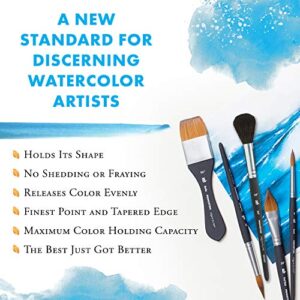
- Two or three brushes: a medium round, a small round, and a flat
- A palette or plate and a water jar
Choosing a Beginner Medium
| Medium | Why beginners like it | Challenges |
|---|---|---|
| Graphite pencil | Inexpensive, erasable, perfect for learning value | Can smudge; limited to grayscale |
| Charcoal | Rich darks, fast tone, expressive | Messy; needs fixative |
| Colored pencil | Controlled, portable, clean | Slow to cover large areas |
| Acrylic paint | Fast drying, forgiving, can paint over mistakes | Dries quickly on the palette |
| Watercolor | Luminous, portable, quick setup | Hard to correct; requires planning |
| Oil pastel | Vivid, bold, no drying time | Hard to get fine detail |
| Digital | Undo, layers, no material costs after setup | Higher upfront cost for tablet and software |
Many teachers recommend starting with pencil to learn value and proportion, then adding one color medium. Acrylic is a common first paint because it is forgiving and cleans up with water.
Simple Art for Beginners: Easy First Projects
These projects each focus on one or two basics so you can see progress quickly.
- Five-step value scale and shaded sphere (value, form).
- Still life of three simple objects such as a mug, an apple, and a box (shape, proportion, shading).
- Contour drawing of your hand without looking at the paper (line, observation).
- Negative space drawing of a plant (space).
- Limited-palette landscape in acrylic using three colors plus white (color mixing, value).
- One-point perspective street (space, perspective).
- Texture sampler of six materials (texture, mark-making).
- Monochrome painting using one color plus white and black (value, unity).
A 30-Day Beginner Practice Plan
| Week | Focus | Daily practice (15 to 30 minutes) |
|---|---|---|
| Week 1 | Line and shape | Line drills, contour drawings, simplifying objects into shapes |
| Week 2 | Value and form | Value scales, shaded spheres, cubes and cylinders, simple still life |
| Week 3 | Space and perspective | Negative space, one-point and two-point perspective, overlapping objects |
| Week 4 | Color | Color wheel, mixing tints and shades, small limited-palette paintings |
At the end of the month, redo a drawing from day one and compare. Seeing measurable improvement is one of the best motivators to keep going.
Easy Art for Beginners: Habits That Speed Up Progress
- Practice little and often. Fifteen minutes daily usually beats a long session once a week.
- Keep a sketchbook. Date pages so you can track progress.
- Draw from life when possible. Real objects teach more about form and light than photos.
- Study artists you admire. Ask which elements and principles they emphasize.
- Squint at your subject. It blurs details and reveals big value shapes.
- Step back often. Problems show up more clearly from a distance.
- Accept bad drawings. They are part of practice, not proof of no talent.
Common Beginner Mistakes
- Starting with details before the overall shape is right.
- Outlining everything heavily, which flattens form.
- Using too narrow a value range, so drawings look gray and flat.
- Buying too many supplies at once and never learning any well.
- Comparing early work with professionals online.
- Practicing only what is comfortable and avoiding weak areas.
FAQs
What are the basics of art for beginners?
The seven elements of art (line, shape, form, value, color, texture, space), the principles of design such as contrast, balance, and emphasis, and core skills like observation, proportion, and shading.
What should a beginner learn first in art?
Most teachers start with line, shape, and value through pencil drawing. These skills transfer to every other medium.
Can you learn art as an adult?
Yes. Drawing and painting are learnable skills, and adults often progress steadily because they can practice deliberately and understand theory.
How long does it take to get good at art?
It varies widely with practice time and goals. Many beginners notice clear improvement in basic drawing within a few months of regular practice.
What is the easiest type of art for beginners?
Pencil drawing is often the easiest to start, followed by acrylic painting. Both are forgiving and inexpensive.
Do I need expensive supplies to learn art basics?
No. A few pencils, an eraser, paper, and a small set of paints are enough. Better materials help later, but fundamentals can be learned with simple tools.
Final Thoughts
Art basics are the foundation that makes every later technique easier. Learn the seven elements, use one design principle at a time, and practice observation, measuring, and shading in short daily sessions. Within a month, you will see your drawings and paintings become more solid, readable, and confident.
The right starter materials make this practice smoother. Explore our guide to affordable art sets for adults learning the basics to find a kit that covers drawing and painting fundamentals.