PaintingProGuide is reader-supported. When you buy through links on this page we may earn an affiliate commission at no extra cost to you.
Blushing is the technique that makes miniature food look baked, doll cheeks look alive and fantasy figures look sun-kissed: you scrape a soft pastel stick into powder, pick it up on a dry brush and dust it onto raw polymer clay before curing. The right soft pastels for polymer clay are soft enough to shave easily, pigmented enough that a tiny amount reads clearly, and sold in a range that covers browns, oranges, pinks and a few surprise colors. Fine-art pastel brands work beautifully here, and so do a few budget sets, as long as you know what to look for. This guide covers the sets that make sense for clay work and explains how to choose between them.
Quick answer: The Mungyo Soft Pastel Set of 48 (Non Toxic, Square) is the best soft pastel set for polymer clay blushing: soft, square sticks that shave into fine powder, a well-balanced range of browns and warm tones, and a non-toxic label that matters when clay pieces might be handled by kids. For a bigger palette, the Mungyo 64-color set adds more subtle shades. If you only need basics for miniature food, the Soft Chalk Pastels Set, 24 Colors is the cheapest sensible starting point.
Our Top Picks at a Glance
- Mungyo Soft Pastel Set of 48, Non Toxic, Square — Best overall for polymer clay blushing
- Mungyo Soft Pastel Set, 64 Colors, Square — Best extended palette for clay artists
- Mont Marte Soft Pastels in Tin Box, 48 pc — Best for storage and portability
- Artecho Soft Pastels, 50 pcs, 48 Colors — Best budget set with doubled essentials
- Artecho Soft Pastels, 72 pcs, 70 Colors — Best large budget set for fantasy and character work
- Soft Chalk Pastel Sticks Set, 48 Colors — Best cheap soft pastels for clay in a mid-size range
- Soft Chalk Pastels Set, 24 Colors — Best minimal starter set for miniature food
| Product | Best For | Key Spec (from title) | Key Strength | Who Should Skip It |
|---|---|---|---|---|
| Mungyo Soft Pastel Set of 48 (Non Toxic) | All-round clay blushing | 48 colors, square sticks, non-toxic | Balanced warm range, shaves cleanly | Anyone needing 60+ shades |
| Mungyo Soft Pastel Set, 64 Colors | Detailed character and figure work | 64 colors, square | More intermediate tones | Beginners who want simplicity |
| Mont Marte Soft Pastels Tin Box, 48 pc | Crafters who travel or share space | 48 colors, tin storage case | Protective metal tin | Anyone who dislikes round sticks |
| Artecho Soft Pastels, 50 pcs / 48 colors | Budget buyers | 50 sticks, 48 colors | Two extra sticks of core colors | Painters needing artist-grade pigment |
| Artecho Soft Pastels, 72 pcs / 70 colors | Fantasy, dragon and doll makers | 72 sticks, 70 colors | Widest range for the money | Miniature food only |
| Soft Chalk Pastel Sticks Set, 48 Colors | Cheap mid-size range | 48 colors | Low cost, usable range | Anyone wanting brand consistency |
| Soft Chalk Pastels Set, 24 Colors | Miniature food basics | 24 colors | Covers browns and oranges cheaply | Character artists needing pinks and greens |
How We Chose
These picks are based on Amazon.com listings checked in November 2026, evaluated against what polymer clay blushing demands and against well-established knowledge of soft pastel composition. Prices and ratings are not reproduced; please check the listing. We excluded a FIMO clay product that appeared in the search because it is clay, not pastel.
What makes a soft pastel good for clay:
- Softness. Softer sticks shave into finer powder with a craft knife and pick up on a brush more evenly. True soft pastels beat hard pastels and chalk-like school pastels.
- Color range for clay subjects. Browns, tans, oranges and dusty pinks for food and skin; blues, purples and greens for fantasy pieces.
- Stick shape. Square sticks have edges that are easy to scrape; round sticks roll but shave fine too.
- Non-toxic labeling. Important for sellers making pieces that children will handle, and for peace of mind when sanding or baking.
- Set size versus waste. A single stick lasts years in clay work, so huge sets are about variety, not volume.
- Storage. Pastels break and smear; a tin or foam tray keeps them usable.
Best Soft Pastels for Polymer Clay Reviewed
1. Mungyo Soft Pastel Set of 48, Non Toxic, Square — Best Overall
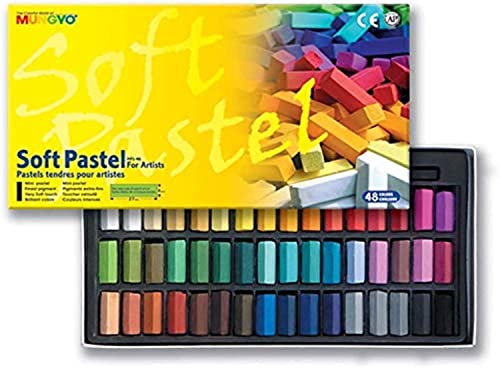
Mungyo is the brand polymer clay artists mention most often, and this 48-color square set is the version to get. The sticks are soft enough to scrape into fine, even powder, the square profile gives you a clean edge to work a blade against, and the assortment leans toward exactly the earth tones and warm mid-tones that miniature food and skin blushing rely on. The listing specifies a non-toxic, US English version, which is reassuring if you sell pieces or craft with children.
Forty-eight colors is the sweet spot for clay: enough browns to graduate a loaf from golden to deep crust, enough pinks and corals for cheeks, and a scattering of blues and greens for fruit, fantasy and shading. Each stick lasts an enormous amount of clay work because you use dust, not strokes.
Best suited for: Any polymer clay crafter who wants one reliable pastel set for food, dolls and figures.
Key features
- 48 assorted colors
- Square soft pastel sticks
- Non-toxic labeling
- Soft texture that shaves into fine powder
Pros
- Strong range of browns and warm tones
- Square edges are easy to scrape
- Widely used by clay artists, so tutorials often reference it
Cons
- Cardboard tray offers limited protection once sticks break
- Fewer pale skin tones than the 64 set
Buying consideration: Keep a dedicated dry brush for each color family so brown dust never contaminates your pinks.
2. Mungyo Soft Pastel Set, 64 Colors, Square — Best Extended Palette

The 64-color Mungyo set is the same square, blendable soft pastel in a larger assortment. The extra sixteen colors are mostly intermediate tones: more tints toward white, more muted mid-values, more steps between the primaries. For clay artists that translates into subtler skin blushing, more realistic fruit and the ability to build a gradient on a dragon’s belly without mixing.
If you make figures, dolls or anything with graduated color, the larger set earns its place. If you only make cookies and bread, the 48 set already covers you.
Best suited for: Character, doll and fantasy clay artists who want fine color control.
Key features
- 64 colors
- Square soft pastel sticks
- Smooth, blendable formulation
Pros
- More intermediate and pale tones
- Same easy-shaving softness as the 48 set
Cons
- More colors than miniature-food work needs
- Larger tray takes more bench space
Buying consideration: Clay artists often decant their most-used ten colors into a small labeled tin and leave the main set stored, which keeps the big set clean.
3. Mont Marte Soft Pastels in Tin Box, 48 pc — Best for Storage

Pastel dust gets everywhere, and loose sticks in a cardboard tray crumble when a toolbox gets knocked. Mont Marte’s Signature 48-piece set comes in a metal tin, which solves both problems for crafters who work at a kitchen table and have to pack up, or who carry supplies to classes and markets. The listing describes the sticks as vibrant and good for blending, which is what you want for layered blushing.
Forty-eight colors again hits the clay sweet spot. The tin is the differentiator, and it also keeps pastel dust away from your clay, which otherwise picks up stray particles.
Best suited for: Crafters who need to store pastels safely or transport them.
Key features
- 48 assorted colors
- Metal tin storage case
- Soft, blendable sticks
Pros
- Tin protects sticks and contains dust
- Easy to carry to workshops or craft fairs
Cons
- Round-profile sticks have no scraping edge
- Tin lids can trap dust that transfers between colors
Buying consideration: Add a sheet of foam or folded paper towel inside the lid to stop sticks rattling in transit.
4. Artecho Soft Pastels, 50 pcs, 48 Colors — Best Budget Set With Doubled Essentials

Fifty sticks in 48 colors means two colors are doubled, which in pastel sets almost always means an extra white and an extra black, the two sticks artists burn through. For clay that extra white is useful for lightening blushing mixes and for frosting and sugar effects. Artecho is a budget brand, and the sticks are generally softer and more chalk-forward than Mungyo, but for dusting onto clay that softness is an advantage.
Budget soft pastels can have less pigment per stick, which shows up in painting but matters far less in clay work where you build color in thin dusted layers.
Best suited for: Cost-conscious crafters and anyone who wants a backup set for messy jobs.
Key features
- 50 sticks, 48 colors
- Soft, chalk-based pastel formulation
- Extra sticks of core colors
Pros
- Very low cost per stick
- Soft enough to scrape with a fingernail
Cons
- Lower pigment load than artist brands
- Fragile sticks that snap easily
Buying consideration: Broken sticks are fine for clay work, since you shave them anyway; keep fragments in labeled pill organizers.
5. Artecho Soft Pastels, 72 pcs, 70 Colors — Best Large Budget Set

Seventy colors at a budget price is attractive for anyone making fantasy creatures, mermaid tails, galaxy effects or anything that needs blues, violets and teals alongside the usual browns. The 72-stick count again doubles two core colors. This is the set to consider if your clay work is more about color variety than about realistic food tones.
Best suited for: Fantasy, dragon, doll and decorative clay artists who want maximum color choice cheaply.
Key features
- 72 sticks, 70 colors
- Soft chalk-based pastels
- Broad range across the spectrum
Pros
- Widest palette in this roundup
- Low cost per color
Cons
- Many colors will rarely be used for food or skin
- Budget pigment strength
Buying consideration: Large sets are only worthwhile if you actually reach for the unusual colors; be honest about what you make.
6. Soft Chalk Pastel Sticks Set, 48 Colors — Best Cheap Mid-Size Range

This unbranded 48-color chalk pastel set is for crafters who want the standard clay palette size at the lowest possible cost. “Chalk pastel” in a listing title usually means a softer, more chalk-heavy stick, which is fine for dusting onto clay even if it would be weak for fine-art drawing. The range is comparable to the Mungyo 48 in breadth, if not in pigment depth.
Best suited for: Beginners testing the blushing technique before investing in a brand-name set.
Key features
- 48 colors
- Soft chalk pastel sticks
Pros
- Inexpensive entry into a full 48-color palette
- Soft enough to shave easily
Cons
- No brand track record; consistency may vary
- Pale colors may need several dusted layers
Buying consideration: Test a dusted swatch on scrap clay and bake it; cheaper pastels can shift slightly in the oven.
7. Soft Chalk Pastels Set, 24 Colors — Best Minimal Starter for Miniature Food

Miniature bakers need surprisingly few colors: a golden yellow, two or three browns, an orange, a dusty red and a white get you from raw dough to a burnt-edge croissant. A 24-color set covers all of that with change to spare. This is the smallest set we would recommend, and the one to buy if clay blushing is a side interest rather than your main craft.
Best suited for: Miniature food makers and occasional crafters who want the essentials only.
Key features
- 24 colors
- Soft chalk pastel sticks
Pros
- Lowest cost and smallest footprint
- Covers the full baked-goods range
Cons
- Limited pinks, greens and blues for figures
- Likely to be outgrown by character artists
Buying consideration: If you later move into dolls or fantasy, add a Mungyo 48 rather than a second cheap set; the two combine well.
Buying Guide: How to Choose Soft Pastels for Polymer Clay
Pastels made for drawing and pastels used for clay have different priorities. Here is what to weigh when the end use is blushing, shading or tinting polymer clay.
Soft pastels, not oil pastels
Oil pastels contain wax and oil that never fully dry; they smear on raw clay and can interfere with curing and with varnish. Soft pastels (also sold as chalk pastels) are pigment and a chalk or clay binder, which is dry, scrapes into powder and bakes into the clay surface without reacting. Always confirm “soft” or “chalk” in the title and avoid anything labeled oil pastel.
Softness grade
The softer the stick, the finer the powder and the easier the pickup on a brush. Very soft artist pastels are ideal; mid-soft student pastels like Mungyo are nearly as good and far cheaper; hard pastels and pastel pencils are too firm for efficient dusting. Budget chalk sets tend to be soft but crumbly, which is fine for this use.
Color range for your subjects
Miniature food needs yellows, oranges, browns and a dusty red. Dolls and figures need pinks, corals, peach and soft browns. Fantasy work needs blues, violets, teals and greens. A 24-color set serves food; 48 serves most mixed makers; 64 to 70 serves character artists who want gradients without mixing.
Stick shape
Square sticks (both Mungyo sets) have corners that a craft knife catches cleanly, producing powder quickly with less wasted stick. Round sticks work fine but roll off the bench and need a sanding-block or sandpaper scrape instead of a blade.
Non-toxic labeling
Pastel dust is fine and airborne. A non-toxic label (as on the Mungyo 48) tells you the pigments are safe for general use, which matters when sanding blushed pieces or when the finished items will be handled by children. Work with a window open and avoid blowing dust off pieces with your mouth.
Storage and cross-contamination
Pastel dust travels. A tin (Mont Marte) or a lidded tray keeps sticks intact, and a set of small labeled containers for scraped powder lets you reuse dust instead of scraping fresh each time. Keep brown and pink brushes separate.
How much you actually need
One stick yields hundreds of blushed miniatures. Buy for color variety, not volume. Doubling up on core colors (as the Artecho 50 and 72 sets do) is helpful only for white.
Who Should Buy What
Miniature food maker. The 24-color Soft Chalk Pastels Set covers every stage of browning; upgrade to the Mungyo 48 if you want richer, more consistent browns.
Doll and figure sculptor. The Mungyo 64-color set for subtle skin tones and graduated blushing.
Fantasy and creature artist. The Artecho 72-piece set for the widest range of blues, violets and greens at low cost.
Market seller or teacher. The Mungyo 48 Non Toxic for its safety labeling, or the Mont Marte tin for durability in transit.
Curious beginner. The Soft Chalk Pastel Sticks Set of 48 or the Artecho 50 to learn the technique cheaply before investing.
Not sure whether soft pastels are the same as the chalk pastels you see at craft stores? Our comparison of soft pastels vs chalk pastels clears that up, and soft pastels vs oil pastels explains why oil pastels do not belong near raw clay.
Common Mistakes to Avoid
- Buying oil pastels by accident. They never dry and will ruin raw clay.
- Applying pastel after baking. Dust onto raw clay so the pigment fuses during curing; post-bake pastel rubs off unless sealed.
- Using a wet or damp brush. Blushing needs a completely dry, soft brush.
- Overloading the first layer. Build color in several light dustings; you cannot remove excess cleanly.
- Sharing one brush across all colors. Brown contaminates pink immediately.
- Scraping directly over your work surface. Scrape onto a scrap of paper or into a small container.
- Skipping a sealer on handled pieces. Baked-in pastel is durable, but a matte or satin varnish protects jewelry and charms from wear.
Helpful Guides Before You Buy
- Do You Need Fixative for Soft Pastels? On Paper and Clay
- How to Soften Polymer Clay That’s Gone Hard
- Using Pastels on Polymer Clay for Blush and Shading
- Polymer Clay Still Soft After Baking? Causes and Fixes
FAQs
What are the best soft pastels for polymer clay?
Mungyo’s square soft pastel sets are the most widely recommended because they shave into fine powder and offer a well-balanced warm palette. Budget chalk pastel sets also work well for dusting since the technique uses very little pigment.
Can I use chalk pastels for polymer clay instead of soft pastels?
Yes. Chalk pastels and soft pastels are closely related; both are dry, pigment-and-binder sticks that scrape into powder and bake safely. The difference is mostly pigment concentration and softness.
Do soft pastels bake safely on polymer clay?
Yes. Dusted soft pastel fuses into the clay surface during a normal cure at standard polymer clay temperatures. Oil pastels, by contrast, should never be baked on clay.
Which pastel colors do I need for miniature food?
A golden yellow, a light tan, a medium brown, a dark brown, an orange and a dusty red cover nearly all baked goods. A 24-color set includes all of them.
Are cheap soft pastels for clay good enough?
For blushing, yes. The technique uses tiny amounts of pigment in thin layers, so budget sets perform well. The main compromises are fragility and slightly weaker pale colors.
How do I apply pastels for clay blushing?
Scrape a stick with a craft knife onto paper, load a soft dry brush with the powder, tap off the excess and dust it onto the raw clay in light passes. Bake as normal, then seal if the piece will be handled.
Final Recommendation
For most polymer clay artists the Mungyo Soft Pastel Set of 48 (Non Toxic, Square) is the one to buy: it shaves cleanly, the colors suit food and skin, and the safety labeling matters for sellers. Character and doll makers should step up to the Mungyo 64 for finer gradations, while fantasy artists get more variety per dollar from the Artecho 72. If clay blushing is a small part of what you do, the 24-color chalk set handles baked goods for very little money, and the Mont Marte tin is the choice for anyone who needs to pack up and move between sessions.