
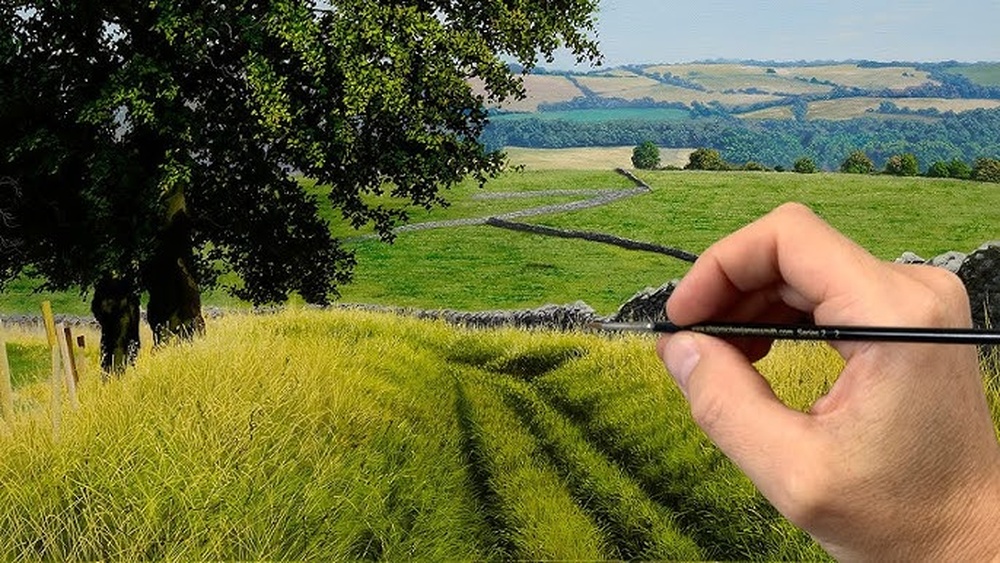
Quick answer: To paint grass in oil painting, block in the field as broad planes of value and color first, darker and warmer near the bottom of each clump and lighter where the tops catch light. Then add a limited number of upward, tapered blade strokes only in the foreground, letting texture fade into simple flat color in the distance. Realistic grass comes from correct planes and perspective, not from painting thousands of blades.
A green field looks simple until you try to paint one. Mix a single green and spread it across the canvas, and you get a flat carpet. Paint every blade, and you get a stiff, busy hedge that pulls attention from everything else. Good grass sits between those extremes. This guide explains how to paint grass in oil painting from distant meadow to foreground detail, with mixing charts, a step-by-step method, tall grass techniques and fixes for the most common problems.
Why Grass Is Harder Than It Looks
Grass presents two challenges at once: it is a vast plane that recedes into the distance, and it is made of countless tiny vertical forms. Painters often focus on the second and forget the first.
- Grass is a horizontal plane. It faces the sky, so it usually receives a lot of light and is often lighter than you expect, especially compared with trees, which are vertical and more shaded.
- Grass changes with distance. Near grass shows individual blades and strong color; far grass merges into a smooth field with cooler, grayer color.
- Grass has its own shadows. The base of every clump is darker because blades shade each other. That dark-bottom, light-top pattern is the key to texture.
- Green is rarely pure. Fields carry yellows, ochres, blue-greens, violets in shadow and dry straw tones.
Materials for Painting Grass in Oils
Standard landscape supplies are all you need. For broader advice on choosing paints and surfaces, our oil painting hub with styles, tips and buying guidance is a good next read.
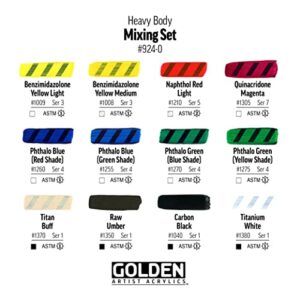
- Paints: titanium white, cadmium yellow light (or hue), yellow ochre, ultramarine blue, a phthalo or viridian green (optional), burnt sienna and alizarin crimson or a red.
- Brushes: large hog bristle flats for blocking in, medium filberts, a worn or splayed bristle brush for broken texture, a small round and a rigger for blades and seed heads.
- Palette knife: excellent for crisp light blades and for scraping thin lines into wet paint.
- Medium: solvent for early thin layers, and a little linseed-based medium for later strokes that need to flow.
- Surface: any primed canvas or panel. A slight texture can help broken-color effects in the middle ground.
Mixing Greens for Grass
Tube greens straight out of the tube can look harsh and artificial in a landscape. Mixing your own greens from blues and yellows, then adjusting with reds or earths, gives more natural and varied results.
| Grass color | Starting mix | Adjust with |
|---|---|---|
| Sunlit summer grass | Cadmium yellow light + small amount of ultramarine | White to lighten; touch of ochre to calm it |
| Shadowed grass | Ultramarine + yellow ochre | Touch of alizarin or burnt sienna to deepen and neutralize |
| Distant field | Sunlit mix + white + a little blue | Speck of red to gray it down |
| Dry or autumn grass | Yellow ochre + white + burnt sienna | Small amount of green mix for transition areas |
| Deep base darks | Ultramarine + burnt sienna + small amount of yellow | Alizarin for a cooler, richer dark |
A useful rule: adding the complement (a red) to a green grays it down without making it muddy if you add very small amounts. Adding white cools and lightens, which helps distance. Adding yellow warms and brightens, which brings areas forward.
How to Paint Grass in Oil Painting: Step by Step
This method works for a typical meadow running from foreground to a distant tree line.
- Tone the canvas. A thin wash of burnt sienna or a warm earth, wiped back with a rag, gives a warm undertone. Flecks showing through green add vibrancy, since warm and cool sit side by side.
- Design the field shapes. Draw the main shapes of the land: the line where field meets trees, any paths, dips or rises, and large shadow patches cast by trees or clouds. Think of the field as several large planes, each angled slightly differently to the light.
- Block in the darks. Paint the shadow areas and the base of the nearest grass with your deep base dark, thinned with solvent. This dark foundation gives the light strokes later something to sit on.
- Block in the middle and light values. With large brushes, cover the field in broad horizontal strokes. Use cooler, lighter, grayer greens at the back and warmer, stronger greens toward the front. Do not paint blades yet.
- Check the value pattern. Step back and squint. The field should already look like a believable, receding plane with clear light and shadow areas. Fix it now if not.
- Add middle-ground texture. Using a splayed bristle brush or the side of a filbert, dab and drag short, broken strokes of a slightly lighter green over the middle ground. Keep strokes small and mostly horizontal clusters, since grass at this distance reads as texture, not blades.
- Build the foreground clumps. In the nearest area, paint the dark base of each clump, then flick strokes upward from the base with a small round or filbert, lifting pressure so they taper. Vary lean, height and color. Group them into clumps with gaps rather than an even fence.
- Add light blades over dark. With a palette knife edge or rigger, pull a few light, warm blades over the darker base. This is where the eye perceives individual grass. Use a small number with care.
- Introduce variety. Add a few touches of ochre, straw, violet-gray or small flower colors. Dry stalks, seed heads and the occasional weed make a field feel real.
- Integrate edges. Soften the transition where foreground texture meets middle ground so there is no obvious band. Make sure grass overlaps the base of trees, posts and figures so they sit in the field rather than on top of it.
How to Oil Paint Tall Grass
Tall grass, reeds and wild meadows call for a slightly different approach because individual stalks and their movement become a major part of the design.
- Paint the mass first. Treat the tall grass as a soft-edged block of color with a dark lower half and a lighter, more broken top. Its upper edge against the sky or background should be irregular, not a straight line.
- Use long, curving strokes. With a rigger loaded with paint thinned slightly with medium, pull long, tapered stalks in one motion, curving them in the direction of the wind. Keep the curves consistent so the field looks like it moves together.
- Layer dark and light stalks. Dark stalks against a light background and light stalks against dark areas both work. Alternating them builds depth.
- Add seed heads last. Small dabs of ochre, cream or warm brown at the tips of some stalks suggest wheat, foxtail or wild oats. Keep them uneven in size and spacing.
- Use the palette knife for crisp lines. Load the edge of a knife with a thin ridge of paint and touch it to the canvas, drawing it upward. This makes clean, sharp stalks difficult to get with a brush.
- Scrape for light blades. Scratching into wet paint with the end of a brush handle (sgraffito) reveals the lighter ground underneath, creating fine light stalks quickly.
Painting Grass in Oils: Distance Zones
| Zone | Color | Texture | Edges |
|---|---|---|---|
| Foreground | Warmest, most saturated, strongest darks | Visible blades and clumps, varied strokes | Some crisp edges, especially light blades |
| Middle ground | Slightly cooler and lighter | Broken, dabbed texture; no individual blades | Mostly soft |
| Background | Cool, light, grayed | Smooth, flat color | Soft, sometimes lost against trees or sky |
Perspective affects stroke size too. Blades and clumps shrink and crowd together as the field recedes. If foreground and middle-ground strokes are the same size, the field tilts upward like a wall.
Common Problems and How to Fix Them
The field looks like a flat green carpet
Add value variation: shadows from clouds or trees, darker dips, lighter rises. Vary temperature too, with warmer greens in front and cooler, grayer ones behind.
The grass looks like a comb or fence
This comes from evenly spaced, same-length, vertical strokes. Group strokes into clumps, vary their angle and height, and leave gaps showing the darker base.
The greens are too bright
Overly saturated greens are common. Neutralize with tiny amounts of red or burnt sienna, or use yellow ochre instead of cadmium yellow in the mix.
Mud in the foreground
Repeatedly brushing light strokes into wet dark paint mixes them into a dull green. Load more paint, place strokes with a single motion and avoid going back over them. Alternatively, let the dark base become tacky before adding lights.
Too much detail everywhere
Restrict blade detail to the nearest foreground, and only around your focal area. Everything else can be suggestion.
Oil Painting Tips for Beginners Painting Grass
- Practice a single 6 by 8 inch strip of field before tackling a full landscape.
- Make a swatch chart of 10 to 15 greens mixed from your own palette and keep it for reference.
- Paint wet into wet for small studies; it teaches soft transitions quickly.
- Keep large brushes in hand as long as possible. Switching to small brushes early leads to fussy, overworked grass.
- Look at real grass outdoors and notice how little detail you actually see past about 20 feet.
Oil Underpainting Tips for Landscapes With Grass
An underpainting can simplify field painting significantly. A warm earth underpainting in burnt sienna or a mix of sienna and ultramarine lets you design the value pattern before color complicates it.
- Keep it thin and lean so subsequent layers adhere well and follow fat over lean.
- Establish shadows and darker field areas clearly; leave the toned ground showing for lights.
- A warm underpainting peeking through cool greens adds a lively vibration often seen in impressionist landscapes.
- Let it dry to the touch before painting color over it, unless you want the colors to mix.
Grass in Combination With Other Subjects
Grass rarely appears alone. Foggy morning meadows benefit from the approach in our guide on how to paint fog in oil, where foreground grass becomes the sharp anchor against a soft background. Dune grass works especially well with the techniques from our article on painting sand and beaches in oil, where pale sand provides a light ground for darker, wiry blades.
When grass meets trees, flowers or figures, remember to overlap. A few blades crossing the bottom of a tree trunk instantly settle it into the scene.
Related Reading
FAQs
How do you paint grass in oils realistically?
Start with broad planes of value and color, keep the field cooler and lighter as it recedes, and save individual blades for the nearest foreground. Painting light blades over a darker base and grouping them into clumps creates convincing texture.
What brush is best for painting grass with oil paint?
Large flats handle the block-in, a splayed or worn bristle brush creates broken middle-ground texture, and a rigger or small round makes individual blades. A palette knife is also excellent for sharp, light stalks.
What colors do I mix for grass in oil painting?
Mix greens from ultramarine and cadmium yellow or yellow ochre, then adjust with white, burnt sienna or a touch of red. Using several mixed greens instead of one tube green gives more natural variety.
Should I paint grass wet-on-wet?
Wet-on-wet works well for blocking in and middle-ground texture. For crisp foreground blades, many painters wait until the base layer is tacky so light strokes stay clean instead of blending into the darks.
How do I paint grass in the distance?
Use smooth, flat strokes of cooler, lighter, grayer green with very little texture. Distant grass should read as a continuous surface, and its edge with trees or hills is often soft.
How do I keep grass from looking too busy?
Limit detail to the focal area of the foreground, use large brushes for most of the field and let some areas stay simple. Contrast between detailed and quiet areas is what makes texture look intentional.
Final Thoughts
Convincing grass is mostly about planes, value and perspective, with blades added as the final, sparing touch. Paint the field first, then the grass in it, and your landscapes will gain depth and calm instead of clutter.
If you want to refine your palette or try better brushes and surfaces for landscape work, visit our expert guide to oil painting techniques and supplies for recommendations matched to your skill level.


4 Comments