PaintingProGuide is reader-supported. When you buy through links on this page we may earn an affiliate commission at no extra cost to you.
Impasto is greedy. A single palette-knife sky can use more paint than a week of thin glazing, and the paint has to hold the ridges you put into it instead of slumping back into a flat film. That is why the best oil paints for impasto share two traits: a stiff, buttery body straight from the tube and enough volume per tube that you are not rationing color mid-stroke.
This guide ranks six products from the October 2026 Amazon listings by how well they suit thick, textured oil work, then explains the chemistry that keeps impasto from wrinkling or cracking years later.
Quick answer: The PHOENIX Studio Oil Paint Set (40 x 50ml) is the strongest all-round choice for impasto, combining large tubes with a listed thick, creamy consistency. For a smaller palette in the same tube size, choose Paul Rubens 20 x 50ml. Add a tube of Winsor & Newton Griffin Alkyd Mixing White for thick highlights that touch-dry in about 24 hours.
Our Top Picks at a Glance
- PHOENIX Studio Oil Paint Set, 40 x 50ml — Best overall for impasto volume and body
- Paul Rubens Oil Paint, 20 x 50ml — Best curated palette in large tubes
- Winsor & Newton Griffin Alkyd Mixing White — Best for thick, faster-drying highlights
- Magicfly Oil Paint Set, 40 x 18ml — Best budget set with thick consistency and metallics
- MyArtscape Oil Paint Set, 48 x 12ml — Best for testing a wide color range
- U.S. Art Supply Impasto Clear Gel (acrylic) — Best for building texture underneath oils
| Product | Best For | Key Spec | Key Strength | Price Tier |
|---|---|---|---|---|
| PHOENIX Studio 40 x 50ml | Large impasto paintings | 40 colors, 50ml tubes | Thick, creamy consistency listed | $$$ |
| Paul Rubens 20 x 50ml | Focused palette, big tubes | 20 colors, 50ml tubes | Refined linseed oil, high pigmentation | $$$ |
| Griffin Alkyd Mixing White | Thick highlights and underlayers | 37ml, PW6, touch dry ~24h | Faster drying for thick passages | $$ |
| Magicfly 40 x 18ml | Budget texture work | 40 colors incl. gold and silver | Extra white tubes | $$ |
| MyArtscape 48 x 12ml | Color exploration | 48 colors, 12ml tubes | Wide range, high-sheen finish | $$ |
| U.S. Art Supply Impasto Gel | Acrylic texture underlayers | 500ml clear gel | Holds peaks; dries clear | $$ |
How We Chose
We did not paint with these sets for this review. Picks are based on Amazon listing details and specifications checked in October 2026, on how well each product’s format, tube size and described consistency suit impasto, and on how widely each product is reviewed by Amazon buyers. We also applied well-established oil painting practice, such as fat over lean and the drying behavior of alkyds.
- Body: whether the listing describes a thick or buttery consistency that holds marks.
- Tube size: 50ml tubes ranked higher because impasto uses paint fast.
- Pigment strength: stated pigmentation and tinting strength, since thick paint mixed with white needs strong color.
- Drying behavior: fast-drying options for thick passages.
- Palette usefulness: whether the color selection includes the whites and earths impasto painters lean on.
We left out the RoseArt 24-color set: its tubes are small for impasto, and its listing confusingly describes the oil paint tubes as acrylic in one bullet.
What Makes an Oil Paint Good for Impasto?
Paint for impasto needs a high ratio of pigment to oil and a short, stiff body. Stiff paint stands up in peaks and keeps the marks of a knife or bristle brush. Oily, loose paint sags and levels out, and thick oily layers are more likely to wrinkle as they dry because the surface skins over while the inside is still soft.
Student and studio-grade sets vary in body from brand to brand and even color to color. Some colors, especially transparent ones, are naturally softer. Many impasto painters stiffen paint by letting it sit on absorbent paper for a few minutes to draw out excess oil, or by adding a dedicated oil impasto medium. What you should not do is thicken oil paint with acrylic gel; acrylic and oil do not mix in the same layer.
Best Oil Paints for Impasto Reviewed
1. PHOENIX Studio Oil Paint Set, 40 x 50ml — Best Overall for Impasto

This set addresses impasto’s biggest practical problem, volume, with forty 50ml tubes. The listing describes a thick and creamy consistency that can be used directly to create texture or thinned with medium, along with high color saturation, strong tinting strength and good lightfastness. It is certified to EN 71 and ASTM D-4236.
Forty colors in large tubes is a lot of paint to store, but it means you can lay in a heavily textured background without hunting for a second tube of the same blue. Strong tinting strength also matters here: impasto mixtures often contain a lot of white, and weak pigments go chalky fast.
Best suited for: painters working larger than 16×20 or using palette knives heavily.
Key features
- 40 colors x 50ml tubes
- Thick, creamy consistency listed
- High saturation and tinting strength
- EN 71 and ASTM D-4236 certified
Pros
- Large tubes suit thick application
- Wide color range
- Body suited to knife work
Cons
- Highest price tier here
- 40 tubes is more than many palettes need
- Studio-grade consistency may vary between colors
Buying consideration: You will run out of white first. Even in a 50ml set, buy an extra large tube of titanium white if you plan to paint impasto regularly.
2. Paul Rubens Oil Paint, 20 x 50ml — Best Curated Palette in Large Tubes

Paul Rubens offers twenty colors selected for landscape, seascape, portrait and still life work, each in a 50ml tube. The listing describes fine-art pigments with high pigmentation, strong covering power and tinting strength, and a smooth, buttery consistency made with refined linseed oil. It also claims excellent lightfastness and a non-toxic formulation.
A tighter palette suits impasto well. Thick paint is harder to adjust once laid down, so limited, well-chosen colors encourage you to mix decisively on the palette rather than on the canvas.
Best suited for: painters who want large tubes without a sprawling color list.
Key features
- 20 colors x 50ml
- Refined linseed oil binder
- High pigmentation and tinting strength
- Selected for landscape, seascape, portrait and still life
Pros
- Large tubes in a manageable set
- Buttery texture suits knife and brush impasto
Cons
- Fewer colors than the PHOENIX set
- Matte finish listed; may want a final varnish for evenness
Buying consideration: Linseed oil is the classic binder for strong, flexible films, which helps thick layers. It can yellow slightly over time in whites; that is normal and less visible in mixed colors.
3. Winsor & Newton Griffin Alkyd Mixing White — Best for Thick Highlights

Thick white highlights are the signature of much impasto, and they are also the slowest areas to dry. Griffin Alkyd is a fast-drying oil color designed to be touch dry in about 24 hours. This tube is Mixing White, PW6 (titanium white), with an AA permanence rating, opaque, in a 37ml tube conforming to ASTM D4236.
Alkyd colors can be mixed with conventional oils. Using alkyd white in your underlayers or thick textural passages speeds up drying so you can paint over them sooner. Because alkyds dry faster, they belong in lower or thicker layers, with slower conventional oils on top, in keeping with the principle that faster-drying layers go underneath.
Best suited for: painters who want thick whites and textured underpaintings to dry faster.
Key features
- Fast-drying alkyd oil, touch dry in about 24 hours
- PW6 titanium white, opaque
- Permanence AA
- 37ml tube
Pros
- Speeds drying of thick passages
- Mixes with regular oils
- Opaque, strong white
Cons
- Single color, not a set
- Shorter working time on the palette
Buying consideration: Put out only what you need. Alkyd begins to set on the palette faster than conventional oil, especially in warm rooms.
4. Magicfly Oil Paint Set, 40 x 18ml — Best Budget Set for Texture
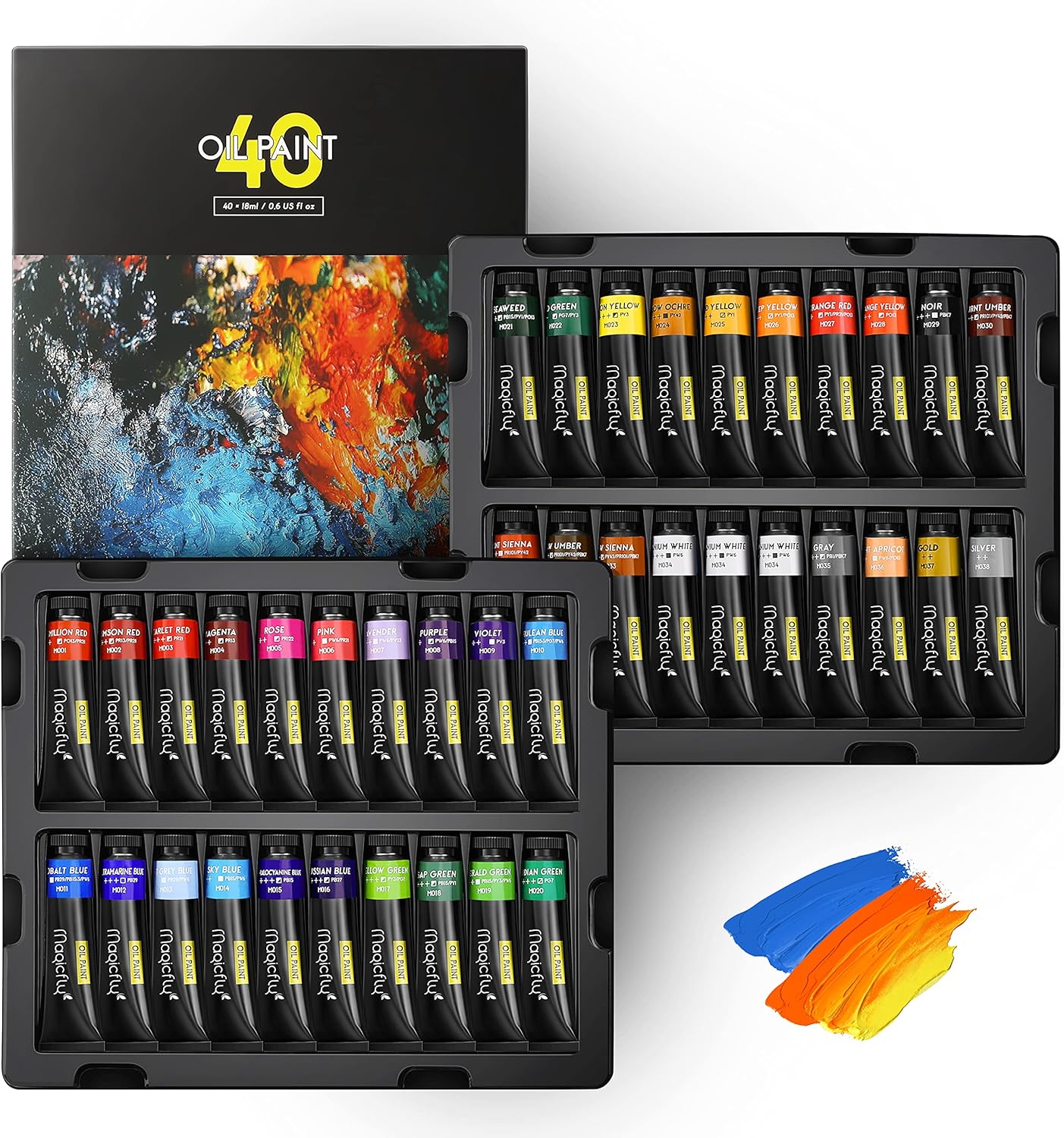
Magicfly’s set is a lower-cost way to experiment with thick paint. The listing describes 40 colors including metallic gold and silver, a thick consistency with good coverage, and two extra white tubes compared with typical sets. The paint conforms to ASTM D-4236.
The 18ml tubes are larger than the common 12ml size but still small for serious impasto. Treat this set as a texture sampler: try knife techniques on small panels before investing in large tubes of your favorite colors.
Best suited for: beginners learning palette knife impasto on small canvases.
Key features
- 40 colors x 18ml including gold and silver
- Extra white tubes
- Thick, creamy texture listed
- ASTM D-4236
Pros
- Budget-friendly price tier
- Metallics add interest to textured abstracts
Cons
- Tubes empty fast with thick application
- Pigment strength likely below artist-grade paints
Buying consideration: Metallic oil paints can look striking in raised ridges because they catch light from different angles. Use them sparingly as accents.
5. MyArtscape Oil Paint Set, 48 x 12ml — Best for Color Exploration

Forty-eight colors in 12ml tubes gives you a broad range to test before buying larger tubes of your favorites. The listing describes artist-quality, lightfast colors with a traditional high-sheen finish suitable for canvas, pads, boards, panels and paper, backed by a satisfaction guarantee.
For impasto, 12ml tubes are the main limitation. They are ideal for accent colors pressed into a thick passage of white or earth color, but you will need larger tubes for the main body of paint.
Best suited for: painters who want to try many hues before committing to a limited impasto palette.
Key features
- 48 colors x 12ml
- Lightfast pigments listed
- High-sheen finish
Pros
- Wide color selection
- Glossy finish shows off texture
Cons
- Small tubes for thick work
- Body may vary across colors
Buying consideration: Pair this set with a large tube of white and a large tube of your most-used earth color for a cost-effective impasto palette.
6. U.S. Art Supply Impasto Clear Gel (Acrylic) — Best for Texture Underneath Oils

This is an acrylic product, and it is here for one specific use. Mixed into oil paint, it will not work, because acrylic and oil do not combine. But you can build sculptural texture with acrylic gel on a primed canvas, let it dry fully, and then paint over it in oils. Oil over cured acrylic is a common and sound practice; acrylic over oil is not.
The listing describes a thick clear gel in a 500ml tub that holds peaks, ridges and knife marks as it dries, remains flexible, adheres to many surfaces and is non-yellowing. It dries clear when used alone.
Best suited for: painters who want heavy texture without using huge amounts of oil paint, or who want texture to dry quickly before oil layers.
Key features
- 500ml clear acrylic gel
- Holds peaks and ridges
- Flexible, non-yellowing, dries clear
Pros
- Saves oil paint on heavy texture
- Dries far faster than thick oil
Cons
- Cannot be mixed into oil paint
- Texture must be fully dry before oiling over it
Buying consideration: Apply the gel on an acrylic-primed surface, not over oil ground. Allow thick passages to dry thoroughly before starting oil layers.
Buying Guide: How to Choose Oil Paints for Impasto
Body and consistency
Look for listings that describe thick, stiff or buttery paint. If a color is too loose, blot it on paper towel or newsprint for a few minutes to draw out excess oil before use.
Tube size and cost per milliliter
Impasto uses several times more paint than thin layering. Fifty milliliter tubes, or larger single tubes of your most-used colors, are far more practical than 12ml sets for anything bigger than a small study.
Tinting strength
Impasto passages often mix strong white with color. Paints with strong tinting strength hold their hue in those mixtures; weaker paints turn pastel quickly.
Drying time and alkyds
Thick oil dries slowly from the outside in. Fast-drying alkyd colors or an alkyd white help underlayers and thick passages set sooner. Keep slower conventional oils for the top layers.
Mediums for impasto
If you want even stiffer paint, choose an oil-compatible impasto medium rather than acrylic gel. Avoid thinning impasto layers with solvent, which weakens the film.
Surface strength
Heavy impasto puts weight and stress on its support. Rigid panels or well-stretched, well-primed canvas handle thick paint better than flimsy canvas boards.
How to Make Impasto Last
Impasto failures, such as wrinkling, cracking and slumping, usually come from technique rather than the paint itself. Keep these principles in mind:
- Fat over lean. Each layer should be as flexible as or more flexible than the one beneath. Thick, oily impasto belongs on top of thinner lean layers.
- Build in stages on big pieces. Very thick single applications can skin over and wrinkle. Building texture in two or three sessions dries more evenly.
- Avoid excess medium. Too much oil in a thick layer increases wrinkling risk.
- Allow long drying. Thick impasto can take weeks to dry to the touch and much longer to cure. Wait before varnishing.
- Store flat during drying if passages are very heavy, to reduce sagging.
Impasto is a natural fit for textured subjects. Try it on the petals and drapery in our step-by-step oil still life guide, or use thick highlights to suggest shine in our tutorial on painting a seashell in oil.
Common Mistakes to Avoid
- Mixing acrylic gel into oil paint. It will not bind. Use acrylic gel only as a dried underlayer.
- Starting a large impasto painting with 12ml tubes. You will run out mid-passage.
- Thinning impasto with solvent. It weakens the paint film and causes matte, fragile patches.
- Applying fast-drying layers on top of slow ones. Keep alkyds underneath.
- Varnishing too soon. Thick paint needs a long cure before final varnish.
- Overworking thick paint. Fresh, confident strokes keep texture crisp; going back over them muddies color and flattens ridges.
FAQs
Can you do impasto with regular oil paint?
Yes. Most oil paints can be applied thickly. Stiffer paints hold marks better, and you can blot excess oil or add an oil impasto medium to increase body.
How long does impasto oil paint take to dry?
It depends on thickness, pigments and conditions. Thick passages may take weeks to become touch-dry and much longer to fully cure. Alkyd colors like Griffin Alkyd touch-dry in about 24 hours in normal layers.
Can I mix acrylic impasto gel with oil paint?
No. Acrylic and oil do not mix in the same layer. You can build texture in acrylic gel, let it dry fully and paint oils on top.
Does thick oil paint crack?
It can wrinkle or crack if layers break fat over lean, contain excess oil, or are applied too thickly in one go. Building texture in stages helps.
What tube size is best for impasto?
50ml tubes or larger, especially for white and your main colors. Small 12ml tubes work for accents.
Which white is best for impasto?
An opaque titanium white with a stiff body. A fast-drying alkyd titanium white, such as Griffin Alkyd Mixing White, helps thick white passages dry sooner.
Final Recommendation
For painters who want to commit to thick, textured oils, the PHOENIX Studio 40 x 50ml set offers the volume and listed body impasto demands, while the Paul Rubens 20 x 50ml set keeps the same big tubes in a more focused palette. Whichever you choose, add Griffin Alkyd Mixing White for faster-drying highlights and underlayers. On a budget, the Magicfly and MyArtscape sets are fine for learning knife work on small panels. Reach for the U.S. Art Supply impasto gel only as a dried acrylic underlayer, never as an oil additive.