PaintingProGuide is reader-supported. When you buy through links on this page we may earn an affiliate commission at no extra cost to you.
Airtight palette vs stay wet palette comes down to one physical difference: an airtight palette slows drying by sealing paint away from air, while a stay-wet palette actively feeds moisture to the paint from a damp sponge underneath. That sounds like a small distinction, but it decides which paints each palette suits. Acrylics, which dry by evaporation and cannot be rewetted, benefit enormously from a stay-wet. Watercolor and gouache rewet with water anyway, so an airtight well palette is usually the better home for them. Oil paint, which dries by oxidation, belongs in an airtight box and never on a wet sponge.
Quick answer: Choose a stay-wet palette if you paint mainly in acrylics and want paint to stay workable for days; the Daler-Rowney Staywet Palette Large (10.1 × 14 in) is the roomiest option here. Choose an airtight palette if you paint in watercolor, gouache or oils, or want to store many mixed colors in wells; the Mijello Artelier Airtight palette covers acrylic and oil, and the Mijello Fusion 33-well is the pick for watercolor and gouache.
Our Top Picks at a Glance
- Daler-Rowney Staywet Palette Large, 10.1 × 14 in — Best stay-wet palette for acrylic painters
- Mijello Artelier Airtight Palette, 330 × 230 × 30 mm — Best airtight palette for acrylic and oil
- Mijello Fusion 33-Well Airtight Palette — Best airtight palette for watercolor and gouache
- Jack Richeson Lock Box Palette System, 24 wells — Best sealed storage for many mixed colors
- Mr. Pen Airtight Watercolor Palette, 18 wells — Best budget airtight palette
- Stay Wet Palette Starter Kit with 100 hydro papers — Best budget stay-wet for miniatures and small work
- Golden Maple 2-in-1 Dry and Wet Palette with brushes — Best hybrid for painters who want both
Airtight Palette vs Stay Wet Palette: Side-by-Side
| Factor | Airtight palette | Stay-wet palette |
|---|---|---|
| How it works | Sealed lid slows evaporation or oxidation | Damp sponge plus membrane feeds moisture to paint |
| Best paints | Watercolor, gouache, oils, acrylics short term | Acrylics, acrylic gouache |
| Typical layout | Wells plus mixing areas | Flat surface on membrane or hydro paper |
| How long acrylic stays usable | Hours to a day or so, depending on seal and amount | Commonly several days with the lid on |
| Consumables | None | Membrane or hydro paper, sponges |
| Maintenance | Wash wells | Rinse sponge, prevent mold, replace paper |
| Oil paint? | Yes | No |
Product Comparison Table
| Product | Best For | Key Spec (from title) | Key Strength | Who Should Skip It |
|---|---|---|---|---|
| Daler-Rowney Staywet Large | Acrylic painters | 10.1 × 14 in | Large stay-wet surface | Watercolorists |
| Mijello Artelier Airtight | Acrylic and oil storage | 330 × 230 × 30 mm | Sealed tray sized for oils and acrylics | Miniature painters |
| Mijello Fusion 33-Well | Watercolor and gouache | 33 wells, airtight/leakproof | Many deep wells, travel-safe lid | Acrylic-only painters |
| Jack Richeson Lock Box | Storing many mixes | 24-well insert | Locking lid over removable insert | Painters needing a flat mixing slab |
| Mr. Pen Airtight Palette | Budget watercolor and gouache | 18 wells, 2 mixing areas | Simple, compact, lidded | Professionals with large palettes |
| Stay Wet Starter Kit | Miniatures, small acrylic work | 100 hydro papers and sponge | Low-cost entry to wet palettes | Large-canvas painters |
| Golden Maple 2-in-1 | Hybrid wet and dry use | 11 brushes, 100 papers, 4 sponges | Wet and dry zones plus brushes | Painters who already own brushes |
How We Chose
We compared palettes using Amazon listing information checked in November 2026 and the well-understood ways different paints dry. We have not used these particular palettes for this guide, and we omit prices and ratings because they change too often to print. Dimensions and well counts come straight from listing titles.
- Drying control mechanism — sealing versus active moisture.
- Paint compatibility — acrylic, watercolor, gouache and oil each need different treatment.
- Working area — well count and mixing space from the listing.
- Seal reliability — whether the listing specifies airtight or leakproof construction.
- Running costs — consumables needed to keep the palette working.
Best Airtight and Stay-Wet Palettes Reviewed
1. Daler-Rowney Staywet Palette Large, 10.1 × 14 in — Best Stay-Wet for Acrylics

At 10.1 × 14 inches, this is the largest stay-wet surface in the roundup. That size matters more than any other feature for acrylic painters, because the most common complaint about stay-wet palettes is running out of room once a full palette is laid out. Here you can set out a dozen colors around the edge and still mix in the middle.
The system works the same way as other sponge-and-membrane palettes: a damp reservoir underneath, a special paper on top, and a lid to hold the humidity in. For painters who work over several days on canvases of 18 × 24 inches and up, it is the logical choice.
Best suited for: Acrylic painters working medium to large who want paint to keep for days.
Key features:
- 10.1 × 14 inch working surface
- Stay-wet sponge-and-membrane system
- Lidded tray from a long-established art brand
Pros:
- Generous room for a full palette
- Keeps acrylics workable across sessions
- Better suited to larger canvases than compact stay-wets
Cons:
- Takes up significant table space
- Needs replacement paper and sponge care
- Not useful for oils
Buying consideration: Check the replacement paper size before you buy so you can stock refills in advance.
2. Mijello Artelier Airtight Palette, 330 × 230 × 30 mm — Best Airtight for Acrylic and Oil

Mijello is best known for watercolor palettes, but the Artelier line targets acrylic and oil painters. The listed dimensions, 330 × 230 × 30 mm (about 13 × 9 × 1.2 inches), give a broad flat area with enough depth to hold mounds of paint under a sealing lid.
For oil painters, an airtight box slows the skin that forms on paint as it oxidizes, letting you keep a palette for a day or two longer, especially if you also store it somewhere cool. For acrylic painters, it is a short-term solution: good overnight, not as effective as a stay-wet over several days.
Best suited for: Oil painters and acrylic painters who want sealed storage without sponges or paper.
Key features:
- 330 × 230 × 30 mm airtight palette (MAP-3025)
- Designed for acrylic and oil color
- No consumables required
Pros:
- Works with oils, unlike stay-wets
- Low maintenance
- Large flat mixing area
Cons:
- Acrylics still dry eventually without added moisture
- Plastic surface can stain with strong pigments
- Bulkier than a simple glass palette
Buying consideration: Oil painters can extend its usefulness by storing it in a cool spot or refrigerator between sessions.
3. Mijello Fusion 33-Well Airtight Palette — Best for Watercolor and Gouache

The Fusion is a well-known choice among watercolorists for a reason: 33 wells are enough for an extensive palette, and the airtight, leakproof lid means tube paint squeezed into wells stays moist for longer and does not dry out completely between sessions. Because watercolor rewets anyway, an airtight palette is about convenience and cleanliness rather than salvaging paint.
It also suits gouache painters, who often find that gouache cracks when it dries hard in open wells. Keeping it sealed reduces that cracking.
Best suited for: Watercolor and gouache painters with large palettes, including travel painters.
Key features:
- 33 paint wells
- Airtight, leakproof lid
- Designed for watercolor paints
Pros:
- Large well count
- Reduces cracking in gouache
- Travel-friendly seal
Cons:
- Wells take up space that could be mixing area
- Not designed for acrylics over several days
- Larger than a pocket palette
Buying consideration: Leave the lid slightly open for a few hours after filling wells so fresh paint can firm up before sealing.
4. Jack Richeson Lock Box Palette System, 24 Wells — Best Sealed Storage for Mixes

The Lock Box pairs a locking outer box with a removable 24-well insert. That design suits painters who pre-mix batches of color, such as portrait painters preparing flesh-tone strings or designers matching specific hues, because each mix gets its own well and stays sealed until the next session.
Best suited for: Painters who pre-mix and store many colors between sessions.
Key features:
- Lock box palette with 24-well insert
- White surface for judging color
- Removable insert for cleaning
Pros:
- Separate well for every mix
- Locking lid for storage and transport
- Works with multiple paint types
Cons:
- Less open mixing area
- Acrylic mixes still dry slowly over time
- Bulkier than a flat palette
Buying consideration: Ideal if you value consistent mixes; less useful for loose, intuitive palette mixing.
5. Mr. Pen Airtight Watercolor Palette, 18 Wells — Best Budget Airtight Palette

For beginners or anyone wanting a spare palette, this simple lidded tray offers 18 wells and 2 mixing areas, enough for a full student palette of watercolor or gouache. It is not a professional tool, but it does the core job of keeping paint clean and slowing drying between sessions.
Best suited for: Beginners and students working in watercolor or gouache.
Key features:
- 18 wells and 2 mixing areas
- Airtight lid
- Compact size
Pros:
- Affordable entry point
- Enough wells for a starter palette
- Easy to clean
Cons:
- Limited mixing space
- Plastic may stain
- Seal quality less proven than premium brands
Buying consideration: A good second palette for travel or a classroom even if you own a premium one.
6. Stay Wet Palette Starter Kit with 100 Hydro Papers — Best Budget Stay-Wet

This starter kit includes a tray, sponge and 100 hydro papers, a large enough supply to last a long time. Hydro paper wicks moisture quickly, which keeps thinned acrylics fluid. That is ideal for miniatures and fine detail, less so for heavy-body acrylic on canvas.
Best suited for: Miniature painters and acrylic beginners trying a stay-wet for the first time.
Key features:
- Acrylic paint tray with sponge
- 100 hydro papers included
- Marketed as a miniatures starter kit
Pros:
- Low cost to try a wet palette
- Large paper supply
- Good for thin layers
Cons:
- Small working area
- Keeps heavy-body paint too wet
- Generic build
Buying consideration: Best as a learning tool; canvas painters will outgrow it quickly.
7. Golden Maple 2-in-1 Dry and Wet Palette with Brushes — Best Hybrid
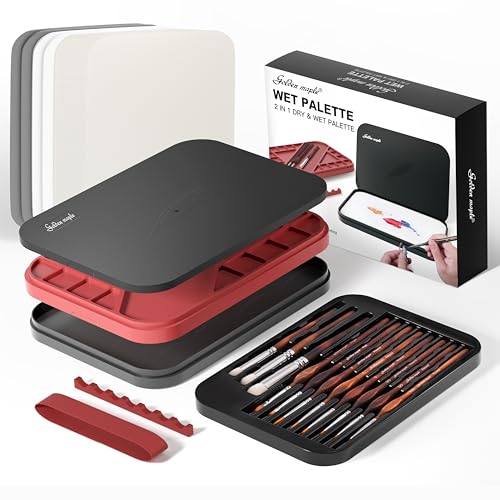
If you cannot decide between the two approaches, this palette offers both: a wet zone for paint you want to keep moist and a dry zone for mixing. The listing adds 11 miniature brushes, 100 palette papers, 4 sponges and brush holders, making it a complete starter setup for miniatures.
Best suited for: Miniature painters who want an all-in-one kit with wet and dry areas.
Key features:
- Combined dry and wet palette with lid
- 11 miniature brushes and brush holders
- 100 palette papers, 4 sponges
Pros:
- Both palette types in one
- Includes brushes and spares
- Good value as a starter bundle
Cons:
- Each zone is relatively small
- Bundled brushes may not suit experienced painters
- Aimed at miniatures rather than canvas work
Buying consideration: Experienced painters with brushes already can choose the version without them.
Buying Guide: How to Choose Between an Airtight and a Stay-Wet Palette
Start with how your paint dries
Acrylic dries by water evaporation and becomes permanent plastic; once dry on a palette, it is waste. That is why acrylic painters gain most from a stay-wet, which replaces lost moisture. Watercolor and traditional gouache dry by evaporation too, but they rewet, so you only need to keep them clean and slow down cracking. Oil dries by oxidation, so it needs air exclusion, not water.
How long you need paint to last
If you paint in one sitting, neither is essential. If you return the next day, an airtight lid is often enough for acrylics in modest amounts. If you return days later, a stay-wet becomes the more reliable choice for acrylics.
Wells versus a flat surface
Airtight palettes usually provide wells, which suit storing many colors and pre-mixed batches. Stay-wets provide a flat surface for mounds of paint and mixing. Painters who use a palette knife generally prefer a flat surface.
Consumables and maintenance
Stay-wets need membrane or hydro paper and periodic sponge rinsing to prevent mold. Airtight palettes only need washing. If low maintenance matters, airtight wins.
Size relative to your work
For canvases larger than about 16 × 20 inches, look for a palette of at least 9 × 12 inches; the 10.1 × 14 inch Daler-Rowney or the roughly 13 × 9 inch Mijello Artelier both qualify. Miniature painters can work happily on much smaller surfaces.
Travel and portability
Leakproof airtight palettes travel better than stay-wets, which can drip if tilted. Plein air watercolorists should favor a sealed well palette.
Who Should Buy What
Acrylic painter on canvas
Daler-Rowney Staywet Large. The surface area and moisture system suit multi-day acrylic work.
Acrylic and gouache painter who works in short sessions
Mijello Artelier for acrylic, or the Mijello Fusion if gouache is your main medium. A sealed lid handles overnight storage without sponges.
Watercolorist
Mijello Fusion 33-Well for a big home palette; Mr. Pen as a budget or travel spare.
Oil painter
Mijello Artelier Airtight. Never use a stay-wet for oils.
Miniature painter
The Stay Wet Starter Kit or the Golden Maple 2-in-1 for wet and dry zones with included brushes.
If you already own a stay-wet, our guide on how to use a stay-wet palette correctly covers sponge wetness and paper prep. You can also learn how to make a stay-wet palette from a food container before buying one.
Common Mistakes to Avoid
- Putting oil paint on a stay-wet palette. Oil and water do not mix and the sponge will be ruined.
- Expecting an airtight palette to keep acrylic for a week. Sealing slows drying but does not stop it.
- Sealing freshly squeezed watercolor immediately. Let it firm up first to avoid mold and runny wells.
- Buying a palette too small for your canvas size. Cramped palettes lead to muddy mixes.
- Neglecting sponge hygiene. Stay-wets can develop mold if never rinsed.
- Tilting a stay-wet in transport. Water and paint can spill out.
Helpful Guides Before You Buy
New to this? These guides answer the questions most buyers have before choosing:
- How Wet Should a Wet Palette Be? A Simple Moisture Guide
- DIY Wet Palette for Acrylic Painting: How to Make One
FAQs
Is a stay wet palette for acrylics better than an airtight palette?
For acrylics kept over several days, yes. A stay-wet actively adds moisture, while an airtight palette only slows evaporation.
Can I use an airtight paint palette for oils?
Yes. Sealing reduces air exposure, which slows oxidation. Storing it somewhere cool helps further.
What is the best palette for acrylic paint if I paint every day?
If you paint daily, an airtight palette may be enough because paint does not sit for long. A stay-wet is still helpful for slow or detailed work.
Do sealed paint palettes work for gouache?
Yes. A sealed palette reduces cracking and keeps gouache easier to rewet.
Masterson Sta-Wet vs Mijello: which should I choose?
They solve different problems. A Sta-Wet suits multi-day acrylic painting; Mijello’s airtight palettes suit watercolor, gouache, and short-term acrylic or oil storage.
Can a palette be both airtight and stay-wet?
Yes. Most stay-wet palettes have lids, and hybrid designs like the Golden Maple 2-in-1 include dry areas too.
Final Recommendation
For acrylic painters who return to work over several days, buy a stay-wet; the Daler-Rowney Staywet Large gives the most room. For watercolor and gouache, an airtight well palette is the better tool, with the Mijello Fusion 33-Well leading and the Mr. Pen palette as a budget option. Oil painters should choose the Mijello Artelier Airtight. Miniature painters can start with the Stay Wet Starter Kit or the Golden Maple 2-in-1. Check current price on Amazon before you decide.