
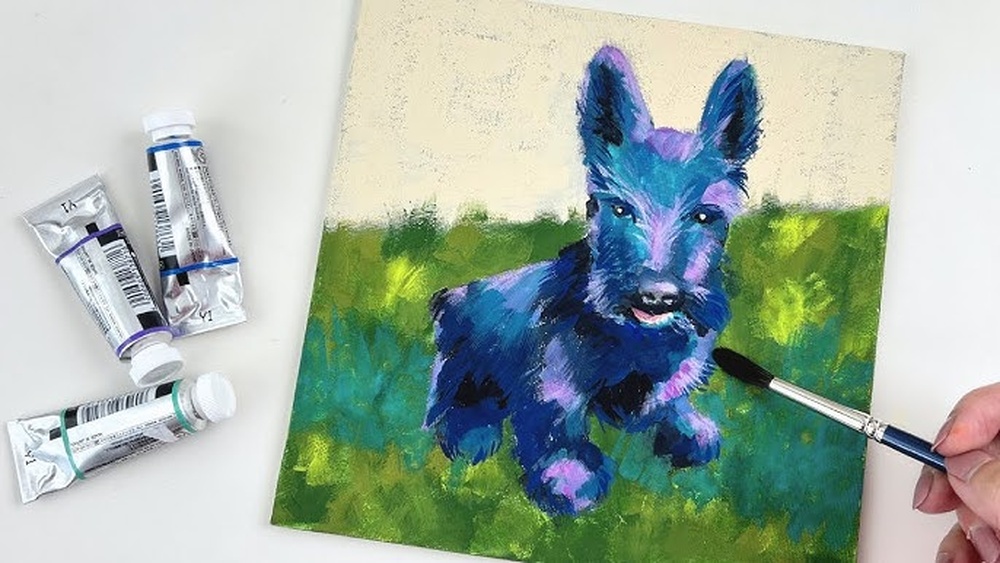
Quick answer: Can you use gouache paint on canvas? Yes, but traditional gouache works best on rigid, absorbent surfaces such as canvas panels, canvas boards or a canvas coated with an absorbent ground, and it should be applied in thin layers. Thick traditional gouache can crack on flexible stretched canvas and stays water-soluble, so finished work needs a protective fixative or varnish. Acrylic gouache is the easier option for canvas: it dries water-resistant, flexes better and can be varnished like acrylic.
Gouache has a look that is hard to get any other way: flat, velvety, matte color with crisp edges. It is natural to want that look on canvas, whether for display without glass, for a larger format or simply because canvas is what you have on hand.
The answer to “can you use gouache paint on canvas” depends on two things: which kind of gouache you use and how you prepare the surface. This guide explains how gouache behaves on canvas, how to prepare different canvas types, step-by-step painting methods, how traditional and acrylic gouache compare and how to protect your finished painting.
What Makes Gouache Different on Canvas
Traditional gouache is an opaque watercolor. Like watercolor, it uses gum arabic as a binder, but it has a higher pigment load and often an added white filler, which makes it opaque and matte. Two properties matter when you move it to canvas:
- It is rewettable. Dried gouache softens and lifts when water touches it again. On a nonabsorbent surface, it can lift very easily.
- It is not very flexible. Gum arabic dries relatively brittle. Thick gouache layers on a surface that flexes, like stretched canvas, can crack or flake.
Paper solves both issues by absorbing some of the paint and staying flat when mounted or framed. On canvas, you need to recreate those conditions: an absorbent ground and a surface that does not flex much.
Does Gouache Work on Canvas? Surface by Surface
| Surface | Traditional gouache | Acrylic gouache | Notes |
|---|---|---|---|
| Stretched canvas, standard acrylic gesso | Fair to poor; can crack and lift | Good | Use thin layers; consider an absorbent ground |
| Canvas board or panel, standard gesso | Fair; better than stretched due to rigidity | Very good | Rigid surface reduces cracking |
| Canvas with absorbent ground | Good | Good | Ground helps traditional gouache adhere |
| Canvas made for watercolor/gouache | Good | Good | Specially primed to absorb water-based media |
| Canvas paper | Fair | Good | Fine for practice; can buckle with water |
Rigid, absorbent surfaces give the best results for traditional gouache. For a closer look at surfaces designed with gouache in mind, see our guide to the best canvas for gouache.
Traditional Gouache vs Acrylic Gouache on Canvas
| Feature | Traditional gouache | Acrylic gouache |
|---|---|---|
| Binder | Gum arabic | Acrylic polymer |
| Finish | Matte, velvety | Matte, slightly less chalky |
| Rewettable when dry | Yes | No; water-resistant once dry |
| Flexibility | Low; thick layers can crack | Higher; better on flexible supports |
| Layering | Lower layers can lift | Layers stay put |
| Corrections | Easy to rewet and adjust | Must paint over |
| Palette reuse | Dried paint can be rewet | Dried paint is unusable |
| Best canvas match | Rigid, absorbent surfaces | Most primed canvas surfaces |
Acrylic gouache on canvas
Acrylic gouache combines gouache’s opaque, matte look with an acrylic binder. It adheres to standard acrylic-gessoed canvas, layers without lifting and is flexible enough for stretched canvas. If your goal is a matte, flat-color painting on canvas, acrylic gouache is usually the simplest route. It can be varnished like acrylic paint, though a varnish may change the matte finish unless you choose a matte varnish.
Gouache Paint vs Acrylic on Canvas
Regular acrylic and gouache can both produce strong paintings on canvas, but they look and behave differently.
- Finish: Gouache dries flat and matte; regular acrylic dries with a slight sheen (varies by brand and medium).
- Opacity: Gouache is designed to be opaque; many acrylics are semi-transparent unless you use opaque formulations.
- Color shift: Gouache light colors often dry slightly darker and dark colors slightly lighter. Acrylic tends to dry a little darker overall.
- Durability: Acrylic is more durable on canvas without additional sealing.
Gouache Paint for Canvas: Choosing a Formula
Within traditional gouache, formulas vary. Some student lines use more filler to boost opacity at low cost, which can make dried color look chalky and slightly more prone to cracking when applied thickly. Artist-grade gouache typically relies more on pigment for opacity. Either can work on canvas if you keep layers thin, but if you plan to work large or on stretched canvas, acrylic gouache is the lower-risk choice. Read the label: products intended for canvas usually say so.
How to Prepare Canvas for Gouache
Option 1: Use a rigid canvas panel
Canvas panels resist flexing, which reduces the risk of cracking. Many work well with gouache as-is, especially for thin applications. For better adhesion with traditional gouache, add an absorbent ground.
Option 2: Apply an absorbent ground
- Clean the canvas surface of dust.
- Apply a thin coat of absorbent ground (often sold as watercolor ground or absorbent gesso) with a wide brush.
- Let it dry, then apply a second coat at a right angle to the first.
- Allow the ground to cure fully according to product instructions, often 24 hours or more.
- Lightly sand if you want a smoother surface.
Option 3: Use canvas designed for water-based media
Some canvases and panels are specifically primed to accept watercolor and gouache. These require no extra preparation.
How to Use Gouache on Canvas: Step by Step
1. Sketch lightly
Use a light pencil or a thin wash of gouache to sketch. Heavy graphite can smear into light colors.
2. Mix to a creamy consistency
Gouache should be the consistency of heavy cream or soft yogurt for opaque coverage. Too watery and it streaks; too thick and it can crack on canvas.
3. Apply thin, even layers
Thin layers are the key to durability on canvas. Build opacity with two thin coats instead of one thick one. This reduces cracking and helps the paint adhere.
4. Work from dark to light or broad to detailed
Because gouache is opaque, you can paint light over dark. A common approach is to block in large shapes and middle values, then add darks and finally highlights.
5. Use a light touch when layering
With traditional gouache, each new wet layer can reactivate the one underneath. Lay strokes down quickly and avoid scrubbing. Let layers dry fully before adding more.
6. Watch the color shift
Test mixes on a scrap and let them dry to see the final color before committing to large areas.
7. Let the painting dry thoroughly
Allow the finished painting to dry completely, preferably overnight, before sealing.
8. Seal and protect
For traditional gouache, apply several light coats of a spray fixative or varnish designed for watercolor and gouache. Spray rather than brush the first coats, since brushing can lift the paint. Once sealed, the painting can be displayed without glass, although it will remain more delicate than acrylic. For acrylic gouache, use a varnish suitable for acrylics, choosing matte if you want to preserve the finish.
Gouache Techniques That Work Well on Canvas
- Flat color shapes: Gouache excels at graphic, poster-like designs with clean edges.
- Light over dark: Opaque coverage allows highlights over darker areas.
- Dry brush: Canvas texture catches dry-brushed gouache for texture effects.
- Masking: Low-tack tape creates sharp edges on rigid canvas panels.
- Limited palettes: Gouache’s matte finish makes simple palettes look cohesive.
Brushes for Gouache on Canvas
Canvas texture is rougher than paper, so it wears brushes faster and pulls paint differently. Soft-to-medium synthetic brushes are a good match: they push creamy gouache into the weave without scrubbing up lower layers. Useful shapes include a 1/2-inch flat for large flat areas, a medium round for shapes and edges, a small round or liner for details and an angled flat for crisp corners. Stiff hog bristle brushes are usually too harsh for traditional gouache, since they can lift underlayers.
First Project: A Flat-Color Landscape on a Canvas Panel
This exercise shows off gouache’s strengths while keeping layers thin. Use a 9×12-inch canvas panel prepared with an absorbent ground, or any primed panel if you are using acrylic gouache.
- Plan five shapes: sky, distant hills, middle hills, foreground field and a sun or moon. Sketch them lightly.
- Mix every color first: Gouache rewards pre-mixing. Make one creamy puddle per shape, plus a slightly lighter version of each for a later highlight.
- Paint the sky: Fill it in one thin, even coat with a flat brush. Let it dry, then add a second thin coat if it looks streaky.
- Work forward: Paint distant hills, then middle hills, then the foreground, letting each dry before painting the overlapping shape.
- Add the sun or moon: Paint it last, light over dark, using a round brush.
- Highlights: With the lighter versions of each color, add a few edge highlights along hill tops.
- Seal: Once completely dry, apply light spray coats of a fixative or varnish suitable for your type of gouache.
Keeping the design to a handful of flat shapes helps you focus on consistency, coverage and the color shift as gouache dries.
Common Problems and Fixes
| Problem | Cause | Fix |
|---|---|---|
| Cracking | Thick paint on flexible canvas | Use thin layers, rigid panels or acrylic gouache |
| Paint lifting | Nonabsorbent gesso; rewetting | Use an absorbent ground; layer with light strokes |
| Streaky coverage | Paint too thin | Mix to a creamy consistency; apply two thin coats |
| Chalky appearance | Too much white or overly thick paint | Adjust mixes; use quality pigments |
| Smudging after sealing | Heavy brush-on varnish | Start with light spray coats |
Best Canvas for Acrylic Gouache
Acrylic gouache is less demanding than traditional gouache. It works on:
- Standard pre-primed stretched canvas
- Canvas boards and panels
- Canvas paper for practice
- Wood panels primed with acrylic gesso
A smooth or fine-weave canvas gives the cleanest flat color, while a medium weave adds subtle texture.
Displaying and Storing Gouache Paintings on Canvas
Sealed traditional gouache on canvas can hang without glass, but it remains more sensitive than acrylic. Hang it away from kitchens, bathrooms and humid rooms, avoid direct sunlight, and dust it gently with a soft, dry brush rather than a cloth. Unsealed pieces should be stored flat with a sheet of glassine or acid-free paper over the surface, and never stacked face to face. Acrylic gouache paintings can be treated much like regular acrylic paintings once varnished.
Tips by Experience Level
Beginners
- Start with acrylic gouache on canvas panels for easy results.
- Practice flat color shapes and simple designs.
- Keep layers thin.
Intermediate
- Try traditional gouache on canvas prepared with an absorbent ground.
- Experiment with combining gouache and acrylic in the same piece.
- Test fixatives and varnishes on scrap pieces first.
Advanced
- Use gouache for underpainting and finish with acrylic or oil where appropriate.
- Explore larger gouache works on rigid panels.
- Develop a consistent sealing process for archival display.
FAQs
Can you use gouache paint on canvas?
Yes. Traditional gouache works best on rigid, absorbent canvas surfaces in thin layers, while acrylic gouache works on most primed canvas.
Does gouache crack on canvas?
It can, especially when applied thickly on flexible stretched canvas. Thin layers, rigid panels or acrylic gouache reduce the risk.
Do I need to seal gouache on canvas?
Yes, for traditional gouache. It stays water-soluble, so a fixative or varnish suitable for gouache helps protect it. Acrylic gouache is water-resistant but can still be varnished for protection.
Is acrylic gouache better for canvas than regular gouache?
For most canvas work, yes. Acrylic gouache adheres to standard gesso, flexes better and does not reactivate with water.
Can I mix gouache and acrylic on canvas?
Many painters use them together, for example gouache underlayers with acrylic on top. Traditional gouache layers underneath may be less stable, so test the combination first.
What is the best canvas for gouache?
Rigid canvas panels, canvases primed for water-based media, or canvas prepared with an absorbent ground generally give the best results.
Final Thoughts
Gouache on canvas works well when you respect its nature: keep layers thin, choose a rigid or absorbent surface and protect the finished piece. If you want the gouache look with fewer constraints, acrylic gouache is the easiest option.
The right surface is the single biggest factor in success. Compare canvases and panels suited to gouache to find one that holds your colors without cracking or lifting.


One Comment