
PaintingProGuide is reader-supported. When you buy through links on this page we may earn an affiliate commission at no extra cost to you.
Gouache was made for paper, and that history explains most of what goes wrong when people try it on canvas. Traditional gouache is a water-soluble, matte paint with a high pigment load and a gum arabic binder. It needs a surface with some absorbency and tooth to grip, and it does not like to flex once dry. A slick acrylic-primed canvas lets it bead, lift and crack; a soft, bouncy stretched canvas can shed thick layers over time. The best canvas for gouache is therefore a rigid, primed canvas panel with a medium grain, used with thin to moderate layers, ideally after a light prep that makes the surface more receptive.
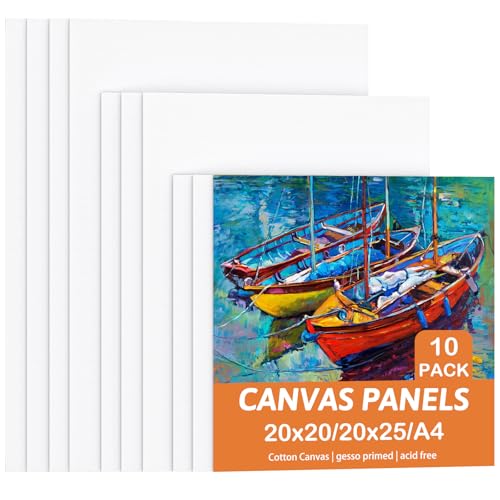
Quick answer: The GOTIDEAL 8×10 Canvas Boards (10 oz primed, medium grain) are our top pick for gouache on canvas: rigid, with a medium grain that gives gouache something to hold. The Simetufy 8×10 Canvas Boards with MDF core are a strong everyday alternative, and the ESRICH 12 Pack Multi-Size Boards are ideal for small gouache studies in four sizes.
If you are still deciding whether to use canvas at all, our explainer on whether you can use gouache paint on canvas walks through the pros and cons. This guide assumes you want to, and focuses on choosing and preparing the right board.
Our Top Picks at a Glance
- GOTIDEAL 8×10 Canvas Boards, Set of 10 — Best overall canvas board for gouache
- Simetufy 8×10 Canvas Boards, 12 Pack — Best rigid everyday board
- ESRICH 12 Pack Multi-Size Canvas Boards — Best for small gouache studies
- GOTIDEAL 18 Pcs Multi Pack Canvas Boards — Best multi-size value set
- Simetufy 32 Pack 11×14 Canvas Boards — Best for larger gouache pieces and classes
- Jofuler 8×10 Canvas Boards, 5 Pack — Best small trial pack
| Product | Best For | Key Spec | Key Strength | Price Tier |
|---|---|---|---|---|
| GOTIDEAL 8×10 Set of 10 | Overall gouache use | 10 oz acid-free gesso, medium grain cotton | Tooth for gouache to grip | $ |
| Simetufy 8×10 Boards | Everyday studies | 12 pack, cotton, MDF core | Very rigid | $ |
| ESRICH 12 Multi-Size | Small studies | 4×4, 5×5, 5×7, 8×10; board core | Four small sizes | $ |
| GOTIDEAL 18 Multi Pack | Varied projects | 4×4 to 11×14, warp-resistant core | Size range | $$ |
| Simetufy 32 x 11×14 | Larger pieces, groups | 32 pack, cotton, MDF core | Bulk 11×14 | $$ |
| Jofuler 8×10 5 Pack | Trying gouache on canvas | 5 pack, cotton, sturdy backing | Low commitment | $ |
How We Chose
We did not paint gouache on these boards ourselves. The picks are based on the Amazon listing details and specifications checked in October 2026, how well each board’s rigidity, grain and priming suit gouache, and how widely each product is reviewed by Amazon buyers. Every pick is a flat canvas panel, because rigidity protects dried gouache from cracking. We left out one 8×10 five-pack that duplicated the Jofuler option.
What we weighed:
- Rigidity: gouache is brittle when thick and dry, so a board core matters.
- Grain: a medium grain gives the matte paint mechanical grip.
- Priming: stated gesso weight and how smooth or slick the surface is.
- Size: gouache is often used for small to medium pieces and studies.
- Pack format: single size for series, multi-size for exploration.
Best Canvas for Gouache Reviewed
1. GOTIDEAL 8×10 Canvas Boards, Set of 10 — Best for gouache on canvas overall

GOTIDEAL lists ten 8×10 panels, each primed with 10 oz of acid-free acrylic gesso, with 100% cotton canvas that has a medium grain and holds paint without absorbing it. The listing names gouache among compatible media, along with oil, watercolor, acrylic, pastels and tempera.
A medium grain is useful for gouache because the paint relies on mechanical grip on non-absorbent grounds. Little peaks in the weave catch the paint and help the first layer stay put. The board backing gives the rigidity gouache needs to avoid cracking as it dries.
Ten panels at 8×10 is a good working stock for a gouache series or a sketchbook-style daily practice on canvas.
Best suited for: Gouache painters who want a dependable, slightly toothy canvas board.
Key features:
- 8×10 inch, set of 10
- 10 oz acid-free acrylic gesso
- 100% cotton, medium grain
- Board backing
Pros:
- Medium grain helps gouache grip
- Stated priming weight
- Rigid support
- Standard frame size
Cons and limitations:
- Acrylic gesso is not as absorbent as paper
- Medium grain shows in very flat passages
Buying consideration: For better adhesion, brush on a thin coat of matte medium or absorbent ground before painting, then let it cure.
2. Simetufy 8×10 Canvas Boards, 12 Pack — Best for everyday gouache studies

Simetufy lists 100% cotton, acid-free panels with a nice surface texture over an MDF core, primed with acid-free acrylic. The MDF core is the most rigid support type in this list, which is ideal for gouache: no flex, no cracking.
The surface texture description suggests a moderate tooth that can help gouache adhere.
Best suited for: Gouache painters doing regular studies who want a rigid, frame-friendly board.
Key features:
- 8×10 inch, 12 pack
- 100% cotton, acid-free
- MDF core
- Pre-primed
Pros:
- Very rigid MDF
- Good count
- Frame-friendly size
Cons and limitations:
- Priming coats not stated
- Heavier than paper
Buying consideration: Keep layers thin to moderate; thick gouache is more likely to crack on any surface.
3. ESRICH 12 Pack Multi-Size Canvas Boards — Best for small gouache studies

ESRICH packs 12 canvas boards in four sizes: 4×4, 5×5, 5×7 and 8×10. The listing describes a smooth pure cotton surface, non-toxic acid-free primer and a sturdy board core. Small sizes suit gouache, which is often used for quick studies, color sketches and illustrations.
The smooth surface gives clean edges for illustrative gouache, though you may want a light prep coat for adhesion.
Best suited for: Illustrators and painters doing small gouache studies and color sketches.
Key features:
- 12 boards in 4 sizes
- Smooth pure cotton
- Acid-free primer
- Sturdy board core
Pros:
- Small sizes suit gouache
- Variety in one pack
- Low cost
Cons and limitations:
- Smooth surface offers less tooth
- Few boards of each size
Buying consideration: Smooth boards are great for flat graphic shapes; scuff lightly with fine sandpaper if gouache beads.
4. GOTIDEAL 18 Pcs Multi Pack Canvas Boards — Best for a multi-size value set

GOTIDEAL offers 18 boards in 4×4, 5×7, 8×10, 9×12 and 11×14, 100% cotton with non-toxic, acid-free gesso, a smooth surface and a warp-resistant core. The listing mentions stability even with heavy paint.
A spread of sizes lets you test how gouache behaves at different scales before committing to larger work.
Best suited for: Painters exploring gouache across several sizes.
Key features:
- 18 boards in 5 sizes
- 100% cotton
- Acid-free gesso
- Warp-resistant core
Pros:
- Wide size range
- Warp-resistant
- Good value set
Cons and limitations:
- Smooth surface
- Priming weight not stated
Buying consideration: Use the smallest boards to test any prep coat before applying it to larger panels.
5. Simetufy 32 Pack 11×14 Canvas Boards — Best for larger gouache pieces and classes

Simetufy packs 32 flat 11×14 panels, 100% cotton, acid-free, pre-primed, on an MDF core. The listing names gouache among suitable media and targets schools, painting classes and beginners.
For a gouache class or a long project at a medium size, a bulk pack of identical rigid boards keeps everyone working on the same surface.
Best suited for: Teachers, workshops and painters who want many medium-size gouache boards.
Key features:
- 11×14 inch, 32 pack
- 100% cotton, acid-free
- MDF core
- Pre-primed
Pros:
- Bulk quantity
- Rigid MDF
- Consistent surface for classes
Cons and limitations:
- Large box
- Overkill for occasional use
Buying consideration: Gouache dries fast; at 11×14, work in sections and keep a spray bottle handy to re-wet the palette.
6. Jofuler 8×10 Canvas Boards, 5 Pack — Best for a small trial pack

Jofuler lists cotton canvas boards with a smooth surface and sturdy backing, coated with acid-free primer and ready to paint. The listing names gouache among suitable paints and notes the boards are lightweight and stackable.
Five boards is enough to see whether gouache on canvas suits your style.
Best suited for: Anyone curious to try gouache on canvas before investing more.
Key features:
- 8×10 inch, 5 pack
- Cotton, smooth surface
- Acid-free primer
- Sturdy backing
Pros:
- Very low commitment
- Light and stackable
Cons and limitations:
- Only five boards
- Few construction details
Buying consideration: Try one board as-is and one with a thin matte medium coat to compare adhesion.
Buying Guide: How to Choose Canvas for Gouache
Rigid boards over stretched canvas
Dried gouache is relatively brittle, especially in thicker layers. Stretched canvas flexes when moved, which can crack or flake the paint. Boards with MDF or heavy cores keep gouache stable.
Tooth helps adhesion
Gouache does not bond chemically to acrylic gesso the way acrylic paint does. It relies on grip. A medium grain or a lightly sanded surface gives the paint something to hold.
Consider an absorbent prep coat
Painters often brush on a thin layer of an absorbent ground or matte medium to make acrylic-primed canvas more receptive to water media. Test any product on a small board first.
Thin to moderate layers
Gouache is happiest in thin, opaque layers. Very thick, impasto-like gouache is prone to cracking on any surface. Build opacity in two or three thin layers instead.
Size
Gouache dries quickly and is often used for small pieces. 5×7 and 8×10 boards suit most gouache work; larger boards are fine but require faster working or re-wetting.
Consider acrylic gouache
Acrylic gouache (sometimes called acryla gouache) dries matte like gouache but water-resistant like acrylic. It bonds better to acrylic-primed canvas and does not re-wet. If you want gouache looks on canvas with fewer adhesion worries, it is worth considering.
Protection and display
Traditional gouache re-wets and scuffs. Frame it behind glass, or seal it carefully with a fixative or varnish tested on a sample. Some sprays can darken gouache colors.
Preparing a Canvas Board for Gouache
- Check the surface. Run a damp brush across the board. If water beads up heavily, the surface is slick and needs prep.
- Lightly sand. A quick pass with fine sandpaper adds tooth to smooth gesso. Wipe off dust.
- Apply a receptive coat. Brush a thin, even layer of absorbent ground or matte medium. Let it cure fully according to the product instructions.
- Tone if you like. A thin wash of gouache or acrylic as a tone gives you a mid-value to work from.
- Paint in thin layers. Work light to dark or dark to light, but keep each layer thin and let it dry before adding more.
Gouache on Canvas: What to Expect
Painters who come to canvas from paper often notice three differences. Colors may look slightly lighter because less paint soaks into the surface. Brushstrokes show more because the weave breaks up the paint film. And reworking is easier in some ways, since a damp brush can lift paint from the non-absorbent surface, but harder in others, since lifted paint can leave a streaky edge. None of these is a flaw; they are the character of the combination. Embrace the visible texture, keep layers thin, and plan for framing or sealing at the end.
Gouache Techniques That Suit Canvas Boards
Flat graphic shapes
Gouache is loved for flat, even, matte color. On a smooth board, mix paint to the consistency of heavy cream and lay each shape in one or two strokes. Masking tape works well on rigid boards for crisp edges; burnish it down and remove it while the paint is just dry.
Opaque layering
Because gouache is opaque, you can paint light over dark. Let the lower layer dry completely, then apply the top layer with minimal brushing so you do not lift what is underneath. One deliberate stroke beats several scrubbing ones.
Dry brush texture
On medium-grain boards, a nearly dry brush dragged across the surface catches the tops of the weave and leaves broken color. It is useful for grass, foliage, rock and weathered wood.
Soft blends
Gouache dries fast, so blends need speed. Lay two colors side by side, then blend the boundary with a clean, slightly damp brush. Working on a smaller board makes this easier.
Plein air sketches
Small boards and a compact gouache palette make a light outdoor kit. Gouache dries in minutes, so finished sketches can be packed quickly, though they must be kept dry on the way home.
Mixing with acrylic
Some painters underpaint in acrylic, which bonds to the canvas and does not re-wet, then finish in gouache on top. The acrylic layer also gives gouache a slightly better grip.
Related Guides
Gouache paintings on small boards look great displayed in groups; see how to plan a multi-canvas wall art set. For accurate drawings before you paint, use this guide to gridding a canvas.
Common Mistakes to Avoid
- Painting thick gouache on a flexible stretched canvas.
- Expecting gouache to bond to slick gesso without prep.
- Layering wet gouache over wet gouache, which lifts the lower layer.
- Spraying varnish on gouache without testing first.
- Leaving gouache paintings unprotected where they can get damp.
- Using too much water, which makes gouache streaky and transparent.
FAQs
Can you use gouache on canvas?
Yes. Rigid, primed canvas boards work best. Adding tooth or an absorbent prep coat helps the paint adhere.
Do I need to prepare canvas for gouache?
It helps. Lightly sanding and applying an absorbent ground or matte medium makes acrylic-primed canvas more receptive.
Why does gouache crack on canvas?
Usually because layers are too thick or the canvas flexes. Use thin layers and rigid boards.
Is acrylic gouache better for canvas?
Acrylic gouache bonds better to acrylic-primed canvas and is water-resistant once dry, so it is often easier to use on canvas.
How do I seal gouache on canvas?
Frame it behind glass, or test a fixative or varnish on a sample first, since some products darken or reactivate gouache.
What size canvas board is best for gouache?
5×7 and 8×10 suit most gouache work because the paint dries fast and is often used for studies and illustrations.
Final Recommendation
For gouache on canvas, start with the GOTIDEAL 8×10 boards: rigid, generously primed and with a medium grain that helps the paint grip. Choose Simetufy 8×10 boards for an everyday rigid surface, the ESRICH or GOTIDEAL multi packs for small studies across sizes, the Simetufy 32-pack for classes, and the Jofuler five-pack for a trial. Prep the surface, keep layers thin, and protect the finished piece.
If you are coming from paper, give yourself a few boards purely for experiments: one untreated, one sanded, one with a matte medium coat and one with an acrylic underpainting. Paint the same small motif on each. Fifteen minutes of side-by-side testing will tell you more about how your particular gouache brand behaves on canvas than any listing can.



One Comment