PaintingProGuide is reader-supported. When you buy through links on this page we may earn an affiliate commission at no extra cost to you.
Quick answer: For the most painting surface per dollar, the Simetufy 12-pack of 8×10 canvas boards gives you a dozen primed cotton panels on an MDF core. If you want real stretched canvas on wood frames, the LEYEMO 5-pack covers five sizes from 4×6 to 11×14, and the ESRICH 12-pack in four sizes is the pick for kids, classrooms and paint parties that need lots of small boards.
Finding canvas for painting under 20 dollars is easy; finding canvas under 20 dollars that does not warp, bleed or flake is the real job. Budget canvas is one of the best deals in art supplies, because practice paintings, studies and paint-party pieces do not need museum-grade linen. The catch is that listings use the same words for very different products, so a “canvas” can be a board panel, a stretched canvas on a pine frame, or a thin sheet that curls the moment it gets wet.
The seven options below all sat in the under-20 range when we checked listings in October 2026, and each serves a slightly different painter. We explain what you get, where the corners have been cut, and how to make cheap canvas behave like more expensive canvas.
Our Top Picks at a Glance
- Simetufy 12 Pack 8×10 Canvas Boards — Best value bulk boards for practice
- LEYEMO 5 Pack Stretched Canvas Set — Best stretched canvas assortment
- ESRICH 12 Pack Canvas Boards (4×4 to 8×10) — Best for kids and classrooms
- wingpaper 4 Pack Multi-Size Stretched Canvas — Best mixed sizes including 3×5 minis
- ESRICH 3 Pack Stretched Canvas (5×7, 8×10, 11×14) — Best cheapest stretched trio
- ESRICH 6 Pack 8×10 Canvas Boards — Best small pack of a single standard size
- Mr. Pen Canvas Panels 2 Pack — Best for trying a single painting
| Product | Best For | Key Spec | Key Strength | Price Tier |
|---|---|---|---|---|
| Simetufy 12 Pack 8×10 | Bulk practice | 12 cotton boards, MDF core | Rigid, will not warp | $ |
| LEYEMO 5 Pack | Stretched canvas variety | 4×6, 6×8, 8×10, 9×12, 11×14 on pine | Hand-splined, drum-tight per listing | $ |
| ESRICH 12 Pack Boards | Kids, classes, parties | 4×4, 5×5, 5×7, 8×10 cotton boards | Lots of small surfaces | $ |
| wingpaper 4 Pack | Mini to medium pieces | 3×5, 5×7, 8×10, 11×14 stretched | Includes a tiny 3×5 | $ |
| ESRICH 3 Pack Stretched | Lowest-cost stretched set | 5×7, 8×10, 11×14 on pinewood | Real frames at a tiny price | $ |
| ESRICH 6 Pack 8×10 | Standard-size studies | 6 cotton boards, 8×10 | Fits standard 8×10 frames | $ |
| Mr. Pen 2 Pack Panels | One-off projects | Two 8×10 cotton panels | Cheapest way to start | $ |
How We Chose
These picks are based on the Amazon listing details and specifications checked in October 2026: construction (board, MDF core or stretched on wood), fiber, priming, sizes and number of pieces. We compared that against what cheap canvas is actually used for, and we considered how widely each product is reviewed by Amazon buyers. We have not painted on these canvases ourselves, so performance claims are the maker’s own and are labeled as such.
- Price: every pick was listed under 20 dollars on our check date; prices change, so confirm before buying.
- Construction: rigid boards for flat, portable studies; stretched canvas for hanging and gifting.
- Priming: all picks are pre-primed with acid-free acrylic gesso according to their listings.
- Size mix: one standard size for frames and series, or a mixed pack for variety.
- Cost per surface: how much painting area you get for the money.
Best Canvas for Painting Under 20 Reviewed
1. Simetufy 12 Pack 8×10 Canvas Boards — Best for Bulk Practice

If you paint often, the cost that adds up is the surface, not the paint. A dozen 8×10 boards is enough for a month of daily studies, and the Simetufy listing describes 100% cotton panels primed with acid-free acrylic over an MDF board core rather than recycled paper.
The MDF core is the reason this pick leads. Cheap canvas panels often use pressed cardboard that bows when it gets wet. A denser board stays flat under acrylic washes and heavy oil, which makes it easier to tape down, varnish and frame. The maker says the surface holds paint without absorbing it and suits acrylic, oil, tempera and watercolor, although watercolor on primed canvas behaves very differently from watercolor on paper.
Best suited for: daily practice, color studies, plein air sketches and teaching.
Key features:
- 12 boards, 8×10 inches
- 100% cotton surface, acid-free acrylic primer
- MDF board core
- For acrylic, oil and tempera
Pros:
- Lowest cost per surface in this guide
- Rigid core resists warping
- Standard 8×10 fits ready-made frames
Cons and limitations:
- One size only
- Boards are heavier than paper-core panels
- Not a gallery-wrap look for hanging unframed
Buying consideration: 8×10 is the most common frame size in stores, so a good study can go straight into an inexpensive frame.
2. LEYEMO 5 Pack Stretched Canvas Board Set — Best for Stretched Canvas Variety

Stretched canvas has a bounce that boards do not, and it hangs on a wall with no frame. The LEYEMO set gives you five different sizes, 4×6, 6×8, 8×10, 9×12 and 11×14, each on a pine frame that the maker says is hand-stretched and splined to stay drum-tight.
Getting five sizes in one pack is useful when you are not yet sure what scale you like to work at. The small 4×6 is good for quick color tests, while the 11×14 is large enough for a finished piece to hang or give as a gift. The listing describes natural cotton fibers, an acid-free and non-toxic primer, and suitability for acrylic, oil, watercolor, mixed media and pouring.
Best suited for: painters who want to hang or gift finished work and try several sizes.
Key features:
- 5 stretched canvases: 4×6, 6×8, 8×10, 9×12, 11×14
- Cotton canvas on pine frames
- Acid-free primer
- Suitable for acrylic, oil, mixed media and pouring
Pros:
- Ready to hang without framing
- Wide spread of sizes
- Splined construction, per listing
Cons and limitations:
- Only one canvas of each size
- Higher cost per surface than boards
Buying consideration: Paint the edges of stretched canvas, or keep them clean and white, before you start; it is hard to tidy them later.
3. ESRICH 12 Pack Canvas Boards in 4 Sizes — Best for Kids, Classrooms and Paint Parties

Twelve boards across four small sizes, 4×4, 5×5, 5×7 and 8×10, is a format built for groups. Children, students and party guests all get their own surface, and the small sizes finish quickly enough for a single session.
ESRICH describes pure cotton boards with a smooth surface, a safe, non-toxic and acid-free primer, and a sturdy board core that resists warping. Square 4×4 and 5×5 boards are particularly fun for kids, mini abstract pieces and coaster-sized gifts.
Best suited for: art teachers, birthday parties, family craft nights and mini paintings.
Key features:
- 12 boards in 4×4, 5×5, 5×7 and 8×10
- Pure cotton surface
- Non-toxic, acid-free primer
- Board core resists warping
Pros:
- Many surfaces for a group
- Small sizes finish fast
- Square formats add variety
Cons and limitations:
- Small sizes limit detailed work
- Boards rather than stretched canvas
Buying consideration: For a group, count the pieces against the number of participants before you buy; three of each size is the usual split.
4. wingpaper 4 Pack Multi-Size Stretched Canvas — Best for Mini to Medium Pieces

This set covers the widest range of scale for the money: a tiny 3×5, a 5×7, an 8×10 and an 11×14, all stretched and nailed to frames. The listing pitches the small sizes for mini artworks and gift tags and the larger two for bedroom decor, gallery walls and small portraits.
Each canvas is described as pre-primed acid-free cotton for oil, acrylic, gouache and pouring. The frames are said to keep the canvas flat while you paint, pour or add texture.
Best suited for: trying a series from very small to medium, or making a small matching set of gifts.
Key features:
- 4 stretched canvases: 3×5, 5×7, 8×10, 11×14
- Pre-primed acid-free cotton
- Nailed to wooden frames
- Oil, acrylic, gouache and pouring
Pros:
- Includes a true mini size
- Stretched and ready to hang
- Low price for four frames
Cons and limitations:
- Only four canvases
- Nailed rather than stapled construction may be less tight
Buying consideration: If you want to try acrylic pouring, use the two smaller sizes first; they need much less paint to cover.
5. ESRICH 3 Pack Stretched Canvas (5×7, 8×10, 11×14) — Best for Cheapest Stretched Trio

Sometimes you only need a few canvases for a weekend project. This ESRICH pack gives you three, 5×7, 8×10 and 11×14, each nailed to a pinewood frame and pre-coated with acid-free acrylic gesso.
It was the cheapest stretched option we found in this range, and the three sizes neatly match a typical beginner progression: try a small piece, then a medium, then something to hang.
Best suited for: beginners, single projects and gifts for someone who wants to try painting.
Key features:
- 3 stretched canvases: 5×7, 8×10, 11×14
- Pinewood frame
- Acid-free acrylic gesso
- For oil, acrylic, gouache and tempera
Pros:
- Very low price
- Three useful sizes
- Hangs without a frame
Cons and limitations:
- Only three surfaces
- The maker advises checking the back for quantity because sizes ship stacked
Buying consideration: Sizes ship nested, so check behind the largest canvas before assuming one is missing.
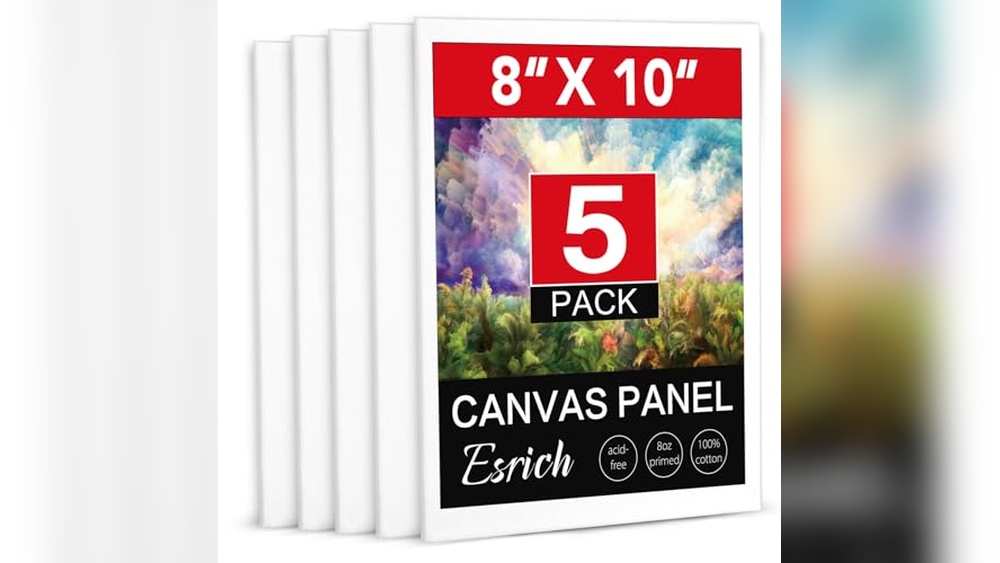
6. ESRICH 6 Pack 8×10 Primed Canvas Boards — Best for Standard-Size Studies
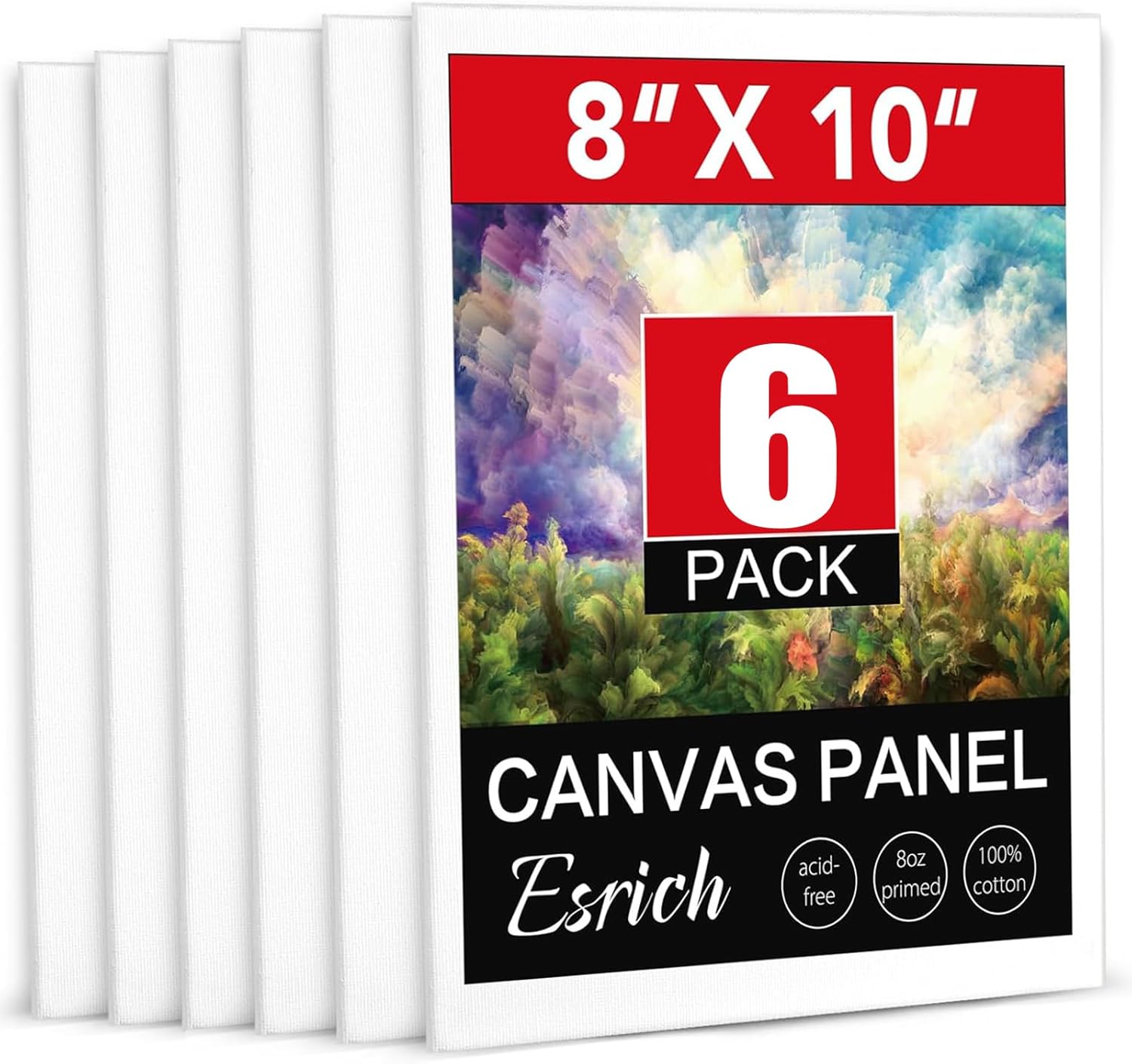
Six boards in one standard size is a tidy middle ground between the twelve-pack and a single panel. Working in a consistent 8×10 format makes it easy to compare studies side by side and frame the best ones in matching frames.
ESRICH lists pure cotton, a non-toxic, acid-free primer and a sturdy board core, the same construction as its 12-pack, and says the boards suit oil, acrylic, tempera and pouring.
Best suited for: beginners who want a small batch of identical surfaces.
Key features:
- 6 boards, 8×10 inches
- Pure cotton surface
- Acid-free primer
- Board core
Pros:
- Consistent size for series work
- Fits standard frames
- Inexpensive
Cons and limitations:
- One size only
- Fewer pieces than the 12-packs
Buying consideration: If you know you like 8×10, the Simetufy 12-pack may be a better per-board deal.
7. Mr. Pen Canvas Panels, 2 Pack, 8×10 — Best for One-Off Projects

When you need just one or two surfaces, a two-pack is the lowest-commitment option. Mr. Pen’s panels are two 8×10 cotton canvases on an acid-free construction, described as lightweight and slender.
The listing positions them for experiments, teaching, wine parties and children’s parties, and says they suit oils, acrylics, alkyds and tempera. Thin panels are easy to carry in a sketch bag, though they are more likely to flex than an MDF-core board.
Best suited for: a single gift painting, a class with two pieces, or trying canvas for the first time.
Key features:
- 2 cotton canvas panels, 8×10
- Acid-free construction
- Lightweight and slim
- Oil, acrylic, alkyd and tempera
Pros:
- Lowest upfront cost
- Light and portable
- Standard frame size
Cons and limitations:
- Only two panels
- Slim panels can flex with heavy, wet media
Buying consideration: Tape the edges to a board while painting thin washes to keep a slim panel flat.
Buying Guide: How to Choose Canvas for Painting Under 20
Board or stretched canvas
Canvas boards (also called panels) are cotton glued to a rigid backing. They are flat, cheap, portable and easy to frame, which makes them ideal for practice. Stretched canvas is fabric pulled over a wooden frame. It has spring under the brush, it can hang unframed, and it feels more like a “real painting.” For under 20 dollars you can get a dozen boards or a handful of stretched canvases, so decide which matters more: quantity or presentation.
Check what is inside the board
The core is where budget panels differ most. MDF and dense board cores stay flat; thin cardboard can bow with water-based paint. If a listing names its core material, that is a good sign.
Primer and fiber
Nearly all budget canvas is cotton primed with acrylic gesso, which works for both acrylic and oil. Cheap primer can be thin, so if a surface feels too absorbent or toothy, brush on one more coat of gesso and sand lightly once dry. That single step makes inexpensive canvas behave like a far pricier one.
Sizes and framing
Standard sizes such as 5×7, 8×10 and 11×14 fit inexpensive store-bought frames. Odd sizes and squares are fun, but framing them can cost more than the canvas. If you plan to frame, buy standard sizes.
Quantity versus project
Count how many pieces you will actually paint. A twelve-pack makes sense for daily practice or groups; a two- or three-pack is enough for a weekend.
Medium compatibility
Primed canvas suits acrylic, oil, gouache and pouring. Watercolor does not soak in and stays fragile on standard gesso, so watercolorists should use paper or a canvas specifically made for watercolor.
Learn the Techniques Before You Paint
A cheap canvas is the perfect place to practice a first full painting, and our step-by-step guide to painting a sunset on canvas for beginners is built for exactly that. If you buy boards and want to display your work, see how to put a canvas panel in a frame. And if you outgrow pre-stretched packs, how to put rolled canvas on a frame explains how to stretch your own for even less per square inch. Accidents happen with budget canvas too; our guide to fixing a ripped canvas painting can save a favorite piece.
Common Mistakes to Avoid
- Buying by count alone. Twelve tiny squares are not the same value as six 8x10s; compare total area.
- Using cheap canvas for watercolor. Standard acrylic gesso repels watercolor; choose paper instead.
- Skipping an extra coat of gesso. A thin factory primer can be fixed in ten minutes.
- Soaking thin panels. Heavy washes on slim panels can warp them; work thicker or tape them down.
- Buying odd sizes you plan to frame. Custom frames will cost more than the canvas.
- Ignoring the back. Packs ship nested, so a missing canvas is often hidden behind a bigger one.
FAQs
Is cheap canvas good enough for acrylic painting?
Yes for practice, studies and most hobby work. Budget cotton canvas primed with acrylic gesso takes acrylic well. If the surface feels thin or absorbent, add one coat of gesso before painting.
Are canvas boards or stretched canvas better for beginners?
Boards are cheaper, flatter and easier to store, which makes them better for practice. Stretched canvas is better when you want to hang or gift a finished piece without framing it.
Can I use oil paint on budget canvas?
Most budget canvas is primed with acrylic gesso, which accepts oil paint. Work fat over lean as usual, and for a piece you want to keep long term, consider a higher-quality surface.
Why does my cheap canvas warp?
Thin cores and loosely stretched fabric react to water and heavy paint. Choose boards with an MDF or dense core, avoid soaking washes, and let paintings dry flat.
What size canvas should a beginner buy?
An 8×10 or 11×14 is a comfortable size to learn on: big enough for a composition, small enough to finish in one session. Mixed packs let you try several sizes.
Can you frame canvas boards?
Yes. Standard-size boards such as 8×10 slip straight into ordinary picture frames, usually without the glass.
Final Recommendation
For steady practice, the Simetufy 12-pack of 8×10 boards gives the most usable surface for the money, and the ESRICH 6-pack is the smaller version of the same idea. If you want work that hangs on a wall, choose the LEYEMO 5-pack for its range of stretched sizes or the ESRICH 3-pack if you only need a few. Teachers and party hosts should go for the ESRICH 12-pack in four small sizes, the wingpaper set suits a mini-to-medium series, and the Mr. Pen two-pack is the cheapest way to paint a single piece.