

PaintingProGuide is reader-supported. When you buy through links on this page we may earn an affiliate commission at no extra cost to you.
Painting canvas panels in 9×12 inches are one of the most useful sizes in any studio. A 9×12 panel is big enough for a complete landscape, still life or portrait study, small enough to finish in a session, and it matches the most common sketchbook and paper pad size, so references and studies line up neatly. Flat panels are also cheaper, lighter and easier to store than stretched canvas, which makes them ideal for practice and plein air painting.
The real differences between 9×12 panel packs are in the core, the priming and the pack size. This guide explains what to look for and compares the best 9×12 canvas panel packs for individual painters, classrooms and bulk buyers.
Quick answer: The Simetufy 24-pack of 9×12 canvas boards is the best all-round choice: 100% cotton, triple-primed with acid-free gesso and glued to an acid-free MDF board that resists bending. Teachers and parents should look at the Simetufy 48-pack, which has a 3 mm core and rounded edges. For a small trial, ESRICH’s 5-pack is the lowest commitment.
Why 9×12 Is Such a Popular Panel Size
A 9×12 panel has a 3:4 ratio, close to the proportions of many camera images and phone screens, so photo references usually fit without heavy cropping. It is also a standard frame size in the US, which means inexpensive off-the-shelf frames are easy to find for finished work.
For practice, the size hits a sweet spot. Smaller panels such as 5×7 or 6×6 encourage tight, fussy painting. Larger sizes such as 16×20 take longer and use much more paint. At 9×12 you can paint loosely with a medium brush and still include enough detail to make a satisfying picture.
Our Top Picks at a Glance
- Simetufy 24 Pack 9×12 Canvas Boards — Best overall 9×12 canvas panels
- Simetufy 48 Pack 9×12, 3 mm Core — Best for classrooms and kids
- YONEVALON 28 Pack 9×12 — Best mid-size bulk pack
- BAKEYBA 36 Pack 9×12 — Best for paint parties and plein air practice
- ESRICH 5 Pack 9×12 — Best small trial pack
| Product | Best For | Key Spec | Key Strength | Price Tier |
|---|---|---|---|---|
| Simetufy 24pk | Most painters | 100% cotton on acid-free MDF, triple-primed | Resists bending | $$ |
| Simetufy 48pk | Classrooms and kids | 3 mm core, rounded edges, 8 oz cotton | Kid-friendly edges | $$$ |
| YONEVALON 28pk | Mid-size bulk | Cotton on acid-free MDF, triple-primed | Balanced quantity | $$ |
| BAKEYBA 36pk | Parties and practice | 100% cotton, primed | Portable bulk | $$ |
| ESRICH 5pk | Trying panels | Pure cotton, board core | Low commitment | $ |
How We Chose
These picks are based on the Amazon listing details and specifications for each pack as checked in October 2026, how well each pack’s core, priming and quantity fit acrylic and oil painting on 9×12 panels, and how widely each pack is reviewed by Amazon buyers. We have not painted on these specific panels; surface and core claims come from the listings.
- Core: MDF and thicker cores ranked above paper-based boards.
- Priming: acid-free gesso, ideally triple-coated.
- Surface: 100% cotton with a texture that holds paint.
- Quantity: matched to individual, family and classroom use.
- Listing clarity: clear statements of materials and sizes.
Best 9×12 Painting Canvas Panels Reviewed
1. Simetufy 24 Pack 9×12 Flat Canvas Boards — Best Overall 9×12 Canvas Panels

Simetufy’s 24-pack uses pure cotton canvas without alkaline chemicals, hand stretched and glued to acid-free MDF heavy board. The listing says the panels do not shrink, bend or curl and do not deform after extensive application of paint. They are triple-primed with acid-free acrylic gesso.
The surface is described as holding paint without absorbing it, keeping color and gloss. Twenty-four panels is a good quantity for a regular painter: enough to paint several studies a week for a couple of months.
Simetufy also sells the same construction in a 12-pack and a 60-pack if you need fewer or more.
Best suited for: Regular painters in acrylic and oil who want reliable, rigid 9×12 panels.
Key features (from the listing):
- 24 panels, 9 x 12 in
- 100% cotton, acid-free
- Acid-free MDF heavy board
- Triple-primed with acid-free gesso
- For oil, acrylic, watercolor and tempera
Pros:
- Rigid MDF core
- Good quantity for regular practice
- Available in several pack sizes
Cons and limitations:
- MDF is heavier than paper board
- Watercolor needs an absorbent ground
- Texture is medium; not ultra-smooth
Buying consideration: Lightly sand and add a coat of gesso if you want a smoother surface for portraits and fine detail.
2. Simetufy 48 Pack 9×12 Canvas Boards, 3 mm Core — Best for Classrooms and Kids
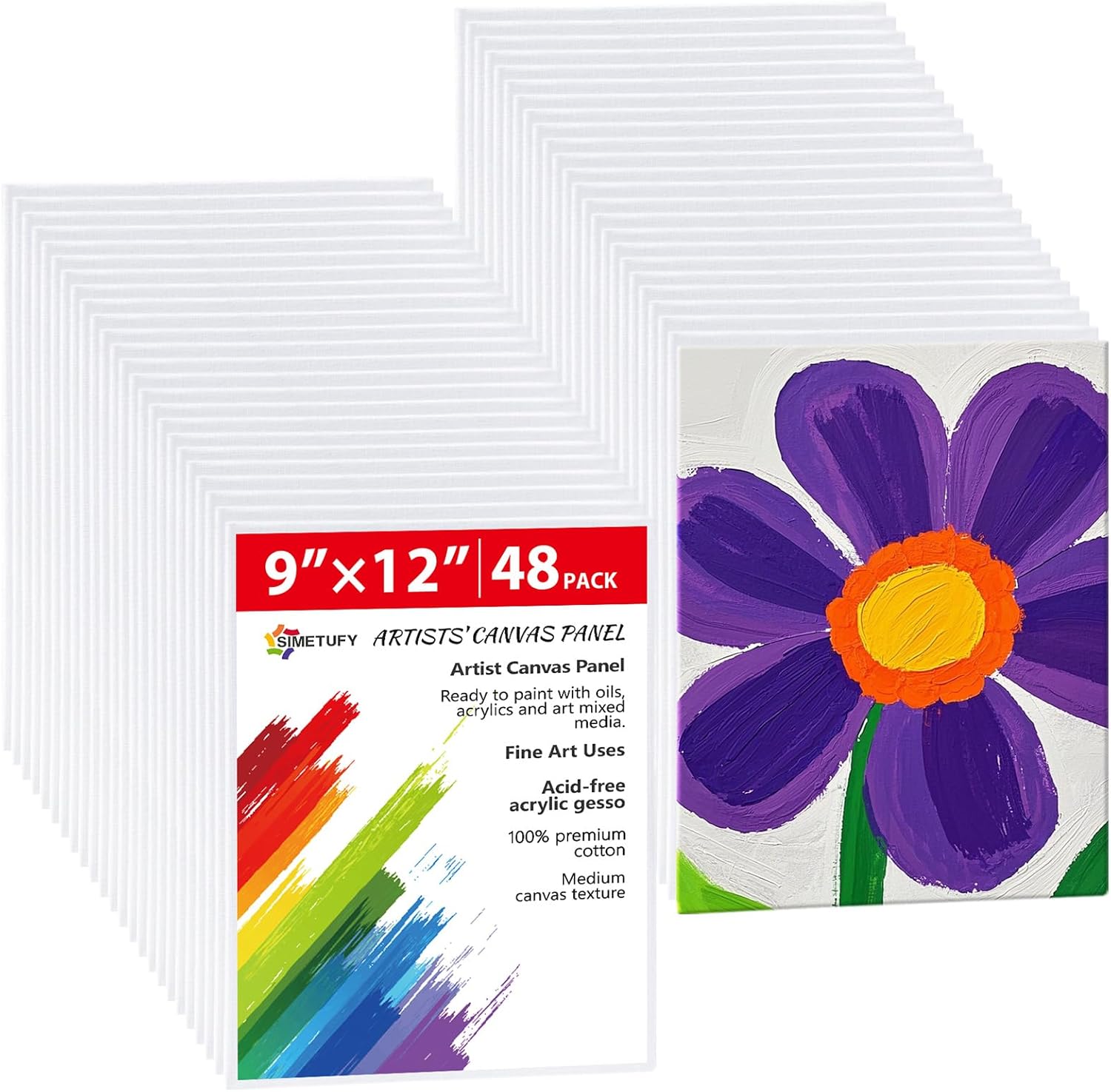
This Simetufy 48-pack uses a 3 mm rigid core with 8 oz acid-free cotton and rounded edges. The listing pitches it for kids’ desks, schools, hobby groups and studios, with triple gesso coating ready to paint.
Rounded edges are a nice safety detail for young painters, and the thicker core resists bending with wet media.
Best suited for: Teachers, parents and groups.
Key features (from the listing):
- 48 panels, 9 x 12 in
- 3 mm rigid core
- 8 oz acid-free cotton
- Rounded edges
- Triple-primed
Pros:
- Classroom quantity
- Thicker core
- Kid-friendly edges
Cons and limitations:
- Heavy pack (14.72 lb listed)
- Top tier because of quantity
- Large storage need
Buying consideration: Label the back of each panel with the student’s name before the session starts.
3. YONEVALON 28 Pack 9×12 Canvas Boards — Best Mid-Size Bulk Pack
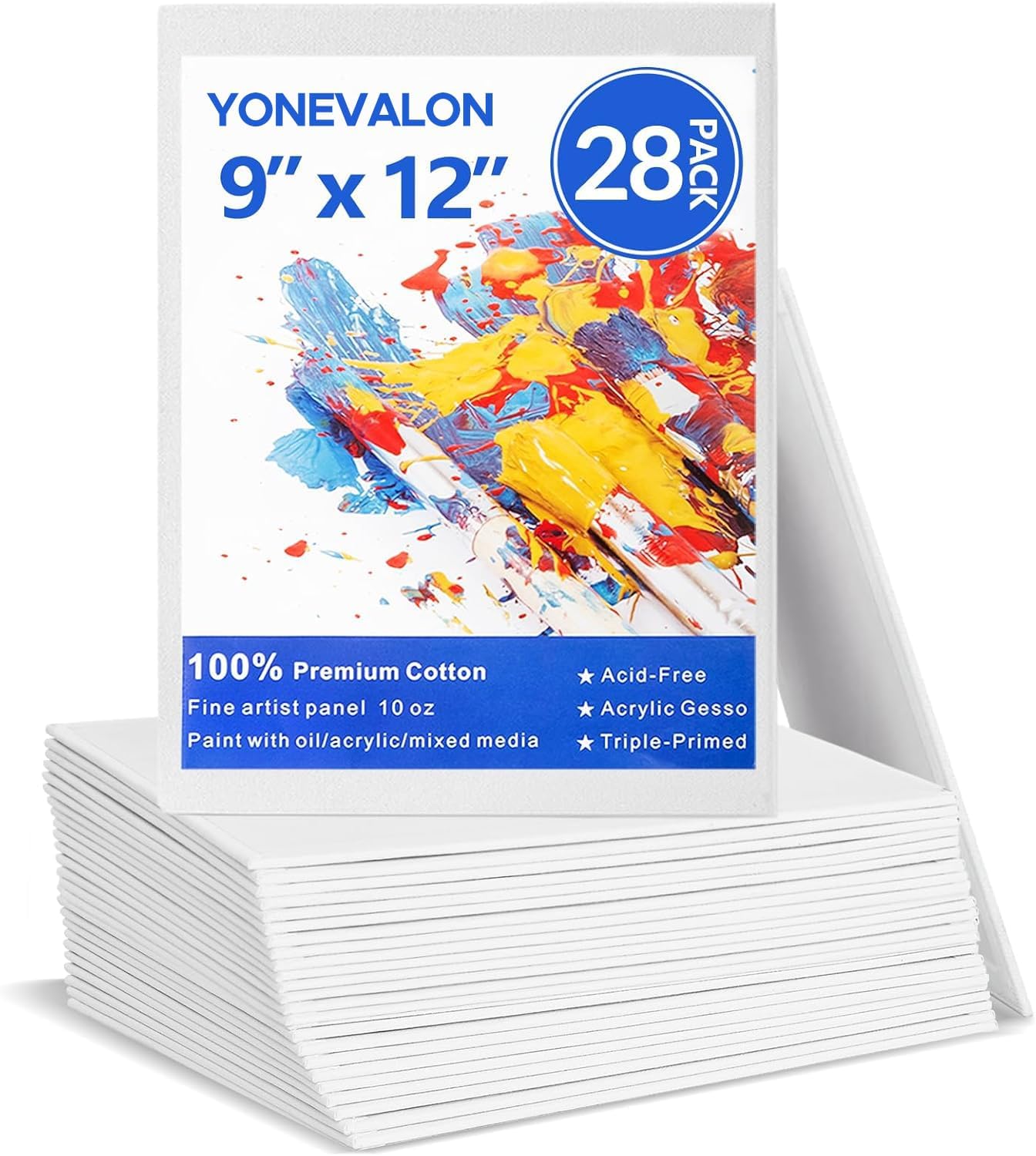
YONEVALON’s 28-pack uses pure cotton canvas glued to acid-free MDF heavy board, triple-primed with acid-free acrylic gesso, according to the listing. It is suitable for oil, watercolor, acrylic, pastel and tempera.
Twenty-eight panels sits between a personal pack and a classroom pack.
Best suited for: Painters who want more than 24 panels without committing to 48 or more.
Key features (from the listing):
- 28 panels, 9 x 12 in
- Cotton on acid-free MDF
- Triple-primed
- Multi-media
Pros:
- Good middle quantity
- MDF core
- Clear construction details
Cons and limitations:
- Listing details partly garbled
- Not specified thickness
- Similar to Simetufy construction
Buying consideration: If you paint daily, compare cost per panel across the pack sizes before you buy.
4. BAKEYBA 36 Pack 9×12 Canvas Boards — Best for Paint Parties and Practice

BAKEYBA’s 36 canvas boards are 100% cotton and primed for all types of paint, aimed at studios, plein air outings, classrooms, workshops and painting parties. The listing describes them as lightweight and portable.
One bullet describes the canvas as “stretched over a sturdy canvas frame”, which is unusual wording for flat boards; expect flat panels and check the core when they arrive.
Best suited for: Paint parties, workshops and plein air practice.
Key features (from the listing):
- 36 panels, 9 x 12 in
- 100% cotton
- Primed
- Lightweight and portable
Pros:
- Party-sized pack
- Light for travel
- Good value
Cons and limitations:
- Core material unclear
- Construction wording inconsistent
- Pack weight listed at 10.89 lb
Buying consideration: For plein air, bring a few more panels than you plan to use; quick studies often take several attempts.
5. ESRICH 5 Pack 9×12 Canvas Boards — Best Small Trial Pack

ESRICH’s 5-pack offers pure cotton canvas boards with a sturdy board core and non-toxic, acid-free primer. The listing says large amounts of paint will not affect the board and that it suits oil, acrylic, watercolor, tempera, pouring and gouache.
Best suited for: Beginners and gift buyers who only need a few panels.
Key features (from the listing):
- 5 panels, 9 x 12 in
- Pure cotton
- Acid-free primer
- Board core
Pros:
- Low tier
- Low commitment
- Good for trying panels
Cons and limitations:
- Few panels
- Core material not detailed
- Higher cost per panel
Buying consideration: Use a small pack to compare surfaces before buying a bulk pack from the brand you prefer.
How Canvas Panels Are Made, and Why It Matters
A canvas panel has three layers: a rigid core, a fabric surface and a ground. The core is usually MDF (medium-density fiberboard) or a compressed paper board. MDF is denser and much less likely to warp when wet paint, humidity or heavy impasto is applied, which is why listings that specify MDF or a 3 mm core are worth favoring. Paper boards are lighter and cheaper, fine for quick sketches, but can bow over time.
The fabric is almost always cotton at this price, described by weight before and after priming; 4 oz raw and 8 oz primed are common figures. Heavier fabric and more priming give a more durable, less absorbent surface. Linen panels exist and are prized for oil painting, but they cost considerably more.
The ground is acrylic gesso, which is compatible with both acrylic and oil. “Acid-free” claims refer to the materials not becoming acidic and degrading over time, which matters if you plan to keep or sell your work. Triple priming builds a smoother, more even surface than a single coat.
Painting a 9×12 Study in One Session
Because 9×12 is so manageable, it is a perfect format for alla prima, or one-session, painting. Start by toning the panel and sketching the big shapes with a thin brush. Block in the darkest darks and the largest masses with a medium flat, around a size 10 or 12, keeping paint thin. Move to mid-tones, then lights, thickening the paint as you go. Save the highlights and a few crisp details for the last ten minutes. Aim to finish in one to three hours. Paint several of these and you will improve far faster than by laboring over a single large canvas.
Taking 9×12 Panels Outdoors
Flat panels are the plein air painter’s favorite surface. They fit pochade boxes and French easels, weigh little and can be carried in a wet-panel box that keeps finished studies separated on the way home. Choose a panel pack with a rigid core so studies stay flat in the sun and wind, and pre-tone a few panels at home to save time on location. If you work in oil, a panel carrier with slots is worth the investment; wet studies are easily smudged in a bag.
Displaying and Storing Finished 9×12 Panels
Finished panels are easy to display. Standard 9×12 frames, with or without a mat, give studies a gallery look, and floater frames suit panels with painted edges. Small table easels work well for shelves and desks. For storage, let paintings dry completely, then stack them face to face with a sheet of glassine or parchment between each one, or store them upright in a slotted rack. Write the title, date and medium on the back of every panel; when you have dozens of studies, that record becomes a valuable diary of your progress.
If you sell small originals, 9×12 is a popular size with buyers because it fits most walls and frames, and it ships flat in a modest box. Varnish finished acrylic or oil panels before shipping to protect the surface.
A wall of 9×12 studies hung in a grid also makes an attractive, affordable display, and it shows visitors how your work develops over time.
What to Paint on 9×12 Panels
A 9×12 panel suits almost any subject. Landscapes fit naturally in horizontal orientation, with room for a sky, a middle ground and a foreground. Still lifes of two or three objects work well vertically or horizontally. Head-and-shoulders portrait studies fit comfortably at a slightly under-life size. Pet portraits, florals, seascapes and city scenes are all popular. Because panels are cheap, they are ideal for series: paint the same view in morning and evening light, or the same still life in three different color palettes.
Preparing 9×12 Panels Before Painting
Most panels are ready to paint, but a few minutes of preparation improves results. Wipe the surface with a dry cloth to remove dust. Tone it with a thin wash of a mid-value color, such as burnt sienna or a gray, so you are not judging values against stark white. For oil painting, some artists add an extra coat of gesso or an oil ground for a slightly less absorbent surface. Mark a light border if you plan to frame, so important details do not end up hidden under the frame lip.
Buying Guide: How to Choose 9×12 Canvas Panels
Look for an MDF or thick core
MDF and 3 mm cores resist warping with heavy or wet paint better than thin paper boards.
Check the priming
Acid-free gesso, triple-coated, gives a stable, slightly toothy surface for acrylic and oil.
Consider surface texture
Medium texture grabs paint for painterly work; smoother surfaces suit detail. Sanding and an extra coat of gesso smooth any panel.
Choose the right pack size
Five to twelve panels for trying, about 24 for a regular painter, 48 or more for classes.
Think about weight and storage
MDF panels are heavier. Store packs flat in a dry place.
Match to your medium
Acrylic and oil work directly on most panels. Watercolor and gouache need an absorbent ground on canvas.
Panels or Stretched Canvas?
Panels are flat, rigid, cheaper and easier to store and frame. Stretched canvas hangs without a frame and has a springy surface some painters prefer. Read our comparison of canvas panels vs stretched canvas to decide which suits your work. Planning a group of small pieces? Our guide to painting a multi-canvas wall art set works well with 9×12 panels.
Common Mistakes to Avoid
- Buying paper-core boards for very wet or heavy paint.
- Painting watercolor directly on acrylic gesso without an absorbent ground.
- Storing panels upright in humid rooms, which can warp them.
- Using huge bulk packs before testing the surface.
- Forgetting that frames cover a small border of the panel.
- Skipping varnish on finished acrylic or oil studies.
FAQs
Are 9×12 canvas panels good for oil painting?
Yes. Primed cotton panels on MDF are well suited to oil, and the rigid core helps prevent cracking.
Can you frame a 9×12 canvas panel?
Yes. 9×12 is a standard frame size, and flat panels fit standard frames easily.
Do canvas panels warp?
Thin paper-core boards can warp with wet media or humidity. MDF and 3 mm cores resist warping better.
Are canvas panels archival?
Panels with acid-free cotton and acid-free cores are more archival than paper-board panels, though stretched linen remains the gold standard for longevity.
How many canvas panels should a beginner buy?
A 12 or 24-pack lets you paint regularly for weeks without worrying about wasting surfaces.
Can I use watercolor on 9×12 canvas panels?
Not well on standard acrylic gesso. Apply an absorbent watercolor ground first, or use watercolor paper instead.
Final Recommendation
For most painters, the Simetufy 24-pack is the best choice of painting canvas panels in 9×12, combining cotton, triple priming and an acid-free MDF core. Classrooms should choose Simetufy’s 48-pack with rounded edges, YONEVALON’s 28-pack is a good middle ground, BAKEYBA suits paint parties, and ESRICH’s 5-pack is the easiest way to try panels before buying in bulk.




