PaintingProGuide is reader-supported. When you buy through links on this page we may earn an affiliate commission at no extra cost to you.
Quick answer: Princeton wins on breadth and value in synthetics: the Velvetouch 3950 five-piece set is the best mixed-media starting point, the Aspen 6500 set is the pick for stiff-bristle acrylic and oil work, and the Neptune synthetic squirrel round is the softest watercolor option here. Winsor & Newton wins on heritage and natural hair, and its Foundation watercolor six-pack is the most affordable branded way to try a complete beginner watercolor kit.
Princeton vs Winsor & Newton brushes is really a comparison of two philosophies. Princeton Artist Brush Co. is an American maker that has built its reputation on engineered synthetics, each series tuned to imitate a specific natural hair. Winsor & Newton is a British company whose name is tied to the Series 7 Kolinsky sable and to broad, tiered ranges in every medium. Both make excellent brushes; which one suits you depends on the medium you paint in, how much you want to spend, and whether you prefer synthetic or natural hair.
Princeton vs Winsor & Newton at a Glance
| Factor | Princeton | Winsor & Newton |
|---|---|---|
| Core strength | Specialized synthetic lines (Neptune, Velvetouch, Aspen, Heritage) | Natural hair heritage (Series 7 Kolinsky) plus tiered synthetics |
| Best-known watercolor brush | Heritage 4050 synthetic sable; Neptune synthetic squirrel | Series 7 Kolinsky sable; Cotman and Foundation synthetics |
| Acrylic and oil | Aspen 6500 stiff synthetic; Velvetouch mixed media | Monarch synthetic mongoose, Artisan and Galeria ranges |
| Handle and ferrule | Lacquered wood, FSC-certified on Velvetouch; non-glare ferrules on Aspen | Wood handles; seamless nickel ferrules on most lines |
| Price position | Mid-range, strong value in sets | Budget (Foundation, Cotman) through premium (Series 7) |
| Who it suits | Painters who want synthetic performance matched to a medium | Painters who value natural hair or want one brand across all tiers |
Our Top Picks at a Glance
- Princeton Velvetouch 3950 5-Piece Set — Best for mixed media and detail
- Princeton Aspen 6500 5-Piece Set — Best for acrylic and oil with stiff synthetics
- Princeton Neptune 4750 Round Size 8 — Best soft watercolor round
- Princeton Heritage 4050 Round Size 6 — Best single synthetic sable watercolor brush
- Princeton Heritage 4050 Set of 4 — Best synthetic sable set
- Winsor & Newton Foundation Watercolour Set, 6 Pack — Best budget beginner watercolor set
| Product | Best For | Key Spec | Key Strength | Price Tier |
|---|---|---|---|---|
| Princeton Velvetouch 3950, 5 pc | Mixed media, detail | Spotter 5/0, angle shader 1/4″, rounds 8 and 2, filbert 8 | Luxury synthetic blend with satin handle | $$$ |
| Princeton Aspen 6500, 5 pc | Acrylic and oil | Round 2/0, bright 2, flat 6, short filbert 4, liner 2 | Stiff synthetic that resists solvents | $$$ |
| Princeton Neptune 4750 Round 8 | Soft watercolor washes | Synthetic squirrel, round size 8 | Very high water and pigment load | $ |
| Princeton Heritage 4050 Round 6 | Watercolor detail | Golden taklon synthetic sable, round 6 | Sharp point and sable-like snap | $ |
| Princeton Heritage 4050 Set of 4 | Synthetic sable set | Four assorted Heritage brushes | Flagship line in a single set | $$$ |
| Winsor & Newton Foundation, 6 pack | Beginner watercolor | Rounds 1, 5, 6; flats 3, 4; filbert 2; short handle | Complete starter shapes at low cost | $$ |
How We Chose
This comparison is based on the Amazon listing details and specifications checked in October 2026, how well each brush line fits its stated medium, and how widely each product is reviewed by Amazon buyers. Only one Winsor & Newton product was available in the listings for this page, so the brand-level discussion draws on the long-established structure of its ranges (Series 7, Cotman, Foundation, Monarch, Galeria, Artisan) rather than on additional listings.
- Hair type and what it is designed to imitate.
- Shape assortment and whether a set covers a real workflow.
- Handle length and ferrule construction.
- Medium compatibility stated by the maker.
- Value relative to the number and size of brushes.
Princeton Brush Lines Explained
Velvetouch 3950
Velvetouch is Princeton’s mixed-media line. Each shape uses a blend of several synthetic filaments to balance color-holding capacity, spring and a precise taper, and the series is sold for watercolor, gouache, oil and acrylic. The handles are a distinctive satin-finish, slip-resistant FSC wood. The collection runs to 72 brushes across 20 shapes, so a Velvetouch set can be expanded piece by piece.
Aspen 6500
Aspen is the stiff-bristle synthetic designed for heavy-body acrylic and oil, including plein air work. The fibers are built to resist solvents and paint, which is the usual failure point for synthetics used in oils. Non-glare ferrules help outdoors.
Neptune 4750
Neptune imitates squirrel hair: extremely soft, very thirsty, and happiest in watercolor washes. Princeton describes it as its softest and thirstiest brush. The shape range includes daggers, quills, mottlers and oval washes alongside rounds.
Heritage 4050
Heritage is Princeton’s flagship synthetic sable, developed with Japanese brush-maker Naohide Takamoto. Golden taklon in multiple diameters gives a fine point, crisp edges and a snap closer to natural sable than most synthetics manage. It is the Princeton line most often compared to Winsor & Newton’s sable and sable-imitation brushes.
Winsor & Newton Brush Lines Explained
Series 7 Kolinsky Sable
Series 7 is the benchmark natural-hair watercolor brush: pure Kolinsky sable, hand-made, prized for point, snap and flow control. It is also expensive, and single brushes are the norm rather than sets.
Foundation and Cotman
Foundation is the entry-level synthetic range, sold in affordable sets like the six-pack reviewed below. Cotman sits one step up with golden synthetic hair and a wide shape range. Both use short handles and are designed around watercolor.
Monarch, Galeria and Artisan
For acrylic and oil, Monarch is a synthetic mongoose with a firm but responsive feel, Galeria is the student acrylic brush line, and Artisan is designed for water-mixable oils. The breadth of these ranges is Winsor & Newton’s practical advantage: one brand can cover a beginner’s first set and a professional’s last brush.
Princeton vs Winsor & Newton Brushes Reviewed
1. Princeton Velvetouch Series 3950, 5-Piece Set — Best for Mixed Media and Detail

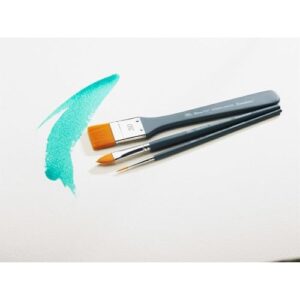
This five-piece Velvetouch set is the most useful single purchase on the page. It covers a spotter 5/0 for the finest detail, an angle shader 1/4 inch for edges and foliage, a round 8 and a round 2 for general work, and a filbert 8 for soft blending. Princeton markets it for watercolor, oil, acrylic, gouache and paint-by-number.
The synthetic blend is built to mirror sable characteristics without the cost, with a resilient snap and strong color-holding capacity. Handles are the signature satin Velvetouch finish in FSC wood. For a painter who switches between media, it removes the need to buy separate sets.
Best suited for: Painters working in more than one medium, illustrators who need detail brushes, and anyone wanting a premium synthetic set rather than a bag of basic brushes.
Key features:
- Spotter 5/0, angle shader 1/4″, round 8, filbert 8, round 2
- Multi-filament luxury synthetic blend
- Slip-free satin FSC wood handles
- Rated for watercolor, oil, acrylic and gouache
- Part of a 72-brush, 20-shape collection
Pros:
- Genuinely versatile across media
- Excellent detail coverage with the spotter and round 2
- Expandable within the same line
Cons and limitations:
- Highest price tier among the Princeton sets here
- Only five brushes; no large wash or flat
- Soft-to-medium stiffness is not ideal for heavy impasto
Buying consideration: Buy this if you paint small to medium work in several media. Add an Aspen flat or a Neptune wash separately for large coverage.
2. Princeton Aspen 6500 Series, 5-Piece Set — Best for Acrylic and Oil With Stiff Synthetics

Aspen is the Princeton answer to hog bristle. The five-piece set includes a 2/0 round, a 2 bright, a 6 flat, a 4 short filbert and a 2 liner, which is a compact but complete kit for alla prima acrylic or oil painting. The stiff synthetic fibers are designed to hold their shape under thick paint and to shrug off solvents that would ruin a softer synthetic.
Princeton pitches it at plein air painters, and the non-glare ferrule reflects that. Paint release is described as smooth and even, which matters with heavy body acrylics that can drag.
Best suited for: Acrylic and oil painters who want synthetic durability with bristle-like stiffness, and anyone painting outdoors.
Key features:
- Round 2/0, bright 2, flat 6, short filbert 4, liner 2
- Stiff synthetic bristles with strong shape retention
- Built to resist damage from solvents and paint
- Wooden handles, non-glare ferrules
- Sold as a professional acrylic and oil set
Pros:
- Handles thick paint without splaying
- Cleans easily compared with natural hog
- Good shape mix for direct painting
Cons and limitations:
- Too stiff for watercolor
- Sizes are small to medium; large canvases need bigger flats
- Price is close to the Velvetouch set
Buying consideration: Choose Aspen over Velvetouch when your paint is thick and your strokes are direct. Choose Velvetouch when you need softness and detail.
3. Princeton Neptune Series 4750, Round Size 8 — Best for Soft Watercolor Washes

Neptune imitates squirrel: silky, supple and extremely thirsty. A size 8 round is the classic all-purpose watercolor size, large enough for washes on a quarter sheet and still able to point for mid-size detail. Princeton calls it its softest and thirstiest brush, and the listing emphasizes a reservoir of water that delivers “oceans of color” in a stroke.
Because it is synthetic, it avoids the cost and ethical questions of natural squirrel while being easier to care for. The trade-off is snap: squirrel-type brushes, natural or synthetic, have less spring than sable types, which suits loose washes more than crisp edges.
Best suited for: Watercolorists who paint loose, wet and large, and anyone who wants a squirrel feel without natural hair.
Key features:
- Synthetic squirrel hair, round size 8
- Very high water and pigment capacity
- Dark wood short handle
- Part of a range including daggers, quills, mottlers and oval washes
Pros:
- Exceptional for washes and soft blending
- Affordable entry into the Neptune line
- Vegan alternative to natural squirrel
Cons and limitations:
- Low snap compared with sable-type brushes
- Single brush, not a set
- Not suited to acrylic or oil
Buying consideration: Pair a Neptune 8 with a Heritage 6 and you have soft washes and crisp detail covered for a small outlay.
4. Princeton Heritage Series 4050, Round Size 6 — Best for Watercolor Detail

The Heritage round is Princeton’s flagship and the brush most often mentioned in the same breath as natural sable. Golden taklon filaments in multiple diameters give it a fine point, crisp edge and real snap, and it drinks water generously for a synthetic. Size 6 is small enough for detail and still useful for small washes.
This is the direct Princeton rival to Winsor & Newton’s sable-type brushes. It will not match a Series 7 for point retention and flow, but it costs a fraction and does not demand the same careful handling.
Best suited for: Watercolor and gouache painters who want sable-like control without sable prices.
Key features:
- Golden taklon synthetic sable, round size 6
- Developed with master brush-maker Naohide Takamoto
- Fine point, crisp edge, sable-like snap
- Scarlet wood handle
- Full shape range available in the series
Pros:
- Best point-and-snap combination among the synthetics here
- Low cost per brush
- Holds up well with gouache
Cons and limitations:
- Size 6 is small for large work
- Synthetic will not fully match Kolinsky flow
- Scarlet handle lacquer can chip over years of use
Buying consideration: If you buy one Princeton watercolor brush, make it a Heritage round in size 6 or 8.
5. Princeton Series 4050 Heritage Synthetic Sable Set of 4 — Best for A Synthetic Sable Set

This four-brush Heritage set, listed as a Blick exclusive assortment, gathers the flagship synthetic sable into a single purchase. The listing gives the assortment only as “assorted,” so expect a mix of round sizes typical of starter sets rather than a specified lineup.
Its value is in consistency. Four brushes from the same series behave the same way, which makes it easier to learn how much water and pressure each size wants than a mixed bag of brands.
Best suited for: Watercolorists who want to commit to the Heritage line in one step.
Key features:
- Four Heritage 4050 synthetic sable brushes
- Assorted shapes and sizes
- Same golden taklon construction as the single rounds
- Blick exclusive assortment per the listing
Pros:
- Flagship quality in a set
- Consistent feel across sizes
- Cheaper than four comparable natural sable brushes
Cons and limitations:
- Listing does not specify the exact sizes
- Higher price tier than buying one or two singles
- No flats or wash brushes guaranteed
Buying consideration: Check the current assortment before buying if you need specific sizes. Otherwise it is a sound way to build a Heritage kit quickly.
6. Winsor & Newton Foundation Watercolour Brush Set, Short Handle, 6 Pack — Best for Beginner Watercolor on a Budget

Foundation is Winsor & Newton’s entry-level synthetic watercolor line, and this six-pack is the only Winsor & Newton product in the listings for this page. It includes rounds in sizes 1, 5 and 6, flats in 3 and 4, and a filbert 2, all with short handles and golden synthetic hair. That is a complete beginner’s shape set for watercolor.
It is not a Series 7 and does not pretend to be. What it offers is a trusted brand name, sensible shapes and a low price, which is exactly what a first watercolor kit should be. Painters who stay with the hobby typically move up to Cotman or Series 7 within the same brand, or across to Princeton Heritage.
Best suited for: Beginners buying a first watercolor brush set, students, and anyone who wants a cheap backup set from a known maker.
Key features:
- Rounds 1, 5, 6; flats 3, 4; filbert 2
- Golden synthetic hair
- Short handles for watercolor
- Winsor & Newton entry-level Foundation range
Pros:
- Lowest price tier on the page
- Covers the essential watercolor shapes
- Recognized brand with clear upgrade paths
Cons and limitations:
- Entry-level synthetic with modest snap and capacity
- Not designed for acrylic or oil
- No large wash brush in the set
Buying consideration: An excellent first set. Expect to add a larger round or a Neptune wash as your work grows.
Verdict by Use Case
Watercolor beginners
Winsor & Newton Foundation six-pack for the lowest entry cost, or a single Princeton Heritage round 6 if you would rather have one better brush than six adequate ones.
Serious watercolor on a budget
Princeton. A Heritage round plus a Neptune round gives sable-like control and squirrel-like washes for less than one natural sable brush.
Watercolor with natural hair
Winsor & Newton. Series 7 Kolinsky remains the reference point, and nothing in Princeton’s synthetic range claims to replace it.
Acrylic and oil
Princeton Aspen for stiff, solvent-resistant synthetics in a compact set. Winsor & Newton Monarch is the alternative if you prefer a softer synthetic mongoose feel.
Mixed media and illustration
Princeton Velvetouch. No Winsor & Newton line is marketed as broadly across media.
Buying Guide: How to Choose Between Princeton and Winsor & Newton
Match the hair to the medium
Soft synthetics and natural hair (Neptune, Heritage, Series 7, Foundation) are for watercolor and gouache. Stiff synthetics (Aspen) and bristle are for acrylic and oil. Mixed-media synthetics (Velvetouch) sit between.
Handle length
Short handles suit watercolor at a table. Long handles suit easel painting at arm’s length. Most sets here are short-handled; check before buying for oils.
Set versus singles
Sets are cheaper per brush but often include sizes you will not use. Buying two singles in the sizes you actually need is often smarter after the first set.
Ferrule and handle construction
Seamless or double-crimped ferrules reduce shedding and loosening. Lacquered wood handles are standard; the Velvetouch satin finish is a comfort upgrade.
Natural versus synthetic
Natural sable and squirrel still lead in flow and point, but modern synthetics are close for most painters, cost far less, and tolerate acrylics and solvents. Princeton’s entire catalog here is synthetic; Winsor & Newton offers both.
Upgrade path
Think about where you will be in two years. Winsor & Newton lets you climb from Foundation to Cotman to Series 7 without changing brands. Princeton lets you deepen within a series, for instance adding Velvetouch shapes one at a time.
Keep Either Brand Performing
Whichever maker you choose, care decides how long the brushes last. Our guides on keeping paint brushes from shedding and drying paint brushes correctly apply equally to Princeton synthetics and Winsor & Newton sable, and if you move up to bigger canvases, painting with large brushes explains which shapes to add.
Common Mistakes to Avoid
- Buying watercolor softs for acrylic. Neptune, Heritage and Foundation will splay and wear quickly in heavy body paint.
- Judging Princeton by its cheapest set or Winsor & Newton by Series 7 alone. Both brands span wide quality ranges.
- Leaving brushes standing in water, which bends synthetic tips and loosens ferrules.
- Expecting a synthetic sable to hold a point exactly like Kolinsky.
- Overbuying sets instead of two or three singles in the sizes you use most.
- Using solvents on soft synthetics not rated for them.
FAQs
Is Princeton or Winsor & Newton better for watercolor?
For natural hair, Winsor & Newton Series 7 Kolinsky is the benchmark. For synthetics, Princeton Heritage 4050 and Neptune 4750 are generally regarded as stronger value than Winsor & Newton’s Foundation and Cotman ranges, which are aimed at beginners.
Are Princeton Velvetouch brushes good for oil painting?
Princeton rates Velvetouch for oil as well as watercolor, acrylic and gouache. They suit smoother, thinner oil work and detail. For thick paint and solvent-heavy cleaning, the stiffer Aspen 6500 line is the better Princeton choice.
What is the Winsor & Newton equivalent of Princeton Heritage?
Heritage is a synthetic sable, so the closest Winsor & Newton comparison is the Cotman synthetic range for price, or Series 7 for the natural sable it imitates. There is no exact one-to-one equivalent.
Are Princeton brushes made in the USA?
Princeton Artist Brush Co. is an American company based in New Jersey. The listings here do not state the country of manufacture for each series, so check the individual product page if that matters to you.
Do I need long or short handle brushes?
Short handles for watercolor and tabletop work; long handles for easel painting in acrylic or oil. The Winsor & Newton Foundation set and the Princeton watercolor brushes here are short-handled.
Which set is best for a complete beginner?
For watercolor, the Winsor & Newton Foundation six-pack. For acrylic or mixed media, the Princeton Velvetouch five-piece set gives better brushes you will not outgrow quickly.
Final Recommendation
There is no single winner. Princeton is the stronger choice for synthetic brushes matched to a medium, and the Velvetouch 3950 set or Aspen 6500 set will serve most acrylic, oil and mixed-media painters better than anything at the same price from Winsor & Newton. For watercolor, a Heritage round and a Neptune round cover detail and washes economically.
Winsor & Newton is the brand to choose when natural sable matters or when you want one maker from your first Foundation set to a Series 7 later on. Buy by medium first, hair type second, and brand last.