Acrylic leather paint is flexible, durable, and easy for beginners.
You scuff your favorite sneakers. Your jacket needs a color refresh. Or your car seat shows wear. I have been there. I have restored hundreds of pairs and leather goods with acrylic leather paint. It grips, bends, and resists cracking when used right. It also opens the door to art on everyday items. In this guide, I’ll help you choose the right set, prep leather like a pro, and avoid mistakes that ruin a finish. I’ll compare top kits and single colors, and I’ll share my tested tips to make your first coat look clean.

ARTME Acrylic Leather Paint Set,…
20 VIBRANT COLORS: Each color has 30ml large content. ARTME Acrylic Leather Paint Set comes with 19 Vibrant Colors, and 1 Acrylic Finisher. White, Yellow, Orange, Hot Pink, Red, Rose…

Angelus Acrylic Leather Paint For…
WIDE APPLICATION: Our Angelus Black Acrylic leather paint is perfect for any smooth leather goods, such as leather shoes, sneakers, sofas, leather jackets, handbags, leather bags, wallets, & more. QUICK…

Smalltongue 14 Original Colors Acrylic…
14 Vibrant Colors: Smalltongue Acrylic Leather Paint Set comes with 14 Bulk Vibrant Colors. The Acrylic Leather Paint Kit contains all the basic colors so that you can mix any…
ARTME Acrylic Leather Paint Set, 20 Colors

This 20-color ARTME set gives beginners and hobbyists a wide palette to start painting leather. Each bottle holds 30 ml, which is more than many starter kits. The paint lays down smooth and levels well if you use thin coats. It works on shoes, jackets, couches, and even auto seats when you prep the surface.
I like that the colors mix cleanly, so you can make custom shades. Coverage is solid on light leather. On darker leather, two to three thin coats look rich without bulk. The finish stays flexible after cure, which helps reduce cracking in high-bend zones like toe boxes.
Pros:
- 20 versatile colors in larger 30 ml bottles
- Good flow and easy blending for custom shades
- Flexible finish resists hairline cracks when applied thin
- Works on shoes, jackets, bags, and seats
- Great value for learning color mixing with acrylic leather paint
Cons:
- No dedicated finisher or sealer in the box
- Dark leather may need extra coats for full opacity
- Brushes and prep chemicals not included
My Recommendation
If you want a budget-friendly color range, pick this ARTME kit. It is a smart way to learn acrylic leather paint without overpaying. Add a deglazer and a clear finisher for best results. It suits custom sneaker art, cosplay details, and light furniture touch-ups.
| Best for | Why |
|---|---|
| Beginners on a budget | 20 colors, easy flow, and lots of paint per bottle |
| Custom color mixing | Colors blend clean with minimal muddiness |
| Light leather projects | Solid coverage with fewer coats on lighter bases |
Angelus Acrylic Leather Paint, 1 oz Black

Angelus is the gold standard for acrylic leather paint in the sneaker world. This 1 oz Black is a workhorse. It has high pigment load and grabs leather well after prep. It lays flat and dries with a soft, flexible feel.
For swooshes, midsole lines, and panels, it gives reliable edges with a fine brush. When you use thin coats, it resists cracking after cure. I often use this black to restore scuffed boots and to block-in artwork outlines on white sneakers.
Pros:
- Trusted brand for leather restoration and customs
- Deep, opaque black with strong coverage
- Flexible film with proper prep and thin coats
- Great for detail work and edge lines
- Plays well with Angelus finishers and additives
Cons:
- Small 1 oz bottle can run out fast on large jobs
- Best results need deglazer and sealer (sold separately)
- Can thicken if left open; cap quickly
My Recommendation
If you only buy one core color of acrylic leather paint, make it this black. It is ideal for touch-ups, logos, outlines, and deep fills. Pair it with a matte finisher for a factory look or a gloss finisher for a wet shine.
| Best for | Why |
|---|---|
| Sneaker details | High opacity and crisp line control |
| Boot and bag touch-ups | Masks scuffs fast with rich black pigment |
| Layering and outlines | Works as a clean base for complex designs |
Smalltongue 14-Color Leather Paint Kit, 30ml

This Smalltongue kit includes 14 colors and adds a cleaner/deglazer. That is a big deal. Good prep is half the battle with acrylic leather paint. The 30 ml bottles give you enough paint to do shoes and small furniture panels.
The included leather preparer saves a trip, and it helps the paint fuse to the surface. Coverage is decent, and the finish remains flexible when you keep layers thin. Color range is balanced for common projects, without odd filler shades.
Pros:
- Includes leather preparer/deglazer for proper surface prep
- 14 core colors with 30 ml per bottle
- Good balance for shoes, bags, and seats
- Flexible finish with proper technique
- Convenient all-in-one starter for acrylic leather paint
Cons:
- No clear finisher included
- Fewer colors than 20+ count kits
- Labels can smudge if they get paint on them
My Recommendation
If you want a kit that covers prep and paint, start here. It is ideal for first projects where you want the right cleaner and reliable colors. It keeps your workflow simple and reduces errors in bonding.
| Best for | Why |
|---|---|
| First-time restorers | Comes with deglazer for better adhesion |
| Shoe and bag refresh | Core colors cover common needs |
| Budget-minded DIY | Large 30 ml size stretches across projects |
Angelus Acrylic Leather Paint, 4 oz Black

For bigger jobs, the 4 oz Angelus Black makes more sense. You get the same proven formula used by customizers and repair shops. The pigment density lets you cover dark scuffs fast. It still brushes smooth and dries flexible for long wear.
I keep this size for midsoles, boots, and multiple pairs. It is also handy for airbrush use when thinned with an appropriate reducer. As always, proper prep with a deglazer is key to strong adhesion on leather.
Pros:
- Pro-grade acrylic leather paint in a larger bottle
- High coverage saves time on big areas
- Good for brush or thinned airbrush work
- Long-lasting, flexible finish after cure
- Reliable black for consistent color matching
Cons:
- Costs more than 1 oz; not needed for tiny jobs
- Still requires a separate finisher for best wear
- Must store sealed tight to avoid skinning
My Recommendation
Choose the 4 oz Angelus Black if you plan to restore several items. It is efficient for bulk coverage and pro workflows. Pair it with a satin finisher for a stock look or matte for stealth.
| Best for | Why |
|---|---|
| Large restorations | More paint, faster coverage on big areas |
| Shops and regular users | Reliable supply for repeat projects |
| Airbrush users | Thins well for even spray coats |
Angelus Best Sellers Leather Paint Kit, 12 Colors
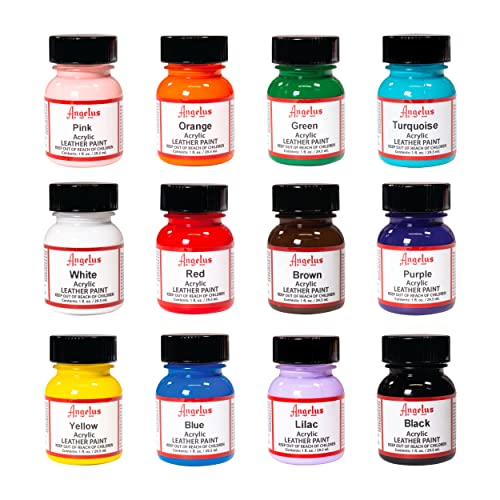
The Angelus Best Sellers Kit bundles 12 core shades that customizers use most. Each bottle is 1 oz, which is plenty for details, accents, and small sections. The colors are bright, consistent, and designed for leather flex.
I reach for this kit when I need a high-quality palette that behaves the same across shades. Color mixing is predictable. If you plan to do logos, gradients, or multi-color patterns on shoes, this set feels dialed in.
Pros:
- Curated colors used by many pros
- Known, reliable acrylic leather paint formula
- Great consistency across shades
- Ideal for multi-color sneaker customs
- Pairs with Angelus finishers and additives
Cons:
- 1 oz size may be small for full repaints
- Does not include prep or clear coat
- Higher price than off-brand kits
My Recommendation
Get this kit if you want pro-grade color right away. It is perfect for art-forward customs and precise color work. Add a deglazer and a finisher to complete your setup.
| Best for | Why |
|---|---|
| Custom sneaker art | Balanced palette and repeatable results |
| Detailed designs | Predictable mixing and edge control |
| Brand-conscious buyers | Trusted performance and finish quality |
How to choose the right acrylic leather paint
Pick paint based on project type, surface, and wear. Shoes bend a lot at the toe box. Choose a flexible formula and apply thin coats. Jackets need smooth blends and soft hand. Seats need stain resistance and strong bonding.
Match volume to job size. Sets under 1 oz are fine for small art and touch-ups. Mid-size 30 ml bottles suit shoes and bags. Larger 4 oz sizes save money for bulk work. Always check if the kit includes a deglazer or finisher.
Think about color plan. If you want fast results, buy a curated set like best sellers. If you love mixing, buy a wide 20-color set. For heavy black work, get a large single bottle.
Look for additive support. Brands that offer thinners, dullers, and finishers help you tune the look. This matters when you want matte, satin, or gloss control.
Prep and application: the method that stops peeling
Most failures happen before the first coat. Clean the leather with a leather preparer or deglazer. This removes oils, factory finish, and grime. I avoid harsh scrubbing on delicate leather. Use light pressure and lint-free cloths.
Scuff glossy areas with very fine abrasive if needed. Wipe dust away. Mask edges with low-tack tape. Stir paint well. Do not glob thick coats. Thin, even layers bond stronger and flex better.
Brush in one direction on the first coat. Let it dry to the touch. Add the next coat crosswise. I usually do two to four thin coats. For airbrush, reduce with the brand’s thinner. Spray light passes to avoid texture.
Let the paint cure. Many users rush. I set projects aside 24 hours before finisher. Full cure often improves in 48 to 72 hours. A clear finisher adds scuff resistance and a uniform sheen.
Sealing and finish options that last
A finisher locks in color and adds durability. Choose matte for a stock look. Satin adds a soft sheen. Gloss brings a bold shine. I brush on thin coats to avoid streaks. Some pros spray the finisher for a smooth film.
On high-wear zones like toe boxes and car bolsters, I use two thin finisher coats. Let each layer dry fully. Avoid bending the leather hard on day one. Give the finish time to set up.
If you want a duller look, use a duller additive in the paint or a matte finisher. If you need more slip and stain resistance, a tougher topcoat can help. Always test on a hidden spot first.
Color mixing tips for clean, bright results
Start with primaries and white. Keep mixes simple. Two-color mixes stay clean longer. When you mix three or more, colors can get muddy. Add white to increase opacity for dark leather.
Record your ratios if you love a custom shade. I mark bottle caps with a swatch once dry. This keeps project colors consistent across sessions. Use a wet palette to slow drying while you work.
If you need pastels, cut bold colors with white in small steps. For shadows, add a touch of complementary color, not only black. This keeps depth rich without killing saturation.
Troubleshooting common problems
Peeling or flaking means poor prep or thick coats. Deglaze better, then apply thin layers. Use proper cure time. Cracking often comes from heavy coats on flex points. Thin and build slowly.
Streaks and brush marks usually mean overworking wet paint. Lay it down and leave it. Use soft, flat brushes. For perfect flats, switch to airbrush with a reducer.
Sticky finish suggests heavy finisher coats or short dry time. Apply lighter layers and wait longer. Yellowing can come from some gloss coats in UV. Choose a finisher that resists UV if the item sees sun.
Care and cleaning after you paint
Give acrylic leather paint time to cure before use. I wait at least 24 hours, longer for heavy layers. Avoid hard bends or rain in that window. Store shoes stuffed with paper to hold shape.
Clean with a damp cloth and mild soap. Do not use strong solvents. Avoid oil conditioners on painted areas. If scuffs happen, spot repair with thin touch-up and reseal the spot.
For car seats, keep a soft towel handy for quick dusting. UV shade and parking in garages extend finish life. Little habits protect your work for years.
Expert notes from the workbench
I have learned that patience beats any hack. The best acrylic leather paint job is 70% prep, 20% thin coats, and 10% sealer. Tools matter too. Good tape saves edges. Good brushes save time.
When in doubt, test. A small swatch tells you how the leather absorbs, how the paint levels, and how the finish looks. Not all leather is equal. Coated leather can need extra prep or lighter coats.
If you want soft panels on jackets, consider mixing a tiny bit of flexible additive where the brand supports it. This keeps the hand soft. On seats, keep the finish a bit more robust to handle friction.
Project ideas that shine
Try color blocking on retro sneakers. Use high contrast on panels and subtle tones on swooshes. Add a matte finisher for a factory vibe. For boots, restore the toe and heel to deep black and leave the body natural.
On bags, paint a monogram or a thin stripe that echoes heritage luggage styles. For car seats, match a seam color with a fine brush and steady hand. Small changes look premium when done clean.
Jackets love gradient fades on cuffs or collars. Keep blends light and controlled. Seal with satin to keep the leather look alive. Make art that wears well.
FAQs Of acrylic leather paint
Does acrylic leather paint crack?
It stays flexible when you prep right and use thin coats. Cracks come from thick layers or poor prep. Seal with a finisher to add strength.
How long does it take to dry and cure?
Touch-dry in 15–30 minutes per thin coat. Allow 24 hours before sealing. Full cure improves over 48–72 hours.
Can I use acrylic leather paint on vinyl or faux leather?
Yes, with proper cleaning and light scuffing. Bond can vary by material. Always test a small spot first.
Do I need a finisher over acrylic leather paint?
For best wear, yes. A finisher adds scuff resistance and controls sheen. Choose matte, satin, or gloss.
Can I airbrush acrylic leather paint?
Yes. Thin with a compatible reducer. Spray light passes and let each layer flash off before the next.
Final Verdict: Which Should You Buy?
For most people, the Angelus Best Sellers Kit delivers pro results and easy color control. If you need bulk black, the 4 oz Angelus Black is the best buy.
On a budget, ARTME’s 20-color set offers range for learning acrylic leather paint. If you want prep included, choose the Smalltongue kit.