

PaintingProGuide is reader-supported. When you buy through links on this page we may earn an affiliate commission at no extra cost to you.
An airbrush lays down paint as a fine mist, which makes it ideal for smooth gradients, soft shadows, stencil art and the base coats miniature and model painters love. The best airbrush kits for beginners include a reliable compressor with pressure control, a dual-action gravity-feed airbrush in a versatile 0.3 mm nozzle size, and enough accessories to clean the tool properly, because cleaning is where most beginners struggle.
This guide compares six kits for art and craft use, explains the terms that confuse first-time buyers, and walks through a basic setup and cleaning routine.
Quick answer: For most beginners, the Master Airbrush Cool Runner II Kit is the strongest all-in-one choice: a dual-fan 1/5 hp compressor, three airbrushes (0.2 mm, 0.3 mm and a 0.8 mm single-action), and a six-color water-based paint kit with reducer and cleaner. On a tighter budget, the Timbertech AS18-2K Basic Start Kit pairs a quiet auto-stop compressor with a regulator and water trap. If you need portability, the Ovaga 32 PSI rechargeable kit removes the hose and cord.
Airbrush Terms Beginners Should Know
- Dual action: pressing the trigger releases air; pulling it back releases paint. You control both, which allows fine lines and soft fades. Most artists learn on dual action.
- Single action: the trigger only controls air; paint flow is preset. Simpler, good for broad, even coverage.
- Gravity feed: paint sits in a cup on top and flows down. Needs less pressure and wastes less paint; ideal for detail.
- Siphon feed: paint is drawn up from a bottle below. Good for larger volumes of one color.
- Nozzle size: 0.2 mm for fine detail, 0.3 mm as the all-rounder, 0.5 mm and larger for broad coverage and thicker paints.
- PSI: air pressure. Lower PSI suits fine detail; higher PSI helps with thicker paint and wider spray.
- Regulator and moisture trap: let you set pressure accurately and keep water droplets out of the airflow.
Compressor Kits vs Cordless Airbrushes
| Feature | Compressor kit | Cordless rechargeable |
|---|---|---|
| Air supply | Separate compressor with hose | Built-in mini compressor |
| Pressure control | Regulator with gauge (on better kits) | Preset modes |
| Run time | Continuous (with cooling) | Limited by battery |
| Best for | Regular painting, miniatures, canvas, larger work | Small projects, travel, quick touch-ups |
| Noise | Varies; some are quiet | Generally quiet |
If you plan to airbrush regularly, a compressor kit is the better long-term buy. Cordless units are convenient for small projects and for trying airbrushing before committing.
Our Top Picks at a Glance
- Master Airbrush Cool Runner II Airbrush Kit — Best for the most complete beginner system
- Timbertech AS18-2K Basic Start Airbrush Kit — Best for a quiet, budget compressor kit
- Ovaga 32 PSI Rechargeable Airbrush Kit — Best for cordless convenience with real pressure
- Roizefar Airbrush Kit with 18 Paints — Best for paints and nozzles in one box
- piig Portable Cordless Airbrush Kit — Best for trying airbrushing at the lowest tier
- Crayola Marker Airbrush Spray Art Kit — Best for kids ages 6+ trying spray art
| Product | Best For | Key Spec | Key Strength | Price Tier |
|---|---|---|---|---|
| Master Airbrush Cool Runner II Airbrush Kit | The most complete beginner system | 1/5 hp dual-fan compressor; 3 airbrushes (0.2, 0.3, 0.8 mm) | Paints, reducer, cleaner and a quick start guide included | $$$ |
| Timbertech AS18-2K Basic Start Airbrush Kit | A quiet, budget compressor kit | Oil-less piston, 47 dB, auto-start/stop, 120V | Regulator with gauge, water trap and overheat protection | $$$ |
| Ovaga 32 PSI Rechargeable Airbrush Kit | Cordless convenience with real pressure | Up to 32 PSI, 8–10 L airflow, dual action | Rechargeable, supports two airbrushes, 11 paints | $$$ |
| Roizefar Airbrush Kit with 18 Paints | Paints and nozzles in one box | 55 PSI, 3 airflow settings, 0.2/0.3/0.5 mm nozzles | 18 paints, 2 thinners and 4 large cleaner bottles | $$$ |
| piig Portable Cordless Airbrush Kit | Trying airbrushing at the lowest tier | 30/35/48 PSI modes, 0.3 mm nozzle | Three paint cups (7, 20 and 40 cc) and cleaning tools | $$ |
| Crayola Marker Airbrush Spray Art Kit | Kids ages 6+ trying spray art | Battery airbrush, 8 washable markers, 5 stencils | Sprays washable marker ink, no paint or compressor | $$ |
How We Chose
We based these picks on Amazon listing details and specifications checked in October 2026; we have not used these kits ourselves. We compared compressor type and pressure control, airbrush action and feed type, nozzle sizes, included paints and cleaning accessories, and how well each kit suits someone new to airbrushing, giving weight to kits that are widely reviewed by Amazon buyers.
Criteria:
- Dual-action gravity-feed airbrush, ideally 0.3 mm.
- Pressure control: a regulator with gauge, or adjustable modes.
- Compressor features: auto-stop, cooling, moisture trap.
- Included extras: paints, reducer, cleaner, brushes.
- Electrical fit for US buyers (120V), where the listing states it.
Best Airbrush Kits for Beginners Reviewed
1. Master Airbrush Cool Runner II Airbrush Kit — Best for the most complete beginner system
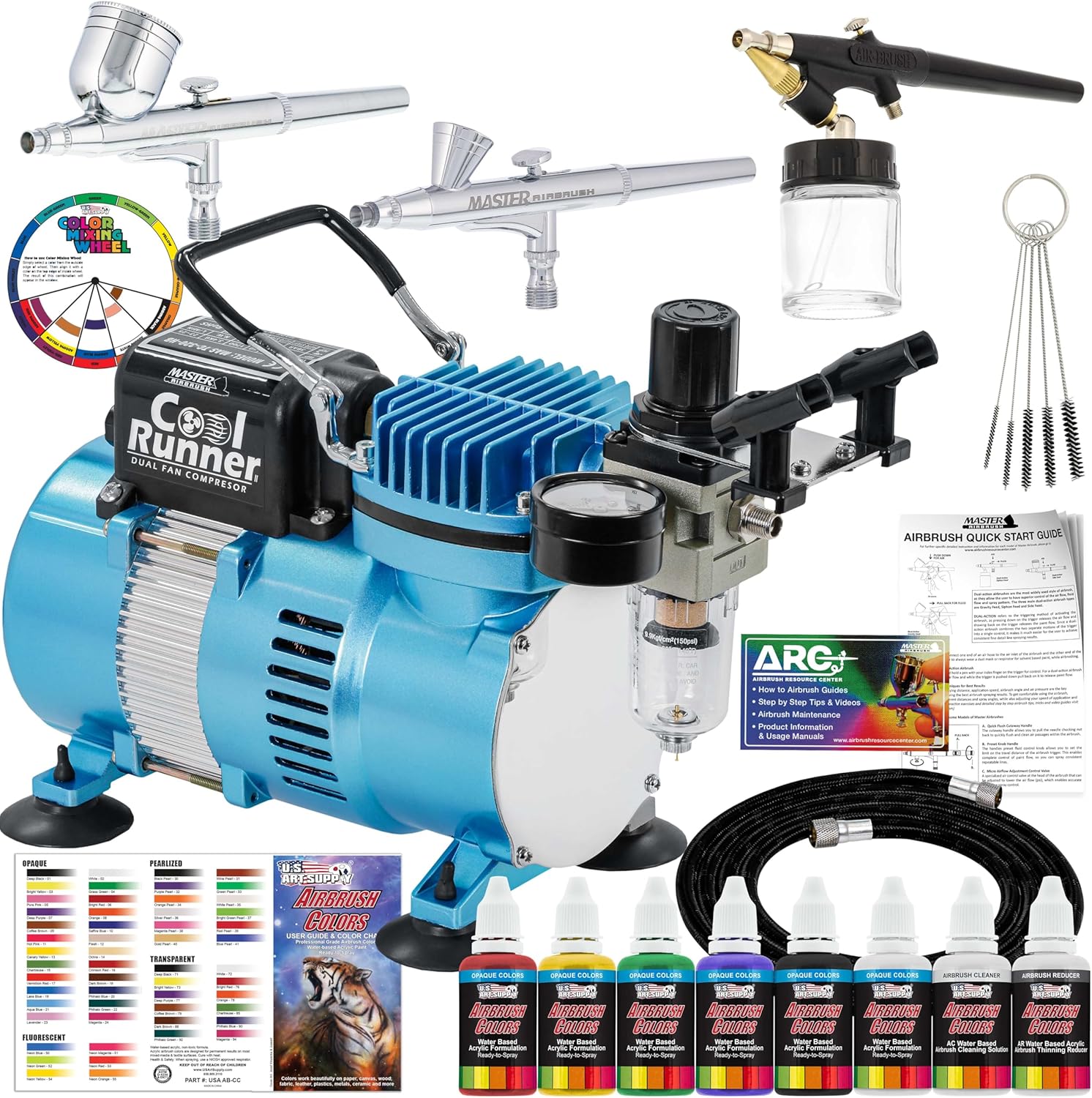
This kit is a full system. The Model TC-320 Cool Runner II compressor is a 1/5 hp single-piston unit with two cooling fans, which the listing says lets it run cooler for longer continuous sessions. It includes a holder for two airbrushes.
You get three airbrushes: a G22 dual-action gravity feed with a 1/3 oz cup and 0.3 mm tip (the all-rounder), a G25 dual-action gravity feed with a 1/16 oz cup and 0.2 mm tip (fine detail), and an E91 single-action siphon feed with a 0.8 mm tip and two 3/4 oz bottles (broad coverage). A U.S. Art Supply primary color kit adds six opaque water-based acrylic airbrush paints plus reducer and cleaner, a color wheel and cleaning brushes.
Best suited for: Beginners who want room to grow, miniature and model painters, canvas and craft artists.
Key features:
- 1/5 hp compressor with dual cooling fans
- G22 0.3 mm and G25 0.2 mm dual-action gravity airbrushes
- E91 0.8 mm single-action siphon airbrush
- 6 water-based acrylic paints, reducer, cleaner and brushes
Pros:
- Three airbrushes cover detail to broad coverage
- Cooling fans support longer sessions
- Starter paints and cleaning supplies included
Cons and limitations:
- Highest price tier in this list
- Three airbrushes means more to learn and clean
Buying consideration: Start with the G22 0.3 mm airbrush and leave the others until you are comfortable. Learning one tool well builds trigger control faster.
2. Timbertech AS18-2K Basic Start Airbrush Kit — Best for a quiet, budget compressor kit
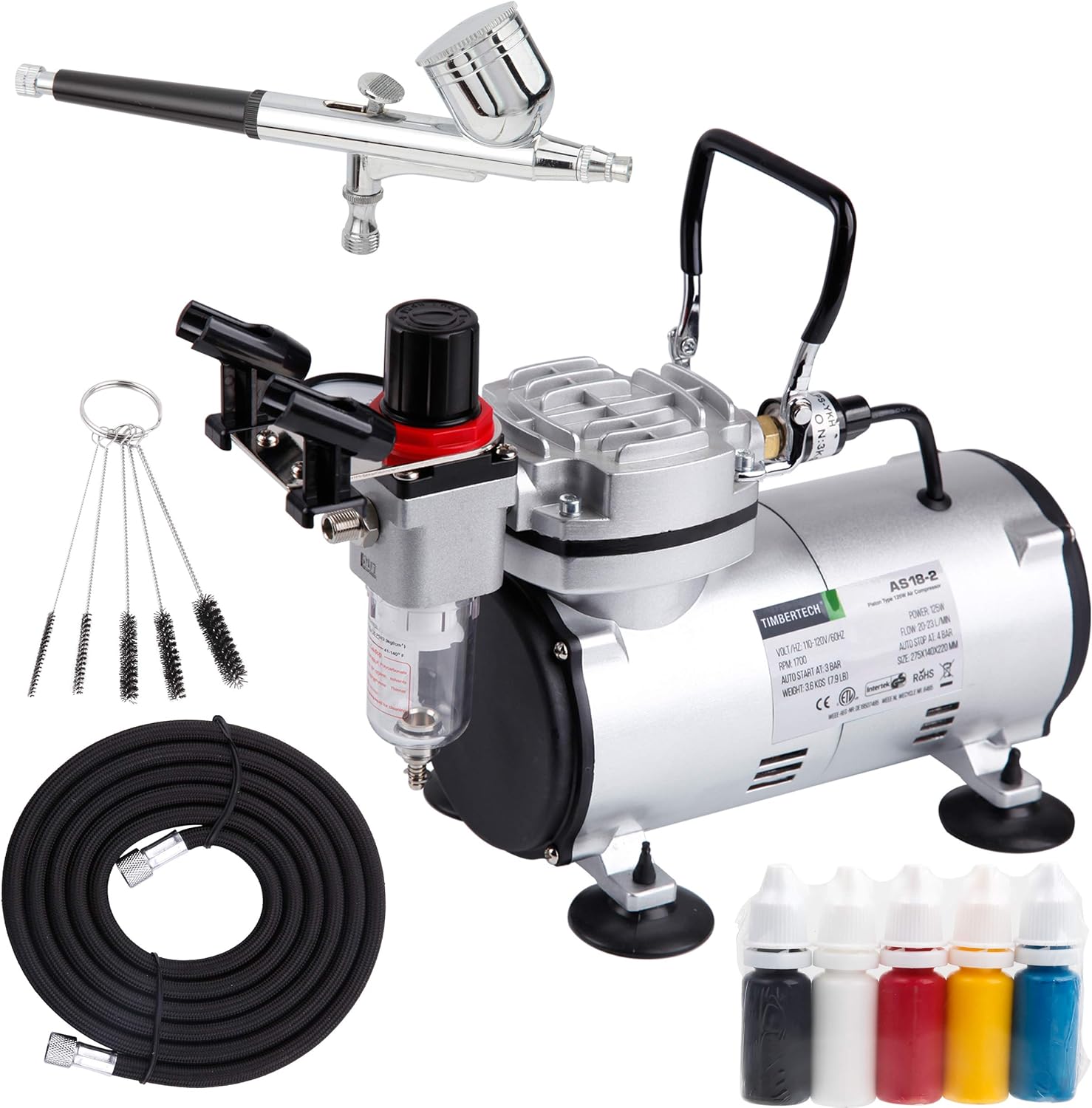
Timbertech’s starter kit focuses on a well-equipped compressor at a lower price tier. The listing describes an oil-less, maintenance-free piston compressor rated at 47 dB with a carry handle, airflow of 20 to 23 L/min, auto-start at 3 bar and auto-stop at 4 bar, a regulator with gauge, a water trap and air filter, a pressure relief valve and overheat protection. It is listed at 120 volts.
The airbrush is a basic double-action gravity-feed model with a 0.30 mm nozzle and needle, plus a 6 ft hose, mini filter, cleaning brush and five test paints.
Best suited for: Budget-minded beginners, apartment painters who value low noise, and model or craft painters.
Key features:
- Oil-less piston compressor, 47 dB
- Auto-start/auto-stop
- Regulator, gauge, water trap and filter
- Dual-action gravity airbrush, 0.30 mm
Pros:
- Key compressor features at a mid tier
- Quiet operation
- Auto-stop reduces wear and heat
Cons and limitations:
- Single basic airbrush
- Only small test paints included
Buying consideration: The auto-stop feature means the compressor does not run constantly, which helps with noise and heat during longer sessions.
3. Ovaga 32 PSI Rechargeable Airbrush Kit — Best for cordless convenience with real pressure

Ovaga’s kit is rechargeable, so you can airbrush without a cord tethering you to an outlet. The listing describes a dual-action airbrush, up to 32 PSI with airflow up to 8 to 10 L, and a compressor that can connect two airbrushes. An 11-color acrylic airbrush paint set is included.
The listing also states a one-year warranty, which is reassuring for a first airbrush purchase.
Best suited for: Beginners wanting portability, small craft projects and painters short on desk space.
Key features:
- Rechargeable compressor
- Up to 32 PSI
- Dual-action airbrush
- 11 acrylic airbrush paints
Pros:
- No cord during use
- Paints included
- Supports two airbrushes
Cons and limitations:
- Lower airflow than full compressors
- Battery limits continuous run time
Buying consideration: Charge fully before a session and keep the charger nearby. Pressure can drop as the battery runs low, which affects spray consistency.
4. Roizefar Airbrush Kit with 18 Paints — Best for paints and nozzles in one box

Roizefar bundles a lot of consumables. The listing describes a compressor delivering up to 55 PSI with three airflow settings, a dual-action airbrush, three interchangeable nozzles (0.2, 0.3 and 0.5 mm), 18 paints (12 standard, 3 metallic, 3 fluorescent), two thinners, four 3.38 fl oz bottles of airbrush cleaner and a cleaning brush set.
One important note for US buyers: the listing shows the voltage as 240 volts. Confirm the plug and voltage on the listing match your outlets before buying.
Best suited for: Beginners who want paints, nozzles and cleaner in one purchase, after checking electrical compatibility.
Key features:
- Up to 55 PSI with 3 airflow settings
- 0.2, 0.3 and 0.5 mm nozzles
- 18 paints incl. metallic and fluorescent
- 2 thinners and 4 cleaner bottles
Pros:
- Generous paint and cleaner supply
- Three nozzle sizes
- Adjustable airflow
Cons and limitations:
- Listed at 240V; verify compatibility
- No regulator gauge mentioned
Buying consideration: Check the voltage line on the listing carefully. Using a compressor on the wrong voltage can damage it or create a safety hazard.
5. piig Portable Cordless Airbrush Kit — Best for trying airbrushing at the lowest tier

piig’s cordless airbrush is the low-cost way to find out whether airbrushing suits you. The listing describes three pressure options (48, 35 and 30 PSI), a 0.3 mm nozzle, three paint cups of 7, 20 and 40 cc, a dropper, five cleaning brushes and five cleaning needles.
Small cordless units like this work well for stencils on paper, small crafts and touch-ups. For long sessions or large canvases, a compressor kit is more practical.
Best suited for: Curious beginners, stencil art and small craft projects.
Key features:
- Cordless, rechargeable
- 30, 35 and 48 PSI modes
- 0.3 mm nozzle
- Three paint cups and cleaning kit
Pros:
- Lowest price tier here
- Portable and quick to set up
- Cleaning tools included
Cons and limitations:
- Limited run time
- No paints included
Buying consideration: Thin acrylics well for cordless units. Their lower airflow struggles with paint that is too thick, which leads to sputtering.
6. Crayola Marker Airbrush Spray Art Kit — Best for kids ages 6+ trying spray art

For children who want to try airbrushing, Crayola’s kit turns washable markers into a spray. Load a marker, press the button and the battery-powered unit sprays the ink, ideal with the five included stencils. It requires four AA batteries, not included, and is listed as nontoxic for ages 6 and up.
The sprayer works with select Crayola marker styles, so kids can expand colors with markers they may already have.
Best suited for: Kids 6+, stencil art and families who want airbrush effects without paint or a compressor.
Key features:
- Battery-powered marker airbrush
- 8 washable markers
- 5 reusable stencils
- Compatible with select Crayola markers
Pros:
- No paint, thinning or compressor
- Washable ink
- Introduces stencil and spray techniques
Cons and limitations:
- Not a true paint airbrush
- Batteries not included
Buying consideration: Point the sprayer downward as the listing notes; markers only spray in that orientation.
First Session: Setting Up and Spraying
- Set up near ventilation. Even water-based airbrush paint creates fine mist. Work near an open window or with a spray booth, and wear a suitable mask.
- Connect the hose and set pressure. Start around the low-to-middle range of your compressor for thin paint and fine work, then adjust.
- Thin your paint. Airbrush-ready paints can often be used directly. Regular acrylics need thinning with airbrush reducer to roughly the consistency of milk.
- Load a few drops. In a gravity-feed cup, a few drops are enough for practice.
- Practice on paper. Draw dots, then lines, then fades. Always press for air first, then pull back for paint; release paint first, then air.
- Flush between colors. Spray cleaner or water through until it runs clear.
Cleaning: The Habit That Prevents Clogs
- During painting: flush with cleaner between colors.
- End of session: empty the cup, wipe it, spray cleaner through until clear, then back-flush gently by covering the nozzle cap with a cloth (if your manual allows).
- Weekly or as needed: disassemble the needle and nozzle carefully, soak parts in airbrush cleaner, and use the small brushes provided.
- Handle the needle gently. A bent needle tip is the most common beginner damage.
Buying Guide: How to Choose Airbrush Kits for Beginners
Start with dual action, gravity feed, 0.3 mm
This combination is the most forgiving for learning detail and coverage. Kits that include it give you the most transferable skills.
Prioritize pressure control
A regulator with a gauge lets you dial in exact pressure. Without one, you are guessing, which makes troubleshooting harder.
Look for a moisture trap
Compressed air holds moisture that can spit water onto your work. A water trap catches it.
Auto-stop and cooling
Auto-stop compressors run only when needed, reducing noise and heat. Cooling fans support longer sessions.
Check electrical specifications
US buyers should confirm 120V compatibility. Some listings show 240V.
Consider what paint you will use
Airbrush-ready acrylics are easiest. If you plan to spray regular acrylics, budget for reducer and practice thinning.
Plan for cleaning supplies
Airbrush cleaner, brushes and a cleaning pot keep the tool working. Kits that include them save a separate purchase.
Airbrushing for Miniatures, Crafts and More
Miniature painters are often the biggest airbrush converts. Our guide to painting miniatures with an airbrush covers priming and zenithal highlights, and our comparison of airbrush vs brush for miniature painting helps you decide when each tool fits. If you want to use regular paints, read how to use acrylic paint in an airbrush. Airbrushed gradients also look great on craft surfaces like painted wood slices.
Common Mistakes to Avoid
- Paint too thick. It sputters and clogs; thin to milk consistency.
- Pressure too high for detail. Causes spidering; lower the PSI and move closer.
- Releasing air before paint. Stop paint first, then air, to avoid blobs.
- Skipping cleaning. Dried paint in the nozzle is the top cause of beginner frustration.
- Forcing the needle. It bends easily; handle with care.
- Spraying without ventilation. Use a booth, open windows or a mask.
FAQs
What is the best airbrush for a complete beginner?
A dual-action, gravity-feed airbrush with a 0.3 mm nozzle is the most versatile starting point. Kits like the Master Airbrush Cool Runner II and Timbertech AS18-2K include this type with a compressor.
Do I need a compressor to airbrush?
You need an air source. Compressor kits offer continuous air and pressure control, while cordless airbrushes have small built-in compressors with limited run time. For regular painting, a compressor is more practical.
Can I use regular acrylic paint in an airbrush?
Yes, if you thin it properly with airbrush reducer or a suitable thinner and strain any lumps. Airbrush-specific paints are easier for beginners because they are already thinned.
What PSI should a beginner use?
Lower pressure suits fine detail and thin paint, while higher pressure suits thicker paint and broad coverage. Start in the low-to-middle range of your compressor and adjust while practicing on paper.
How often should I clean my airbrush?
Flush between colors and clean thoroughly at the end of every session. Deeper disassembly cleaning is needed whenever spray becomes inconsistent.
Is a cordless airbrush good for beginners?
For small projects and trying the technique, yes. For longer sessions, larger surfaces and consistent pressure, a compressor kit performs better.
Final Recommendation
If you want one purchase that covers learning and growth, choose the Master Airbrush Cool Runner II Kit. The Timbertech AS18-2K is the best-value compressor kit with a regulator, water trap and auto-stop. For portability, the Ovaga rechargeable kit is the stronger cordless choice, while the piig unit is the lowest-cost way to try airbrushing. Consider Roizefar for its generous paint bundle only after confirming voltage, and choose the Crayola Marker Airbrush for children.




