PaintingProGuide is reader-supported. When you buy through links on this page we may earn an affiliate commission at no extra cost to you.
A good mop brush is the quiet engine of a watercolor painting. Its job is to carry a lot of water, release it evenly across the paper and do so without scrubbing up the layers underneath. The best mop brush for watercolor is soft enough to glide over a dry glaze, full enough to lay a sky in two or three strokes, and shaped well enough to come back to a point when you need to cut around a cloud edge.
That combination is harder to find than it sounds. Plenty of brushes labeled “mop” are really stiff blenders made for acrylic, and they will lift your washes instead of laying them. Below we compare seven mop and quill brushes currently listed on Amazon, explain the difference between squirrel-style quills, oval mops and goat hair rounds, and show how to choose the right size for the paper you actually use.
Quick answer: For most watercolorists, the Princeton Neptune Quill, Size 6 is the best mop brush to start with: a very soft, thirsty synthetic squirrel blend that holds a big reservoir and still points. If you prefer a flatter wash shape, the Princeton Aqua Elite 3/4″ Mop releases water evenly with crisper edges. On a budget, the Fuumuui 3-Piece Quill Mop Set gives you three sizes for less than one premium brush.
Our Top Picks at a Glance
- Princeton Neptune Quill, Size 6 — Best overall mop brush for watercolor washes
- Princeton Aqua Elite Mop, 3/4 inch — Best for even, controlled wash release
- Fuumuui 3-Piece Round Quill Mop Set (#2, 6, 8) — Best budget set with multiple sizes
- Princeton Velvetouch Series 3950 Oval Mop, 3/4 inch — Best mixed-media mop for watercolor and gouache
- XDT #920 Goat Hair Round Mop Set (#8, 10, 12) — Best natural hair option for large wet-in-wet areas
- Royal & Langnickel Camel Mop 3-Pack — Best cheap mop for students and classrooms
- GACDR 1 Inch Oval Mop 6-Piece Set — Best for blending and softening rather than pure washes
| Product | Best For | Key Spec | Key Strength | Price Tier |
|---|---|---|---|---|
| Princeton Neptune Quill #6 | Large, soft washes | Quill shape, short handle | Softest, thirstiest Princeton synthetic | Varies |
| Princeton Aqua Elite 3/4″ Mop | Even wash release | 3/4 inch oval, short handle | Kolinsky-style synthetic spring | $$ |
| Fuumuui Quill Mop Set | Budget multi-size kit | Sizes 2, 6, 8 | Four-crimped ferrules | $$ |
| Princeton Velvetouch 3950 Oval Mop | Mixed media | 3/4 inch, synthetic blend | Holds color, springs back | $ |
| XDT #920 Goat Hair Set | Wetting big areas | Sizes 8, 10, 12, long handle | Natural goat hair capacity | $ |
| Royal & Langnickel Camel Mop 3-Pack | Students and classrooms | 1/2 inch mops | Very low cost per brush | $ |
| GACDR 1″ Oval Mop Set | Blending and softening | 6 brushes, 1 inch | Nylon and weasel hair mix | $ |
How We Chose
Our picks are based on the Amazon listing details and specifications checked in October 2026, how closely each brush matches what watercolor washes demand, and how widely each one is reviewed by Amazon buyers. We excluded listings whose descriptions point mainly at acrylic blending unless the brush also suits watercolor, and we noted those limits honestly.
What we looked for:
- Water capacity: how much the hair is described as holding and releasing.
- Softness: squirrel-like softness so the brush does not disturb dry layers.
- Shape and point: quills and rounds that return to a point versus oval mops for broad strokes.
- Ferrule construction: crimped metal or traditional quill ferrules that resist shedding.
- Size range: whether the brush suits quarter sheets, half sheets or larger.
Best Mop Brushes for Watercolor Reviewed
1. Princeton Neptune Quill, Synthetic, Size 6 — Best for Overall Watercolor Washes

Princeton describes Neptune as its softest and thirstiest brush, made from a blend of synthetic hair that is as soft and supple as natural squirrel. That is exactly the profile a mop brush needs. A quill shape holds a large belly of water and tapers to a point, so one brush can lay a graded sky and then cut a crisp edge around a rooftop.
Because it is synthetic, it avoids the cost and animal-hair concerns of real squirrel while staying durable. The short handle suits tabletop watercolor work. Size 6 in a quill is a generous brush for quarter and half sheets.
Best suited for: watercolorists who want one soft, high-capacity brush for skies, backgrounds and wet-in-wet work.
Key features:
- Synthetic squirrel-style blend
- Quill shape with point
- Short handle
- Part of a range that includes oval wash, mottlers and daggers
Pros:
- Very soft, so it does not lift dry layers
- Holds a large reservoir of water
- Animal-friendly and durable
Cons and limitations:
- Too soft for scrubbing or lifting
- Price not shown on the listing at check time
Buying consideration: quill sizes run larger than round sizes; check the brush dimensions so the head suits your paper size.
2. Princeton Aqua Elite Mop, Synthetic, Short Handle, 3/4 inch — Best for Even, Controlled Washes

Aqua Elite is Princeton’s Kolinsky-style synthetic, described as holding an abundance of water and releasing it evenly for smooth, consistent flow. Compared with a squirrel-style quill, it has a bit more spring, which gives you more control on the edge of a wash and makes it easier to stop exactly where you want.
The 3/4 inch mop is a versatile size: wide enough for backgrounds on a half sheet, small enough for controlled shapes. The listing also highlights fine points and tapered edges, useful if you want one mop that can still describe form.
Best suited for: painters who find very soft mops too floppy and want more control in their washes.
Key features:
- 3/4 inch mop
- Kolinsky-style synthetic hair
- Even water release
- Short handle
Pros:
- Balanced softness and spring
- Smooth, even flow
- Widely reviewed listing
Cons and limitations:
- Single brush at a mid-range price
- Slightly less capacity than an ultra-soft quill
Buying consideration: if you already own a large soft quill, this makes an excellent second wash brush with a different feel.
3. Fuumuui 3-Piece Round Quill Mop Set, Sizes #2, 6, 8 — Best for Budget Multi-Size Kit

This set gives you three quill mops in sizes 2, 6 and 8, covering everything from large even washes to fine lines. The listing describes soft synthetic squirrel bristles that are highly absorbent, and ferrules with four deep crimps pressed into the wooden handle to prevent shedding.
For painters who want to try the quill shape without paying premium-brand prices, three sizes in one box is a smart way to learn which size you use most. It is also suited to ink and gouache, and comes in a gift box.
Best suited for: beginners and budget-conscious painters who want to explore quill mops in several sizes.
Key features:
- Sizes 2, 6 and 8
- Synthetic squirrel bristles
- Four-crimped ferrules
- Short handles, gift box
Pros:
- Three sizes for the price of one premium brush
- Soft and absorbent
- Secure ferrule design
Cons and limitations:
- Smallest size is more of a detail brush than a mop
- Listing advises against soapy water cleaning, which is unusual
Buying consideration: the listing recommends cleaning with water only; follow that to keep the hair in shape.
4. Princeton Velvetouch Series 3950 Oval Mop, 3/4 inch — Best for Watercolor and Gouache Mixed Media

Velvetouch is Princeton’s mixed-media line, built from a blend of multiple synthetic filaments for color-holding capacity, precise placement and resilient spring. The oval mop shape gives a rounded, soft-edged stroke that is excellent for washes, glazes and softening edges.
Because it is designed for watercolor, gouache, oil and acrylic, it is a touch firmer than a dedicated watercolor quill. That makes it useful if you paint gouache over watercolor or want a mop that can also lay smooth acrylic glazes.
Best suited for: mixed-media painters who want one mop that works across watercolor and gouache.
Key features:
- 3/4 inch oval mop
- Multi-filament synthetic blend
- FSC wood handle
- Part of a 72-brush, 20-shape range
Pros:
- Versatile across media
- Good spring and shape retention
- Comfortable handle
Cons and limitations:
- Less water capacity than a pure watercolor quill
- Firmer than squirrel-style mops
Buying consideration: keep separate brushes for acrylic and watercolor if you use both; acrylic residue changes how a mop releases water.
5. XDT #920 Round Mop-Style Goat Hair 3-Piece Set, #8, 10, 12 — Best for Large Wet-in-Wet Areas
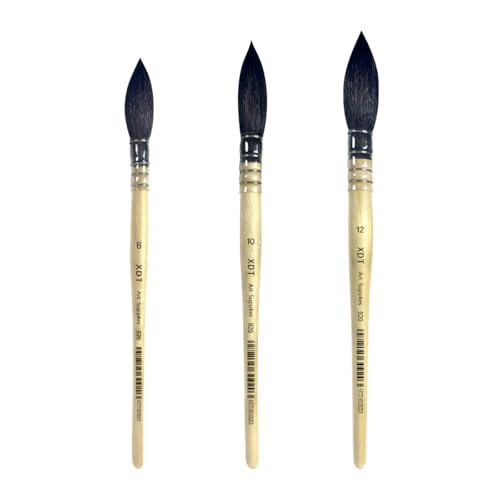
Goat hair is a traditional natural fiber for wash brushes: soft, very absorbent and inexpensive compared with squirrel. This XDT set includes three round mop-style brushes in sizes 8, 10 and 12 with natural black goat hair and solid birch long handles.
The listing positions these for watercolor washes, gouache, ink and even glazing ceramics, and for wetting large surfaces. Goat hair does not snap back to a point as crisply as synthetics, so think of these as broad wash and wetting brushes rather than precision tools.
Best suited for: painters working on larger sheets who want natural-hair capacity at a low price.
Key features:
- Three sizes: 8, 10, 12
- Natural black goat hair
- Long birch handles
Pros:
- Big water capacity
- Inexpensive way to try natural hair
- Good for pre-wetting paper
Cons and limitations:
- Weaker point than synthetic quills
- Long handles are less common for watercolor tabletop work
- Natural hair may shed a little at first
Buying consideration: rinse new goat hair brushes and gently tug out loose hairs before your first painting session.
6. Royal & Langnickel Camel Mop Brush 3-Pack — Best for Students and Classrooms

This inexpensive three-pack of half-inch mop brushes is aimed at arts and crafts. “Camel” in brush naming is a traditional trade term for soft blended hair rather than literal camel hair, and the listing material field says synthetic. The appeal is cost: for very little money you get three soft mops for wetting paper, softening edges and small washes.
They will not match a premium quill in capacity or point, but for classrooms, kids or practice sheets they are a practical, widely reviewed option.
Best suited for: students, teachers and casual painters who need cheap, soft mops in quantity.
Key features:
- Three mops per pack
- About 1/2 inch width
- Soft hair suited to arts and crafts
Pros:
- Very low cost per brush
- Widely reviewed
- Fine for wetting and softening
Cons and limitations:
- Limited listing detail
- Small size for large washes
- Less durable than artist brushes
Buying consideration: treat these as practice or classroom brushes, and upgrade your main wash brush when you can.
7. GACDR 1 Inch Oval Mop Brush 6-Piece Set — Best for Blending and Softening

These six 1-inch oval mops use a mix of synthetic nylon and weasel hair on birch handles with double-crimped aluminum ferrules. The listing focuses on blending and softening color with acrylics or watercolor and laying base color.
For watercolor, they are better at softening edges and laying even base tones than at carrying huge, flowing washes; the nylon content gives them more stiffness than a squirrel-style quill. Having six identical brushes is handy if you keep one per color family.
Best suited for: painters who need soft blenders for edges and base layers, or who also paint acrylic.
Key features:
- Six 1-inch oval mops
- Nylon and weasel hair blend
- Double-crimped aluminum ferrules
- Birch handles
Pros:
- Lots of brushes for the money
- Good for softening edges
- Works across watercolor and acrylic
Cons and limitations:
- Firmer than true watercolor mops
- Less water capacity than quills
Buying consideration: if pure, floppy washes are your goal, choose one of the quills above instead.
Buying Guide: How to Choose a Mop Brush for Watercolor
A mop brush seems simple, but small differences in hair, shape and size change the way your washes behave on paper.
Hair Type: Squirrel, Synthetic Squirrel, Goat and Blends
Natural squirrel is the classic mop hair: extremely soft and absorbent but expensive. Synthetic squirrel blends like Princeton Neptune imitate that softness at lower cost. Goat hair is soft and cheap with good capacity but a weaker point. Nylon-heavy blends are springier and better for control or acrylic, but they release water less generously.
Shape: Quill, Oval Mop or Round
Quills are full-bellied with a point, making them the most versatile wash brushes. Oval mops lay soft, rounded strokes with less of a point. Round mops behave like oversized rounds. Pick a quill if you want one brush to do washes and edges; pick an oval for broad, soft areas.
Size Relative to Your Paper
On a quarter sheet, a 3/4 inch mop or size 6 quill is plenty. Half and full sheets benefit from larger heads so you can cover a sky before the edge dries. Too small a mop forces you to rework the wash and creates blooms.
Ferrule Type
Traditional quill brushes may use a wire-bound or plastic quill ferrule; modern versions use crimped metal. Look for multiple crimps or a seamless ferrule, which reduce wobbling and shedding.
Handle Length
Short handles are standard for watercolor because you usually paint on a flat or slightly tilted surface close to the paper. Long handles suit easel work or painters who like to stand back.
Softness Versus Control
Very soft brushes protect dry glazes underneath but can feel floppy. Springier brushes give control but can disturb previous layers. Many painters own one of each.
Care and Longevity
Rinse in clean water, reshape the point and dry flat or tip-down. Never leave a mop standing on its head in water; it will permanently bend. Synthetic mops generally last longer than natural hair with the same care.
Learn to Use Your Mop Brush
Owning the right brush is half the job; the other half is technique. Our step-by-step guide on how to use a mop brush in watercolor covers flat washes, graded washes and wet-in-wet skies. If you are deciding whether you need a mop at all, read mop brush vs round brush for watercolor to see when each shape earns its place.
Once your washes are in, finishing details call for different tools. See our tips on using a liner brush for detail work.
Common Mistakes to Avoid
- Buying a stiff acrylic blender labeled “mop” and expecting it to carry watercolor washes.
- Using a mop that is too small for the paper and reworking a drying wash.
- Scrubbing with a soft mop, which damages the hair and lifts paint.
- Leaving brushes standing in water so the hair bends and the ferrule loosens.
- Overloading the mop and creating puddles that turn into blooms.
- Storing wet brushes tip-up so water seeps into the ferrule.
FAQs
What is a mop brush used for in watercolor?
A mop brush lays large, even washes, pre-wets paper, softens edges and glazes over dry layers without disturbing them. Its high water capacity lets you cover big areas quickly before the edge dries.
What size mop brush is best for watercolor?
For quarter and half sheets, a 3/4 inch mop or a size 6 quill is a versatile starting point. Larger sheets benefit from bigger heads. Quill sizes do not match round sizes, so check the actual head dimensions.
Is a synthetic mop brush as good as squirrel hair?
Modern synthetic squirrel blends come close in softness and capacity, last longer and cost less. Natural squirrel still has a slightly different feel that some painters prefer, but synthetics are an excellent choice for most artists.
What is the difference between a quill and a mop brush?
A quill is a type of mop with a full belly that tapers to a fine point, so it handles both washes and edges. Oval mops have a rounded, softer tip that is better for broad, soft strokes.
Can I use a watercolor mop brush with acrylic paint?
You can, but acrylic dries in the hair and is harder to clean out, which ruins soft watercolor mops quickly. Keep a separate, firmer mop for acrylic.
How do I clean a mop brush?
Rinse thoroughly in clean water, gently squeeze out excess water, reshape the head with your fingers and dry it flat or tip-down. Use a mild brush soap occasionally if pigment builds up, unless the manufacturer advises otherwise.
Final Recommendation
If you want one mop brush for watercolor and nothing else, choose the Princeton Neptune Quill in size 6 for its softness and capacity. Choose the Princeton Aqua Elite 3/4 inch mop if you prefer more spring and control at the edges of a wash. On a budget, the Fuumuui three-piece quill set lets you try several sizes. Large-format painters should look at the XDT goat hair set, classrooms will get value from the Royal & Langnickel three-pack, and anyone who also paints acrylic can use the GACDR oval set for blending.