PaintingProGuide is reader-supported. When you buy through links on this page we may earn an affiliate commission at no extra cost to you.
Babies explore with their mouths. Hand a ten-month-old a dollop of paint and some of it will end up on paper, some on their feet, and some, inevitably, on their tongue. That is why parents look for edible paint for babies: paint made from food ingredients, so a taste is not a cause for alarm. Most products in this category are vegetable-based powders you mix with water just before play, using ingredients such as beet, pumpkin, spinach and butterfly pea flower for color.
The label language matters, though. “Edible,” “taste-safe” and “safe if accidentally ingested” all mean a small taste should not be harmful. None of them mean paint is a snack. This guide compares the three vegetable-based baby paints in our product research, plus one non-toxic finger paint for babies who are past the mouthing stage, and explains ingredients, age ranges, allergy checks and how to mix and store powder paints safely.
Quick answer: The Jar Melo Vegetable Finger Paint Powder is the best edible paint for babies for most families: 10 colors made from pure vegetable powders and food-grade thickeners, labeled safe if accidentally ingested and suitable from 10 months, with each bag making about 260 ml of paint. For the youngest babies, Lattooland Natural Vegan Finger Paints are labeled from 6 months and come with art sheets in a simple 4-color kit. The ABEIER Finger Paint Powder is the best organized set, with a bowl and scraper for each of its 8 plant-based colors.
Our Top Picks at a Glance
- Jar Melo Vegetable Finger Paint Powder, 10 Colors — Best overall edible paint for babies
- Lattooland Natural Vegan Finger Paints, 4 Colors — Best for babies from 6 months
- ABEIER Vegetable Finger Paint Powder, 8 Colors — Best kit for siblings and playgroups
- Honeysticks Non-Toxic Finger Paint, 6 Colors — Best ready-mixed alternative once mouthing stops
| Product | Best For | Key Spec | Key Strength | Price Tier |
|---|---|---|---|---|
| Jar Melo Powder | Most families, 10 months+ | 10 colors; 60 g bags (~260 ml paint each) | Widest vegetable color range | $$ |
| Lattooland Vegan Paints | Youngest babies, 6 months+ | 4 colors; 50 g each; 5 art sheets | Lowest stated starting age | $$ |
| ABEIER Powder | Group play, ages 1 to 6+ | 8 colors; 8 bowls; 8 scrapers | One bowl and tool per color | $$ |
| Honeysticks Finger Paint | Toddlers past mouthing | 6 pots, 2.02 fl oz each; ready to use | Thick, ready-mixed, recycled packaging | $$ |
How We Chose
Our picks are based on the Amazon listing details and specifications checked in October 2026, how well each product’s ingredients, stated age range and format fit infant and early toddler play, and how widely each product is reviewed by Amazon buyers. We have not used these paints with babies ourselves. Every ingredient and safety claim below is the manufacturer’s own; safety advice reflects widely accepted guidance for feeding and supervising young children.
Our criteria:
- Ingredients: food-based colorants and food-grade thickeners, with the color sources listed.
- Ingestion language: clear statements such as “safe if accidentally ingested” or “taste-safe.”
- Stated age range: the youngest age the maker recommends.
- Format: powders stay fresh until mixed; ready-mixed paints are convenient but usually not edible.
- Kit contents: bowls, spoons, palettes and paper reduce prep time.
- Washability: honest notes about porous fabrics and wood.
Only three products in our research were genuinely made as food-based baby paints. We added one ready-mixed non-toxic finger paint as a next step, and left out an edible metallic cake paint because it is a baking decoration rather than a baby art product.
Best Edible Paint for Babies Reviewed
1. Jar Melo Vegetable Finger Paint Powder, 10 Colors — Best for most families, from 10 months

Jar Melo’s powder set has the broadest food-based palette here. The listing names the source of each color: yellow from pumpkin, orange from carrot, red from beetroot, pink from prickly pear, light green from green tea, dark green from spinach, brown from tomato, purple from purple sweet potato, blue from butterfly pea flower, and a coffee shade from cocoa. Food-grade thickeners give it body, and the brand says there are no additives.
Each 60 g bag makes about 260 ml of paint when mixed with warm water, so you mix only what you need. The kit includes two mixing palettes, a large and small spoon, and 10 stirring sticks. Jar Melo describes the result as a creamy, mousse-like texture that is gentle on skin, and labels it safe if accidentally ingested for children 10 months and older. It notes that porous fabrics and wood may absorb the paint.
Best suited for: Babies from 10 months and toddlers; families who want lots of colors for handprints, footprints and color-mixing play.
Key features:
- 10 vegetable-based colors with named sources
- 60 g bag per color, about 260 ml paint each
- Food-grade thickeners; no additives listed
- Includes 2 palettes, 2 spoons, 10 stirring sticks
- Labeled safe if accidentally ingested; 10 months+
Pros:
- Most colors of any edible set here
- Transparent ingredient list
- Powder stays fresh until mixed
- Large yield per bag
Cons and limitations:
- Higher price tier than the other powders
- Mixing adds prep time
- Contains cocoa and green tea, which some parents may prefer to avoid for infants
Buying consideration: Mix small batches with warm water and discard leftovers after play. Check each ingredient against foods your baby has already eaten.
2. Lattooland Natural Vegan Finger Paints — Best for babies from 6 months

Lattooland’s kit has the youngest stated age in this guide: 6 months and up. It contains four paint powders, pink, yellow, blue and green, each 50 g for 200 g in total, plus five art sheets, a wooden spoon and a paint palette. The listing describes the formula as natural, vegetable-based, vegan, chemical-free and taste-safe.
Four colors is a simple palette, but for a first painting experience that is plenty. Primary-style colors also mix into new shades, which is part of the fun. The brand says the paint washes off skin, clothes and most surfaces, and the powder format lets you mix fresh paint at the consistency you want.
Best suited for: First painting sessions for babies from 6 months, and parents who want a simple, complete starter kit.
Key features:
- 4 vegetable-based powders (pink, yellow, blue, green), 50 g each
- Includes 5 art sheets, wooden spoon, palette
- Labeled vegan, taste-safe, non-toxic
- Suitable from 6 months
- Mix with water to desired consistency
Pros:
- Youngest stated age range here
- Paper included, ready to start
- Simple, uncluttered palette
- Mid price tier
Cons and limitations:
- Only 4 colors
- Listing does not name each color’s food source
- Small number of included art sheets
Buying consideration: A gentle first kit. Ask the maker for an ingredient list if your baby has known food allergies.
3. ABEIER Vegetable Finger Paint Powder, 8 Colors — Best for siblings and playgroups

ABEIER’s strength is organization. The kit includes eight mixing bowls, two large and two small spoons, eight plastic scrapers and a palette, so each color gets its own bowl and tool. That makes it easy for several children to paint at once without colors turning brown.
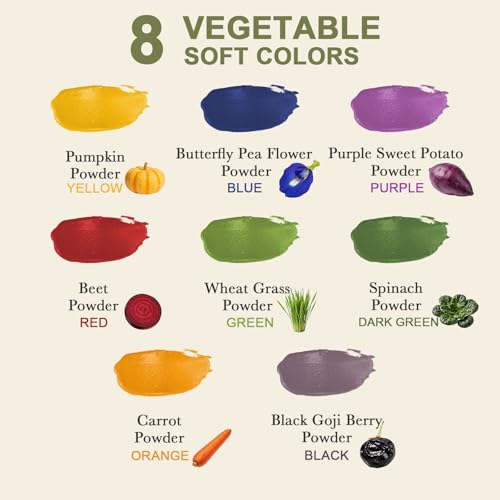
The eight colors are made from plant powders: red from beet, yellow from pumpkin, dark green from spinach, green from wheat grass, purple from sweet potato, blue from butterfly pea, orange from carrot and black from black goji. The listing describes food-grade ingredients that are safe if a child “taste-tests,” and a water-soluble formula that washes off hands, faces and most fabrics with warm water. It is marketed for ages 1 to 6 and up.
Best suited for: Families with more than one young child, playgroups and early-years classrooms.
Key features:
- 8 plant-based colors with named sources
- 8 bowls, 8 scrapers, 4 spoons, 1 palette
- Food-grade ingredients; labeled safe if tasted
- Washes off with warm water
- Marketed for ages 1 to 6+
Pros:
- Best organized kit for group play
- Named food source for every color
- Includes a black shade
- Mid price tier
Cons and limitations:
- Stated age starts at 1, not younger
- Wheat grass may concern families managing wheat or gluten sensitivities
- More pieces to wash after play
Buying consideration: Ideal when two or more children paint together. Families managing wheat sensitivities should check with the maker about the wheat grass color.
4. Honeysticks Non-Toxic Finger Paint, 6 Colors — Best for a ready-mixed next step once mouthing stops

Honeysticks is not marketed as edible, and that distinction matters. It is a water-based, non-toxic finger paint made with cosmetic-grade colorings, sold ready to use in six honeypot-style pots of 2.02 fl oz each: yellow, red, blue, purple, orange and green. We include it as the natural next step once your baby has moved past constant mouthing.
The thick, creamy texture is designed for control by little fingers, with fewer spills. The brand says it washes easily from skin and dries well on paper, so artwork can be hung without smudging. The pots are made from 100% reclaimed curbside plastic and the cardboard is FSC sourced, both recyclable. Honeysticks positions it as perfect for first birthdays and beyond.
Best suited for: Toddlers past the mouthing stage, and parents who want ready-mixed convenience without preparing powder.
Key features:
- 6 colors, 2.02 fl oz pots
- Water-based, non-toxic, cosmetic-grade colorings
- Thick, creamy texture for little fingers
- Washes easily from skin
- Recycled plastic pots; FSC cardboard
Pros:
- No mixing required
- Thick texture reduces spills
- Dries cleanly on paper
- Sustainable packaging
Cons and limitations:
- Not edible or labeled taste-safe
- Highest price tier here
- Six colors only
Buying consideration: Switch to a ready-mixed paint like this once your child reliably keeps hands out of their mouth. Until then, stick with a food-based powder.
Buying Guide: How to Choose Edible Paint for Babies
With baby products, the details on the label matter more than the photos. Here is what to look for.
Understand the label language
“Edible,” “taste-safe” and “safe if accidentally ingested” all signal that a small taste should not harm a child. “Non-toxic” on its own usually means the paint is safe for normal use as an art material, not that it is meant to be eaten. If your baby mouths everything, choose a product with explicit ingestion language.
Check every ingredient
Vegetable-based paints list their color sources: beet, pumpkin, spinach, carrot, sweet potato, butterfly pea and more. Compare these against foods your baby has already eaten without reaction. Watch for items like cocoa, green tea, wheat grass or tomato if you are cautious about specific foods.
Respect the stated age
Lattooland is labeled from 6 months, Jar Melo from 10 months, and ABEIER from 1 year. Starting ages differ because formulas and textures differ. Use the product only from the age the maker recommends.
Powder vs. ready-mixed
Powders stay shelf-stable until you add water, and you control thickness. Once mixed, food-based paint behaves like food: it can spoil. Ready-mixed paints are convenient but are rarely food-based.
Kit contents
Bowls, spoons, scrapers and palettes save you raiding the kitchen. Included paper is a bonus. Kits with one bowl per color are best for group play.
Cleanup
All four products are described as washable. Several makers note that porous fabrics and wood can absorb color, so use a smock or let babies paint in just a diaper, and cover wooden tables.
Prefer to Make Your Own?
Commercial powders are convenient, but you can also make paint at home from pantry staples. Our step-by-step guide on how to make edible finger paint covers simple recipes using ingredients like cornstarch, yogurt and food coloring or vegetable purees, along with storage tips and which recipes suit which age. Homemade paint lets you control every ingredient, which is useful if your baby has food allergies.
How to Set Up a Safe Painting Session
- Choose the right moment. A fed, rested baby is a happier painter.
- Prepare the space. A high chair tray, a splat mat on the floor, or the bathtub (without water) all work well.
- Mix fresh paint. Use clean bowls and warm water; mix only a small amount.
- Offer one or two colors. Too many choices can overwhelm a young baby.
- Stay within arm’s reach. Supervise the entire time.
- Keep it short. Five to ten minutes is often plenty.
- Clean up promptly. Wash hands and face with warm water and discard leftover paint.
Common Mistakes to Avoid
- Treating edible paint as food. It is designed to be safe if tasted, not eaten as a snack.
- Ignoring allergens. Check every ingredient against foods your baby has tried.
- Saving mixed paint for days. Food-based paint can spoil; mix fresh and discard leftovers.
- Using non-edible paint with a baby who mouths. Choose a food-based or taste-safe product until mouthing stops.
- Painting on wooden tables or good clothes. Porous surfaces may absorb color.
- Leaving spoons, scrapers or lids within reach. Small kit parts should stay with the adult.
FAQs
What is the best edible paint for babies?
Jar Melo Vegetable Finger Paint Powder is a strong all-round choice, with 10 colors from named vegetable sources and a label stating it is safe if accidentally ingested from 10 months. For babies from 6 months, Lattooland is labeled for the youngest age.
At what age can babies use edible paint?
It depends on the product. Lattooland is labeled from 6 months, Jar Melo from 10 months and ABEIER from 1 year. Follow the maker’s stated age and supervise closely.
Is edible paint safe for babies to eat?
Edible or taste-safe paint is designed so a small taste is not harmful. It is not intended as food, so discourage eating and supervise the whole session.
Can babies be allergic to edible paint?
Yes. Vegetable-based paints are made from foods, and any food can trigger a reaction in a sensitive child. Check every listed ingredient and use paints made from foods your baby has already eaten safely.
How long does mixed edible paint last?
Treat mixed food-based paint like fresh food. Mix small batches just before play and discard leftovers afterward rather than storing them.
What is the difference between edible paint and non-toxic paint?
Edible or taste-safe paint is made from food ingredients so a taste is not harmful. Non-toxic paint is safe for normal art use but is not designed to be eaten. Honeysticks, for example, is non-toxic with cosmetic-grade colorings but not edible.
Final Recommendation
For most families, Jar Melo Vegetable Finger Paint Powder is the best edible paint for babies, thanks to its 10 food-based colors, clear ingredient sources and generous yield. If your baby is between 6 and 10 months, Lattooland is the option labeled for that age, with a simple four-color kit and paper included.
For siblings, playgroups and classrooms, ABEIER’s one-bowl-per-color kit keeps play organized. Once your child stops mouthing, move up to a ready-mixed paint like Honeysticks for convenience. Whatever you choose, check ingredients, mix fresh, and stay close.