PaintingProGuide is reader-supported. When you buy through links on this page we may earn an affiliate commission at no extra cost to you.
A baby’s first painting session is mostly about touch: squishing color between fingers, slapping a palm on paper, and very likely tasting it. That changes what “best” means. The best first paint set for babies is one made for the age printed on the box, that washes off skin easily, and that keeps the inevitable mouthful as harmless as possible. Brush control, color range and archival quality barely matter yet.
This guide sorts seven sets by age suitability and mess level, and is clear about which ones are really for older toddlers.
Quick answer: For babies under a year, the Jar Melo vegetable-powder finger paint is the best first paint set, since the listing says it is made from vegetable powders and food-grade thickeners for children 10 months and older. From age 1, the Honeysticks non-toxic finger paint offers thick, washable paint in recyclable pots, and the Crayola Mess Free Finger Painting Station lets a 1-year-old paint through a sealed cover with almost no cleanup.
Our Top Picks at a Glance
- Jar Melo Washable Finger Paint Powder, 6 Colors — Best for babies 10 months and up
- Honeysticks Non-Toxic Finger Paint, 6 Colors — Best first finger paint for age 1+
- Crayola Mess Free Finger Painting Station — Best mess-free option for age 1+
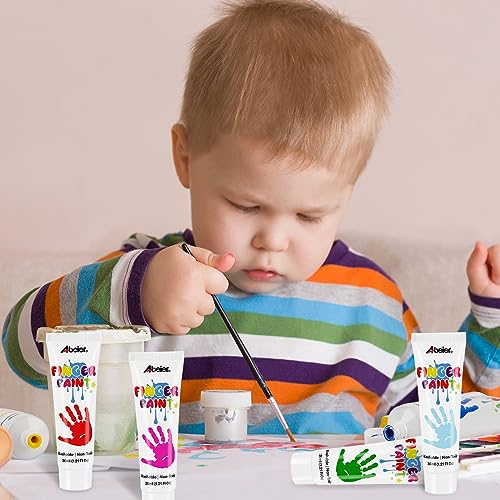
- ABEIER Washable Finger Paint, 12 Colors — Best color variety for toddlers
- Honeysticks My First Paint Brush Set — Best first brushes
- Shuttle Art 37-Piece Washable Finger Paint Set — Best all-in-one toddler kit
- Crayola Spill Proof Paint Set — Best step-up set for age 3+
| Product | Best For | Key Spec | Key Strength | Price Tier |
|---|---|---|---|---|
| Jar Melo Powder Paint | Babies 10 months+ | 6 x 60 g powder bags, each makes about 260 ml | Vegetable-based colors | $$ |
| Honeysticks Finger Paint | First finger painting, 1+ | 6 pots, 2.02 fl oz each | Cosmetic-grade colorings | $$ |
| Crayola Mess Free Station | Low-mess painting, 1+ | 3 x 5 oz paints, 10 sheets, sealed case | Paint stays under cover | $$ |
| ABEIER Finger Paint | Toddlers 1-3 | 12 colors, 1.21 fl oz each | Most colors | $ |
| Honeysticks First Brushes | Ages 1-3 | 3 jumbo wooden brushes | Chunky ergonomic handles | $$ |
| Shuttle Art 37-Piece | Busy toddlers, preschool | 10 x 2 oz paints + smock, sponges, brushes | Most tools included | $$ |
| Crayola Spill Proof | Preschoolers 3+ | 5 spill-proof jars, brush, 20 sheets | Semi-solid, no-drip paint | $ |
How We Chose
We have not used these sets with children. Our picks are based on the Amazon listing details and specifications checked in October 2026, how well each set’s stated age range, ingredients and format suit babies and young toddlers, and how widely each product is reviewed by Amazon buyers.
Our criteria, in order of importance:
- Stated age: we ranked sets by the minimum age on the listing and flag any that start above 1 year.
- Ingredients and safety labeling: non-toxic, ASTM D-4236 conformance or food-based ingredients.
- Washability: paint should come off skin, high chairs and most clothes with water.
- Texture: thick, creamy paint is easier for small hands and spills less.
- Mess control: sealed stations and spill-proof jars for parents who want minimal cleanup.
Safety First: What “Non-Toxic” Means for Babies
Non-toxic art labels, including ASTM D-4236 conformance, mean the product has been reviewed for chronic health hazards and labeled accordingly. They do not mean the paint is food. Several listings here, such as ABEIER’s, specifically say not to swallow. That matters for babies, who explore everything with their mouths.
Only one set here, Jar Melo, describes itself as made from vegetable powders and food-grade thickeners and safe if accidentally ingested. Even so, always supervise, keep sessions short, and check the age printed on the product. Many parents also make a simple homemade edible paint from yogurt and food coloring for the youngest babies, which is worth knowing as an alternative.
Best First Paint Sets for Babies Reviewed
1. Jar Melo Washable Finger Paint Powder, 6 Colors — Best for Babies 10 Months and Up

Jar Melo takes a different approach from bottled paints. You get six bags of colored powder made from vegetables (beet, pumpkin, spinach, sweet potato, butterfly pea flower and tomato, per the listing) plus food-grade thickeners. Mix with warm water and it turns into a creamy, mousse-like paint. Each 60 g bag makes about 260 ml.
The listing says it has no additives, is safe if accidentally ingested, and is suitable from 10 months, the youngest stated age in this roundup. A mixing palette, two spoons and six stirring sticks are included. Because you mix it yourself, you can make it thicker for tiny hands or thinner for brushes later on.
Best suited for: Babies from about 10 months, parents who want the most food-like ingredients, and first sensory play sessions.
Key features:
- 6 powder colors from vegetable sources
- Each 60 g bag makes about 260 ml
- Palette, spoons and stirring sticks included
- Water-soluble, washes from skin
- Listed for 10 months and older
Pros:
- Youngest stated age in this list
- Vegetable-based colors
- Mix only what you need
Cons and limitations:
- Requires mixing before each session
- Natural colors are softer than synthetic paints
- Porous fabric and wood may still stain
Buying consideration: The best choice before your baby’s first birthday. Mix small batches so leftovers do not sit around.
2. Honeysticks Non-Toxic Finger Paint, 6 Colors — Best First Finger Paint for Age 1+

Honeysticks’ finger paint is water-based and made with cosmetic-grade colorings, according to the listing. The set includes six pots of 2.02 fl oz each in yellow, red, blue, purple, orange and green. The texture is thick and creamy, which helps little fingers control it and reduces spills.
It washes off hands and feet, dries well on paper without smudging, and comes in honeypot-shaped bottles made from reclaimed curbside plastic with FSC-sourced cardboard packaging. Honeysticks positions it for first birthdays and beyond.
Best suited for: One-year-olds starting finger painting, handprint and footprint keepsakes, and eco-conscious families.
Key features:
- 6 pots, 2.02 fl oz each
- Water-based, cosmetic-grade colorings
- Thick, creamy texture
- Recyclable packaging from reclaimed plastic
Pros:
- Thick texture suits tiny hands
- Washes from skin easily
- Sustainable packaging
Cons and limitations:
- Higher price tier for six colors
- Not food; supervise mouthing
- Bright primaries only, no white or black
Buying consideration: A good first “real” paint once your child is 1. Use heavy paper or a roll of kraft paper taped to the floor.
3. Crayola Mess Free Finger Painting Station — Best Mess-Free Option for Age 1+

Crayola’s station keeps paint and paper locked inside a case. Your child presses and smears paint through a flexible cover, so the hands stay clean while the colors move underneath. The kit includes three 5 oz squeeze bottles of washable finger paint in red, blue and yellow and 10 sheets of coated finger painting paper.
It is labeled safe and non-toxic for ages 1 and up. Cleanup is putting the unit under the faucet or in the dishwasher. Refills of paint and paper are sold separately.
Best suited for: Parents who want painting without mess, travel, restaurants and sensory play for 1-year-olds.
Key features:
- Sealed finger paint case with flexible cover
- 3 x 5 oz washable paints (red, blue, yellow)
- 10 coated paper sheets
- Dishwasher-safe unit
- Ages 1+
Pros:
- Almost no mess
- Teaches color mixing with primaries
- Dishwasher cleanup
Cons and limitations:
- Less direct sensory contact with paint
- Highest price tier in this list
- Refills cost extra
Buying consideration: Great for days you cannot face cleanup. Many families use it alongside a regular finger paint for messier outdoor sessions.
4. ABEIER Washable Finger Paint, 12 Colors — Best Color Variety for Toddlers

ABEIER offers 12 colors, including white and black, which lets toddlers mix and make lighter shades. Each bottle holds 1.21 fl oz. The listing describes a thick, silky cream texture, ASTM D-4236 conformance and washability from skin, fabric and plastic.
It is marketed for ages 1 to 3 but also notes “do not swallow” and a small parts choking hazard, so plan for close supervision. Porous fabric and wood can absorb it, according to the brand.
Best suited for: Toddlers who are past the mouthing stage and want more colors to explore.
Key features:
- 12 colors, 1.21 fl oz each
- ASTM D-4236 conformance
- Washable from skin and many surfaces
- Matte finish
Pros:
- Widest color range here
- Includes white and black for mixing
- Low price tier
Cons and limitations:
- Not intended for swallowing
- Small bottles run out faster
- Choking hazard warning on caps
Buying consideration: Choose this once your toddler mostly paints rather than tastes.
5. Honeysticks My First Paint Brush Set, 3 Pack — Best First Brushes

Standard brushes are too thin for little hands. Honeysticks’ jumbo brushes have chunky, ergonomic wooden handles designed for ages 1 to 3, with vegan bristles. The listing says the brushes are non-toxic and made of natural wood, and come in a plastic-free storage container.
Brushes are not paint, so pair them with a set above. They become useful once your child is curious about tools rather than only hands.
Best suited for: Toddlers ready to move from fingers to tools, and as an add-on to any finger paint set.
Key features:
- 3 jumbo brushes
- Chunky ergonomic wooden handles
- Vegan bristles
- Plastic-free storage container
- Ages 1-3
Pros:
- Easy grip for small hands
- Natural materials
- Reusable storage
Cons and limitations:
- Paint sold separately
- Only three brushes
- Wooden handles should be dried after washing
Buying consideration: Add this to your cart with any finger paint once your child shows interest in tools.
6. Shuttle Art 37-Piece Washable Finger Paint Set — Best All-in-One Toddler Kit

Shuttle Art packs in 10 washable finger paint colors in 2 oz bottles plus a kids’ apron, 2 palettes, 6 brushes, 4 roller sponges, 2 sponge shovels, 4 square and round sponge brushes, 4 broom sponge brushes and 4 sponge stampers.
The paint is water-based, conforms to ASTM D-4236 and EN71-3, and is described as washable from skin, desks, glass and fabric. The tool variety suits toddlers who get bored with plain finger painting.
Best suited for: Older toddlers and preschoolers, playgroups and families who want a full art kit in one box.
Key features:
- 10 washable paints, 2 oz each
- Smock, 2 palettes, 6 brushes
- 14 sponge tools and 4 stampers
- ASTM D-4236 and EN71-3
Pros:
- Most complete kit here
- Sponge tools add variety
- Smock included
Cons and limitations:
- Small sponge parts not suitable for babies who mouth objects
- More items to clean and store
- Paint is not food-grade
Buying consideration: Better for ages 2 and up. For a 1-year-old, start with a simpler paint-only set.
7. Crayola Spill Proof Paint Set — Best Step-Up Set for Age 3+

Crayola’s spill-proof set uses semi-solid paints in reusable jars designed to resist spills and drips. It includes five washable paints, one brush and 20 sheets of paper. The listing states ages 3 and up.
We include it because many parents search for a “first paint set” when buying for a preschooler. It is not a baby product, but it is a natural next step after finger paints.
Best suited for: Preschoolers age 3 and older moving from fingers to brushes.
Key features:
- 5 spill-proof washable paints
- 1 brush and 20 sheets of paper
- Semi-solid formula
- Ages 3+
Pros:
- Spill-resistant jars
- Washable from skin and most clothing
- Low price tier
Cons and limitations:
- Not for babies or young toddlers
- Only one brush
- Limited color range
Buying consideration: Keep this for after the third birthday. Before then, choose a finger paint set.
Buying Guide: How to Choose a First Paint Set for a Baby
For babies and young toddlers, the right paint is about age, ingredients and how much cleanup you can handle.
Check the Minimum Age
The age on the package is a key safety signal. Here, Jar Melo lists 10 months, Honeysticks and Crayola Mess Free list age 1, ABEIER lists 1 to 3, and the Crayola Spill Proof set lists 3+. Do not size down based on enthusiasm.
Ingredients and Labeling
Look for non-toxic labeling and ASTM D-4236 conformance at minimum. For babies who mouth everything, food-based options like vegetable powder paint are the most cautious choice. Read warnings carefully; “do not swallow” is a meaningful note.
Texture
Thick, creamy paint is easier for babies to control and less likely to splash. Thin, runny paint drips off paper and spreads more widely on skin and surfaces.
Washability
Washable paint should rinse off skin with water and come out of most clothing. Porous fabrics and wood can still stain, so dress your child in old clothes or a smock and cover the table.
Mess Level
Decide how much mess you can handle. Sealed stations keep paint contained; open pots give full sensory play. Many parents keep one of each.
Colors and Tools
Babies do not need many colors. Three to six is plenty and helps them notice mixing. Brushes and sponges come later, usually after 18 months to 2 years.
Setup and Surface
Tape heavy paper or a roll of kraft paper to a high chair tray, floor or table. Bath time painting on the tub wall is another easy cleanup option for washable paints.
More Creative Projects for Little Ones
As your child grows, paint becomes part of bigger projects. When they are a bit older, a simple family craft like a painted birdhouse is a fun shared activity, and preschoolers often love scratch art painting crafts, which reveal color under a dark layer.
Common Mistakes to Avoid
- Buying a set labeled 3+ for a 1-year-old.
- Assuming “non-toxic” means safe to eat.
- Leaving a baby unsupervised with any paint.
- Using thin printer paper that tears under wet hands.
- Starting with lots of small tools that become choking hazards.
- Planning long sessions; 10 to 15 minutes is often plenty for babies.
- Dressing babies in favorite clothes for painting.
FAQs
At what age can a baby start painting?
Some products are labeled for babies from about 10 months, such as vegetable-based powder paint. Most finger paints are labeled for age 1 and up. Always follow the age on the package and supervise closely.
What paint is safe for babies who put things in their mouth?
Food-based paints made from vegetable powders, or homemade paint from yogurt and food coloring, are the most cautious options. Standard non-toxic finger paints are not intended to be eaten.
Is Crayola finger paint safe for 1-year-olds?
The Crayola Mess Free Finger Painting Station is labeled non-toxic for ages 1 and up. Because the paint stays under a cover, there is less chance of mouthing.
How do I clean finger paint off a baby?
Washable finger paints rinse off skin with warm water and a little soap. Painting just before bath time makes cleanup simple.
Do babies need paint brushes?
Not at first. Babies paint with hands and feet. Chunky brushes like the Honeysticks set become useful once toddlers show interest in tools, often around 18 months to 2 years.
What paper should I use for baby finger painting?
Heavy paper, coated finger paint paper or kraft paper rolls work best. They hold wet paint without tearing.
Final Recommendation
For babies under a year, choose the Jar Melo vegetable powder paint. From the first birthday, the Honeysticks finger paint is an excellent open-pot option, and the Crayola Mess Free Station is ideal when you want painting without cleanup.
Toddlers who are past the mouthing stage can enjoy the 12 colors in the ABEIER set or the tool-packed Shuttle Art kit. Add the Honeysticks jumbo brushes when they are ready for tools, and save the Crayola Spill Proof set for preschool.