
PaintingProGuide is reader-supported. When you buy through links on this page we may earn an affiliate commission at no extra cost to you.
Amsterdam is the acrylic line from the Dutch paint maker Royal Talens, and it has a reputation as a sensible middle ground: more serious than craft acrylic, kinder to the wallet than the top professional brands. Anyone searching for an Amsterdam heavy body acrylic paint review wants to know two things. How thick is it really, and does it hold up against heavy body paints from Liquitex, GOLDEN and the newer budget brands?
The Amsterdam product available on Amazon in our October 2026 check is the Standard Series primary set of five 120 ml tubes. Below we look at what that listing actually promises, where it fits on the thickness scale, and how it compares with four heavy body sets that are listed alongside it.
Quick answer: The Amsterdam Standard Series primary set is a strong pick for painters who mix their own colors and want large 120 ml tubes of a durable 100 percent acrylic resin paint. If you need the stiffest true heavy body for impasto, the GOLDEN Heavy Body Traditional set and the Liquitex Heavy Body Classic 12-tube set are the professional benchmarks; the MEEDEN 24-tube heavy body set is the value choice for color variety.
Our Top Picks at a Glance
- Amsterdam Standard Series Primary Set, 5 x 120 ml — Best for color mixing in large tubes
- GOLDEN Heavy Body Traditional Set, 8 Colors + Glazing Liquid — Best professional heavy body for figurative work
- Liquitex Heavy Body Classic 12 x 59 ml — Best professional all-round palette
- MEEDEN Heavy Body Satin, 24 x 60 ml — Best value for color range
- PENTRISTA Heavy Body, 9 Colors 220 ml — Best large tubes for impasto on a budget
| Product | Best For | Key Spec | Key Strength | Price Tier |
|---|---|---|---|---|
| Amsterdam Standard 5 x 120 ml | Mixing a full palette | 100% acrylic resin binder; satin | Large tubes, alkali resistant | $$ |
| GOLDEN HB Traditional | Figurative and portrait work | 8 colors + gloss glazing liquid | Pigment-specific formulation | $$$ |
| Liquitex HB Classic 12 | Professional general palette | 12 x 59 ml, satin, flexible | Intermixes with Liquitex range | $$$ |
| MEEDEN HB 24 | Students wanting many colors | 24 x 60 ml, satin | Wide color selection | $$ |
| PENTRISTA HB 9 | Impasto on a budget | 9 colors, 220 ml tubes, gloss | Large volume per color | $$$ |
How We Chose
We based these picks on the Amazon listing details and specifications checked in October 2026, on how well each set’s consistency, color selection and tube size suit heavy body acrylic painting, and on how widely each product is reviewed by Amazon buyers. We have not painted with these sets; product claims come from the listings or from widely known facts about acrylic paint.
- Consistency — whether the listing describes a thick, brushstroke-holding body.
- Binder — 100 percent acrylic resin and flexibility claims.
- Color selection — mixing primaries versus a ready-made range.
- Volume per color — large tubes matter for background and impasto work.
- Finish and lightfastness information — satin or gloss, and any permanency claims.
Amsterdam Heavy Body Acrylic Paint Review: What You Get
The Standard Series set on Amazon
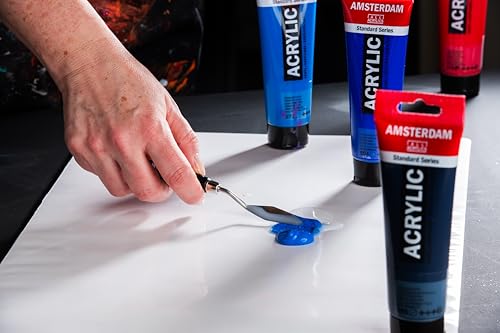
The listing is for the Amsterdam Standard Series primary set, item 17790905: five tubes of 120 ml each, about 4 fl oz per tube. The colors are labeled as a primary set, built for mixing. The binder is stated as 100 percent acrylic resin, and the listing calls the paint film exceptionally durable.
Other listed properties are practical. The paint is alkali resistant, so the maker says it is suitable for wall paintings. It thins easily with water, and thin films dry within about half an hour. The finish is satin, and the product is flagged as fade resistant.
Is Amsterdam Standard Series heavy body?
This is the key point for anyone who searched for “heavy body.” The listing does not call the Standard Series heavy body. Amsterdam positions Standard Series as its core tube paint, and many painters treat it as a medium-to-thick consistency rather than the stiffest paste on the market. If you want peaks that stand up on their own from a palette knife, a dedicated heavy body line or a gel medium will do that more reliably.
For most brush painting, though, the difference matters less than people expect. A tube acrylic that holds a soft brushstroke and mixes cleanly is what most painters actually use day to day.
Who it suits
- Painters who mix their own colors from primaries.
- Murals and large canvases, where 120 ml tubes and the alkali-resistance claim help.
- Students who want a step up from craft acrylic without professional pricing.
Limitations
- Only five colors; you mix everything else.
- Not labeled as heavy body, so impasto may need a gel medium.
- The listing does not name the individual pigments.
Amsterdam and Heavy Body Alternatives Reviewed
1. Amsterdam Standard Series Primary Set, 5 x 120 ml — Best for color mixing in large tubes

This is the reviewed product. Five large tubes give you a lot of paint per color, which suits painters who work big or who burn through white and primaries quickly. The 100 percent acrylic resin binder is the same binder type used across most artist-grade acrylics.
The alkali-resistance and wall-painting note is unusual among art acrylic listings, and makes this set worth considering for murals on primed interior walls.
Best suited for: Painters who mix from primaries and want generous volume; mural painters.
Key features:
- Five 120 ml tubes
- 100% acrylic resin binder
- Satin finish, fade resistant
- Alkali resistant; listed for wall painting
- Thin films dry in about 30 minutes
Pros:
- Large tube size for the price tier
- Durable paint film claim
- Water-thinnable and easy to clean
Cons and limitations:
- Not marketed as heavy body
- Limited to five colors
Buying consideration: Choose this when volume and mixing matter more than maximum thickness. Add a heavy gel if you want sculpted impasto.
2. GOLDEN Heavy Body Traditional Set — Best for figurative and portrait work

GOLDEN’s set gathers eight historically significant colors for figurative painting: Cadmium Yellow Light, India Yellow Hue, Cadmium Red Light, Alizarin Crimson Hue, Ultramarine Blue, Prussian Blue Hue, Viridian Green Hue and Titanium White, plus Gloss Glazing Liquid.
The paint is described as exceptionally smooth and thick, holding brushstrokes and palette-knife marks. Each color is formulated around its pigment, so sheen and opacity vary across the set. GOLDEN is an employee-owned American company and the listing notes excellent permanency and lightfastness.
Best suited for: Figurative, portrait and still-life painters who want a professional heavy body palette.
Key features:
- Eight heavy body colors plus gloss glazing liquid
- Pigment-specific formulation
- Holds brush and knife marks
- Made in the USA
Pros:
- True heavy body consistency
- Classic mixing palette
- Glazing liquid included
Cons and limitations:
- Small tube sizes in this set
- Higher price per milliliter
Buying consideration: The best option here if heavy body texture and pigment quality are your priority and you can accept small tubes.
3. Liquitex Heavy Body Classic 12 x 59 ml — Best for a professional general palette

Liquitex describes its Heavy Body as thick, rich and highly pigmented, with a satin finish that stays flexible when dry. The twelve tubes include Cadmium Yellow Medium Hue, Cadmium Red Light Hue, Quinacridone Magenta, Ivory Black, Emerald Green, Phthalocyanine Green, Phthalocyanine Blue, Brilliant Blue, Bronze Yellow, Dioxazine Purple and two Titanium Whites.
The colors intermix with the wider Liquitex Professional range and mediums, which makes it easy to extend later.
Best suited for: Students through professionals who want a balanced, well-known heavy body palette.
Key features:
- 12 x 59 ml tubes
- Satin finish, flexible film
- Two whites included
- Intermixable with Liquitex mediums
Pros:
- Wide, balanced color range
- Two whites, which run out first
- Established professional line
Cons and limitations:
- Highest price tier here
- Uses hues for cadmium colors
Buying consideration: A dependable default for heavy body painting. Buy it when you want a complete palette from a single trusted line.
4. MEEDEN Heavy Body Satin, 24 x 60 ml — Best for value and color range

MEEDEN offers 24 colors in 60 ml tubes, a much broader range than the professional sets at a lower tier. The heavy body formula is described as moldable for thick, textured layers while keeping clear brushstrokes.
The listing gives a surface dry time of around 15 minutes and describes a soft, water-resistant film. It is listed as non-toxic and fade resistant, and compatible with gels, varnishes and pouring mediums.
Best suited for: Students and hobby painters who want lots of colors to experiment with.
Key features:
- 24 x 60 ml tubes
- Heavy body, satin finish
- Surface dry about 15 minutes
- Non-toxic, fade resistant
Pros:
- Large color selection
- Good tube size for the tier
- Works with common mediums
Cons and limitations:
- Pigment details not listed
- Many premixed colors can discourage mixing practice
Buying consideration: Good for exploring color. If you later move to a professional brand, keep the MEEDEN tubes for underpainting.
5. PENTRISTA Heavy Body, 9 Colors 220 ml — Best for impasto on a budget

PENTRISTA sells nine colors in large 220 ml tubes, emphasizing a thick, buttery paste that holds peaks for impasto and palette knife work. The finish is gloss, and touch-dry time is listed at 15 to 20 minutes.
The listing names AP, ACMI and ASTM D-4236 certification, which is useful for classrooms. It also lists canvas, wood, ceramic, glass and stone as surfaces.
Best suited for: Texture and palette-knife painters who need a lot of paint.
Key features:
- Nine colors, 220 ml tubes
- Thick paste for impasto
- Gloss finish
- AP, ACMI, ASTM D-4236 certified
Pros:
- Most paint per color here
- Clearly aimed at impasto
- Safety certifications listed
Cons and limitations:
- Newer brand with less track record
- Gloss finish may not suit everyone
Buying consideration: If impasto volume is the goal, this gives you the most paint to sculpt with.
The Acrylic Consistency Scale Explained
Acrylic paint is sold in several bodies, and knowing where each sits helps you judge whether Amsterdam or a heavy body alternative suits your work.
Heavy body
Thick, buttery paint that holds brush ridges and knife marks as it dries. It is the choice for impasto, expressive brushwork and alla prima painting where texture is part of the image. GOLDEN, Liquitex, MEEDEN and PENTRISTA all label their sets here as heavy body.
Standard or medium body
A softer tube paint that still has body but levels slightly as it dries. It brushes out smoothly, covers large areas easily and mixes quickly. Many painters prefer it for blended, realistic work and for big canvases.
Soft body and fluid
Pourable or creamy paints for glazing, staining, airbrushing and fine detail. These are the opposite end of the scale from heavy body.
Mediums change the body
Because all acrylics share the same type of binder, you can move a paint along the scale. A heavy gel thickens; a fluid or glazing medium thins without breaking down the film the way excess water can. That flexibility is why a non-heavy-body paint like Amsterdam Standard Series can still be used for textured work.
How to Get Heavy Body Results With Amsterdam Standard Series
If you already own Amsterdam tubes or like their value, these steps help you build texture without switching brands.
- Mix in a heavy gel medium. Start around one part gel to two or three parts paint, then adjust. Gloss gel keeps colors deep; matte gel softens sheen.
- Use a palette knife for the top layers. Knives deposit paint without flattening it the way a soft brush can.
- Build texture in stages. Thick acrylic can skin over while the inside stays wet. Several medium layers cure more evenly than one very thick application.
- Choose firm brushes. Stiff synthetic or bristle brushes leave clearer ridges than soft taklon.
- Let the work cure before varnishing. Thick passages need longer than the half-hour dry time quoted for thin films.
Mixing a Full Palette From Five Primaries
A primary set rewards a little planning. Lay out white at the edge of the palette and your colors around it, then mix secondary colors (orange, green, violet) in small batches before you start the painting. Make a simple chart on scrap canvas showing each primary mixed with white and with each other primary; it takes an hour and shows you exactly what the set can do.
Neutrals come from mixing complements, such as red with a green you mixed from blue and yellow. Those mixed grays and browns are often more harmonious than a tube black. Large 120 ml tubes make this approach economical, because you are never rationing the colors you rely on most.
Buying Guide: How to Choose Heavy Body Acrylic Paint
Decide how thick you really need
Heavy body is a spectrum. If you mostly brush, a standard tube paint is enough. If you sculpt with a knife, choose a true heavy body or add gel medium.
Primaries or full palette
Primary sets like Amsterdam’s teach mixing and save money. Full palettes save time and give consistent colors across paintings.
Check tube size
White and the colors you use most disappear fast. Larger tubes lower the cost per milliliter.
Finish
Satin is the most common; gloss heightens color depth; matte reduces glare. You can change it later with varnish.
Look for binder and lightfastness information
A stated 100 percent acrylic binder and lightfastness notes signal artist-grade intent.
Plan for mediums
Gels, glazing liquids and retarders extend any paint. Check that a brand lists compatibility.
Put Your Paint to Work
Looking for projects? See our guide to making DIY wall art with acrylic and our list of simple acrylic painting ideas for beginners.
Common Mistakes to Avoid
- Expecting standard tube paint to hold sharp impasto peaks without a gel.
- Thinning heavy body acrylic with too much water, which weakens the film.
- Squeezing out too much paint; acrylic dries on the palette quickly.
- Leaving caps loose so tubes dry out.
- Varnishing before thick layers are fully cured.
FAQs
Is Amsterdam acrylic paint heavy body?
The Amsterdam Standard Series set on Amazon is not labeled heavy body. It is a tube acrylic for general painting; add a gel medium if you want thicker impasto.
Who makes Amsterdam acrylic?
Amsterdam acrylics are made by Royal Talens, a Dutch art materials company.
Is Amsterdam paint artist grade?
Amsterdam is usually considered a quality student-to-artist line. The listing describes a 100 percent acrylic resin binder and a durable film.
Can Amsterdam acrylic be used on walls?
The listing says it is alkali resistant and suitable for wall paintings, which makes it a reasonable choice for interior murals on primed walls.
How fast does Amsterdam acrylic dry?
According to the listing, thin films dry within about half an hour. Thick layers take longer.
Is GOLDEN or Liquitex heavy body better than Amsterdam?
They are thicker and more pigment-focused, and cost more per milliliter. Amsterdam wins on volume and value.
Final Recommendation
Buy the Amsterdam Standard Series primary set if you like mixing colors, paint large, or want a durable acrylic for an interior mural. If true heavy body thickness is non-negotiable, GOLDEN’s Traditional set is the most texture-focused professional pick and Liquitex Heavy Body Classic is the most complete palette. MEEDEN suits students who want variety, and PENTRISTA suits impasto painters who need volume.


One Comment