PaintingProGuide is reader-supported. When you buy through links on this page we may earn an affiliate commission at no extra cost to you.
Quick answer: GOLDEN Fluid Acrylics are professional acrylics with a pourable, heavy-cream consistency and a pigment load comparable to GOLDEN Heavy Body. They are an excellent choice for glazing, staining, detail work, pouring and mixed media, but they cost more than student paint and offer no impasto texture on their own. Most buyers should start with the 10-color Fluid Mixing Set, then add Titanium White and one or two signature colors such as Azo Gold or Iridescent Gold Deep (Fine).
This GOLDEN Fluid Acrylics review is for painters deciding whether the line is worth its premium price, and which bottles to buy first. It covers what Fluids actually are, how they differ from Heavy Body and High Flow, the five GOLDEN Fluid products most buyers look at on Amazon, and the practical trade-offs that matter once paint hits the surface.
Fluids sit in an unusual spot. They are thin enough to flow off a brush in long lines and to level into smooth, brushmark-free films, yet they keep the color strength of a tube paint. That combination is why they show up in glazing tutorials, pour paintings, sketchbooks and airbrush setups alike.

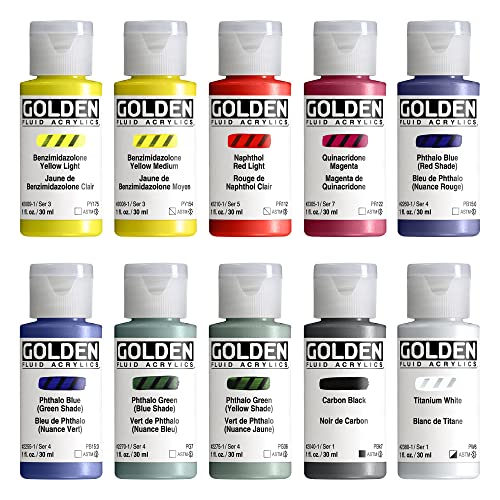
GOLDEN Fluid Acrylics Mixing Set,…
The Fluid Mixing Set contains 10 colors – a warm and cool choice of each primary color in addition to other key colors allows the artist to mix an extensive…

GOLDEN Fluid Acrylics, Titanium White,…
Our most opaque white, made with Titanium Dioxide, is an essential white for most painters. ASTM Lightfastness I (Excellent); Semi-Opaque; Pigment(s): PW6 (Titanium Dioxide Rutile); Vegan VERSATILITY – Blends easily…
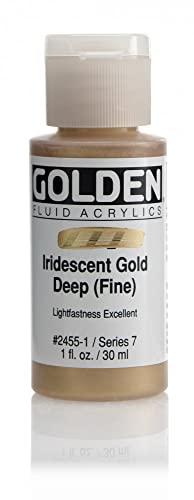
Fluid Acrylics by GOLDEN, Iridescent…
Finely ground, coated mica particles give this paint a rich metallic luster. Excellent Lightfastness; Semi-Opaque; Pigment(s): Titanium Dioxide and Iron Oxide Coated Mica Particles; Vegan VERSATILITY – Blends easily with…
GOLDEN Fluid Acrylics at a Glance
GOLDEN Artist Colors makes several acrylic lines from the same family of pigments: Heavy Body (thick, buttery), Fluid (pourable), High Flow (ink-thin) and OPEN (slow drying). Fluid Acrylics are the middle ground between Heavy Body and High Flow. GOLDEN describes their pigment concentration as similar to Heavy Body, which means you are buying a thinner paint, not a weaker one.
The line comes in squeeze bottles rather than tubes, and in sizes that typically run from 1 oz up to larger studio bottles. Colors are single-pigment wherever practical, and GOLDEN prints pigment information and lightfastness ratings on the label, which is useful when you want to predict how mixes will behave.
| Product | Best For | Key Spec (from listing) | Key Strength | Who Should Skip It |
|---|---|---|---|---|
| GOLDEN Fluid Acrylics Mixing Set | Most new Fluid users | 10 colors, warm and cool of each primary | Full mixing range from one box | Painters who only need one or two colors |
| GOLDEN Fluid Titanium White | Tints, highlights, value control | PW6 (Titanium Dioxide Rutile), ASTM Lightfastness I | The most-used color in nearly any palette | Painters who mainly work in transparent glazes |
| GOLDEN Fluid Iridescent Gold Deep (Fine) | Metallic accents and lettering | Coated mica with titanium dioxide and iron oxide | Warm metallic sheen that will not tarnish like real metal | Anyone needing flat, opaque color |
| GOLDEN Fluid Acrylics Intro Set | Trying the line on a smaller budget | Six-bottle introductory set | Lower entry cost than the Mixing Set | Painters who want a full warm/cool palette |
| GOLDEN Fluid Azo Gold | Warm glazes and glowing light | Single-color bottle | Rich transparent-leaning warmth | Painters who rarely use warm yellows |
How We Evaluated This Line
This review is research-based. It draws on the Amazon listing information for each product (checked in November), GOLDEN’s published product descriptions, and well-established knowledge of how fluid acrylics behave. No claims here rely on personal swatches or studio trials. The criteria were:
- Viscosity fit: whether a fluid consistency suits the techniques the product is aimed at.
- Pigment information: whether the listing discloses pigments and lightfastness.
- Palette value: how many useful mixes a set or single color unlocks.
- Format: bottle size and set composition versus likely usage.
- Versatility: compatibility with mediums, grounds and other acrylic lines.
What Makes GOLDEN Fluid Acrylics Different
High pigment load in a thin body
Many cheap “fluid” or craft acrylics get their flow by adding water, fillers or extra binder, which dilutes color. GOLDEN Fluids are formulated to flow while keeping strong pigmentation. In practice, that means a small amount tints a mix noticeably, and thinned washes stay vivid instead of turning chalky.
Leveling, smooth films
Because the paint is pourable, it settles out of brushstrokes as it dries. That is ideal for flat color fields, hard-edge work, illustration and graphic design-style painting. It is a disadvantage if you want visible, sculpted brush texture; for that you need Heavy Body paint or a gel added to the Fluid.
Fast drying
Like most acrylics, Fluids dry quickly, and thin films dry fastest. A thin glaze can be touch-dry in minutes in a warm room. That speeds up layering but shortens blending time. Painters who need longer working time usually add a retarder or switch to GOLDEN OPEN for blending passages.
Flexible, permanent acrylic film
Once dry, Fluids form a water-resistant, flexible acrylic film that bonds to properly prepared canvas, panel, paper and many primed surfaces. That durability is a big reason they work in mixed media journals, where pages flex and get handled.
The GOLDEN Fluid Products Reviewed
1. GOLDEN Fluid Acrylics Mixing Set — Best Starting Point
The Mixing Set is built around a warm and a cool version of each primary plus a few key supporting colors. That warm/cool approach is the classic way to mix clean secondaries: pair the two primaries that lean toward each other and you avoid the muddy greens and purples that come from mixing “wrong-bias” colors.
For a first purchase in the Fluid line, a curated set also removes guesswork. You get colors chosen to work together, in bottles small enough to explore without committing to large sizes.
Best suited for: painters new to GOLDEN Fluids, color-mixing students, and mixed media artists who want a compact but complete palette.
Pros
- Warm and cool primaries for cleaner mixing
- Professional pigment strength across the set
- Fluid body suits glazing, line work and staining
- Compact enough for a small studio or travel kit
Cons
- Small bottles empty quickly on large canvases
- Higher cost than student-grade sets
- White may run out first, so a larger white is a common add-on
Buying consideration: confirm the exact color list on the listing before buying. If you already own a few GOLDEN colors, check for overlap so you are not paying for duplicates.
2. GOLDEN Fluid Titanium White — Best Add-On Color
Titanium White (PW6) is the workhorse white in almost every acrylic palette. The listing rates it ASTM Lightfastness I, the highest category, and GOLDEN calls it its most opaque white. It is the color you use to lighten values, mix pastels, cover dark grounds and add highlights.
Because white disappears faster than any other color, buying it in a larger bottle than the rest of your palette is usually the economical move. Note that titanium white is strong: a little cools and lightens a mix more than many beginners expect, so add it gradually.
Best suited for: anyone building a Fluid palette, especially painters who mix lots of tints or work over dark or toned grounds.
Pros
- Strong opacity and tinting strength
- Top lightfastness rating per the listing
- Flows well for highlights, dots and fine lines
- Larger bottle suits heavy use
Cons
- Overuse can make mixes look chalky or cool
- Not the right white for delicate transparent tints (zinc white is softer)
- Bottle tip needs wiping to avoid dried plugs
Buying consideration: check the bottle size on the listing and compare unit cost against smaller sizes. For most palettes, the larger white is better value.
3. GOLDEN Fluid Iridescent Gold Deep (Fine) — Best Metallic
GOLDEN’s Iridescent colors use mica flakes coated with metal oxides to create a metallic effect. According to the listing, this one uses titanium dioxide and iron oxide coated mica. “Fine” refers to the particle size: smaller flakes give a smoother, satin-like shimmer rather than a sparkly, coarse glitter.
Unlike real metal leaf or bronze powders, coated mica does not tarnish. The color reads best over dark grounds, where the reflective particles stand out, and in thin glazes over other colors, where it adds a warm gleam.
Best suited for: lettering, accents, icon-style and decorative work, mixed media highlights and frames.
Pros
- Warm, rich gold tone
- Fine particles for smoother lines
- Non-tarnishing mica pigment
- Mixes with mediums for metallic glazes
Cons
- Semi-opaque, so solid coverage may take several coats
- Mica can settle; shake before use
- Over-thinning with water weakens the metallic effect
Buying consideration: metallics look very different under gallery lighting than in a product photo. If the look matters for a commission, try a small bottle before buying large.
4. GOLDEN Fluid Acrylics Intro Set — Best Budget Entry

The Intro Set is a smaller, six-bottle way into the line. It suits painters who want to see how Fluids fit their process before investing in a wider palette. Expect a more limited mixing range than the 10-color Mixing Set, since there are fewer warm/cool pairs to work with.
Best suited for: curious beginners, sketchbook painters, and artists who want to compare Fluids against their current acrylics.
Pros
- Lower entry cost than larger sets
- Same professional formulation as open-stock bottles
- Good for learning glazing and staining
- Compact for travel or a desk setup
Cons
- Narrower color range limits clean mixing
- Probably needs a white added
- Per-ounce cost is usually higher than single large bottles
Buying consideration: compare the color list with the Mixing Set. If the extra colors in the larger set are ones you would buy anyway, the bigger set is often better value.
5. GOLDEN Fluid Azo Gold — Best for Warm Glazes

Azo Gold is a deep, warm yellow-orange with a transparent-leaning character. In thin glazes it gives a golden, sunlit warmth; layered, it moves toward amber. It is a popular choice for wood tones, autumn foliage, warm skies and for knocking cool passages back toward warmth.
Mixed with a blue, it produces olive and earthy greens; mixed with white, soft straw yellows. Because it is a strong color, it can dominate a mix quickly, so add it in small amounts. To see how GOLDEN colors stack up against a major rival, read our Liquitex vs GOLDEN acrylic comparison.
Best suited for: landscape and still life painters, glazing-heavy workflows, and anyone who wants warmer, more luminous shadows and lights.
Pros
- Glowing warmth in thin layers
- Useful for natural, earthy mixes
- A little goes a long way
- Works well over textured gels for an aged look
Cons
- Strong tint can overpower mixes
- Not suited to flat, opaque color blocks without white
- Like most acrylics, may dry slightly darker than it looks wet
Buying consideration: if you already own a warm yellow and a red-orange, check whether you can mix a similar color before adding Azo Gold. Many painters still keep it for the clean glazes a single color gives.
Strengths and Limitations of the GOLDEN Fluid Line
Where Fluids shine: glazing, flat color fields, hard edges, lettering, staining raw canvas, mixed media, pour painting, monoprinting and, when properly reduced, airbrushing. They also intermix with Heavy Body, so you can keep a few Fluids next to thicker paint for line work and washes.
Where they fall short: impasto and visible brush texture, slow wet-into-wet blending, and budget-driven large projects. If you cover big canvases with flat color, the premium per ounce adds up fast.
Price and value: Fluids are priced as professional paint. The value comes from pigment strength: you often need less paint per glaze than with a weaker student paint. Check current prices on Amazon, since set and bottle pricing changes regularly.
How to Use GOLDEN Fluid Acrylics
Glazing
Mix a small amount of a transparent or semi-transparent Fluid into a gloss or matte medium rather than plain water. A starting ratio of roughly 1 part paint to 5–10 parts medium gives a clear, luminous glaze. Medium keeps the binder strong, so the glaze stays durable and adheres well.
Washes and staining
Water is fine for washes on absorbent surfaces like paper or raw canvas, but heavy dilution weakens adhesion. As a general rule for acrylics, keep water additions moderate and switch to a medium when you need very thin layers on non-absorbent surfaces.
Pouring
Combine Fluids with a pouring medium rather than water. Ratios vary by medium and effect, but many painters start around 1 part paint to 2–4 parts medium and adjust to a consistency that flows like warm honey. Too much water causes cracking, crazing and weak films.
Airbrushing
Fluids can be airbrushed when reduced with an airbrush medium and strained. Fine-particle colors spray more reliably than coarse metallics. High Flow acrylics are already airbrush-ready, so they are often the easier choice if spraying is your main technique.
Buying Guide: How to Choose GOLDEN Fluid Acrylics
Set or single colors?
Buy a set if you are new to the line or need a mixing palette. Buy single colors when you know your palette, need a specific pigment, or use some colors far more than others. Most painters end up with a hybrid: a set plus a few open-stock bottles.
Bottle size
1 oz bottles suit sampling, sketchbooks and occasional colors. Larger bottles make sense for white, black and anything you use every session. If you pour or cover large canvases, compare per-ounce costs across sizes before buying.
Opacity and transparency
Check the label or listing for opacity. Transparent colors glaze beautifully; opaque colors cover and block. A balanced palette has both. Titanium White is your main opaque tool, while colors like Azo Gold work well in transparent layers.
Lightfastness
For artwork you plan to sell or display, look for ASTM I or II ratings. GOLDEN lists lightfastness information, which makes it easier to avoid fugitive colors.
Fluid, Heavy Body or High Flow?
Choose Fluids for flow with full color strength. Choose Heavy Body for texture and brushmarks. Choose High Flow for ink-like work, dip pens, markers and airbrush without reduction. Many working artists keep two consistencies rather than forcing one line to do everything.
Who Should Buy What
- New to GOLDEN Fluids: the Fluid Mixing Set plus Titanium White.
- On a tight budget: the Intro Set, then add colors one at a time.
- Glazing and landscape painters: the Mixing Set plus Azo Gold.
- Lettering, decorative and mixed media artists: Iridescent Gold Deep (Fine) plus Titanium White, over a dark ground.
- Experienced painters with an established palette: skip sets and buy the specific colors you use most in larger bottles.
Related Comparisons
If you are still deciding between consistencies, read our GOLDEN Fluid Acrylics vs High Flow comparison and our guide to fluid acrylic vs heavy body acrylic. For a lower-cost way to sample colors, see the GOLDEN Fluid Acrylics sample set review. For a brand-level view, our Liquitex vs GOLDEN breakdown helps when choosing between the two biggest names.
Common Mistakes to Avoid
- Over-thinning with water. Large water additions weaken the acrylic film. Use a medium for very thin layers.
- Forgetting to shake. Pigments and mica can settle in bottles. Shake or stir before use for consistent color.
- Letting tips dry. Wipe the cap tip and close it fully after each session. Remove dried skins rather than pushing them back into the bottle.
- Buying a set without white. Check whether your set includes enough white for your mixing style; most painters need more.
- Expecting impasto. Fluids level out. Add a gel or use Heavy Body when you want texture.
- Judging color wet. Acrylics often shift slightly darker as they dry. Let a swatch dry before final color decisions.
FAQs
Are GOLDEN Fluid Acrylics worth the price?
For glazing, line work, mixed media and finished artwork, yes for most serious painters. The strong pigment load means less paint per layer. For large, flat background areas or practice work, cheaper paint can make more sense.
How are GOLDEN Fluids different from Heavy Body?
GOLDEN states that both have similar pigment concentrations. The difference is viscosity: Fluids pour and level, while Heavy Body holds peaks and brushmarks.
Can GOLDEN Fluids be used for acrylic pouring?
Yes. Mix them with a dedicated pouring medium rather than lots of water to keep the film strong and reduce cracking.
Can you airbrush GOLDEN Fluid Acrylics?
Yes, when reduced with airbrush medium and strained. High Flow acrylics are the more convenient option if you airbrush often.
Are GOLDEN Fluid Acrylics lightfast?
Many colors carry high lightfastness ratings, and Titanium White is listed as ASTM I. Check each color’s label, since ratings vary by pigment.
Do GOLDEN Fluids mix with other acrylic brands?
They generally intermix with other quality artist acrylics. Mix a small batch first when combining brands to check consistency and finish.
Final Verdict: Which GOLDEN Fluid Product Should You Buy?
GOLDEN Fluid Acrylics deliver professional color in a flowing, leveling body, which makes them one of the most versatile acrylic lines for glazing, detail and mixed media. Their main drawbacks are price and lack of texture.
For most artists, the Fluid Mixing Set is the strongest starting point, with Titanium White as the essential add-on. Choose the Intro Set if budget matters most, Azo Gold for warm, glowing glazes, and Iridescent Gold Deep (Fine) for metallic accents.