
PaintingProGuide is reader-supported. When you buy through links on this page we may earn an affiliate commission at no extra cost to you.
Liquitex vs Golden acrylic paint is the comparison almost every acrylic painter makes eventually, because the two brands sit at opposite ends of the same road. Liquitex, which introduced the first water-based artist acrylic in the 1950s, now sells everything from the student-priced BASICS range to professional Heavy Body and Soft Body lines. Golden Artist Colors, an employee-owned company in New York, makes only professional-grade paint and mediums and is best known for Heavy Body and the slow-drying OPEN line.
This review compares the two brands line by line using the Amazon listings available as of October 2026: a Liquitex BASICS tube, a Golden Heavy Body single color, a Golden Heavy Body set and a Golden OPEN set. It explains where each brand is genuinely different, where the differences are mostly about price point, and which to buy for your way of painting.
Quick answer: Buy Liquitex BASICS if you are learning, underpainting, covering large areas or working to a budget: the pigments are the same quality as the professional line, just at lower concentration. Buy Golden Heavy Body when you want maximum pigment load, stroke retention and published lightfastness per color. Choose Golden OPEN if you blend wet-into-wet and keep losing the race against drying time.
Liquitex vs Golden Acrylic Paint at a Glance
- Liquitex BASICS — Best for beginners, students and large areas on a budget
- Golden Heavy Body — Best for professional impasto, texture and archival work
- Golden Heavy Body Traditional Set — Best way to try Golden with a curated figurative palette
- Golden OPEN — Best for blending, portraiture and oil-like working time
| Product | Best For | Key Spec | Key Strength | Price Tier |
|---|---|---|---|---|
| Liquitex BASICS (8.5 oz tube) | Beginners, underpainting, budget | Student grade; lower pigment load; satin finish | Large tube, intermixable with pro lines | $ |
| Golden Heavy Body (5 oz, Yellow Ochre) | Professional texture work | ASTM Lightfastness I; PY43; semi-opaque | Per-color pigment and lightfastness data | $$ |
| Golden Heavy Body Traditional Set | Trying Golden, figurative palette | 8 colors + Gloss Glazing Liquid | Curated historical colors | $$$ |
| Golden OPEN 12-Color Set | Wet-into-wet blending | 12 x 22 ml tubes + OPEN Thinner; slow drying | Working time measured in hours, not minutes | $$$ |
How We Chose
This comparison relies on the Amazon listing details and specifications checked in October 2026, on well-established facts about how student and professional acrylics are formulated, and on how widely each product is reviewed by Amazon buyers. No paint was swatched or applied for this review. Where listings make claims we cannot verify from the page, we say so.
- Pigment concentration: student versus professional formulation.
- Published data: pigment index names, lightfastness ratings, opacity.
- Consistency and drying: heavy body, soft body or slow-drying.
- Range and sets: what each listing actually includes.
- Value by use: cost per ounce matters for underpainting; permanence matters for finished work.
Liquitex: What the BASICS Listing Tells You
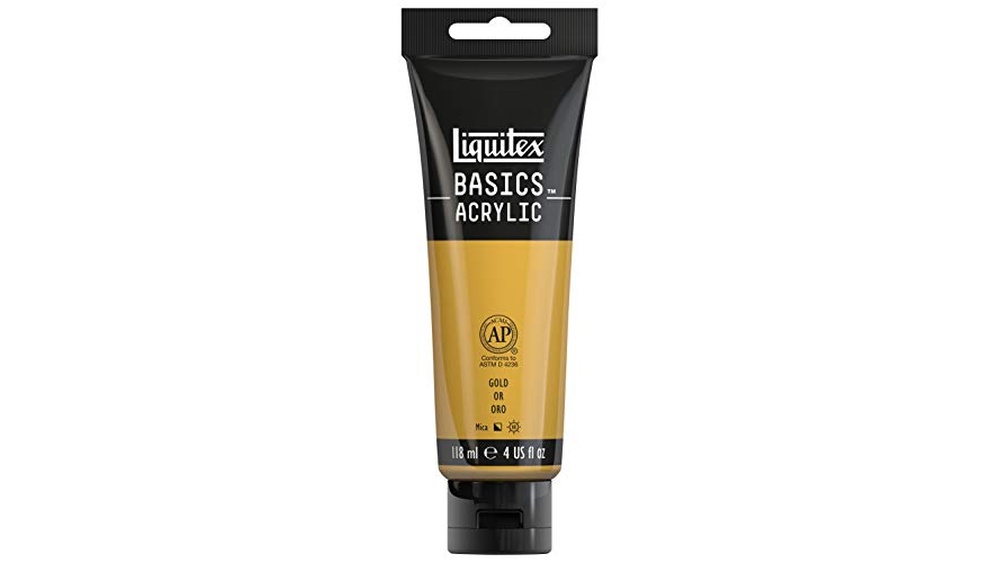
1. Liquitex BASICS Acrylic Paint, 8.5 oz Tube — Best for beginners, students and large areas

Liquitex is unusually honest in its BASICS listing. It states that all Liquitex paints use the same high-quality pigments and manufacturing process, and that with BASICS “the only difference is a lower concentration of pigment than our professional paints.” That single sentence explains the student-versus-professional divide better than most marketing: you get the same colorants, less of them, at a fraction of the price.
The 8.5 oz (250 ml) tube listed here is a gold metallic, but the format is what matters: a large tube suited to underpainting, color studies and covering ground. Liquitex positions BASICS for beginners, budget painters, serious artists sketching ideas, and underpainting beneath professional colors. Every color carries the ACMI Approved Product seal, and the pigments have passed lightfastness testing, so BASICS work is archival rather than disposable.
Best suited for: Students, beginners, and professionals who want an economical paint for sketches, underpaintings and large passages.
Key features:
- Student-grade line using the same pigments as Liquitex Professional
- Lower pigment concentration, so colors are less intense and tint less strongly
- 8.5 oz / 250 ml tube format
- Intermixable with Liquitex professional paints and mediums
- ACMI Approved Product seal; lightfast-tested pigments
- Satin finish listed
Pros:
- Lowest cost per ounce in this comparison
- Honest, specific description of the formulation
- Archival enough for finished student work
Cons and limitations:
- Lower tinting strength means more paint for strong mixes
- Metallic colors like this gold are weaker in coverage than standard hues
- Not a heavy-body paint; texture retention is modest
Buying consideration: If you will eventually move to professional paint, BASICS is a sensible place to start because your skills and leftover tubes transfer directly.
Golden: What the Heavy Body and OPEN Listings Tell You
2. Golden Heavy Body Acrylic, 5 oz, Yellow Ochre — Best for professional texture and archival work

A single Golden tube listing contains more technical data than most brands’ entire catalogs. For Yellow Ochre it states the pigment (PY43, natural hydrated iron oxide), an ASTM Lightfastness rating of I (Excellent), semi-opaque coverage and a vegan formulation. That per-color transparency is the defining difference between Golden and a student line: you know exactly what you are mixing.
The listing describes an exceptionally smooth, thick texture that retains brushstrokes and palette-knife marks, and notes that each color is formulated individually according to its pigment, which is why sheen and opacity vary across the Heavy Body range. Golden is made in the USA by an employee-owned company with over forty years of professional paint-making.
Best suited for: Professional and serious amateur painters who want impasto texture, maximum pigment load and documented permanence.
Key features:
- Professional heavy-body acrylic in a 5 oz tube
- Pigment PY43; ASTM Lightfastness I; semi-opaque
- Thick, smooth consistency that holds knife and brush marks
- Individually formulated per pigment; sheen varies by color
- Made in the USA; vegan
Pros:
- Full pigment and lightfastness disclosure
- High pigment load, strong tinting
- Texture retention for impasto
Cons and limitations:
- Higher price tier per ounce than BASICS
- Sheen inconsistency across colors needs a final varnish for uniformity
- Thick body is less suited to smooth, flat passages without medium
Buying consideration: Earth colors like Yellow Ochre are among the most affordable professional colors; start your Golden collection with earths and buy cadmiums later.
3. Golden Heavy Body Acrylics Traditional Set, 8 Colors + Glazing Liquid — Best for trying Golden with a figurative palette

Golden’s Traditional Set is a curated introduction to the Heavy Body line: Cadmium Yellow Light, India Yellow Hue, Cadmium Red Light, Alizarin Crimson Hue, Ultramarine Blue, Prussian Blue Hue, Viridian Green Hue, Titanium White, plus a bottle of Gloss Glazing Liquid. The listing describes it as historically significant colors selected for mixing the range needed in figurative painting.
The “Hue” suffixes mean modern pigment substitutes for fugitive or toxic historical pigments, chosen to match the traditional color while keeping lightfastness high. The glazing liquid is a smart inclusion: Heavy Body is thick, and a glazing medium lets you thin it for transparent layers without breaking the binder with water.
Best suited for: Painters who want to test Golden across a working palette rather than buying single tubes, especially for portraits and figures.
Key features:
- 8 Heavy Body colors in small tubes plus Gloss Glazing Liquid
- Traditional palette: two yellows, two reds, two blues, a green and white
- Hue versions replace fugitive historical pigments
- Thick texture retaining brush and knife marks
- Made in the USA
Pros:
- Thoughtful, balanced palette
- Includes a medium for glazing
- Lower entry cost than eight full-size tubes
Cons and limitations:
- Tubes are small; it is a trial set, not a studio supply
- No earth colors, so you mix your own browns
- Higher price tier than a BASICS set of similar count
Buying consideration: Add a Yellow Ochre and a Burnt Sienna to this set and you have a complete figurative palette.
4. Golden OPEN Acrylic 12-Color Mixing Set — Best for wet-into-wet blending

OPEN is Golden’s answer to the biggest complaint about acrylics: they dry too fast to blend. The listing describes a slow-drying paint with a slightly softer consistency than Heavy Body, whose extended working time allows traditional techniques once possible only with oils. Painters who cover their palettes have used the same colors for weeks, according to the listing.
The set contains twelve 22 ml (3/4 oz) tubes plus a 30 ml bottle of OPEN Thinner, with warm and cool choices of each primary (Benzimidazolone Yellow Light and Medium, Naphthol Red Light, Quinacridone Magenta, Phthalo Blue Red Shade and more) for mixing from a limited palette. OPEN can be mixed with faster-drying Golden Fluid or Heavy Body colors to speed up drying as needed. Note that this listing is sold under a reseller brand name on Amazon; the product described is Golden’s.
Best suited for: Portrait and landscape painters who blend soft transitions, and oil painters moving to acrylic who miss the open time.
Key features:
- 12 x 22 ml tubes plus 30 ml OPEN Thinner
- Slow-drying; softer body than Heavy Body
- Warm and cool primary pairs for limited-palette mixing
- Mixable with Fluid and Heavy Body acrylics to adjust drying
- Satin finish listed
Pros:
- Solves the fast-drying problem without retarder guesswork
- Reduces paint waste on the palette
- Well-chosen mixing palette
Cons and limitations:
- Highest price tier here
- Thick OPEN layers can stay tacky for a long time
- Small tubes
Buying consideration: Keep OPEN layers thin; the slow cure that makes blending easy also means heavy impasto can take days to firm up.
Liquitex vs Golden: The Real Differences
Pigment load and tinting strength
This is the core difference between the Liquitex BASICS tube and any Golden product here. Liquitex says it outright: BASICS uses the same pigments at lower concentration. In practice that means a BASICS color tints white less strongly and needs more paint for a saturated mix. Golden Heavy Body is formulated for maximum pigment load, and the per-color data (PY43, Lightfastness I) shows you exactly what you are getting. A fairer like-for-like would be Liquitex Professional Heavy Body against Golden Heavy Body, where the gap narrows to formulation preferences.
Consistency and texture
Golden Heavy Body is thick enough to hold knife marks; the listing emphasizes brushstroke retention. BASICS is a medium-body paint that spreads more easily and holds less texture. OPEN is softer still. If you paint impasto, Golden Heavy Body is the clear choice; if you paint flat, smooth or thinned, BASICS’ body is not a disadvantage.
Drying time
Standard Liquitex and Golden acrylics both dry to the touch in minutes. Golden OPEN changes the equation entirely, staying workable for hours. Liquitex offers slow-drying mediums and retarders, but no product in this comparison matches OPEN’s built-in working time.
Transparency and sheen
Golden states that sheen and opacity vary across the Heavy Body line because each color is formulated to its pigment. That is a professional approach that preserves each pigment’s character but means a finished painting may need a unifying varnish. BASICS lists a uniform satin finish, which looks consistent straight off the brush.
Price and value
BASICS sits in the low price tier for a large 8.5 oz tube; Golden single tubes are mid tier for 5 oz, and the Golden sets are in the high tier. Per ounce, BASICS is far cheaper. Per unit of pigment, the gap is much smaller, because a Golden color goes further in mixes. For underpainting and large flat areas, BASICS wins on value; for final color layers and small, intense passages, Golden’s concentration pays for itself.
Intermixability
Both brands are water-based acrylic polymer paints and can be mixed with each other and with each other’s mediums. Liquitex explicitly describes BASICS as combinable with professional materials. A common and sensible setup is a BASICS underpainting with Golden Heavy Body or OPEN on top.
Verdict by Use Case
- Learning to paint: Liquitex BASICS. Mistakes are cheap and the pigments are real.
- Underpainting and large backgrounds: Liquitex BASICS, with professional color on top.
- Impasto, palette knife and textured work: Golden Heavy Body.
- Archival commissions and gallery work: Golden Heavy Body, for the documented lightfastness per color.
- Portraits, soft blending, oil-painter habits: Golden OPEN.
- Trying Golden for the first time: the Traditional Set, then add earths.
- Crafts, murals and decorative work: Liquitex BASICS; the pigment load of Golden is wasted on a wall.
Buying Guide: Choosing Between Liquitex and Golden
Match the grade to the layer
Think in layers rather than brands. Early layers, blocks of color and experiments can be student grade. Final layers, glazes and focal areas benefit from professional pigment load. Many working painters use both in the same picture.
Read the pigment information
Golden prints pigment index names and ASTM lightfastness ratings on every color; the Yellow Ochre listing is a good example. If permanence matters, favor paints that publish this data and avoid colors rated below Lightfastness II for finished work.
Decide on body
Heavy body for texture, soft or medium body for smooth application, fluid for pouring and fine detail. BASICS is medium body; Golden Heavy Body is thick; OPEN is slightly softer. Mediums can adjust any of them, but starting with the right body saves effort.
Consider drying time honestly
If you struggle to blend before the paint skins over, retarders only go so far. OPEN is the only paint here that changes the fundamental working time. If you like fast drying for layering, standard Liquitex or Golden Heavy Body is better.
Start with sets or singles?
Sets like Golden’s Traditional Set give a balanced palette with small tubes for trial. Singles let you buy large sizes of the colors you use most, which is where BASICS 8.5 oz tubes shine for white and background colors.
Budget per ounce versus per painting
Compare cost by how much paint ends up on the canvas, not by tube price. A professional color that tints twice as strongly halves your usage in mixes. For large coverage the cheaper paint still wins; for small, saturated work the expensive tube often costs less per painting.
Further Reading on the Site
Whichever brand you choose, these guides help you use it well. New painters can browse simple acrylic painting ideas for beginners to put a first BASICS set to work, and if you want a larger project, see how to make DIY wall art with acrylic, where the economy of student paint makes real sense.
Common Mistakes to Avoid
- Comparing BASICS to Golden Heavy Body and concluding Liquitex is inferior; compare like grades.
- Thinning Golden Heavy Body with lots of water instead of a medium, which weakens the film.
- Applying OPEN thickly and expecting it to cure overnight.
- Buying a full professional set before knowing which colors you actually use.
- Ignoring sheen differences across Golden colors and skipping a final varnish.
- Mixing metallic BASICS colors into standard mixes and expecting opaque coverage.
FAQs
Is Golden acrylic paint better than Liquitex?
Golden Heavy Body is a higher grade than Liquitex BASICS, with more pigment and per-color lightfastness data. Against Liquitex Professional the difference is mostly formulation preference. Which is better depends on the layer you are painting and your budget.
Can I mix Liquitex and Golden paints together?
Yes. Both are water-based acrylic polymer paints and are fully intermixable with each other and with each other’s mediums. Using BASICS underneath Golden is a common approach.
Why is Golden more expensive?
Higher pigment concentration, individually formulated colors, and published testing all cost money. Per ounce it is pricier; per unit of color strength the gap is smaller.
What does Hue mean on the Golden Traditional Set?
A Hue color matches the appearance of a historical pigment, such as Alizarin Crimson, using modern pigments that are more lightfast or less toxic. It is a quality decision, not a cost-cutting one.
How long does Golden OPEN stay workable?
Far longer than standard acrylics; the listing describes palettes staying usable for weeks when covered. On canvas, thin layers remain blendable for hours but thick layers can take days to cure fully.
Is Liquitex BASICS good enough for finished paintings?
Yes, for most purposes. The pigments are lightfast-tested and the paints carry the ACMI AP seal. The limitation is intensity, not permanence; you may need more paint to reach saturated colors.
Final Recommendation
There is no universal winner in Liquitex vs Golden, because the products compared here occupy different grades. Liquitex BASICS is the right paint for learning, underpainting and covering ground, and its listing is refreshingly honest about why it costs less. Golden Heavy Body is the right paint when pigment load, texture and documented permanence matter most, and the Traditional Set is an affordable way to find that out.
Golden OPEN stands alone for painters who need blending time. The most practical studio often holds both brands: BASICS for the first layers and large areas, Golden for the layers people actually see.




5 Comments