
PaintingProGuide is reader-supported. When you buy through links on this page we may earn an affiliate commission at no extra cost to you.
Liquitex Basics acrylic paint is the student-grade line from Liquitex, one of the longest-established acrylic brands, and it is one of the most common first “real” acrylics painters buy after a craft set. The appeal is simple: a thick, creamy paint with a satin finish, a wide color range, sizes from small tubes to large ones, and full compatibility with Liquitex Professional colors and mediums when you want to upgrade.
This review explains what Liquitex Basics is, how it handles, who it suits and where it falls short, based on the Amazon listing details and well-established facts about student acrylics. We also cover Basics gesso and two alternative paint sets for painters who want more colors or larger bottles for less money.
Quick answer: Liquitex Basics is a strong choice for students and hobby painters who want a thick, buttery acrylic that holds brushstrokes and mixes reliably. Start with a large tube of Liquitex Basics Titanium White, 250 ml and prime surfaces with Liquitex Basics Gesso. If you want many colors at once, the Artbreezing 48-color set is a broad alternative; for bulk volume, consider the Nicpro 14-color 500 ml set.
What Is Liquitex Basics?
Liquitex sells several acrylic lines. The Professional range includes Heavy Body, Soft Body and other formulations aimed at serious and professional painters. Basics is the more affordable line designed for students, beginners and anyone who paints a lot of practice work. It is sold in individual tubes in many colors, in multi-color sets and in larger tubes of the most-used colors such as white.
According to the Amazon listing for Basics Titanium White, the paint is thick and creamy with a satin finish and good pigment load, retains peaks and brushstrokes, is described as ideal for learning color theory and color mixing, is intermixable with Liquitex Professional colors and mediums, and conforms to ASTM D4236, making it safe for educational use.
How Liquitex Basics Handles
Consistency
Basics is a thicker-bodied acrylic. It sits up on the palette, holds brush and knife marks and covers well in one or two coats. That makes it good for expressive, textured work and impasto-style strokes. For smooth blending or glazing, add water sparingly or, better, an acrylic medium.
Finish
The listing describes a satin finish, between matte and gloss. Satin is forgiving: it shows color richly without the glare of gloss paint. You can shift the finish later with matte or gloss mediums or varnish.
Color mixing
As with most student lines, some colors in the Basics range use “hue” formulations, which mimic the look of expensive pigments with more affordable alternatives. Hues mix well and are fine for learning, though they may behave a little differently from single-pigment professional colors. Check the label if you care about specific pigments.
Drying
Like all acrylics, Basics dries quickly, especially in thin layers. Thick passages take longer. A stay-wet palette or a slow-drying medium extends working time.
Compatibility
Because Basics is intermixable with Liquitex Professional colors and mediums, you can add a few professional tubes to a Basics palette, or use Liquitex mediums for glazing, texture and pouring without worrying about compatibility.
Who Liquitex Basics Is For
- Art students who need dependable paint in volume for assignments and practice.
- Beginners stepping up from craft paint who want a thicker, more painterly feel.
- Hobby painters who paint often and want a mid-priced paint that does not feel thin.
- Expressive painters who like visible brushstrokes and knife work.
- Classrooms that need a recognized brand with ASTM D4236 conformance.
Limitations to Know
- Not artist grade. Pigment concentration and lightfastness are lower than professional lines; for works intended to last generations, consider professional colors for key areas.
- Some hue colors. Fine for learning; not identical to single-pigment paints.
- Thick body is not for everyone. If you want smooth, fluid paint for detail or glazing, you will need mediums.
- Color shift. Like most acrylics, colors can dry slightly darker than they look wet.
Building a Starter Palette With Liquitex Basics
You do not need a large set. A practical starter palette in most student acrylic ranges includes:
- Titanium white (buy it large)
- A warm yellow and a cool yellow
- A warm red and a cool red or crimson
- Ultramarine blue and a phthalo blue
- Burnt sienna or burnt umber
- Black (optional; many painters mix darks instead)
Check the Liquitex Basics color range on Amazon for the specific names; the line covers all of these families.
Tips for Getting the Best From Basics
- Prime properly. One coat of Basics gesso is often enough on canvas or board, according to the gesso listing; raw wood and paper benefit from two.
- Use mediums, not lots of water. A gloss or matte medium thins Basics for glazing without weakening the film.
- Exploit the body. Try palette knife work and visible brushstrokes; it is what Basics does best.
- Mix on a stay-wet palette. It stops the thick paint skinning over during long mixing sessions.
- Varnish finished work. A removable acrylic varnish protects paintings and evens sheen.
Three Exercises That Show Off Liquitex Basics
Palette knife landscape
On a 9×12 panel, paint a simple sky, hills and a field using only a palette knife. Basics’ thick body holds the ridges of each knife stroke, which is the best way to feel what makes this paint different from fluid craft acrylic.
Value study in one color plus white
Choose a blue or burnt umber and paint a still life using only that color and Titanium White. Because Basics covers well, you can lay light over dark cleanly, which makes value corrections easy.
Glazing test
Paint a strip of each color, let it dry, then mix a small amount of each with gloss medium and glaze over a dry gray stripe. You will see which colors are transparent and which are opaque, essential knowledge for planning layered paintings.
Sets or Individual Tubes?
Liquitex Basics is sold both ways. Sets are convenient and often include colors you would not choose yourself, which is useful for exploring. Individual tubes let you build exactly the palette you need and buy more of the colors you use most. A sensible route is to start with a small set or a handful of individual primaries, then replace colors one tube at a time as they run out, sizing up the ones you reach for most. Over a few months your palette becomes a personal, efficient selection instead of a box of rarely used shades.
Storing and Caring for Tubes
Thick acrylic dries in the tube neck if caps are left loose. Wipe the threads before closing, store tubes flat or cap-down in a cool place, and avoid freezing temperatures, which can ruin acrylic emulsions. If a cap sticks, run it briefly under warm water rather than forcing it with pliers. Squeeze from the bottom of the tube so paint stays near the opening and you waste less.
Want inspiration? Our simple acrylic painting ideas for beginners suit Basics well, and our guide to DIY wall art with acrylic shows how to turn practice into decor.
Our Top Picks at a Glance
- Liquitex BASICS Acrylic Paint, Titanium White, 250 ml — Best Liquitex Basics tube to buy first
- Liquitex BASICS Acrylic Gesso, 16 oz — Best primer to pair with Basics
- Artbreezing 48 Colors Acrylic Paint Set — Best alternative for a wide color range
- Nicpro 14 Colors Bulk Acrylic Paint, 500 ml — Best alternative for volume
| Product | Best For | Key Spec | Key Strength | Price Tier |
|---|---|---|---|---|
| Liquitex BASICS Titanium White | Core white | 250 ml tube, satin, thick body | Holds brushstrokes; intermixable with Professional | $ |
| Liquitex BASICS Gesso | Priming | 16 oz bottle | One coat often enough | $ |
| Artbreezing 48 Colors | Wide palette | 48 x 22 ml | Many colors at once | $$ |
| Nicpro 14 Colors 500 ml | Bulk painting | 14 x 16.9 oz bottles | Large volume per color | $$$ |
How We Chose
This review is based on Amazon listing details checked in October 2026, well-established information about student-grade acrylics, and how widely each product is reviewed by Amazon buyers. Our product data included one Liquitex Basics paint (Titanium White), Basics gesso and two alternative sets; we describe only what those listings state.
- Paint body, finish and compatibility as described in listings.
- Value for students and frequent painters.
- Safety statements such as ASTM D4236.
- Alternatives that solve different needs: more colors or more volume.
Liquitex Basics and Alternatives Reviewed
1. Liquitex BASICS Acrylic Paint, 250 ml, Titanium White — Best for the first Basics tube to buy

This 8.45 oz (250 ml) tube of Titanium White is described in the listing as thick and creamy with a satin finish and good pigment load. It retains peaks and brushstrokes, is intermixable with Liquitex Professional colors and mediums, and conforms to ASTM D4236.
White is the color every acrylic painter uses most, in tints, highlights and mixing. Buying it in the large tube is the single best value move with any paint line.
Best suited for: Every Basics user, and anyone with a different paint set who runs out of white first.
Key features:
- 250 ml / 8.45 oz tube
- Thick body, satin finish
- Intermixable with Liquitex Professional
- ASTM D4236
Pros:
- Large size for the most-used color
- Holds texture
- Reliable brand consistency
Cons and limitations:
- Student grade
- Thick body needs medium for glazing
Buying consideration: Pair with smaller tubes of your other colors, since you will use far more white than anything else.
2. Liquitex BASICS Acrylic Gesso, 16 oz — Best for priming surfaces for Basics

Liquitex Basics Gesso is a value acrylic gesso for preparing surfaces for acrylic and oil paint. The listing states that one coat is usually all that is required, that it is intermixable with Liquitex Professional colors and mediums, and that it conforms to ASTM D4236.
A 16 oz bottle primes many small panels, raw canvas, wood or cardboard.
Best suited for: Painters who prime their own surfaces or re-prime old canvases.
Key features:
- 16 oz / 473 ml
- Satin finish
- For acrylic and oil
- ASTM D4236
Pros:
- Same family as Basics paint
- Good coverage per coat
- Low-mid price tier
Cons and limitations:
- Raw wood and paper may still need two coats
- Value grade rather than professional
Buying consideration: Tint gesso with a little Basics color to create a toned ground.
3. Artbreezing 48 Colors Professional Acrylic Paint Set — Best for a wide color range
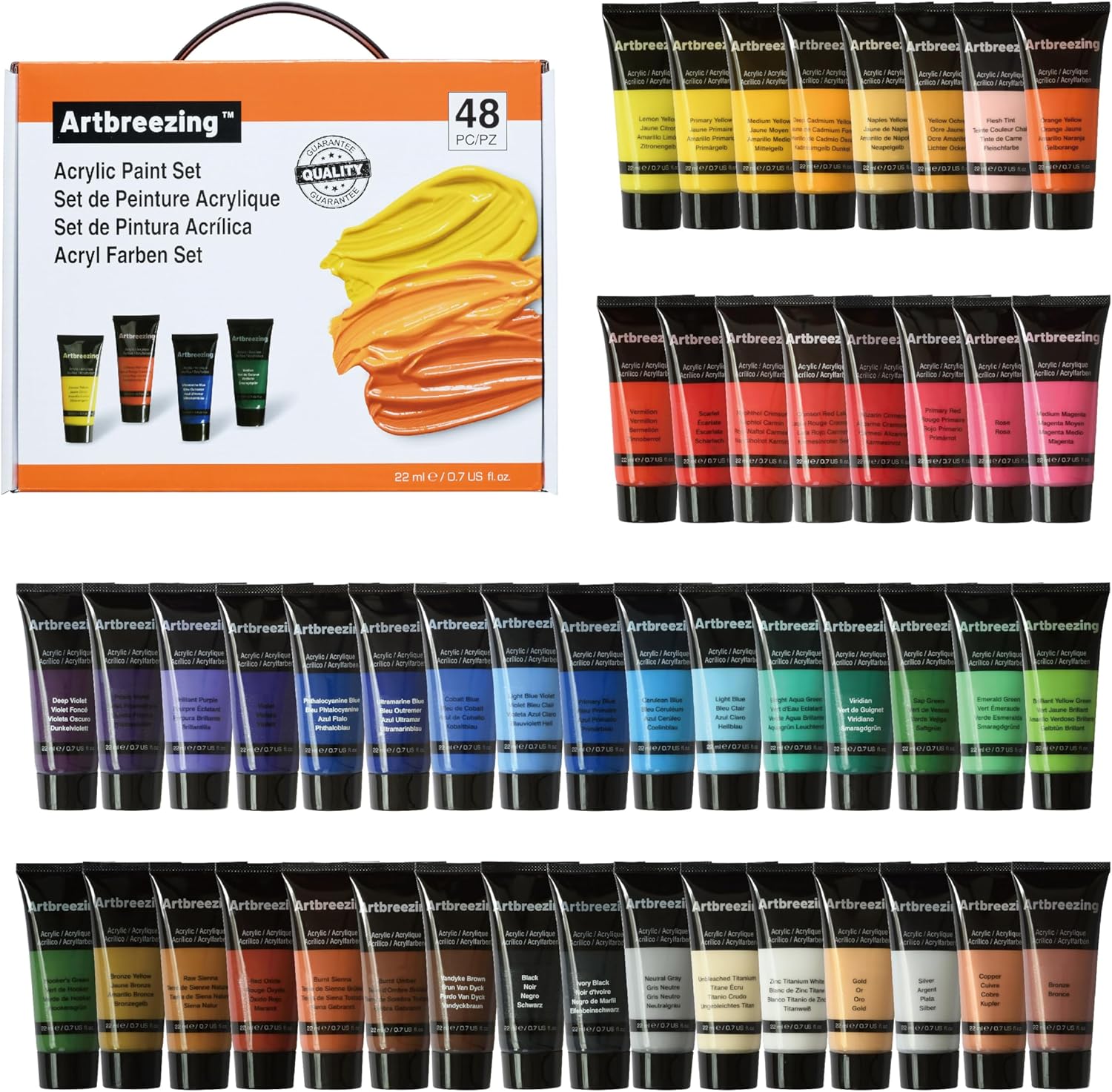
Artbreezing’s set includes 48 colors in 22 ml tubes. The listing describes a pigment-rich, fast-drying, lightfast, water-resistant formula with smooth blending, for canvas, wood and paper, and notes 24 and 36-color options too.
Compared with buying Basics tube by tube, a set like this gives you every color at once for exploring palettes.
Best suited for: Painters who want to explore many colors before choosing favorites.
Key features:
- 48 colors, 22 ml each
- Gloss finish listed
- Smaller set options available
Pros:
- Huge color variety
- Mid-upper price tier for 48 tubes
- Good for color exploration
Cons and limitations:
- Small tubes, especially white
- Less brand track record than Liquitex
Buying consideration: Add a large Liquitex Basics white to this set; the 22 ml white will not last.
4. Nicpro 14 Colors Large Bulk Acrylic Paint Set, 500 ml — Best for volume at a lower cost per ounce

Nicpro includes 14 essential colors such as white, Mars black, red, yellow, blue, green and burnt umber, each in a 16.9 oz squeeze bottle. The listing describes creamy, fast-drying, fade-resistant, non-toxic paint for canvas, rock, wood and more.
For murals, large canvases, pouring or classroom use, bottle volume matters more than brand.
Best suited for: Large-format painters, pourers and classrooms.
Key features:
- 14 x 500 ml bottles
- Core palette including white and black
- Gloss finish listed
Pros:
- Very large volume
- Squeeze bottles
- Good cost per ounce
Cons and limitations:
- Highest upfront cost here
- Fewer colors; mix the rest
Buying consideration: Use Nicpro for big areas and Liquitex Basics for passages where you want thicker texture.
Buying Guide: Is Liquitex Basics Right for You?
Your goals
Learning and frequent practice suit Basics. Gallery or commission work may justify professional colors.
Paint body
If you love texture and visible strokes, Basics’ thick body is an advantage. If you want fluid paint, consider a soft-body line or add medium.
Color range
Buy individual tubes for a curated palette, or a set for variety.
Size
Buy white large; other colors in standard tubes.
Compatibility
If you plan to use Liquitex mediums or professional colors later, Basics fits into that system.
Budget
Basics sits between craft paint and professional paint. Bulk sets cost less per ounce but vary in consistency.
Liquitex Basics vs Craft Paint vs Professional Acrylic
| Craft acrylic | Liquitex Basics | Professional acrylic | |
|---|---|---|---|
| Typical body | Fluid to medium | Thick, creamy | Varies by line |
| Pigment load | Lower | Moderate | Highest |
| Hue colors | Common | Some | Fewer; more single pigments |
| Best use | Crafts, decor, kids | Learning, practice, studies | Finished and archival work |
| Cost | Lowest | Moderate | Highest |
If you paint on unusual surfaces, check compatibility first; our guide on using acrylic paint on glass jars explains preparation and durability on non-porous surfaces.
Common Mistakes to Avoid
- Thinning thick paint with lots of water. Use a medium instead.
- Buying small whites. Get the large tube.
- Expecting professional pigment strength. Basics is student grade by design.
- Skipping gesso on raw surfaces. Paint soaks in and looks dull.
- Leaving caps loose. Thick paint dries in the nozzle quickly.
- Not varnishing finished pieces. Varnish protects and evens sheen.
FAQs
Is Liquitex Basics good for beginners?
Yes. It is a student-grade acrylic with a thick, creamy body, a satin finish and ASTM D4236 conformance, making it a popular step up from craft paint.
Is Liquitex Basics heavy body?
Basics is a thicker-bodied acrylic that holds peaks and brushstrokes, though Liquitex also sells a separate Professional Heavy Body line.
Can I mix Liquitex Basics with Liquitex Professional?
Yes. The listing states Basics is intermixable with Liquitex Professional colors and mediums.
What finish does Liquitex Basics have?
The listing describes a satin finish. You can adjust sheen with matte or gloss mediums or varnish.
Does Liquitex Basics need gesso?
Pre-primed canvas does not need extra gesso, but raw wood, paper and cardboard benefit from a coat of gesso such as Liquitex Basics Gesso.
Is Liquitex Basics lightfast enough for finished paintings?
It is suitable for practice and many finished pieces. For work meant to last a very long time, many painters use professional-grade colors, especially for key areas.
Final Recommendation
Liquitex Basics is a dependable, thick-bodied student acrylic that suits beginners, students and frequent hobby painters, especially those who like texture. Start with the large 250 ml Titanium White and Basics gesso, then add a curated set of colors. If you want to explore a big palette right away, the Artbreezing 48-color set is a broad alternative, and if you need paint in volume for large or pouring work, the Nicpro 500 ml bottles cost less per ounce. Many painters end up using Basics as their everyday paint and adding a few professional tubes where it counts.




