PaintingProGuide is reader-supported. When you buy through links on this page we may earn an affiliate commission at no extra cost to you.
Water alone will not fully clean a brush. Pigment and binder lodge deep in the bristles near the ferrule, and over time that residue stiffens the hair, splays the tip and shortens the brush’s life. A proper brush cleaner reaches what rinsing leaves behind.
Brush cleaner solutions for painters come in four main types: solid soaps and cleaner-preservers, solvent-free liquid cleaners for oil and acrylic, plant-based or natural cleaners, and soaking restorers for dried paint. Many products blur those lines, so it helps to know what each type does best.
We compared six cleaners available on Amazon using each listing’s claims about paint types, hair compatibility and how to use them. One general paint-tool cleaner aimed at rollers and sprayers was left out.
Whatever you buy, the most important habit is the simplest: clean brushes at the end of every session, before paint has a chance to cure.
Quick answer: For an all-round cleaner that also conditions, General’s The Masters Brush Cleaner and Preserver remains the classic: one-step cleaning for oil, acrylic, watercolor and varnish, safe on sable. Oil painters who want a liquid solvent-free option should look at AlphaKlean Brush Cleaner, made for natural and synthetic hair with any paint. For a plant-based choice, Green Piece Paint Brush Cleaner and Restorer uses fruit extracts and minerals.
Types of Brush Cleaner Explained
Solid cleaners and brush soaps are lathered in the palm with water. They are economical, gentle and often condition the hair. Best for daily cleaning in any medium.
Liquid solvent-free cleaners replace mineral spirits for oil painters and also handle acrylic. You swish, soak briefly and rinse.
Plant-based cleaners use natural ingredients such as citrus extracts. They appeal to painters avoiding solvents and harsh chemicals; check that they suit your paint.
Soak restorers soften dried paint so it can be worked out. They are rescue products rather than daily cleaners.
Matching Cleaner to Medium
Acrylic: rinse with water during painting, then wash with soap or a cleaner at the end. A soak restorer rescues brushes with dried acrylic.
Oil: wipe excess paint, clean with a solvent-free liquid cleaner, mineral spirits or a safflower-oil rinse, then wash with soap and water to remove oily residue.
Watercolor and gouache: clean water and an occasional gentle soap. Natural hair benefits from conditioning cleaners.
Varnish and glazes: follow the varnish maker’s cleanup guidance; many artist cleaners handle them.
Our Top Picks at a Glance
- General’s The Masters Brush Cleaner and Preserver (2.5 oz) — Best overall brush cleaner
- AlphaKlean Brush Cleaner (16 oz) — Best solvent-free liquid for oil painters
- Green Piece Paint Brush Cleaner and Restorer — Best plant-based cleaner
- Plant-Based Paint Brush Cleaner and Restorer (16.9 oz) — Best odorless soak cleaner
- U.S. Art Supply Brush Cleaner and Restorer (4 oz) — Best small rescue bottle
- Heirloom Traditions Paint Brush and Tool Cleaner (16 oz) — Best for acrylic and water-based furniture paint brushes
| Product | Best For | Key Spec | Key Strength | Price Tier |
|---|---|---|---|---|
| General’s The Masters Brush Cleaner and Preserver (2.5 oz) | overall brush cleaner | 2.5 oz solid cleaner-preserver | Cleans and conditions all media | $ |
| AlphaKlean Brush Cleaner (16 oz) | solvent-free liquid for oil painters | 16 oz liquid, for any paint, natural and synthetic hair | Aggressive on paint, gentle on brushes | $$ |
| Green Piece Paint Brush Cleaner and Restorer | plant-based cleaner | Natural fruit-extract and mineral formula, made in USA | Removes wet or dry paint without solvents | $$ |
| Plant-Based Paint Brush Cleaner and Restorer (16.9 oz) | odorless soak cleaner | 16.9 oz, plant-based, soak 30 minutes for semi-dry paint | Odorless, rinses clean | $$ |
| U.S. Art Supply Brush Cleaner and Restorer (4 oz) | small rescue bottle | 4 oz liquid, soak and wipe | Restores brushes with dried acrylic | $ |
| Heirloom Traditions Paint Brush and Tool Cleaner (16 oz) | acrylic and water-based furniture paint brushes | 16 oz liquid for acrylic and water-based paints | Softens dried brushes | $ |
We left out a general paint-tool cleaner aimed at rollers, sprayers and wallpaper removal.
How We Chose
We did not test these cleaners. Picks are based on the Amazon listing details and specifications checked in October 2026, how well each cleaner’s stated paint compatibility, hair safety and format fit artist brush care, and how widely each product is reviewed by Amazon buyers.
- Paint types the cleaner handles
- Safety for natural and synthetic hair
- Format: solid, liquid or soak
- Solvent-free or natural formula
- Size and value
- Clarity of directions
Best Brush Cleaner Solutions for Painters Reviewed
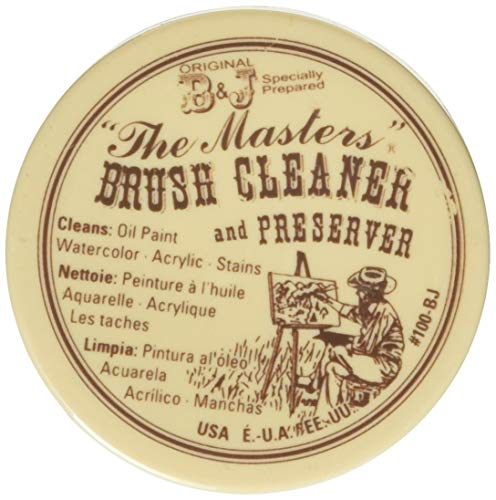
1. General’s The Masters Brush Cleaner and Preserver (2.5 oz) — Best overall brush cleaner

The Masters is a solid cleaner that removes oils, acrylics, watercolors, stains and varnishes, and works on glazes and most synthetic finishes, according to the listing. It is a one-step total care process: lather the brush, rinse, and the hair is cleaned and conditioned together.
It is labeled for sable, bristle and synthetic brushes, which makes it safe for a whole mixed collection. A 2.5 oz tub lasts a long time with daily use.
Best suited for: Painters in any medium who want one daily cleaner for every brush.
Key features:
- Solid cleaner-preserver
- For oil, acrylic, watercolor, varnish and glazes
- Safe on sable, bristle and synthetic
- One-step clean and condition
Pros:
- Works across all media
- Gentle on natural hair
- Economical
Cons / limitations:
- Requires hand lathering
- Slow on fully cured paint
- Small tub for classrooms
Buying consideration: Lather in the palm of your hand and work it toward the ferrule, then rinse until the foam is white.
2. AlphaKlean Brush Cleaner (16 oz) — Best solvent-free liquid for oil painters

AlphaKlean is a highly refined, all-purpose liquid brush cleaner that the listing says can be used on synthetic and natural hair with any type of paint. It is described as aggressive on paint but gentle on brushes.
For oil painters, a liquid cleaner like this can stand in for mineral spirits in the rinse step. It also suits crafters and DIY painters who use a mix of paints.
Best suited for: Oil painters, mixed-media artists and anyone who wants a liquid cleaner for all paints.
Key features:
- 16 oz liquid cleaner
- For any paint type per listing
- Safe on natural and synthetic hair
- All-purpose use
Pros:
- Liquid format for swishing and soaking
- Broad compatibility
- Large bottle
Cons / limitations:
- Higher price tier
- Few usage details in the listing
- Still needs a soap wash after oil
Buying consideration: Follow with soap and water so no cleaner or oil residue stays in the bristles.
3. Green Piece Paint Brush Cleaner and Restorer — Best plant-based cleaner

Green Piece is made from fruit extracts and minerals and is described as 100% natural, non-toxic, biodegradable and made in the USA. The listing says it removes wet or dry paint and works on acrylic, latex, oil and shellac, with no paint thinner or turpentine.
It has a citrus scent and can be used on tools and desks as well. For painters who want to avoid solvents in the studio, it is an appealing option.
Best suited for: Painters avoiding solvents, classrooms and home studios.
Key features:
- Natural, plant-based formula
- Removes wet or dry paint
- For acrylic, latex, oil and shellac
- Made in the USA
Pros:
- No solvent fumes
- Handles dried paint per listing
- Multipurpose
Cons / limitations:
- Highest price tier here
- Citrus scent may not suit everyone
- Listing aimed at general paints as well as art
Buying consideration: Test on one brush first, and rinse thoroughly with water afterward.
4. Plant-Based Paint Brush Cleaner and Restorer (16.9 oz) — Best odorless soak cleaner

This plant-based cleaner removes fresh paint in seconds, and for semi-dry paint the listing recommends a 30-minute soak to soften residue. It covers acrylic, latex, oil, water-based paints and shellac.
The listing says it leaves no residue and does not degrease or make bristles brittle, and describes it as non-toxic, odorless and biodegradable, suitable for studios and classrooms.
Best suited for: Classrooms and painters who want an odorless liquid for daily cleaning and light rescues.
Key features:
- 16.9 oz plant-based liquid
- Fresh paint in seconds; soak for semi-dry
- Acrylic, oil, latex, shellac
- Odorless, biodegradable
Pros:
- No fumes
- Rinses clean per listing
- Large bottle
Cons / limitations:
- Fully cured paint may need longer treatment
- Brand details limited
- Mid price
Buying consideration: Keep a small jar of it by the sink for end-of-session cleaning.
5. U.S. Art Supply Brush Cleaner and Restorer (4 oz) — Best small rescue bottle

The 4 oz size of U.S. Art Supply’s cleaner and restorer is a low-cost way to keep a rescue product on hand. The listing describes it as highly effective for brushes with dried-on acrylic: soak as needed and remove softened residue with a wipe, knife or toothbrush.
It also cleans dried paint from airbrushes and other tools.
Best suited for: Acrylic painters who occasionally forget a brush.
Key features:
- 4 oz bottle
- Soak-and-wipe for dried paint
- For brushes, airbrushes and tools
- Restorer formula
Pros:
- Low cost
- Targets dried acrylic
- Small enough for a kit
Cons / limitations:
- Small volume
- Not a daily conditioner
- Soaking takes time
Buying consideration: Soak only the bristles; keep the ferrule above the liquid.
6. Heirloom Traditions Paint Brush and Tool Cleaner (16 oz) — Best for acrylic and water-based furniture paint brushes

Heirloom Traditions makes paints popular with furniture painters, and its cleaner is aimed at acrylic and water-based paint brushes. The listing says it deep cleans and will soften and bring life back to dried brushes, while noting results cannot be guaranteed.
It suits crafters and furniture painters as much as fine artists working in acrylic.
Best suited for: Acrylic and furniture painters.
Key features:
- 16 oz liquid
- For acrylic and water-based paints
- Softens dried brushes
- Brush and tool cleaner
Pros:
- Focused on water-based paints
- Large bottle
- Restores stiff brushes per listing
Cons / limitations:
- Not for oil per listing focus
- Few usage details
- Results not guaranteed per listing
Buying consideration: Best for water-based paints; choose another cleaner for oil.
A Step-by-Step Cleaning Routine
Wipe the brush on a rag or paper towel to remove as much paint as possible.
Rinse in water (water-based paints) or swish in a liquid cleaner (oil).
Lather with a cleaner-preserver or brush soap in your palm, working toward the ferrule. Rinse and repeat until the foam stays white.
Gently squeeze out water, reshape the tip and dry flat or bristle-down.
For oil brushes, finish with a soap wash even if you used a liquid cleaner, to remove all oil residue.
How to Tell a Brush Is Truly Clean
Squeeze the bristles near the ferrule with a paper towel. If any color appears, there is still paint inside. Lather and rinse again.
Check the foam. When you lather a cleaner-preserver or soap, colored foam means pigment is still coming out; white foam means you are done.
Feel the hair once it dries. Clean bristles are soft and springy. Stiffness at the base means residue is building up and a deeper clean is due.
Disposing of Cleaner and Rinse Water
Do not pour solvents or oily cleaning liquid down drains. Let it settle in a jar, reuse the clear liquid on top and dispose of sludge according to local hazardous waste rules.
For acrylic rinse water, let solids settle, pour off the clearer water and put the sludge in the trash.
Plant-based and biodegradable cleaners are easier to live with, but paint residue in them still needs sensible disposal.
Safety Basics
Ventilate the room when using any solvent or strong cleaner. Wear gloves if your skin is sensitive, even with natural products.
Store cleaners away from children and pets, in their original labeled containers.
Oily rags and paper towels from oil painting can self-heat; store them in a sealed metal container or spread them flat to dry outdoors, according to local fire guidance.
Buying Guide: How to Choose a Brush Cleaner
Start with your medium
Water-based paints: soap or a cleaner-preserver. Oil: a solvent-free liquid or mineral spirits plus soap.
Mixed-media painters benefit from a cleaner that handles everything.
Hair compatibility
Natural hair needs gentle cleaners labeled safe for sable.
Synthetics are tougher but still benefit from conditioning.
Daily cleaner vs. rescue
Daily cleaners prevent buildup. Soak restorers fix dried paint.
Most painters need one of each.
Format
Solids last longer and travel well. Liquids are faster for soaking and swishing.
Liquids in large bottles suit classrooms.
Formula
Solvent-free and plant-based cleaners reduce fumes.
Check that natural formulas actually list your paint type.
Value
Small tubs and bottles last months for one painter.
Buy larger sizes only if you paint daily or teach.
Clean Brushes, Better Detail
Clean tips matter most for fine work, like the strokes in our liner brush detail guide and painting dots with a round brush.
If a brush is past saving, see which brush sizes to choose for detailed acrylic work before replacing it.
Common Mistakes to Avoid
- Relying on water alone for acrylic and oil
- Skipping the soap wash after oil painting
- Using hot water near the ferrule
- Soaking brushes ferrule-deep in cleaner
- Pouring solvent down the drain
- Storing oily rags in a pile
FAQs
What is the best brush cleaner for acrylic paint?
For daily cleaning, a cleaner-preserver like The Masters or brush soap. For dried acrylic, a soak restorer such as U.S. Art Supply Brush Cleaner and Restorer.
What can I use instead of mineral spirits for oil brushes?
A solvent-free liquid brush cleaner, a plant-based cleaner that lists oil paint, or a rinse in safflower or other vegetable oil followed by soap and water.
Is dish soap okay for cleaning paint brushes?
Mild dish soap works for water-based paints but can dry out natural hair. Brush soaps condition as they clean.
Are natural brush cleaners effective?
Many are, especially for water-based paints. Check the listing for the paint types it handles and test on one brush first.
How often should I deep clean brushes?
Wash with soap at the end of every session. Use a restorer only when paint has dried.
Can brush cleaner damage my brushes?
Harsh solvents can damage natural hair and loosen ferrule glue. Choose cleaners labeled safe for your brush type and rinse thoroughly.
Final Recommendation
For most painters, General’s The Masters is the best brush cleaner to keep by the sink because it cleans and conditions every type of brush. Oil painters wanting a liquid solvent-free option should add AlphaKlean.
Green Piece and the plant-based 16.9 oz cleaner suit studios that avoid solvents, the 4 oz U.S. Art Supply restorer is a cheap rescue bottle for dried acrylic, and Heirloom Traditions is a good fit for acrylic and furniture paint brushes.
Clean at the end of every session, rinse thoroughly and dry flat; the cleaner only works if you use it.