Quick answer: Great painting ideas for kids rooms include a single bold accent wall, color-blocked geometric shapes, a painted headboard or arch, a mountain or wave horizon, a chalkboard or magnetic wall, and a simple mural kids can help fill in. Use a low- or zero-VOC paint in an eggshell or satin finish so walls wipe clean, keep the base colors calm, and put the boldest color where it can grow with the child.
A child’s bedroom has to do a lot of jobs at once: sleep space, play area, homework corner, and gallery for their latest masterpieces. Paint is the cheapest way to make it work for all of them. The best painting ideas for kids rooms balance personality with practicality, so the room feels fun today and does not need a full repaint the moment your child declares they are “too old for dinosaurs.” This guide covers 18 design ideas, color choices by mood, a weekend plan for painting the room yourself, and ways to bring your child’s own artwork into the space.
Before You Pick an Idea: Four Practical Decisions
Settle these first. They narrow down which designs make sense for your room and your child.
- How long should it last? A full mural suits a room you plan to keep for five years or more. Accent walls and painted shapes are easier to update as tastes change.
- How much wall do you want to commit? One feature wall plus three neutral walls is the most flexible setup.
- What finish will survive daily life? Flat paint hides wall flaws but marks easily. Eggshell and satin are the usual sweet spot for kids’ rooms because they wipe clean without looking shiny. Semi-gloss suits trim and doors.
- How old is the house? In US homes built before 1978, existing paint may contain lead. Do not sand or scrape old paint until it has been tested, and follow EPA lead-safe practices if it is present.
Choosing Kid-Safe Wall Paint
Paint chemistry matters more in a bedroom than in most rooms, because children spend long hours there with the door closed. Look for paint labeled low-VOC or zero-VOC, which releases fewer volatile organic compounds as it dries. Some products also carry third-party indoor air quality certifications.
Even with low-VOC paint, ventilate well, run a fan pointing out a window, and plan for the child to sleep elsewhere for at least a night or two while the smell fades. Washability ratings and scrub resistance are the other features to compare. Our breakdown of the best nontoxic, washable paints for a kids’ room compares finishes and formulas in more detail.
Painting Ideas for Kids Rooms: Accent Walls and Color Blocking
1. One Bold Accent Wall
Paint the wall behind the bed in a strong color, such as teal, mustard, coral, or deep green, and keep the other walls soft white or pale gray. This adds energy without overwhelming the room and is the easiest design to change later.
2. Half-Wall Two-Tone
Paint the lower third or half of the wall in a darker, more forgiving color and the upper part in a light shade. The darker lower section hides scuffs and fingerprints right where small kids touch the walls most. Finish the line with painter’s tape and, if you like, a slim strip of wood trim.
3. Painted Headboard Shape
Instead of buying a headboard, paint one: a rectangle, a rounded-top arch, or a scalloped edge centered behind the bed, roughly 6–12 inches wider than the mattress on each side. It anchors the bed and saves money.
4. Color-Blocked Corner
Paint a large square or rectangle that wraps across a corner, covering parts of two walls. It creates a cozy “zone” for a reading nook or desk.
5. Arches and Doorway Shapes
Painted arches remain a popular choice for a reason. Use one large arch as a backdrop for a bookshelf, or overlap two or three arches in related colors for a playful look. A string and pencil pinned at the center point makes a clean curve.
6. Geometric Triangles or Diamonds
Tape off a pattern of triangles across one wall and fill them in three to five colors from one palette. This works well for older kids and teens who want something bold but not babyish.
Nature-Inspired Wall Designs
7. Mountain Range Horizon
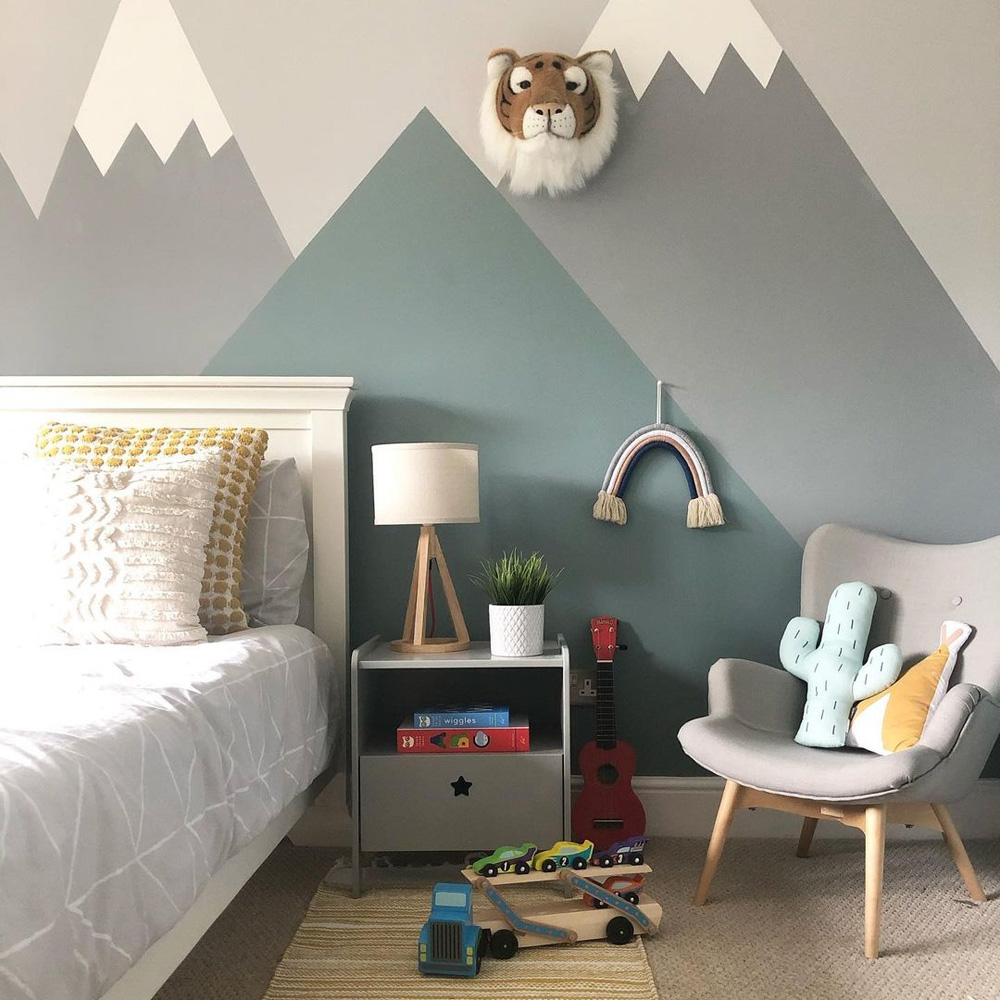
Paint layered mountain silhouettes along the bottom third of a wall, with the darkest range in front and lighter ranges behind. It creates a sense of depth and pairs well with adventure or camping themes. Add a few painted pine trees in the foreground if you want more detail.
8. Ocean Waves
Gentle wavy bands in blues and aqua along the lower wall turn any room into a seaside retreat. Add painted fish, a sailboat on the horizon, or a lighthouse for younger kids.
9. Rainbow Arc
A rainbow made from four or five muted colors (terracotta, sand, sage, dusty blue) feels softer and more grown-up than primary colors, so it can carry from toddler years into the elementary grades.
10. Polka Dot or Confetti Wall
Use a round sponge applicator or a stencil to add scattered dots in two or three colors. Kids can help with this one, and imperfect spacing looks charming rather than messy.
11. Starry Ceiling
Paint the ceiling a deep navy or dusky blue and add small stars or constellations with a fine brush. Glow-in-the-dark paint adds a bedtime surprise. Keep the walls light to balance the dark ceiling.
12. Tree Mural in the Corner
A simple stylized tree trunk rising from the floor with branches spreading across two walls becomes a frame for hanging photos or kids’ art from the branches.
Interactive and Functional Wall Ideas
13. Chalkboard Wall
Chalkboard paint turns a wall or a section of wall into a drawing surface. Apply it in a defined shape, such as a rectangle with painted trim, so it looks intentional. Most chalkboard paints need curing time before you “season” them by rubbing chalk across the whole surface and wiping it off; follow the product directions.
14. Magnetic Wall
Magnetic primer layered under a topcoat lets kids hang artwork and letters with magnets. It typically takes several coats to hold well and works best with strong magnets.
15. Growth Chart Stripe
Paint a vertical ruler stripe on a door frame or wall and mark heights each birthday. It becomes a family keepsake. Seal it with a clear water-based topcoat if you expect lots of wiping.
16. Art Display Rail
Paint a horizontal band at kid height and mount a picture ledge or wire with clips across it. The band frames whatever artwork is on display and protects the wall behind.
Murals and Themed Rooms
17. Outline Mural Kids Can Color
Draw large, simple outlines of animals, planets, or flowers on the wall in a dark color. Then let your child fill sections in with a small set of chosen colors. It gives kids real ownership of the room while you control the overall design. Supervise closely and use the same low-VOC wall paint for all colors.
18. Subtle Theme Accents
Instead of a full themed room, add small painted touches: a few clouds and hot air balloons, a row of tiny houses along the baseboard, or dinosaur footprints walking up one wall. These can be painted over easily when the theme fades.
Color Ideas by Mood and Age
| Mood | Color ideas | Best for |
|---|---|---|
| Calm and restful | Soft sage, pale blue, warm greige, lavender | Nurseries, light sleepers |
| Cheerful | Butter yellow, peach, mint, sky blue | Toddlers and preschoolers |
| Bold and playful | Teal, coral, mustard, cobalt | Accent walls for school-age kids |
| Grown-up and moody | Forest green, navy, charcoal, terracotta | Tweens and teens |
| Gender-neutral | Sand, olive, clay, dusty blue | Shared rooms, long-term schemes |
A useful rule: keep around 60% of the room in a neutral base, 30% in a secondary color (often on one wall or in furniture), and 10% in an accent color through accessories or small painted details. It stops a kid’s room from feeling chaotic.
A Weekend Plan for Painting a Kids’ Room
- Friday evening: clear the room or move furniture to the center, remove outlet covers, and wash walls with a damp sponge and mild soap. Fill small holes with spackle.
- Saturday morning: sand patched spots lightly once dry (only on walls confirmed lead-free), wipe away dust, and apply painter’s tape along trim and ceiling lines.
- Saturday midday: prime any patched areas or dark walls. Cut in edges with an angled brush, then roll the base color in W-shaped sections.
- Saturday afternoon: apply the second coat after the recoat time on the can, often 2–4 hours.
- Sunday: tape off and paint accent shapes, stripes, or murals on the fully dry base. Pull tape while the final coat is still slightly tacky for cleaner lines.
- Sunday evening: ventilate, reinstall outlet covers, and move furniture back once paint is dry to the touch. Avoid scrubbing walls for a couple of weeks while the paint fully cures.
Involving Kids Without the Chaos
Children are more likely to love a room they helped create. Give them specific, contained jobs rather than a roller and free rein.
- Let them choose between two or three pre-approved color swatches.
- Assign them dots, stars, or one section of an outline mural.
- Have them paint a sample board first to test colors.
- Keep them out of the room during priming, base coats, and any sanding.
Bringing Kids’ Own Art Into the Room
Wall paint sets the stage, but children’s own artwork makes the room theirs. A simple gallery of their canvases and paper paintings ties the room together and changes as they grow.
Easy Canvas Painting Ideas for Kids to Hang
- Color-matched abstracts: give kids paint in the same colors as the room and let them create abstract canvases. They will coordinate automatically.
- Initial canvas: tape the child’s first initial onto a canvas, paint over it with bright colors, and peel the tape to reveal the letter.
- Handprint series: one canvas per year shows growth over time.
- Animal portraits: a set of three small canvases with a favorite animal in different colors makes a striking trio.
Mixed Media Art Ideas for Kids’ Walls
Painted paper collages, leaf prints, and fabric scraps glued onto painted backgrounds add texture to a wall of art. Frame them in matching simple frames, or clip them to a string with wooden pegs so they are easy to swap.
Mistakes to Avoid
- Choosing a color from a tiny chip. Paint a large swatch, about 2 feet square, and look at it morning and night before committing.
- Going too bright on every wall. Saturated colors on four walls can feel intense and may affect how restful the room feels.
- Using flat paint on high-traffic walls. It is harder to clean.
- Skipping primer over dark colors or patches, which leads to patchy coverage.
- Rushing the mural. Layered designs need each coat to dry. Rushing causes tape to pull up paint.
- Sleeping in the room too soon. Give fumes time to clear even with low-VOC paint.
Looking for Ideas Beyond the Bedroom?
Many of the techniques here, such as color blocking, arches, and two-tone walls, also work in shared family spaces. For color schemes and layouts aimed at main living areas, see our living room painting ideas.
FAQs
What is the best paint finish for a kids’ room?
Eggshell or satin is usually best for walls because it can be wiped clean without looking glossy. Semi-gloss works well for trim, doors, and furniture that gets handled often.
What colors are best for a child’s bedroom?
Soft greens, blues, warm neutrals, and muted pastels tend to feel calm and restful, while bolder colors work best on one accent wall. Choosing a palette that can grow with the child helps avoid frequent repaints.
Is it safe for kids to sleep in a freshly painted room?
It is wise to wait until the paint smell has faded and the room has been well ventilated, often at least a day or two even with low-VOC paint. Check the paint maker’s guidance and keep windows open where possible.
Can kids help paint their bedroom?
Yes, with specific tasks like painting dots, filling in an outline mural, or testing sample boards. Keep them away from sanding, priming, and ladders, and use low-VOC paint.
What are easy painting ideas for kids rooms on a budget?
A single accent wall, a painted headboard shape, polka dots, or a half-wall two-tone design need only a quart or two of extra color and a roll of painter’s tape. Kids’ own canvas art adds personality at almost no cost.
How do I paint straight lines for stripes or shapes?
Use a level and pencil to mark lines, apply painter’s tape firmly, and seal the tape edge with a thin coat of the base color first. Then apply the new color and remove the tape while the final coat is slightly wet.
Final Thoughts
Start with a calm base, choose one standout idea, and leave room for your child’s own art to fill the walls. That combination gives you a space that feels personal now and adapts easily as your child grows. When you are ready to pick the paint itself, our guide to kid-safe, scrubbable wall paint options helps you choose a formula and finish that will stand up to everyday family life.