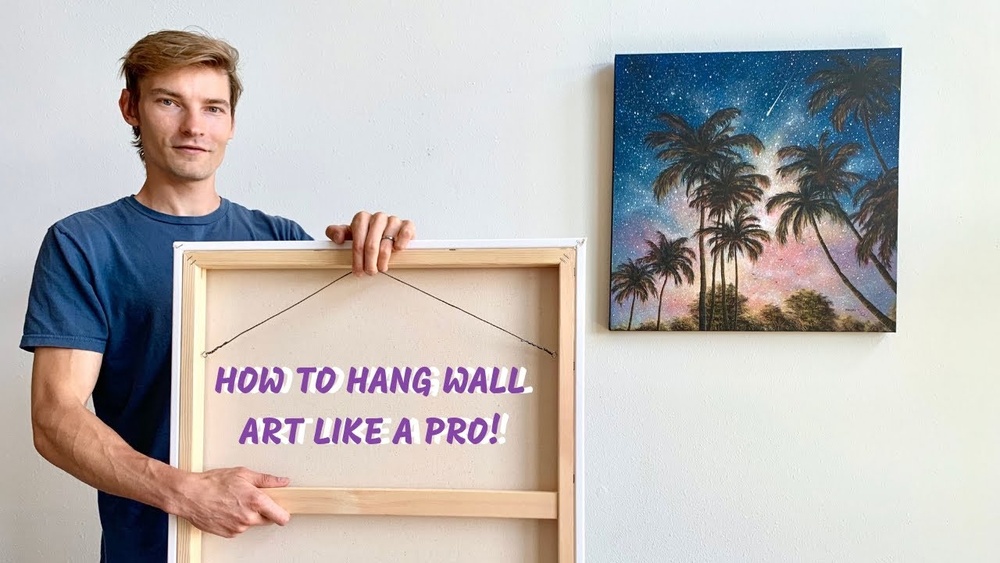
Quick answer: To hang a canvas painting on a wall, weigh it, attach two D-rings to the back of the stretcher bars about one-third of the way down, and either string picture wire between them or hang the rings directly on two level hooks. Aim for the center of the canvas at roughly 57 to 60 inches from the floor, use fasteners rated well above the canvas weight, and switch to a French cleat screwed into studs for large or heavy pieces.
Hanging a canvas painting on a wall is mostly a measuring job. The hardware is cheap and simple; what goes wrong is a hook placed two inches too high, a wire that stretches overnight, or an anchor that was never meant for a 30-pound piece. Get the numbers right before you drill and the rest takes minutes.
Below is a full sequence for hanging a canvas painting on a wall, plus specific advice for large canvases, canvas panels and boards, rolled canvas, and grouped arrangements. The goal is a painting that hangs level, sits flat and stays put for years.
Step 1: Know What You Are Hanging
The back of the canvas decides which hardware you can use. Turn it over and check for these three situations:
- Stretched canvas: Fabric wrapped over a wooden frame of stretcher bars. You can screw D-rings, sawtooth hangers or a cleat into the wood.
- Canvas panel or canvas board: Canvas glued flat to a thin rigid board, often only about 1/8 inch thick. There is nothing to screw into, so hanging needs a different approach (covered below).
- Ready-to-hang print or painting: Already fitted with a sawtooth, wire or keyhole hanger. Check that the factory hardware is secure and rated for the weight before trusting it.
Next, weigh it. Hold the canvas and step on a bathroom scale, then subtract your own weight. This one number determines your fasteners. Small canvases usually weigh very little, but large gallery-wrapped pieces with crossbars and heavy paint can surprise you.
Step 2: Pick a Spot and a Height
Before touching a tool, decide where the canvas goes and how high. A widely used gallery rule is to place the center of the artwork at about 57 to 60 inches above the floor. This keeps paintings at a comfortable standing eye level and keeps multiple pieces around a room on a consistent line.
Adjust that rule for context:
- Above a sofa or bench: Leave about 8 to 10 inches between the top of the furniture and the bottom of the canvas.
- Above a console or mantel: Roughly 4 to 8 inches of gap keeps the art and the furniture visually connected.
- Dining rooms: People view the art while seated, so hanging a little lower than 57 inches often looks better.
- Width relative to furniture: Art that spans about two-thirds to three-quarters of the furniture width below it tends to look proportionate.
Choosing the piece itself is a separate question from hanging it. If you are still deciding what belongs on a big living room wall, our guide to canvas wall art styles for living rooms walks through sizes, color stories and layouts that suit different spaces.
Step 3: Install Hardware on the Canvas
For most stretched canvases, D-rings are the best all-round choice. They are stronger than sawtooth hangers, hold the canvas closer to the wall, and work with either wire or direct hooks.
- Place the canvas face down on a soft, clean surface.
- Measure down one-third of the canvas height on each vertical stretcher bar. Mark both bars at the same height.
- Drill a small pilot hole at each mark, using a bit thinner than your screws, to keep the wood from splitting.
- Screw in a D-ring on each side, angled toward the top corner. Use screws short enough that they cannot pass through the bar.
- If using wire, thread it through both rings, twist each end back on itself several times, and leave enough slack that the pulled peak sits a few inches below the top edge.
Step 4: Calculate the Hook Position
This is where most hanging mistakes happen. Here is a simple formula for a single hook with wire:
- Decide your center height (for example, 58 inches).
- Add half the canvas height. For a 30-inch-tall canvas, 58 + 15 = 73 inches. That is where the top edge goes.
- Pull the wire up taut toward the top of the canvas and measure from the peak of the wire to the top edge. Say it is 3 inches.
- Subtract: 73 – 3 = 70 inches. Mark the wall at 70 inches, centered on your chosen spot.
For two hooks with D-rings hung directly, measure the exact distance between the rings and the distance from the top of each ring to the top of the canvas. Mark two points level with each other at that spacing. A short level or a laser level helps here.
Step 5: Choose the Right Wall Fastener
| Wall type | Light canvas | Medium canvas | Heavy canvas |
|---|---|---|---|
| Drywall | Angled picture hook with nail | Two picture hooks or self-drilling anchors | Screw into a stud, or toggle bolts |
| Plaster and lath | Picture hook with tape over the spot | Pilot hole plus screw into lath | Stud screw or heavy toggle |
| Brick or concrete | Masonry nail in mortar | Masonry bit with plastic anchor | Masonry anchor with screw, two points |
| Wood paneling | Small screw | Screw | Screw into framing behind panel |
Read the rating on every package and treat it as a ceiling, not a target. Rated loads assume a perfect installation. Doubling the canvas weight is a sensible safety margin.
Step 6: Hang, Level and Protect the Wall
Lift the canvas with both hands on the stretcher bars, never by the wire or the front of the canvas. Settle it on the hook or hooks, step back, and check level. With wire, nudge the bottom corners until the bubble is centered.
Stick small clear bumper pads on the two bottom corners of the back. They stop the canvas from scuffing the wall, help it sit plumb, and add friction so it stays level when doors slam or someone brushes past.
How to Hang a Large Canvas
Large canvases need more planning because the stakes are higher: more weight, more leverage on the hardware, and more damage if something lets go. Here is the best way to hang a large canvas painting safely:
- Use two points of contact at minimum. Two hooks on the wire, two D-rings on two hooks, or a full-width cleat. Never a single nail.
- Find studs. Studs in most US homes are spaced 16 inches apart on center. A wide canvas will usually span at least two, so you can screw both hooks or the full cleat into solid framing.
- Consider a French cleat. Two beveled strips interlock to spread the load across the whole width. The canvas sits flat and cannot slip sideways.
- Get a helper. One person holds and lowers the canvas while the other guides it onto the hooks and checks level from a distance.
- Check the crossbar. Large stretched canvases often have a center crossbar. It is a strong place to attach the canvas half of a cleat.
For how to hang large canvas art above furniture, keep the bottom edge closer to the furniture than you would with a small piece. A big canvas hung too high floats awkwardly and loses its connection to the room.
How to Hang Canvas Panels
Canvas panels and canvas boards are thin and rigid, with no wooden frame on the back. That rules out screws and D-rings, but there are still good options for how to hang canvas panels:
- Adhesive hanging strips. Press strips to the back corners of the panel and to a clean, smooth wall. Stay well within the weight rating.
- Glue on a wooden cleat or cradle. Attach a thin strip of wood across the back near the top with strong wood glue or construction adhesive, then add a sawtooth hanger or D-rings to that strip.
- Picture ledge. Lean panels on a narrow wall shelf with a front lip. Easy to swap and rearrange.
- Frame it. Panels fit standard picture frames sold in common sizes like 8 x 10, 11 x 14 and 16 x 20, which makes framing the most polished option.
- Clips or easel display. Small panels look good on tabletop easels or clipped to a wire display system.
How to Hang Canvas Board Without Damaging It
Avoid nailing or drilling straight through a canvas board. The board may split, and the hole will be visible from the front. Glue-on hardware or a frame keeps the painted surface intact and lets you remove the piece later.
Rolled Canvas vs Ready to Hang
If you buy canvas art or have a painting shipped, you will often choose between rolled canvas and ready to hang. The difference affects how much work you do before the piece goes up.
| Rolled canvas | Ready to hang | |
|---|---|---|
| Arrives as | Loose canvas rolled in a tube | Stretched on bars, often with hardware fitted |
| Shipping cost | Usually lower | Usually higher, bulky box |
| Work before hanging | Needs stretching or framing | Hang right away |
| Flexibility | Choose your own frame or stretcher depth | Depth and edge treatment already decided |
| Risk | Creases if rolled tightly or painted thickly | Corners can be dented in transit |
To hang a rolled canvas, let it relax flat for a day or two at room temperature, then have it stretched onto bars or mounted in a frame. Painted canvases should be rolled with the paint facing outward to reduce cracking, and unrolled gently. Avoid taping rolled canvas directly to a wall, since tape can lift paint and the canvas will curl and collect dust.
Arranging Several Canvases Together
Gallery walls and multi-panel sets look best when spacing is consistent. A few working rules:
- Keep 2 to 3 inches between canvases in a tight grid or triptych, and 3 to 5 inches in a looser salon-style wall.
- Treat the whole group as one piece. Put the center of the group, not each canvas, at about 57 to 60 inches.
- Make kraft paper templates for each canvas, mark the hardware positions on the paper, and tape them up. Drill through the paper, then tear it off.
- Start with the largest or central canvas and work outward.
Placement That Protects the Painting
Where you hang a painting affects how long it looks good. Strong direct sunlight can fade some pigments over time, and heat sources dry out canvas and stretcher wood. Kitchens add grease, and bathrooms add humidity that can loosen canvas tension or encourage mold on the back.
Good spots are interior walls away from heaters and vents, with indirect natural light or adjustable lamps. If a room gets strong afternoon sun, hang the canvas on a wall that does not catch the beam directly.
Common Mistakes When Hanging a Canvas
- Guessing the hook height. Always measure the wire drop. Eyeballing almost always leaves the canvas too high or too low.
- Single hook on a wide canvas. One hook lets the canvas see-saw out of level.
- Wire too loose. The top of the canvas tilts away from the wall and the wire may show above the frame.
- Anchors in the wrong wall. Drywall anchors in plaster can crumble the plaster; masonry needs masonry anchors.
- Hanging over a radiator or fireplace without checking heat. Feel the wall surface when the heat is on. If it is warm to the touch, choose another spot.
FAQs
What is the best way to hang a large canvas?
Use two points of support anchored into studs, either D-rings on two hooks or a French cleat across the top. Spreading the load and using solid framing behind the wall is safer than relying on drywall anchors alone.
How high should a canvas painting be hung?
A common guideline places the center of the painting about 57 to 60 inches from the floor. Over furniture, leave roughly 8 to 10 inches between the furniture and the bottom of the canvas.
How do you hang canvas panels without frames?
Use adhesive hanging strips, glue a wooden cleat to the back and attach a hanger to it, or rest the panels on a picture ledge. Panels are too thin for screws or D-rings directly.
Can you hang a canvas with just a nail?
For small, light canvases, yes. Rest the inside edge of the top stretcher bar on an angled picture hook. For anything larger or heavier, use D-rings and at least two hooks.
Is rolled canvas or ready to hang better?
Ready to hang is faster and simpler. Rolled canvas costs less to ship and lets you pick your own frame or stretcher depth, but it needs stretching or framing before it can go on the wall.
Do I need to hit a stud to hang a canvas?
Not for light pieces. Picture hooks and drywall anchors are fine within their ratings. For heavy canvases or anything hung above seating, screwing into a stud is the safer choice.
Next Step
Once you know how to hang a canvas painting on a wall properly, the fun part is choosing what goes up. A level hang, the right height and solid fasteners make any piece look more considered, whether it is your own painting or a purchased print.
If you are planning a new focal wall, see our roundup of the best canvas wall art for living room trends, where sizes and styles are matched to different rooms so your next piece goes up as easily as this one.