
PaintingProGuide is reader-supported. When you buy through links on this page we may earn an affiliate commission at no extra cost to you.
The best spray varnish for acrylic paintings protects the surface from dust, UV and handling, evens out patchy sheen, and does it without yellowing or clouding dark colors. Spray application is popular because it avoids brush marks and works well on textured impasto, where a brush can leave varnish pooled in the valleys. The trade-off is that spraying needs ventilation, warm and dry conditions, and patience with thin coats.
Not every clear spray is a fine-art varnish. Artist varnishes are formulated to stay clear and flexible on a painting for decades. Craft sealers and general clear coats work for décor, rocks and crafts, and some painters use them on practice pieces, but they are not designed with the same goals. The picks below make that distinction clear.
Quick answer: Liquitex Professional Spray Varnish is the best spray varnish for finished acrylic paintings: archival, non-yellowing, water-resistant when dry and intermixable with Liquitex acrylics. Choose the gloss version for saturated color. If you want a satin look and the ability to rework later, Krylon Kamar Varnish is the classic alternative. For crafts and décor rather than fine art, Krylon COLORmaxx Clear Gloss or Aleene’s Spray Acrylic Sealer are economical options.
Our Top Picks at a Glance
- Liquitex Professional Spray Varnish (Gloss) — Best overall spray varnish for acrylic paintings
- Krylon Kamar Varnish (Satin) — Best satin spray that allows rework
- Krylon COLORmaxx Acrylic Clear Gloss — Best for crafts and mixed surfaces
- Aleene’s Spray Acrylic Sealer (Gloss) — Best small can for craft projects
- Krylon Triple Thick Clear Glaze — Best extra-high-gloss coating for décor pieces
- MCTRHG Clear Acrylic Paint Sealer — Best brush-on alternative for high gloss
| Product | Best For | Key Spec | Key Strength | Price Tier |
|---|---|---|---|---|
| Liquitex Professional Spray Varnish | Finished fine art | 12 oz, gloss, archival | Non-yellowing, non-tacky | $$ |
| Krylon Kamar Varnish | Satin finish, reworkable | 11 oz, satin | For oil, acrylic and watercolor | $ |
| Krylon COLORmaxx Clear | Crafts and mixed surfaces | 11 oz, gloss | Wide surface list | $ |
| Aleene’s Spray Sealer | Small craft projects | 6 oz, gloss | Indoor and outdoor projects | $ |
| Krylon Triple Thick | High-gloss décor | 12 oz, extra high gloss | One coat equals three (listed) | $ |
| MCTRHG Brush-On Sealer | Brush-on high gloss | Brush-on, self-leveling | Wet-look shine | $ |
How We Chose
These picks are based on the Amazon listing details and specifications for each product as checked in October 2026, how well each product’s stated properties fit varnishing acrylic paintings, and how widely each is reviewed by Amazon buyers. We have not run aging tests; claims such as “non-yellowing” are the manufacturers’ and are labeled that way.
- Intended use: fine-art varnish first, craft sealers second.
- Finish: gloss, satin or extra-high gloss.
- Removability: permanent versus reworkable coatings.
- Clarity and yellowing: what the maker states about long-term color.
- Surface fit: canvas, paper, wood and mixed media.
Varnish vs Sealer vs Clear Coat
An artist varnish is a final protective layer designed for paintings. It should stay clear, remain flexible as canvas moves, protect against UV and dirt and, ideally, be removable for future cleaning by a conservator. Liquitex Professional Spray Varnish is described as permanent and non-removable, which is common for acrylic varnishes and still suitable for most artists. Krylon Kamar is often chosen because it allows easy rework.
A craft sealer or clear coat protects décor, crafts and functional objects. These are tough and convenient but are formulated for durability on varied surfaces rather than for the long-term appearance of fine art. Use them for painted rocks, wood signs, ornaments and practice pieces.
Many acrylic painters also apply an isolation coat before the final varnish: a clear, permanent acrylic layer, often a thinned gel medium, that seals the painting so a removable varnish can later be taken off without disturbing the paint. It is optional, but worth knowing about if you sell work.
Best Spray Varnishes for Acrylic Paintings Reviewed
1. Liquitex Professional Spray Varnish, Gloss — Best Overall for Acrylic Paintings

Liquitex’s spray varnish is built for acrylic paintings. The listing describes it as archival and permanent, drying to a non-tacky, hard, flexible surface that is non-yellowing and water-resistant when dry. It is intermixable with Liquitex Professional acrylic colors and mediums, which helps compatibility on Liquitex-painted work.
The gloss version deepens darks and saturates color, which suits most acrylic paintings. It is non-removable, so treat it as the final coat. Several thin passes give a more even result than one heavy spray.
The 12 oz can covers a good number of small and medium canvases if you spray efficiently and keep a consistent distance.
Best suited for: Acrylic painters finishing work for sale, display or gifting who want a dedicated artist varnish.
Key features (from the listing):
- 12 oz (400 ml) aerosol
- Gloss finish
- Archival, permanent, non-removable
- Non-yellowing, water-resistant when dry (listed)
- Conforms to ASTM D4236
Pros:
- Formulated for acrylic paintings
- Dries hard yet flexible and non-tacky
- Compatible with Liquitex products
Cons and limitations:
- Non-removable
- Gloss may not suit every style
- Requires good ventilation
Buying consideration: If you prefer a softer sheen, look for the satin or matte versions of the same varnish line and apply as a final coat over gloss for depth plus lower sheen.
2. Krylon Kamar Varnish, Satin — Best Satin Spray That Allows Rework

Kamar is a long-standing Krylon varnish used on oil, acrylic and watercolor paintings. The listing says it protects paintings, keeps colors looking fresh from the palette and allows easy rework. That last feature is why many painters like it: you can continue working on a piece after varnishing.
The listing details are mixed, showing both “matte” color and “satin” finish. Expect a satin sheen. It is fast-drying and comes in an 11 oz can.
Best suited for: Painters who want a lower sheen than gloss, or who like to rework paintings after a protective coat.
Key features (from the listing):
- 11 oz aerosol
- Satin finish
- For oil, acrylic and watercolor paintings
- Allows easy rework
- Fast drying
Pros:
- Versatile across media
- Satin reduces glare
- Rework friendly
Cons and limitations:
- Listing finish details conflict
- Less detail on archival claims
- Satin can slightly mute darks
Buying consideration: Test on a scrap with your darkest colors. Satin and matte varnishes can make deep tones look a little cloudy if sprayed heavily.
3. Krylon COLORmaxx Acrylic Clear Finish, Gloss — Best for Crafts and Mixed Surfaces

COLORmaxx Clear Gloss is a general acrylic clear coat for indoor and outdoor use. The listing details list a wide range of surfaces, including wood, ceramic, paper, fabric, glass, plastic, metal and wicker, and describe it as rust resistant.
It is not marketed as an artist varnish, but it is an inexpensive way to protect craft paintings, wood signs and décor that see handling.
Best suited for: Crafters and décor painters protecting painted objects rather than gallery canvases.
Key features (from the listing):
- 11 oz aerosol
- Gloss crystal clear
- Indoor and outdoor use
- Wide surface compatibility
Pros:
- Covers many surfaces
- Low tier
- Easy to find
Cons and limitations:
- Not formulated as a fine-art varnish
- Listing bullets give no detail
- Long-term clarity not stated
Buying consideration: For gifts and décor, two light coats are usually enough. Avoid it on paintings you plan to sell as fine art.
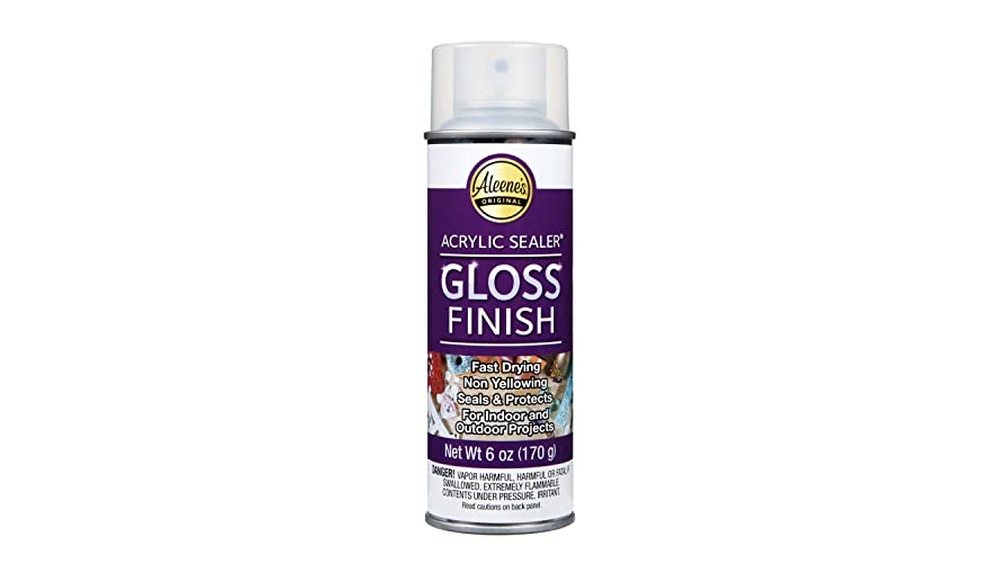
4. Aleene’s Spray Acrylic Sealer, Gloss — Best Small Can for Craft Projects

Aleene’s sealer gives a protective, clear, glossy finish to indoor and outdoor projects. The listing describes a durable finish, even spray and no CFCs. Surfaces listed include paper, cardboard, ceramics, plaster, painted surfaces, wood, glass and metal.
A 6 oz can is ideal for small crafts and occasional use, without committing to a full-size can.
Best suited for: Crafters sealing small painted pieces, paper crafts and décor.
Key features (from the listing):
- 6 oz aerosol
- Gloss clear finish
- Indoor and outdoor projects
- Wide surface list
Pros:
- Small, low-commitment size
- Even spray
- Versatile
Cons and limitations:
- Craft-focused rather than fine art
- Small can runs out quickly
- No archival claims
Buying consideration: Spray outdoors or in a well-ventilated space and hold the can at a consistent distance for an even sheen.
5. Krylon Triple Thick Clear Glaze — Best Extra-High Gloss for Décor

Triple Thick is designed to give a thick, extra-high-gloss coating; the listing says one coat equals three coats of most clear coatings. It is marketed as a non-firing glaze for polymer clay, bisque, plaster and more.
That glassy, almost resin-like look suits ornaments, painted rocks and some pour-style décor pieces. It is a poor match for subtle fine-art paintings, where a heavy coat can look plasticky and may be more prone to tackiness in humid conditions.
Best suited for: Crafters wanting a thick, glossy, glaze-like finish on décor.
Key features (from the listing):
- 12 oz aerosol
- Extra high gloss
- One coat equals three (listed)
- For polymer clay, bisque, plaster and more
Pros:
- Fast route to a deep gloss
- Good on crafts and ornaments
- Widely available
Cons and limitations:
- Heavy coat can look plasticky on paintings
- Not an artist varnish
- Needs long drying in humid weather
Buying consideration: If you want a glassy finish on a fluid art piece, test on a sample first. Triple Thick is easier to overdo than standard sprays.
6. MCTRHG Clear Acrylic Paint Sealer (Brush-On) — Best Brush-On Alternative

If you cannot spray, because of weather, space or ventilation, a brush-on sealer is the alternative. MCTRHG’s is described as a crystal-clear, wet-look high gloss that is non-yellowing, self-leveling and fast-drying, for acrylic paintings, paint pouring, canvas, painted rocks and crafts.
Self-leveling helps minimize brush marks, but thin, even coats are still essential. This is a good option for pours and rock painting, where a deep gloss is the goal.
Best suited for: Painters without a safe place to spray and fluid artists who want high gloss.
Key features (from the listing):
- Brush-on application
- High gloss, wet look
- Self-leveling, fast-drying (listed)
- Non-yellowing (listed)
Pros:
- No aerosol overspray
- Deep gloss for pours
- Good for small studios
Cons and limitations:
- Brush marks possible on flat paintings
- Not a spray
- Lesser-known brand
Buying consideration: Use a wide, soft synthetic brush and work in one direction, then cross-hatch lightly. Avoid overbrushing as it starts to set.
For general-purpose clear coating on small objects, Krylon also sells a solvent-based Clear Gloss spray listed as moisture and UV resistant. Treat it as a craft product rather than an artist varnish.
How to Spray Varnish an Acrylic Painting
Good results come from preparation and patience. Follow these steps for an even finish.
- Let the painting cure fully. Thin acrylic layers may be ready in a few days; thick impasto can take much longer.
- Dust the surface with a soft, wide brush or lint-free cloth.
- Work in a warm, dry, well-ventilated space, ideally outdoors in still air or in a spray booth, wearing a suitable respirator.
- Shake the can well, usually for a minute or more.
- Test spray on cardboard to check the nozzle and pattern.
- Hold the can at the distance stated on the label and spray in overlapping horizontal passes, starting and ending off the canvas.
- Let the coat dry, then spray a second coat in vertical passes for even coverage.
- Allow the final coat to dry fully before framing, wrapping or stacking.
Spray vs Brush-On Varnish for Acrylics
Spray varnish shines on textured work, small pieces and paintings with delicate surface marks, because nothing touches the paint. It also dries quickly and avoids streaks. Its downsides are overspray, the need for ventilation and a respirator, and the difficulty of getting a thick, even coat on very large canvases.
Brush-on varnish gives you more control over film thickness and is easier on large, smooth paintings. It is less suited to impasto, where it collects in the low points and can look shiny in patches. Many painters use both: brush-on for a first, even coat on flat areas and spray for a final, uniform sheen.
Buying Guide: How to Choose a Spray Varnish for Acrylic Paintings
Choose a fine-art varnish for finished work
If the painting is for sale, display or gifting, pick a varnish formulated for paintings, such as Liquitex Professional Spray Varnish. Craft sealers are fine for décor and practice pieces.
Pick your sheen
Gloss saturates color and deepens darks. Satin reduces glare while keeping some depth. Matte removes reflections but can slightly lighten dark areas. Many painters apply gloss first and a satin or matte coat on top.
Decide on removability
Permanent varnishes bond to the painting. Removable varnishes allow future cleaning. If you sell work, consider an isolation coat under a removable varnish.
Check UV and yellowing claims
Look for non-yellowing and UV-protection statements on the label. These are especially important for paintings that will hang in bright rooms.
Consider texture
Spray is ideal for impasto and heavily textured surfaces where brush-on varnish would pool in recesses.
Plan for conditions
Humidity and cold can cause cloudiness or blooming. Spray on dry, mild days and let the can reach room temperature first.
More on Varnishing
For a full walkthrough of brush-on and spray methods, isolation coats and timing, read our guide on how to varnish an acrylic painting. If you also work in oils, our article on varnishing and protecting oil paintings covers the longer curing times involved.
Common Mistakes to Avoid
- Varnishing before the paint has fully cured.
- Spraying one heavy coat instead of several thin ones, causing runs and drips.
- Spraying in cold or humid conditions, which can cloud the finish.
- Using a craft clear coat on gallery work without testing it.
- Skipping a respirator or ventilation.
- Spraying too close to the canvas and creating a blotchy sheen.
FAQs
What is the best spray varnish for acrylic paintings?
Liquitex Professional Spray Varnish is a strong choice for finished paintings because it is formulated for acrylics and described as archival, non-yellowing and water-resistant when dry.
Can I use Mod Podge or craft sealer instead of varnish?
Craft sealers protect décor and crafts, but they are not designed as fine-art varnishes. For paintings you plan to sell or keep long term, use an artist varnish.
How long should acrylic paint dry before varnishing?
Thin layers may be ready within a few days. Thick or textured paint needs longer to cure. Follow the varnish maker’s guidance and err on the side of waiting.
Should I use gloss or matte varnish on acrylic paintings?
Gloss deepens color and darks; matte reduces glare but can lighten darks slightly. Satin is a middle ground. Many painters combine a gloss coat with a satin or matte top coat.
Why did my spray varnish turn cloudy?
Common causes are high humidity, cold temperatures, heavy coats or varnishing before the paint cured. Spray in warm, dry conditions in thin coats.
How many coats of spray varnish should I apply?
Usually two or more thin coats, alternating direction, give even coverage. Let each coat dry as directed before the next.
Final Recommendation
For acrylic paintings you intend to sell, display or keep, Liquitex Professional Spray Varnish is the best spray varnish on this list. Choose Krylon Kamar if you prefer satin or want to keep reworking. For décor and crafts, Krylon COLORmaxx, Aleene’s and Triple Thick are practical choices, and the MCTRHG brush-on sealer is the fallback when spraying is not possible.




