PaintingProGuide is reader-supported. When you buy through links on this page we may earn an affiliate commission at no extra cost to you.
Lead white, also called flake white or Cremnitz white, was the standard oil painting white for centuries. It is still prized for its flexible film and warm, ropey handling, but it is toxic, which is why many painters, schools and home studios avoid it. The best lead-free white oil paint for most people is a titanium white: bright, highly opaque, strong in tinting and far safer to handle. Some formulations blend titanium with zinc to adjust handling and coverage.
Because white goes into nearly every mix, it is also the tube you buy most often, and the choice affects your whole palette. Below we compare seven lead-free titanium whites currently listed on Amazon, from professional walnut-oil white to large student-grade tubes, and explain how binder oil, tube size, pigment and price shape what you should buy.
Quick answer: For most painters, Winsor & Newton Winton Titanium White (200 ml) is the best lead-free white oil paint: a big, affordable tube with ASTM I lightfastness and an AA permanence rating. For professional work with less yellowing, M. Graham Titanium White in walnut oil is the premium pick. If you want an American-made artist white, choose Gamblin Artist Oil Titanium White (150 ml).
Our Top Picks at a Glance
- Winsor & Newton Winton Titanium White, 200 ml — Best overall lead-free white for everyday painting
- M. Graham Artist Oil Titanium White, 5 oz — Best professional white with low-yellowing walnut oil
- Gamblin Artist Oil Titanium White, 150 ml — Best American-made artist-grade white
- Gamblin 1980 Titanium White, 150 ml — Best student-grade white with real value
- U.S. Art Supply Titanium White, 2 x 100 ml — Best twin pack for beginners and classes
- PHOENIX Titanium White, 170 ml — Best budget large tube with stated PW6 pigment
- MEEDEN Titanium White, 60 ml — Best small tube for trying a new white
| Product | Best For | Key Spec | Key Strength | Price Tier |
|---|---|---|---|---|
| Winton Titanium White 200 ml | Everyday painting | 200 ml, series 1 | ASTM I, AA permanence, opaque | $$ |
| M. Graham Titanium White 5 oz | Professional, low yellowing | 5 oz, walnut oil | High pigment load, solvent-free system | $$ |
| Gamblin Artist Titanium White 150 ml | Artist-grade, made in USA | 150 ml | Trusted professional line | $$ |
| Gamblin 1980 Titanium White 150 ml | Students and value | 150 ml, eggshell | High-end student grade | $$ |
| U.S. Art Supply TW 2 x 100 ml | Beginners and classes | 2 x 100 ml, satin | Two tubes, non-toxic | $ |
| PHOENIX Titanium White 170 ml | Budget large tube | 170 ml, PW6, opaque | Very low cost per ml | $ |
| MEEDEN Titanium White 60 ml | Trying a new white | 60 ml | Low commitment | $ |
How We Chose
These picks are based on the Amazon listing details and specifications checked in October 2026, how well each white’s stated pigment, binder, permanence and format suit lead-free oil painting, and how widely each tube is reviewed by Amazon buyers. Every product here is a titanium white, which is lead-free by composition. Where a listing gives little technical information, we say so.
Criteria:
- Pigment: titanium white (PW6), sometimes blended with zinc (PW4).
- Binder oil: linseed, safflower or walnut, which affects yellowing and drying.
- Permanence and lightfastness: published ratings where available.
- Tube size: white is used fastest, so volume matters.
- Grade: professional, high-end student or budget.
Lead-Free White Options Explained
Titanium White
Titanium white is the most opaque and brightest white. It covers well and tints strongly, so a little goes a long way. Its drawbacks are that it can feel chalky in mixes and can overpower delicate colors, so add it gradually.
Zinc White
Zinc white is semi-transparent and cool, ideal for glazing and subtle tints. On its own it can form a brittle film in thick layers, so many painters use it only in small amounts or in blends.
Titanium-Zinc Blends
Blends combine titanium’s opacity with zinc’s smoother handling. Some student and artist whites use this approach; check the pigment codes on the tube.
Lead White Alternatives
Several makers sell “flake white replacement” or “lead white hue” colors that mimic the warmth and handling of lead using titanium and other pigments. If you love the look of lead white but not the risk, those are worth exploring.
Best Lead-Free White Oil Paint Reviewed
1. Winsor & Newton Winton Oil Color, Titanium White, 200 ml — Best for Everyday Painting

Winton is one of the most widely used affordable oil lines, and its titanium white is among the most reviewed white oil paints on Amazon. The listing gives clear technical data: series 1, color code 644, permanence rating AA (extremely permanent), opaque, and ASTM I (excellent) lightfastness.
The 200 ml tube is the key advantage. White disappears faster than any other color, and buying it large saves money and trips to the store. It handles well for blocking in, mixing and impasto, and it pairs with any traditional oil palette.
Best suited for: students, hobbyists and working painters who want a reliable, inexpensive white in a big tube.
Key features:
- 200 ml tube
- Series 1, color code 644
- AA permanence, ASTM I lightfastness
- Opaque
Pros:
- Large volume at a low price tier
- Published ratings
- Very widely reviewed
Cons and limitations:
- Student-grade pigment load compared with professional whites
- Binder oil not stated in the listing
Buying consideration: if you work very thick, consider pairing it with a stiffer artist white for impasto highlights.
2. M. Graham & Co. Artist Oil Paint, Titanium White, 5 oz — Best for Professional Work With Less Yellowing

M. Graham grinds its oil colors in walnut oil, and the listing highlights the benefit: colors retain clarity and are free from the discoloration associated with other drying oils. For a white, resistance to yellowing is especially valuable, since any yellowing is most visible in pale passages.
The listing also notes increased pigment loads for stronger color and positions the line as part of a solvent-free system of traditional oil painting, using walnut oil for thinning and cleanup. It is made in the USA.
Best suited for: professional and serious painters who want a clean, bright white and prefer to work solvent-free.
Key features:
- 5 oz tube
- Ground in walnut oil
- Increased pigment load
- Solvent-free painting system
- Made in USA
Pros:
- Low-yellowing binder
- Strong pigment
- Supports solvent-free studios
Cons and limitations:
- Premium price tier
- Walnut oil dries a little more slowly than linseed
Buying consideration: pair it with walnut oil as your medium to keep the solvent-free approach consistent.
3. Gamblin Artist Oil Color, Titanium White, 150 ml — Best for American-Made Artist Grade

Gamblin is a respected American maker of professional oil colors, and its Artist Oil Titanium White is a staple in many studios. The checked listing gives little technical detail beyond the country of origin, so we recommend reading Gamblin’s own color information for the binder and pigment specifics.
A 150 ml tube is a sensible professional size. Choose it if you already paint with Gamblin colors and want consistent handling across your palette.
Best suited for: painters building a professional Gamblin palette.
Key features:
- 150 ml tube
- Professional artist grade
- Made in USA
Pros:
- Trusted professional line
- Good working size
- Widely reviewed
Cons and limitations:
- Listing has minimal technical detail
- Higher price tier than student whites
Buying consideration: check the tube label for the exact pigment composition before buying if you need a pure titanium white.
4. Gamblin 1980 Oil Colors, Titanium White, 150 ml — Best for Students and Value

Gamblin 1980 is described as a high-end student grade oil that offers true color and real value, and it replaced the Gamblin Artist Sketch Oils. The listing notes an eggshell finish and American manufacture.
For students who want a step up from budget brands without paying professional prices, a 150 ml 1980 white is a strong choice, especially when mixed with other 1980 colors.
Best suited for: art students and value-conscious painters who want a dependable mid-tier white.
Key features:
- 150 ml tube
- High-end student grade
- Eggshell finish
- Made in USA
Pros:
- Good balance of quality and price
- Large tube
- Well reviewed
Cons and limitations:
- Less pigment-rich than artist grade
- Limited technical data in the listing
Buying consideration: use it for underpainting and mixing, and save a professional white for final highlights if you want.
5. U.S. Art Supply Titanium White Oil Paint, 2 x 100 ml — Best for Beginners and Classes
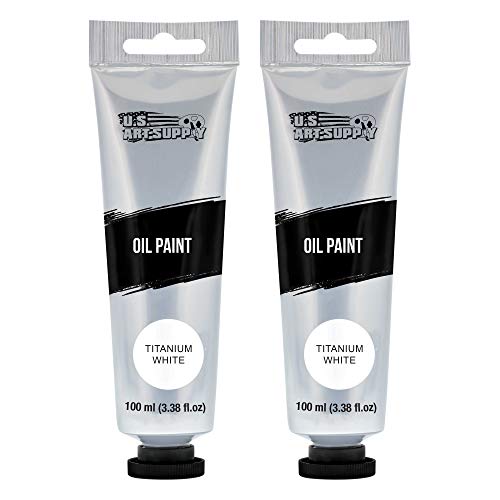
This twin pack gives two 100 ml tubes, a total of 6.76 fluid ounces. U.S. Art Supply describes it as a high-intensity titanium white with excellent covering power, tinting strength, a smooth consistency and a long working time, and states that it is lightfast and permanent.
It conforms to ASTM D4236 and EN71 and is described as non-toxic. Two tubes are handy for classes, shared studios or keeping one at home and one in a plein air kit.
Best suited for: beginners, classrooms and painters who want two tubes on hand.
Key features:
- Two 100 ml tubes
- Satin finish
- ASTM D4236 and EN71
- Long working time per listing
Pros:
- Two tubes in one purchase
- Good total volume
- Very widely reviewed
Cons and limitations:
- Pigment code not specified
- Budget-tier consistency may vary
Buying consideration: keep one tube sealed as a backup; opened white can stiffen if the cap is not tight.
6. PHOENIX Titanium White Oil Paint, 170 ml — Best for Budget Large Tube

PHOENIX lists clear basics: studio level, color code 104, pigment index PW6 (pure titanium dioxide) and opaque, in a large 5.75 oz tube. The listing describes high color saturation, strong tinting strength, exceptional permanence and finely ground pigments with a thick, creamy texture.
It is certified to EN 71 and ASTM-4236. At its price tier, it offers one of the lowest costs per milliliter of the whites here.
Best suited for: budget painters who want a large white with a stated single pigment.
Key features:
- 170 ml tube
- PW6 titanium white
- Opaque
- EN 71 and ASTM-4236
Pros:
- Very low cost per ml
- Pigment index stated
- Large tube
Cons and limitations:
- Studio grade rather than professional
- Binder oil not specified
Buying consideration: good for underpainting and large areas; test it alongside your other colors for consistency.
7. MEEDEN Titanium White Oil Paint, 60 ml — Best for Trying a New White
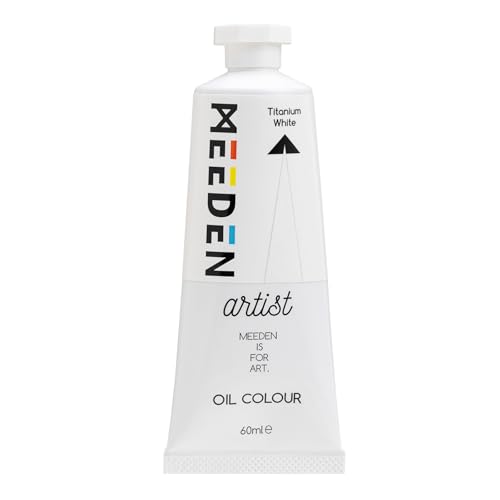
MEEDEN’s 60 ml titanium white is a low-commitment way to try a different white. The listing describes artist-grade paint made from a combination of pigments and linseed oil, with high lightfastness and smooth, rich consistency. Details list it as heavy body.
At 60 ml it will not last long on a busy palette, but it is a good size for a test or for a travel kit.
Best suited for: painters testing a new white or filling a small travel palette.
Key features:
- 60 ml tube
- Linseed oil binder per listing
- Heavy body
- Part of a 37-color range
Pros:
- Low price tier
- Linseed binder stated
- Good travel size
Cons and limitations:
- Small tube for white
- Pigment code not specified
Buying consideration: buy larger once you know you like the handling; white runs out fast.
Buying Guide: How to Choose Lead-Free White Oil Paint
Check the Pigment Code
PW6 is titanium white; PW4 is zinc white. A tube labeled with PW6 alone is a pure titanium white. Blends list both. None of these contain lead, which would be listed as PW1.
Consider the Binder Oil
Linseed oil dries fastest and forms a strong film but yellows slightly over time, most visibly in whites. Safflower and walnut oil yellow less but dry more slowly. Many manufacturers use safflower or walnut specifically for whites.
Opacity and Tinting Strength
Titanium white is very opaque and strong, ideal for highlights and covering. If your mixes look chalky, use less white or add a touch of zinc white or a warmer white hue.
Buy Big
White is used in nearly every mix. Tubes of 150 ml or larger usually offer far better value than small tubes, and you are less likely to run out mid-painting.
Match Grade to Purpose
Student-grade white is fine for practice and underpainting. Professional white gives cleaner tints and stronger coverage for finished work. Many painters keep one of each.
Handling and Consistency
Some whites are stiff and hold impasto peaks; others are softer and smoother. Stiff whites suit knife work and highlights; softer whites blend more easily.
Drying Time
Whites in slower-drying oils can stay tacky longer. If you paint in layers, factor that in, or add a small amount of fast-drying medium to your white.
Paint With Your New White
White plays a starring role in atmospheric and light-filled subjects. Try our guide to painting fog in oil, where subtle white tints build depth, or painting a seashell in oil, which is all about delicate, pale values.
Common Mistakes to Avoid
- Buying tiny tubes of white and running out mid-session.
- Adding too much titanium white and making mixes chalky.
- Using zinc white alone in thick layers, which can become brittle.
- Assuming every “flake white” is lead-free; check for “hue” or “replacement” on the label.
- Ignoring binder oil and wondering why pale passages yellow.
- Leaving caps loose so white stiffens in the tube.
FAQs
Is titanium white lead-free?
Yes. Titanium white is made from titanium dioxide (PW6) and contains no lead. It is the most common lead-free white oil paint.
What is the best substitute for lead white in oil painting?
Titanium white is the most common substitute for opacity. For handling closer to lead white, look for products labeled “flake white hue” or “lead white replacement,” which blend titanium with other pigments.
Does titanium white yellow over time?
Titanium pigment itself does not yellow, but the oil binder can. Linseed oil yellows more than safflower or walnut oil, which is why some whites, like M. Graham’s, use walnut oil.
Is zinc white better than titanium white?
They do different jobs. Titanium is opaque and strong for coverage and highlights. Zinc is semi-transparent and better for glazing and subtle tints, but it can be brittle in thick layers.
How much white oil paint should I buy?
Buy white in the largest size you can afford, typically 150 to 200 ml. Most painters use two to three times as much white as any other color.
Is lead white oil paint dangerous?
Lead white is toxic if ingested or inhaled as dust. Painters who use it should avoid sanding dry paint, wash hands carefully and keep it away from children and pets. Lead-free whites avoid those concerns.
Final Recommendation
For most painters, Winsor & Newton Winton Titanium White in the 200 ml tube is the best lead-free white: affordable, well-rated and big enough to last. Choose M. Graham’s walnut-oil titanium white for professional work where clean, low-yellowing whites matter, or Gamblin Artist Oil Titanium White if you paint with Gamblin colors. Students will do well with Gamblin 1980 or the U.S. Art Supply twin pack, budget painters can stretch further with the PHOENIX 170 ml PW6 tube, and the MEEDEN 60 ml tube is a low-risk way to try something new.