
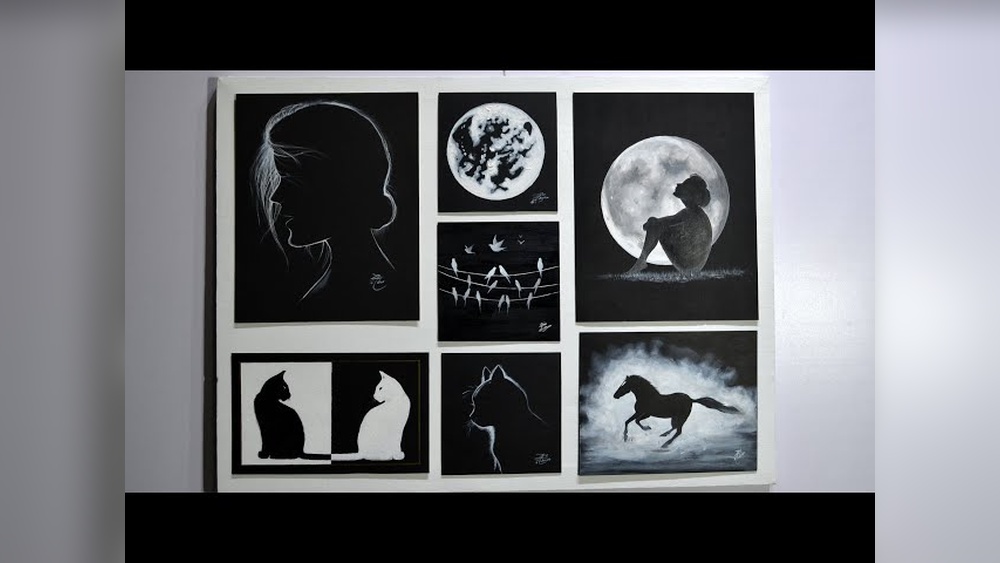
Quick answer: Strong black and white painting ideas for canvas include a single-line face or figure, a moon over water, a stark tree silhouette, geometric hard-edge abstracts, bold botanical leaves, a city skyline at night, ink-style mountain layers and a grayscale portrait study. Work with titanium white, a true black (such as mars black or a mixed chromatic black) and a range of grays mixed between them, and decide early whether to paint white on a black canvas or black on a white one, since that choice changes the whole process.
Removing color strips a painting down to what actually holds it together: shape, value and edge. That is why black and white work looks so striking on a wall, and why it is such a useful training ground for painters at every level.
It is also less forgiving. Without color to carry interest, a weak composition shows immediately. This guide offers black and white painting ideas for canvas sorted by difficulty, along with how to choose between a black or white starting surface, how to mix a useful grayscale, and techniques that make minimalist work look intentional rather than unfinished.
Black Paint and White Paint: What You Actually Need
A monochrome painting does not mean only two tubes, but it comes close.
- Titanium white: Opaque and bright; the standard white for most painting.
- Mars black: Dense and opaque, good for solid blacks and strong contrast.
- Ivory or bone black: Slightly warmer and more transparent; mixes softer grays.
- Optional chromatic black: Mixing ultramarine blue with burnt umber (or phthalo green with alizarin) gives a rich black that makes livelier grays than tube black.
- Optional warm or cool tint: A touch of burnt umber or Payne’s gray can warm or cool your grays without breaking the monochrome look.
Mixing a value scale
Before you start, mix five to seven steps from pure white to pure black on your palette. Number them. Having ready-made grays prevents constant remixing and keeps values consistent across the canvas. A common approach is to mix the middle gray first, then make lighter and darker steps on either side.
White Canvas or Black Canvas?
This decision affects everything from your first mark to your last.
| Starting surface | How you work | Best for | Watch out for |
|---|---|---|---|
| White canvas | Add darks; light is reserved | Line art, ink-style work, botanicals, sketchy styles | Large black areas can need several coats for even coverage |
| Black canvas | Add lights; dark is already done | Moonlit scenes, night skylines, glowing subjects, high drama | White needs multiple layers to look opaque on black |
| Mid-gray toned canvas | Add both lights and darks | Portraits, still life, realistic studies | Requires good value control |
You can buy pre-primed black canvas or make your own with black gesso. Pre-made black canvas saves time and gives an even surface; see our guide to the best black canvas for painting for options in different sizes and textures.
Gesso black canvas yourself
To make your own, apply two or three thin coats of black gesso to a white canvas, letting each coat dry and lightly sanding between coats if you want a smoother surface. Thin coats dry more evenly than one heavy layer.
Toning a mid-gray canvas
For realistic studies, mix white with a little black and a touch of burnt umber to a middle gray, then brush it thinly over a white canvas and let it dry. A toned ground lets you judge darks and lights against a neutral middle value from the first stroke, which is why it is a common starting point for portrait and still life studies. Keep the toning layer thin so it does not fill the canvas texture or slow your next layers.
Easy Canvas Ideas for Beginners
1. Continuous line face
Surface: White canvas, 11×14 inches.
Draw a simple face profile or portrait with one continuous line, never lifting the brush. Use a liner brush or a paint marker with fluid black acrylic. The slightly wobbly line is part of the charm.
2. Moon over water
Surface: Black canvas, 8×10 or 12×12 inches.
Paint a white full moon near the top, with a soft glow made from light gray dabbed around it. Below, paint broken horizontal strokes of white and gray to show moonlight on water.
3. Tree silhouette
Surface: White or light-gray canvas.
Paint a bare tree in solid black, starting thick at the trunk and tapering branches outward with a liner brush. A gradient background from white to light gray adds depth.
4. Geometric shapes with tape
Surface: White canvas.
Mask off triangles or stripes with painter’s tape, fill sections with black, white and two or three grays, then remove the tape for crisp edges.
5. Bold monstera or fern leaves
Surface: White canvas.
Paint large leaf shapes in solid black, or outline them and leave the interior white. Botanical subjects work well because their shapes are already strong and recognizable.
6. Dot mandala
Surface: Black canvas.
Using the end of a brush handle or a dotting tool, create concentric circles of white and gray dots. Vary the dot size for rhythm.
Simple Painting Ideas on Canvas for Intermediate Painters
7. City skyline at night
Surface: Black canvas, 16×20 inches.
Paint building silhouettes in dark gray against a slightly lighter gray sky. Add small white and light-gray windows and a few reflections on a river or street below.
8. Ink-style mountain layers
Surface: White canvas.
Paint layered mountain ridges, with the closest ridge darkest and each farther ridge lighter. This demonstrates atmospheric perspective using value alone.
9. Grayscale still life
Surface: Mid-gray toned canvas.
Set up simple objects such as a cup, an egg and a pear under one light. Paint shadows, mid-tones and highlights from your mixed value scale.
10. Abstract expressive marks
Surface: White canvas, 24×30 inches.
Use large brushes, palette knives or even a squeegee to make bold black gestures across the canvas. Leave plenty of white space and add a few gray layers for depth.
11. Feathers or birds
Surface: Black canvas.
Paint a single feather in white and grays with fine detail along the edges, or a flock of small birds in flight.
12. Black and white florals
Surface: White or black canvas.
Paint a single large flower, such as a peony or rose, using only value to show petals and depth.
Large Canvas Ideas for Beginners and Beyond
Large black and white paintings often look best with simple, bold designs. Fewer elements mean less risk of a cluttered result.
- Giant single brushstroke: One sweeping black stroke across a white canvas, inspired by calligraphy.
- Oversized moon: A large textured moon on black canvas using modeling paste for craters.
- Minimal horizon: A white canvas with a single thin black horizon line and a soft gray sky gradient.
- Abstract grid: Large rectangles of different grays arranged like a mosaic.
- Silhouetted figure: A single black figure walking across a mostly white canvas.
Advanced Black and White Ideas
13. Grayscale portrait
Paint a portrait from a high-contrast black and white photo. Grayscale portraits teach value accuracy without the distraction of skin color mixing.
14. Chiaroscuro study
Paint a subject emerging from a dark background with dramatic side lighting, a technique associated with Baroque painters.
15. Op art patterns
Create optical illusions with precise black and white lines or shapes that appear to move or vibrate.
16. Textured relief abstract
Build up texture with modeling paste or heavy gel, then paint it in black and white. Raking light across the surface adds a third dimension.
Step by Step: Moon Over Water on Black Canvas
This project (idea 2) is a reliable first black-canvas painting because the dark ground does half the work. Plan on about 90 minutes plus drying time.
- Place the moon. Trace a circle with a jar lid in white chalk or a white pencil, about a third of the way down from the top edge and slightly off center.
- Glow first. With a dry, soft round brush and a dark gray, scrub a soft halo around the circle. Add a smaller ring of mid-gray inside it. Keep edges blurry.
- Fill the moon. Paint the disk in light gray, then add titanium white over most of it in two thin coats, leaving a few gray patches to suggest craters.
- Set the horizon. Paint a thin, slightly lighter line about two-thirds of the way down to separate sky and water.
- Moon path. Directly under the moon, paint short horizontal dashes of white and light gray, wider and more spaced out near the bottom edge and tighter near the horizon.
- Accents. Add a small silhouetted sailboat or a few distant trees on the horizon in pure black over a dark gray for subtle definition.
If the white looks chalky or streaky after one coat, that is normal on a black ground. Let it dry and add another thin coat rather than loading on thick paint.
Brushes and Tools for Monochrome Work
- Liner or rigger: Continuous line art, branches, fine highlights.
- Medium flat: Clean edges for geometric pieces and buildings.
- Soft round or filbert: Soft glows, gradients and petals.
- Palette knife: Expressive abstracts and textured moons.
- Painter’s tape: Hard-edge stripes and shapes.
- Paint markers: Optional for fine white lines and dots on dark grounds.
Techniques That Make Black and White Paintings Work
- Plan your values: Squint at your reference or sketch to see major value shapes. Group them into three or four values for a clear design.
- Use negative space: Empty areas are part of the composition, especially in minimalist work.
- Vary edges: Combine crisp edges and soft transitions to create focus and depth.
- Control contrast: Place the strongest black-against-white contrast at the focal point.
- Layer white on black: White over black usually needs two or three coats. Let each coat dry for even coverage.
- Add subtle texture: Texture becomes more noticeable without color and adds interest.
For more ideas specific to dark grounds, our guide on what to paint on a black canvas covers subjects that look best glowing out of darkness.
Common Mistakes in Monochrome Painting
| Mistake | Result | Fix |
|---|---|---|
| Using only black and white with no grays | Harsh, flat look | Mix a value scale and use mid-tones |
| Too many similar grays | Muddy, low-contrast painting | Simplify to clear light, middle and dark groups |
| Thin white over black | Streaky, translucent highlights | Apply multiple thin layers |
| No focal point | Viewer’s eye wanders | Place highest contrast at the focal point |
| Overworking | Loss of crisp design | Plan the composition and stop sooner |
Displaying Black and White Canvas Art
- Hang a series of three small monochrome paintings together for a cohesive look.
- Use thin black or white floater frames to keep the minimalist feel.
- Pair a black-ground painting with a white-ground painting for contrast.
- Monochrome art suits almost any interior color scheme, making it a versatile gift.
FAQs
What are easy black and white canvas painting ideas for beginners?
A tree silhouette, a moon over water, geometric taped shapes, bold leaves and continuous line faces are all approachable and look striking in black and white.
Should I paint on a black canvas or a white canvas?
Choose black canvas for night scenes and glowing subjects where light is the focus. Choose white canvas for line art, botanicals and sketch-like styles. A mid-gray canvas works well for realistic studies.
How do I make gray paint look interesting?
Mix grays from a chromatic black (such as ultramarine and burnt umber) and white, or add a tiny amount of warm or cool color to vary the temperature of your grays.
Can I use gesso to make a black canvas?
Yes. Apply two or three thin coats of black gesso over a white canvas, letting each coat dry before the next. Light sanding between coats gives a smoother surface.
Why does my white paint look streaky on black canvas?
White over black often needs several coats for full opacity. Use an opaque titanium white, apply thin even layers and let each one dry before adding the next.
What size canvas is best for black and white art?
Small sizes (8×10 to 12×12 inches) are good for practice. Large canvases work well for bold, minimal designs with lots of negative space.
Final Thoughts
Black and white painting trains your eye for value and design in a way color can hide. Start with a simple silhouette or taped geometric piece, mix a value scale before you begin and decide early whether your painting is about light emerging from dark or darkness on light.
If you want to try the dramatic moonlit and night ideas above, a good dark surface makes the process easier. Compare pre-primed black canvases for high-contrast art to find one that suits your size and texture preferences.




