
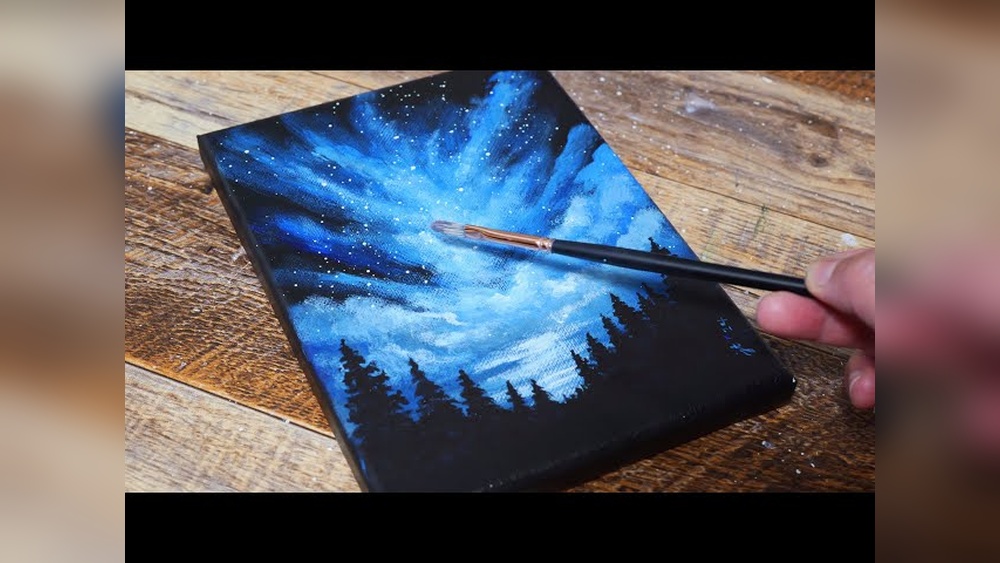
Quick answer: The best answer to what to paint on a black canvas is subjects that are naturally lit against darkness: night skies and galaxies, moons, city lights, fireflies, candles, glowing flowers, neon-style lettering, bioluminescent sea life, and high-contrast portraits lit from one side. Because the black ground already supplies your shadows, you only paint the light. Use opaque or high-pigment colors (or a white underlayer under brights), and keep large areas of black untouched so the glow reads.
A black canvas flips the usual logic of painting. On white, you build darkness up from nothing. On black, the darkness is already there, and every stroke you add is a decision about where light falls. That one reversal is why so many people find it easier to get dramatic results on a dark ground, and why some subjects look flat on white but come alive on black.
This guide gives you a list of what to paint on a black canvas, sorted by difficulty, along with the color and prep knowledge that makes those ideas actually work. If you have not picked up a surface yet, our roundup of pre-primed black canvases worth buying compares the options, from stretched canvas to flat panels.
Why a Black Canvas Changes How You Paint
Every color you put on black behaves differently than it would on white. Transparent pigments, such as phthalo blue, quinacridone magenta or most yellows, nearly vanish on black because there is no bright ground shining back through them. Opaque pigments, such as titanium white, cadmium-type colors, and most earth tones, sit on top and stay visible.
That has three practical consequences:
- You paint light, not shadow. Plan the picture around light sources and the edges they catch. Leave shadow areas bare.
- Brights need help. A clean yellow or pink over black will look muddy unless you lay down white or a light gray first and let it dry.
- Contrast is automatic. Even a simple shape in a pale color pops. This is forgiving for beginners and useful for quick, graphic work.
Keep these in mind as you read the ideas below. Almost every one of them is built on the same principle: let the black do the heavy lifting.
What to Paint on a Black Canvas: Beginner Ideas
These projects need only a few colors, little blending, and can be finished in one or two sessions on a small canvas (8 x 10 or 11 x 14 inches is a comfortable size).
1. A starry night sky
Spatter white paint by loading an old toothbrush and dragging your thumb across the bristles. Vary the density: heavier near one corner, thinner elsewhere. Add five to ten larger stars with a fine round brush, and a faint four-point glint on two or three of them. Silhouette a treeline or hill along the bottom by leaving it black.
2. A full moon
Paint a circle of light gray, then dab in slightly darker gray “seas” with a sponge or dry brush. Add a soft halo by dry-brushing a little diluted white around the edge. The black surroundings make the moon glow without any background work.
3. Fireflies in a field
Paint tall grass with thin upward strokes in dark green and olive, leaving plenty of black between blades. Dot small specks of white, then glaze a touch of yellow-green over each dot once dry. A tiny ring of faint yellow around a few dots sells the glow.
4. Neon-style words or shapes
Draw a word, heart or simple icon in chalk. Paint the line in white first, then go over it in a bright color, slightly wider, using thinned paint for a soft outer halo. Neon signs look convincing on black because real neon is usually seen at night.
5. Single flower with a spotlight
Choose one bloom, such as a rose, poppy or sunflower, and paint only the petals that face the light. Petals that turn away can be left mostly black with a thin lit edge. This teaches you to think in light planes.
6. Dandelion seed head
A center dot and fine white lines radiating out, a few seeds floating away. It is mostly line work with a liner brush and looks delicate against black.
Intermediate Ideas That Use the Dark Ground
These need more color mixing and some blending, but they reward the effort because the black canvas already gives you the depth.
7. Galaxy or nebula
Sponge in clouds of purple, magenta and blue, then knock back the edges with more black so they fade into space. Brighten the core with white mixed into the cloud color, add a starfield by spattering, and place a few bright stars. Because blending is soft and organic, small mistakes disappear.
8. Northern lights over mountains
Paint ribbons of green with vertical strokes that fade upward, add touches of teal and violet at the top edge, and keep mountain silhouettes black. Reflect the color faintly in a lake at the bottom if you want to add another element.
9. City skyline at night
Block building shapes in very dark gray or navy so they read faintly against pure black. Then dot windows in warm yellow and white, varying the pattern so some floors are dark. Add a few car-light streaks along the street with a fan brush.
10. Candle or lantern
Paint the flame as a teardrop of white at the core, then yellow, then orange at the edge. Light only the parts of the candle, holder and nearby objects closest to the flame. The falloff from bright to black is the whole picture.
11. Jellyfish and deep-sea creatures
Bioluminescent subjects are made for black. Paint translucent bells with thin glazes of blue and pink over a white underpainting, then add bright dotted edges and trailing tentacles in thin lines.
12. Chalk-style botanical or kitchen art
White and muted colors in a chalkboard style suit a black canvas well: herbs, coffee cups, recipe lettering. It works as decor and is mostly drawing with a liner brush.
Advanced Ideas: Light, Portraits and Realism
13. Chiaroscuro portrait
Light a face from one side, the way Baroque painters did. Paint only the lit plane: forehead, cheekbone, bridge of the nose, one side of the lips, and a rim on the chin. Let the shadow side dissolve into black. This is a classic exercise in reading value and edges.
14. Still life in candlelight
Arrange a pear, a glass and a cloth near a single light. Paint highlights on glass and metal sharply and keep the falloff gentle on soft objects. A black ground mimics the dark backgrounds of old-master still lifes.
15. Animal eyes in the dark
An owl, cat or wolf emerging from darkness: paint the reflective eyes intensely, then a soft suggestion of fur only where light catches it. It is dramatic and less work than a fully rendered animal.
16. Fireworks
Explosive bursts of radiating lines in several colors, layered over each other. Lay white under each burst so the colors stay vivid. Add smoke as faint gray scumbles.
If you would rather keep the whole surface dark and work only in tones of black, gray and white, our guide on painting all-black canvas art covers texture, sheen contrast and tonal layering in detail.
Best Colors for a Black Background
Color choice matters more on black than on any other ground. Here is how common paint colors tend to behave:
| Color type | Behavior on black | How to use it |
|---|---|---|
| Titanium white | Very opaque, strongest coverage | Base layer under brights, highlights, stars |
| Cadmium-type yellows, oranges, reds (or their hues) | Opaque, stay bright | Flames, flowers, warm light |
| Phthalo blue and green | Very transparent, nearly invisible straight from the tube | Mix with white, or glaze over a white underlayer |
| Quinacridone pinks and violets | Transparent, look dark | Glaze over white for jewel tones in galaxies |
| Metallic and iridescent paints | Reflective, glow strongly | Accents, gold leaf effects, details |
| Fluorescent paints | Vivid but often translucent | Neon effects over a white base |
| Earth tones (ochres, siennas) | Mostly opaque, warm | Skin tones, wood, autumn subjects |
A useful test before starting a big piece: paint a stripe of each color you plan to use on a scrap of black canvas or card. Let it dry. Colors usually dry slightly darker, and on black that shift is easy to notice.
How to Prepare a Black Canvas
You can buy canvases that come pre-primed black, or make your own. Both work; the choice comes down to convenience and how even you want the surface.
Gesso black canvas: making your own
Black gesso is a primer with black pigment, usually carbon black, mixed in. To prepare a white canvas yourself:
- Wipe the canvas with a dry cloth to remove dust.
- Stir the black gesso well. Brush on a thin first coat with a wide flat brush in one direction.
- Let it dry fully, typically 30 to 60 minutes depending on humidity.
- Apply a second coat at a right angle to the first for even coverage.
- For a smoother surface, lightly sand with fine sandpaper (around 220 grit) between coats and wipe away dust.
- Let the final coat cure for several hours, ideally overnight, before painting.
Two thin coats nearly always beat one heavy coat: they dry flatter and are less likely to crack or leave brush ridges. If you are painting with oils, check that your gesso is labeled suitable for oil painting; most acrylic gessoes are.
Black canvas boards for painting
Canvas boards and panels are flat, rigid and inexpensive, which makes them ideal for practice pieces, color tests and small studies. They also pack easily for travel. Stretched canvas is better for larger finished works and has a bit of give under the brush. Many artists keep a stack of small black boards for experiments and save stretched canvases for keepers.
Step-by-Step: A Simple Galaxy on Black Canvas
If you want a single project to start with, this one teaches layering, blending and spatter, and it suits the black ground perfectly.
- Gather materials. Black canvas, titanium white, a violet, a magenta or pink, a blue, a kitchen sponge cut into small pieces, a medium flat brush, a fine round brush, an old toothbrush, and a palette.
- Map the band. Decide on a diagonal path across the canvas where the galaxy will sit. Lightly sponge white along that path, then let it dry. This white base keeps later colors bright.
- Add color. Sponge violet along the outer edges of the band, magenta toward the inside, and blue at a few spots. Overlap them while wet so they blend softly.
- Fade the edges. Sponge a little black (or very dark blue) along the outer edge of the band to pull the clouds back into space.
- Brighten the core. Mix a touch of white into the magenta and dab it along the center line. Then add a few dabs of pure white in the brightest spots.
- Spatter stars. Thin white paint to the consistency of ink. Load the toothbrush and flick across the whole canvas, heavier over the galaxy band. Cover areas you want kept clean with paper.
- Add hero stars. With the fine round brush, paint five or six slightly bigger dots and give two of them thin cross-shaped glints.
- Optional foreground. Leave a black silhouette of pines or a mountain range along the bottom edge for scale.
Common Mistakes on Black Canvas (and Fixes)
- Colors look dull or muddy. You likely used a transparent pigment straight on black. Fix: paint a white or light gray underlayer first, let it dry, then apply color on top.
- Too much coverage. Painting over most of the black loses the drama. Fix: decide early what stays black, and protect it. Aim for at least a third of the canvas to stay dark in most night scenes.
- Chalk lines show through. White chalk or pastel sketch lines can remain visible. Fix: use a light touch, or sketch with a water-soluble pencil and wipe lines with a damp cloth before final layers.
- Streaky white. One heavy coat of white leaves brush marks and patchy coverage. Fix: two thin coats, letting each dry.
- Flat lighting. Lighting everything evenly kills the glow. Fix: choose one light source and fade brightness as you move away from it.
- Uneven homemade gesso. Ridges from a thick coat catch light. Fix: sand lightly and apply thinner coats next time.
Tips by Skill Level
New painters: Work small, use only white plus two colors, and pick subjects with silhouettes such as moons, trees, or skylines. Spatter and sponge techniques forgive a lot.
Comfortable painters: Try glazing transparent color over white underpainting, and practice soft edges where light fades into dark. Northern lights and candles are good targets.
Experienced painters: Push value control with chiaroscuro portraits and still lifes. Experiment with mixing a gloss medium into lit areas and leaving shadows matte, so the finish itself adds contrast. For more graphic, limited-palette directions, browse our black and white painting ideas for canvas.
FAQs
What colors look best on a black canvas?
Opaque colors look best: titanium white, warm yellows and oranges, opaque reds, and metallics. Transparent colors like phthalo blue or quinacridone pink look dark on black unless you mix them with white or paint them over a light underlayer.
Can you use acrylic paint on a black canvas?
Yes. Acrylic is the most common choice for black canvas because it dries quickly, so you can lay down a white base and paint color on top within minutes. Oils also work if the canvas primer is suitable for oil.
How do you make a black canvas yourself?
Brush two thin coats of black gesso onto a white primed canvas, letting the first coat dry before adding the second at a right angle. Sand lightly between coats for a smoother finish and let it cure before painting.
Is black gesso the same as black paint?
Not quite. Black gesso is a primer with more tooth and filler, designed to grip later layers. Black acrylic paint can cover a canvas too, but it gives a smoother, slicker surface that some paints grip less well.
What should a beginner paint on a black canvas?
Start with a moon, a starry sky, fireflies, or a single spotlit flower. These rely on simple shapes and the contrast of the dark ground, so they look striking even with basic brushwork.
Are black canvas boards good for painting?
They are good for studies, color tests and small finished pieces. Boards are rigid and inexpensive, while stretched canvas suits larger works you plan to frame or hang without glass.
Final Thoughts
The secret to deciding what to paint on a black canvas is simple: pick subjects that are defined by light. Night skies, flames, glowing creatures, and faces lit from one side all benefit from a ready-made dark ground. Plan the light first, protect the black, and lay white under any color that needs to stay bright.
When you are ready to choose a surface, our comparison of the top black canvas options for 2026 covers sizes, primer quality and panel versus stretched formats so you can match the canvas to the project.





One Comment