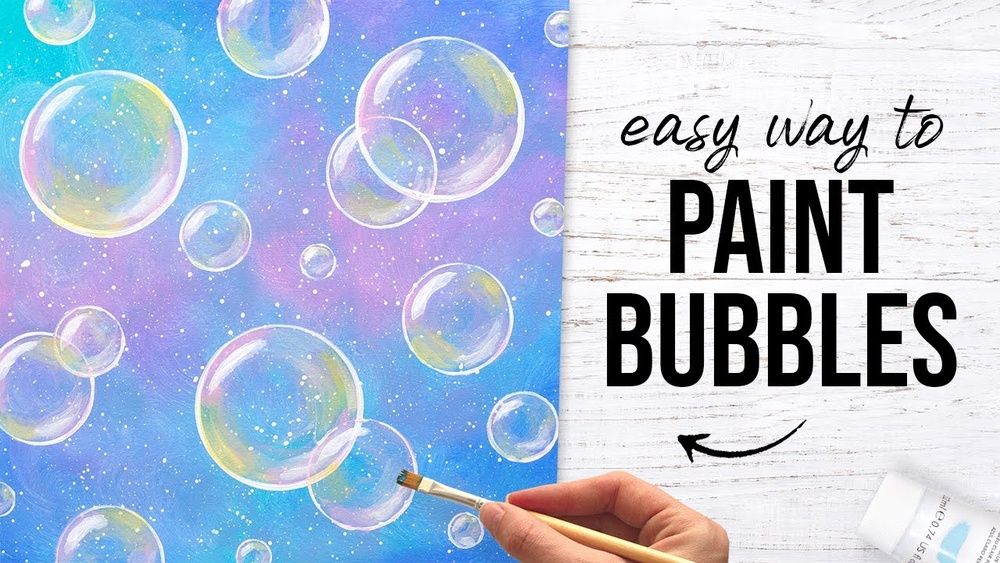
Quick answer: To paint bubbles with acrylic paint, don’t paint the bubble itself. Paint the background, then suggest the bubble with a thin, slightly lighter outline, a bright crescent highlight on one side, a smaller reflected highlight on the opposite side, and a faint wash of rainbow color (magenta, yellow, cyan) along the edges. Keep the center almost the same as the background, because a bubble is transparent. Thin, glazed layers and a crisp white highlight do most of the work.
Bubbles are a lesson in painting something that’s almost not there. A soap bubble is a thin film of water and soap wrapped around air, so you see straight through it. What makes it visible is light: reflections on its curved surface, a sharp highlight from the light source and swirling interference colors where the film is thinnest.
This guide on how to paint bubbles with acrylic paint covers soap bubbles floating in the air, underwater bubbles and simple decorative bubbles for kids’ art. The core principle is the same for all three: paint the light on the bubble, not the bubble.
Why Bubbles Look the Way They Do
Understanding a few bits of physics helps you make better painting decisions.
- Transparency: the center of a bubble shows the background almost unchanged. If you paint the center lighter or a different color, it reads as a solid ball.
- Edges are brighter: at the edges, you’re looking through more of the curved film at a shallow angle, so the edges reflect more light and look lighter or more colorful than the center.
- Specular highlight: the light source creates a bright, sharp highlight, often shaped like a window, a crescent or a small rectangle, on the side facing the light.
- Interference colors: the thin film splits light into swirling bands of magenta, gold, green and blue. These shift as the film thins and flows.
- Reflections: a bubble acts like a curved mirror, reflecting a distorted, tiny version of its surroundings, especially windows and the sky.
Underwater bubbles are different. They’re air in water, not a film, so they look more like bright, silvery spheres with strong highlights and dark edges.
Supplies
- Canvas, panel or heavy paper. Any size works; bubbles look great on small 8×8 inch pieces and on large backgrounds.
- Brushes: a soft flat for backgrounds, a size 4 and size 2 round, a size 0 detail brush and a liner.
- Circle templates, coins, jar lids or a compass for perfect circles (optional).
- Paints: titanium white, a magenta (quinacridone magenta), a yellow (hansa yellow or lemon), a cyan-like blue (phthalo blue), plus background colors.
- Glazing medium. This is essential for transparent bubble effects.
- Optional: iridescent or interference medium for shimmer.
Transparent colors are key for bubbles because you glaze them over the background without hiding it. Phthalo blue, quinacridone magenta and hansa yellow are naturally transparent pigments; cadmiums and titanium white are opaque. Knowing which of your paints are transparent makes a big difference here. If you’re unsure what your current set offers, our guide to the best acrylic paint brands, including transparency and pigment details is a good reference.
How to Paint Bubbles With Acrylic Paint: Step by Step
Step 1: Paint the background
A dark or mid-value background makes bubbles stand out. Deep blue, teal, purple or a dark blurred garden all work well. Bubbles on a white background are much harder to see, because their highlights are white too.
Paint the background completely and let it dry. If you want a soft, out-of-focus look, blend gradients with a soft flat brush, such as lighter in the upper corner and darker at the bottom.
Step 2: Plan bubble sizes and positions
Lightly mark circles with a pencil or chalk pencil, or use a template. Vary the sizes: one or two large bubbles as focal points, several medium ones and a scattering of small ones. Cluster some together and let a few overlap. Evenly spaced, identical bubbles look like polka dots.
Step 3: Paint a faint outline
Mix a color slightly lighter than the background (background color plus a little white). Thin it with glazing medium. Using a small round, trace the edge of each bubble with a thin line. Make the line slightly thicker on the side away from the light, and thinner, almost disappearing, on the side toward it.
Soften the inside edge of the outline with a damp brush so it fades toward the center. The outer edge should stay fairly crisp.
Step 4: Add rainbow interference colors
This step makes soap bubbles look real. Mix three separate glazes: magenta, yellow and cyan blue, each thinned heavily with glazing medium so they’re very transparent.
- Paint a curved stroke of magenta along part of the inner edge of the bubble.
- Paint yellow next to it, slightly overlapping.
- Paint cyan next to the yellow.
- Where the glazes overlap, they create green, orange and violet.
- Soften the colors inward with a damp brush so they fade before reaching the center.
Keep the colors mostly near the edge, and let them swirl a little rather than forming neat stripes. Real bubbles have flowing, marbled color bands.
Step 5: Paint the main highlight
With pure titanium white and a small round, paint the main highlight on the side facing your light source. Common shapes include:
- A curved crescent following the bubble’s edge.
- A small rounded rectangle, which reads as a reflected window.
- A soft oval with one bright spot inside.
Keep the highlight crisp on the edge facing the light and slightly softer on the inner edge. It should be the brightest point on the bubble.
Step 6: Add the secondary highlight
On the opposite side of the bubble, paint a smaller, dimmer highlight: a thin crescent or a short curve. This is light bouncing through the bubble and reflecting off the far wall. It’s a small touch, but it’s one of the details that makes a bubble look three-dimensional and hollow.
Step 7: Optional reflections
For larger bubbles, suggest a tiny, distorted reflection of the environment inside the bubble near the edge: a curved horizon line, a dark window shape or a hint of a tree. Paint it faintly and curve it with the bubble’s surface.
Step 8: Shimmer (optional)
Glaze a thin layer of iridescent or interference medium over the bubble’s rim. It catches light as the viewer moves and adds a subtle sheen. Use it sparingly so the bubble stays transparent.
Bubble Styles Compared
| Style | Background | Main features | Difficulty |
|---|---|---|---|
| Realistic soap bubble | Dark or blurred scene | Transparent center, rainbow rim, crisp highlight | Intermediate |
| Underwater bubble | Blue-green water | Bright silvery body, dark edge, strong highlight | Beginner to intermediate |
| Decorative bubble | Any color | White outline, simple highlight | Beginner |
| Bubble cluster or foam | Any color | Overlapping circles, shared walls | Intermediate |
Painting Bubbles on a Light Background
Sometimes the composition calls for a pale setting, such as bubbles floating in a bright sky or against a white bathroom wall. Since white highlights won’t stand out, you need to rely on the edges and colors instead.
- Make the outline slightly darker than the background rather than lighter, such as a soft blue-gray around each bubble.
- Push the rainbow glazes a little stronger, since they’re now the main thing that defines the bubble.
- Paint a faint dark reflection inside the bubble, like a window frame or a distant tree line, to create contrast near the highlight.
- Surround the brightest highlight with a slightly darker halo so it still reads as the lightest point.
Painting Underwater Bubbles
Underwater bubbles rise from divers, fish or the sea floor. They behave differently from soap bubbles.
- Paint a blue-green water background, lighter at the top where sunlight enters.
- Paint each bubble as a circle filled with a slightly lighter blue than the water.
- Paint a darker ring around the outer edge.
- Add a bright white highlight near the top, on the side facing the light.
- Add a thin, light crescent near the bottom inside edge for reflected light.
Larger underwater bubbles flatten and wobble into irregular, mushroom-like shapes as they rise, while tiny bubbles stay round. Mix shapes for a more natural look, with bubbles getting slightly larger as they rise toward the surface.
Painting Bubble Clusters and Foam
When soap bubbles touch, they don’t stay as separate spheres. They press together and share a flat wall, and three bubbles always meet along a line at roughly equal angles. That geometry is why foam looks like a loose honeycomb.
- Draw a group of circles that overlap slightly. Where two circles meet, replace the overlapping curves with a single straight or gently curved line.
- Paint the shared walls as thin, slightly brighter lines than the outer edges, since you’re seeing the film edge-on.
- Add rainbow glazes only to the outer rims and a few shared walls, not all of them.
- Place a single main highlight on each of the larger bubbles, all facing the same light source.
- For foam, shrink the bubbles toward one area and let them become tiny dots with a highlight each.
Foam clusters work well in bath scenes, in a sink or along a shoreline where waves break. Keep the smallest bubbles crisp and let larger ones fade softly into the background for depth.
Bubbles for Kids and Beginners
- Simple white bubbles: paint a dark background, then draw white circle outlines with a small brush or a white paint marker, plus a small curved highlight inside each.
- Bubble printing: dip the open end of a cup, a bottle cap or a cardboard tube in paint and stamp circles. Add highlights once dry.
- Rainbow bubbles: paint circles with a different pastel color on each edge, then add a white highlight.
- Bubbles with a character: paint a child blowing bubbles, a fish blowing bubbles or a cat chasing them.
Common Mistakes When Painting Bubbles
| Mistake | Result | Fix |
|---|---|---|
| Filling the center with white | Looks like a solid ball or pearl | Keep the center nearly the same as the background |
| Thick, even outline | Looks like a drawn circle | Vary outline thickness; soften the inner edge |
| Opaque rainbow colors | Flat, stripy bubble | Use transparent pigments in glazing medium |
| Highlights in different places | Confusing light direction | Place main highlights on the same side for every bubble |
| Identical sizes | Polka-dot pattern | Vary sizes; cluster and overlap |
| Light background | Bubbles barely visible | Use a dark or mid-value background |
Tips for Better Bubbles
- Study photos of real bubbles. Notice how the highlight often shows a tiny reflected window.
- Keep one consistent light source for all bubbles in the painting.
- Make a few bubbles out of focus by softening their edges, to create depth.
- Let some bubbles overlap. Where they touch, they share a flat wall, which is a convincing detail.
- Add a few tiny “dot” bubbles with just a highlight, for scale.
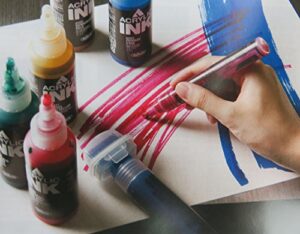
If you like the glassy, transparent look of bubbles, ink and fluid acrylics are especially useful for rainbow glazes. Our Daler-Rowney acrylic ink review covers how that type of ink layers and how transparent it stays.
FAQs
How do you make bubbles look transparent in acrylic?
Leave the center of the bubble almost the same as the background, paint only a thin outline, rainbow glazes near the edge and a crisp white highlight. Use transparent pigments mixed with glazing medium for all the color.
What colors make a soap bubble?
Transparent magenta, yellow and cyan blue glazes create the swirling rainbow film. Titanium white is used for the highlights. The rest of the bubble shows the background color.
What background is best for painting bubbles?
A dark or mid-value background such as deep blue, teal, purple or a blurred dark garden. Bubbles on white backgrounds are hard to see because the highlights blend in.
How do you paint bubbles underwater?
Paint each bubble a little lighter than the water, add a darker rim, a bright highlight near the top and a thin reflected-light crescent near the bottom. Vary their shapes, with larger bubbles flattening as they rise.
Can kids paint bubbles with acrylic paint?
Yes. Stamping circles with a cup or bottle cap and adding a white highlight is easy and fun for kids. Use washable or kid-safe paints for younger children.
How do I paint perfect circles for bubbles?
Trace around coins, jar lids or a circle template, or use a compass. You can also paint freehand and tidy the edge afterward with background color.
Final Thoughts
Bubbles reward restraint. A faint outline, a swirl of transparent color at the rim and one sharp highlight are enough. Everything else is the background showing through.
Because bubbles depend on truly transparent colors and a strong white, paint choice makes a visible difference. To find colors that glaze cleanly and highlight brightly, read our comparison of the most reliable acrylic paint brands for artists.