PaintingProGuide is reader-supported. When you buy through links on this page we may earn an affiliate commission at no extra cost to you.
Search for 3D acrylic paint and Amazon returns three unrelated things: dimensional paints that stand up in raised lines, heavy-body paints and pastes that hold a palette-knife ridge, and ordinary acrylics people use to paint 3D-printed models. All of them are acrylic and all of them are, in some sense, three-dimensional, which is why so many buyers end up with the wrong jar.
This guide separates those three uses. For raised texture on canvas, you want a super-thick paint or a modeling paste. For puffy lines on fabric, glass or cards, you want dimensional paint in a fine-tip bottle. For painting a printed figure, you want a pre-thinned model acrylic. Each product below is placed in the category it actually belongs to, with details taken from the current listings.
Quick answer: For textured 3D effects on canvas and wood, the FolkArt Super Thick Acrylic Paint is the best 3D acrylic paint: a heavy-bodied formula in a 4 oz wide-mouth jar that scoops, holds its shape and dries matte. If you want to sculpt texture at scale and tint it yourself, the Bluebird Thick Modeling Paste (800 g) is the pick. For raised lines on fabric and crafts, the Tulip Puff Paint 20-Color Pack is the classic dimensional paint, and for painting 3D prints, the Smallbudi 20-Color Model Paint Set is formulated for plastic and resin.
Our Top Picks at a Glance
- FolkArt Super Thick Acrylic Paint, Pearl White 4 oz — Best 3D acrylic paint for textured canvas effects
- Bluebird Thick Modeling Paste, 800 g — Best for sculpted texture and large impasto
- Tulip Puff Paint 20-Color Party Pack — Best dimensional paint for fabric and crafts
- Castle Art Supplies 3D Fabric Paint Set, 24 colors — Best 3D paint set with tutorial and brushes
- HissiCo 36-Color Thick Acrylic Set with 12 brushes — Best color range for impasto and palette-knife texture
- Smallbudi 20-Color Model Paint Set — Best acrylic for painting 3D prints and miniatures
| Product | Best For | Key Spec | Key Strength | Price Tier |
|---|---|---|---|---|
| FolkArt Super Thick | Raised texture on canvas and wood | 4 oz jar; heavy body; matte; indoor/outdoor | Holds 3D shapes; scoopable jar | $ |
| Bluebird Modeling Paste | Sculpted impasto, large areas | 28.2 oz (800 g) white paste; quick drying | Volume for big texture; tintable | $$ |
| Tulip Puff Paint 20-Pack | Puffy lines on fabric, cards | 20 x 0.75 oz tip bottles; permanent on fabric | Precision tips; washable when cured | $ |
| Castle Art 3D Fabric Paint | Crafters wanting a guided set | 24 x 29 ml bottles, 3 brushes, tutorial | Expanding 3D effect; cuttable tips | $$ |
| HissiCo 36 Colors | Thick-bodied color for knife work | 36 x 60 ml; holds brush and spatula marks | Wide palette; brushes included | $$ |
| Smallbudi Model Paint | Painting 3D prints | 20 x 20 ml; pre-thinned; thinner; matte | Formulated for plastic, resin, metal | $$ |
How We Chose
These picks are based on the Amazon listing details and specifications checked in October 2026, how well each product’s formulation matches one of the three meanings of “3D acrylic paint,” and how widely each product is reviewed by Amazon buyers. We have not applied these products ourselves. Where the listing describes behavior such as expanding or holding peaks, that is the manufacturer’s description.
We considered:
- Dimensional behavior: whether the listing says the product holds raised shapes, stands in lines or expands.
- Format: wide-mouth jar for scooping, tip bottle for lines, tub for bulk paste, dropper for models.
- Surface fit: canvas, wood, fabric, glass, plastic and resin as named in the listing.
- Finish: matte, gloss or pearl, which affects how texture reads under light.
- Volume: dimensional work consumes far more paint than flat painting.
- Safety and durability: non-toxic labeling, permanence and indoor or outdoor suitability.
Best 3D Acrylic Paints Reviewed
1. FolkArt Super Thick Acrylic Paint, Pearl White — Best for textured 3D effects on canvas and wood
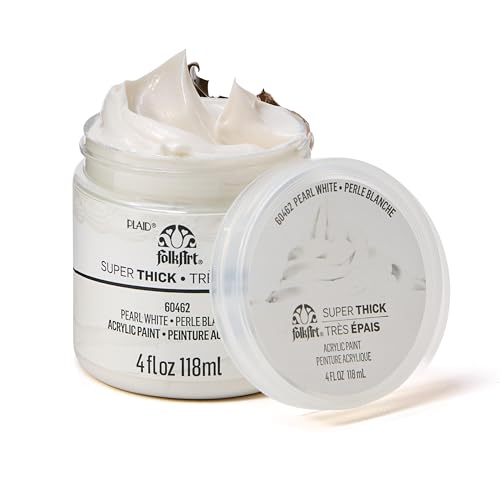
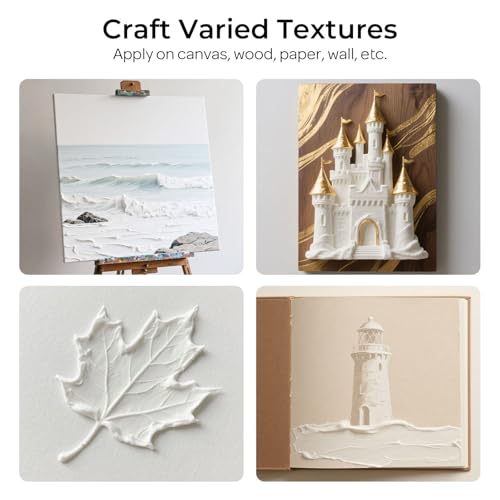
FolkArt Super Thick is the product most people mean when they search for 3D acrylic paint for canvas. The listing describes a heavy-bodied acrylic that creates textured 3D effects through a range of applications and techniques, drying to an opaque, matte finish. It comes in a 4 oz wide-mouth jar, which matters: you scoop it with a knife or spatula straight onto the palette or the surface instead of squeezing a tube.
The formula is non-toxic, water-based and made in the USA, and it is listed for indoor and outdoor projects. The listed item form is gel, and this listing is the Pearl White shade, a useful base because you can tint it with regular acrylic or leave it as a shimmering raised accent on florals, waves and abstract pieces.
Best suited for: Canvas and wood painters who want palette-knife ridges, raised petals, stucco effects and textured backgrounds without buying a separate medium.
Key features:
- Heavy-bodied acrylic for 3D textured effects
- 4 oz wide-mouth jar
- Opaque, matte finish
- Indoor and outdoor use
- Non-toxic, water-based, made in the USA
- Pearl White shade in this listing
Pros:
- Holds shape for palette-knife and stencil texture
- Scoopable jar
- Can be tinted or used as an accent
Cons and limitations:
- 4 oz goes quickly on large textured areas
- Matte finish may need varnish for sheen
- Single color per jar
Buying consideration: Apply through a stencil with a palette knife for crisp raised patterns; the heavy body is designed to keep edges sharp as it dries.
2. Bluebird Thick Modeling Paste, White 800 g — Best for sculpted texture at scale

When the texture covers the whole canvas rather than a few accents, a modeling paste is the economical route. Bluebird’s tub holds 28.2 oz (800 g) of high-density white acrylic paste described as creamy, workable and suited to sculpting, modeling and adding texture to canvas, wood and other surfaces. It is a medium, not a colored paint: you mix in acrylic color before application or paint over it once dry.
The listing claims quick drying without cracking, which allows layered build-up and detailing, and positions it for beginners and experienced artists alike. For 3D abstract art, textured landscapes or sculpted relief, this volume replaces many small jars of super-thick paint.
Best suited for: Abstract and mixed-media artists building heavy relief, and anyone covering large canvases in texture.
Key features:
- 800 g (28.2 oz) white modeling paste
- High density, creamy consistency
- For sculpting, modeling and texture on canvas and wood
- Quick drying, crack-resistant per listing
- Tintable with acrylic color
- Acrylic medium, paste form
Pros:
- Large volume for big projects
- Takes color mixing or overpainting
- Builds thick layers
Cons and limitations:
- White only; needs tinting or painting over
- Very thick layers still take time to cure fully
- Listing offers few ingredient details
Buying consideration: Build texture in two or three layers rather than one deep slab; even crack-resistant pastes cure better in stages.
3. Tulip Puff Paint 20-Color Party Pack — Best for puffy lines on fabric and crafts

Tulip Puff Paint is the dimensional paint most people remember from school, and it remains the standard for raised lines. The 20-color pack provides 0.75 oz easy-squeeze bottles with precision tips for writing, outlining and dotting. The formula is described as 3D, adding texture and dimension, and is non-toxic, permanent and waterproof once cured.
Although sold as fabric paint for cotton, denim and canvas, the details also list glass and wood as surfaces, and it works with stencils or freehand. For t-shirts, tote bags, holiday ornaments and greeting cards, this is the straightforward 3D paint.
Best suited for: Crafters decorating fabric, kids’ projects, ornament makers and anyone who needs raised outlines or lettering.
Key features:
- 20 colors, 0.75 oz bottles
- Precision tips for lines and dots
- 3D formula adds texture and dimension
- Permanent on fabric, waterproof when cured
- Non-toxic
- Surfaces: fabric, canvas, glass, wood
Pros:
- Wide color range in one pack
- Tips make lines easy without a brush
- Permanent on washable fabric
Cons and limitations:
- Small bottles
- Gloss finish on everything
- Not intended for palette-knife canvas texture
Buying consideration: Let dimensional paint cure flat for the full time on the label before washing fabric; the raised bead takes longer to set than a flat coat.
4. Castle Art Supplies 3D Fabric Paint Set, 24 Colors — Best for a guided dimensional paint set

Castle Art’s set is a step up in presentation from the Tulip party pack: 24 colors in 29 ml bottles, three bonus brushes and a fold-out tutorial that teaches a five-step illustration from the box lid. The listing says the paint expands to give a 3D effect, and the soft tips can be snipped to vary flow from thin lines to broad strokes.
Surfaces named include clothes, socks, footwear, backpacks, glass, ceramics and wood, and the colors are organized in families for mixing. The gloss finish is typical of dimensional paints. It is a good choice for a crafter who wants a complete, gift-ready 3D paint kit rather than a bag of bottles.
Best suited for: Gift buyers, teens and crafters who want more colors, brushes and a tutorial in one box.
Key features:
- 24 colors in 29 ml bottles
- 3 brushes included
- Cuttable soft tips for line control
- Expanding 3D effect per listing
- Fold-out step-by-step tutorial
- Surfaces: fabric, glass, ceramics, wood
Pros:
- Larger bottles than Tulip
- Brushes and tutorial included
- Color families aid mixing
Cons and limitations:
- Gloss only
- Not a canvas texture medium
- Listing contains marketing claims about artist testing we cannot verify
Buying consideration: Snip only a tiny amount from the tip at first; a wide opening cannot be undone and thick lines use paint fast.
5. HissiCo 36 Colors Acrylic Paint Set with 12 Brushes — Best for thick color for palette-knife texture

Not every 3D effect needs a specialist product. HissiCo’s 36-color set is a conventional acrylic whose listing specifically describes a thick consistency that keeps brush and spatula marks, which is exactly what you need for moderate impasto and knife texture in full color. Each color comes in a 60 ml flip-top bottle, and the box includes twelve brushes and a palette.
The paint conforms to ASTM D-4236 and EN71, is labeled non-toxic and is listed for canvas, wood, glass, plastic, craft foam and ceramic. For textured flowers, waves and abstract pieces where you want color and body in one stroke, this set complements a white modeling paste nicely: paste for the deepest relief, HissiCo for colored texture on top.
Best suited for: Painters who want colored texture straight from the bottle and a broad palette, and anyone pairing a paste with colors to tint it.
Key features:
- 36 colors in 60 ml flip-top bottles
- Thick consistency that holds brush and spatula marks per listing
- 12 brushes and palette included
- ASTM D-4236 and EN71 conformance
- Multi-surface
- Flip-lid storage box
Pros:
- Color and body in one product
- Wide palette
- Certified non-toxic
Cons and limitations:
- Not as high-relief as a dedicated paste
- Small bottles for heavy texture
- Brushes are basic
Buying consideration: Use these colors to tint the Bluebird paste for deep relief, and apply them neat for the colored ridges on top.
6. Smallbudi 20-Color Model Paint Set with Thinner — Best for painting 3D prints and miniatures

If your 3D paint question is really about painting 3D prints, this is the category you want. Smallbudi’s set gives 20 colors in 20 ml bottles covering base colors, skin tones, shadows and metallics, plus three brushes and a thinner. The listing says the acrylic is formulated for plastic, resin, metal and wood, with smooth flow, strong adhesion and high pigment concentration for solid color in fewer layers.
It is pre-thinned for brush painting straight from the bottle, dries to a refined matte with realistic metallics, and comes with a printed guide and color wheel. The details list it as low odor, fast drying and fade resistant. For PLA or resin prints, the adhesion claim is the key difference from ordinary craft acrylic.
Best suited for: Makers painting 3D-printed figures, terrain and props, and tabletop gamers painting miniatures.
Key features:
- 20 colors in 20 ml bottles, including metallics and skin tones
- 3 brushes and 1 thinner
- Formulated for plastic, resin, metal and wood
- Pre-thinned for brush application
- Matte finish; realistic metallics
- Instruction sheet and color wheel
Pros:
- Adhesion to printed plastic and resin is the point
- Thinner included for airbrush-style control
- Guide for beginners
Cons and limitations:
- Not a texture paint
- Small bottles
- Matte base coats need a sealer for handled models
Buying consideration: Wash and prime 3D prints before painting; even plastic-formulated acrylics bond better over a primer.
Buying Guide: How to Choose a 3D Acrylic Paint
Identify which 3D you mean
Raised texture on canvas calls for a super-thick paint (FolkArt) or a paste (Bluebird). Puffy lines on fabric or cards call for dimensional paint in a tip bottle (Tulip, Castle Art). Painting 3D-printed objects calls for a model acrylic (Smallbudi). Standard thick-bodied acrylic (HissiCo) sits in between for moderate impasto. Choosing across categories is the main cause of disappointment.
Check how the product holds shape
Look for words like heavy-bodied, holds peaks, textured effects or expands. Regular acrylic slumps as it dries; a true 3D paint is formulated to keep the shape you give it. Pastes hold the most, dimensional paints hold fine beads, and thick acrylics hold moderate ridges.
Match the format to the application
Wide-mouth jars suit palette knives; tubs suit spreading large areas; fine-tip bottles suit lines and dots. Buying texture paste in a tip bottle or dimensional paint in a jar makes the job harder than it needs to be.
Consider volume
Texture consumes paint at many times the rate of flat painting. A 4 oz jar covers accents on a few canvases; an 800 g tub covers whole surfaces. Twenty 0.75 oz bottles of puff paint are plenty for lines but nothing for relief.
Mind the finish
Matte (FolkArt, Smallbudi) shows texture through shadows; gloss (Tulip, Castle Art) catches highlights and looks wet. Pearl and metallic add shimmer to raised edges. You can varnish matte texture to gloss, but you cannot easily matte down a gloss dimensional paint.
Confirm surface and durability
Fabric paint needs to be permanent through washing; outdoor texture needs an indoor/outdoor rating like FolkArt’s; model paint needs adhesion to plastic and resin. Read the surface line in each listing rather than assuming acrylic sticks to everything.
Related Techniques and Questions
Dimensional paints are often used with templates and writing pads; our guide on how to use a 3D acrylic writing pad shows how to practice raised lettering before committing to fabric. If your interest is painting printed objects, read can you use acrylic paint on 3D prints for the preparation and priming steps that make model acrylics bond. For a bigger textured project, how to make DIY wall art with acrylic is a natural use for modeling paste, and several products above list glass, so see can you use acrylic paint on glass jars before decorating glassware.
Common Mistakes to Avoid
- Buying puff paint for canvas texture. Fine-tip dimensional paint cannot build relief; use a thick paint or paste.
- Applying texture too thick in one go. Deep slabs crack and take days to cure; build in layers.
- Skipping primer on 3D prints. Even plastic-formulated acrylics adhere better over a primed, washed surface.
- Washing fabric before dimensional paint cures. Raised beads need the full cure time on the label.
- Forgetting that paste is white. Tint it or plan to paint over it; it is a medium, not a color.
- Mixing finishes carelessly. Gloss puff paint next to matte texture looks unintentional unless you varnish.
- Underestimating volume. Texture work empties small jars fast; buy more than you think.
FAQs
What is 3D acrylic paint?
The term covers heavy-bodied acrylics and pastes that hold raised texture, dimensional or puff paints that stand up in lines on fabric and crafts, and, loosely, acrylics used to paint 3D-printed objects. Decide which you need before buying.
Can I make regular acrylic paint 3D?
Yes, by mixing it into a modeling paste such as the Bluebird tub or by using a thick-bodied acrylic like HissiCo that holds knife marks. Thin craft acrylic on its own will slump flat as it dries.
Is FolkArt Super Thick the same as modeling paste?
They are related. Super Thick is a colored, heavy-bodied paint ready to use from a 4 oz jar; modeling paste is a white, tintable medium sold in larger tubs. Use Super Thick for accents and paste for large relief.
Does puff paint work on canvas?
Dimensional paints like Tulip list canvas among their surfaces, so they work for raised lines and dots on canvas. They are not suitable for broad textured areas.
What paint should I use on 3D prints?
A model acrylic formulated for plastic and resin, such as the Smallbudi set, over a washed and primed print. Ordinary craft acrylic can be used but adheres less reliably.
How long does 3D acrylic paint take to dry?
Thin dimensional lines are touch-dry within hours and cure over a day or more; thick texture paste can take several days to cure fully depending on depth and humidity. Follow the label times before washing or varnishing.
Final Recommendation
For textured canvas work, start with the FolkArt Super Thick jar and add the Bluebird Modeling Paste when the texture grows beyond accents; tint the paste with a thick color set like HissiCo so relief and color arrive together. For fabric, cards and ornaments, Tulip Puff Paint is the dependable choice and the Castle Art set is the gift-ready one.
If 3D meant printed models all along, skip the texture products entirely and buy the Smallbudi model paint set, then prime your prints first. There is no single best 3D acrylic paint because the three jobs are different; matching the product to the job is the whole decision.