
Quick answer: The simplest way to find easy acrylic painting ideas for beginners is to look for subjects with simple shapes, few colors and forgiving edges, such as sunsets, silhouettes, single flowers, abstract color blocks and simple animals. Pull ideas from your own photos, step-by-step books, nature walks and color prompts, then filter each idea with one question: can I paint it in three to five colors in under two hours? If yes, it is a good beginner project.
Staring at a blank canvas with no idea what to paint is one of the most common reasons beginners stall. The problem is rarely a lack of ideas; it is that most ideas you see online are either too complex for an early skill level or too vague to start on. Knowing how to find, filter and adapt ideas solves both.
This guide gives you a repeatable system for finding easy acrylic painting ideas for beginners, a list of subject categories that suit early skills, and a simple way to judge whether an idea is realistic before you pick up a brush. Structured books are one of the most reliable sources, and our list of the best acrylic painting books for beginners rounds up options with clear step-by-step projects.
What Makes an Acrylic Painting Idea “Easy”?
Easy does not mean boring. It means the idea plays to the strengths of a beginner and avoids common stumbling blocks. Before you commit to a subject, check it against these criteria:
| Feature | Easy for beginners | Harder for beginners |
|---|---|---|
| Shapes | Large, simple, geometric or organic | Many small, precise details |
| Colors | 3 to 5 colors plus white | Subtle color shifts and skin tones |
| Edges | Soft blends or bold silhouettes | Crisp, accurate outlines everywhere |
| Perspective | Flat or simple horizon | Buildings, interiors, complex angles |
| Proportion | Forgiving (clouds, trees, abstracts) | Unforgiving (faces, hands, cars) |
| Time | Under 2 hours | Multiple sessions |
If an idea fails two or more of these checks, either save it for later or simplify it. For example, a detailed city street can become a silhouette skyline against a sunset.
Seven Places to Find Acrylic Painting Ideas for Beginners
1. Your Own Phone Photos
Scroll through your camera roll for images with strong light, clear shapes and simple backgrounds. A sunset from a road trip, a coffee cup on a windowsill or your dog asleep in a patch of sun can all become paintings. Personal subjects keep motivation high, and you avoid copyright concerns.
Tip: convert a photo to black and white on your phone. If the main shapes are still easy to read, it will translate well to paint.
2. Step-by-Step Books
Beginner painting books are designed around projects that build skills in order. Each lesson usually introduces one technique, such as blending a sky or painting a tree, with a finished piece at the end. This removes the guesswork about whether an idea is achievable.
3. Nature Walks
Look for leaves, stones, single flowers, clouds and tree silhouettes. Take reference photos or collect objects to paint at home. Natural subjects are forgiving because no two leaves or clouds are identical, so mistakes do not look like mistakes.
4. Color Prompts
Instead of choosing a subject, pick a limited palette and let it guide you. “Blue and orange only” might lead to a beach sunset. “Pink, purple and gold” could become an abstract or a twilight scene. Restricting color often sparks ideas faster than open choice.
5. Monthly or Seasonal Themes
Use the season as a starting point: autumn leaves, winter cabins, spring tulips, summer lemons. Seasonal themes also give you a natural reason to paint regularly.
6. Master Paintings, Simplified
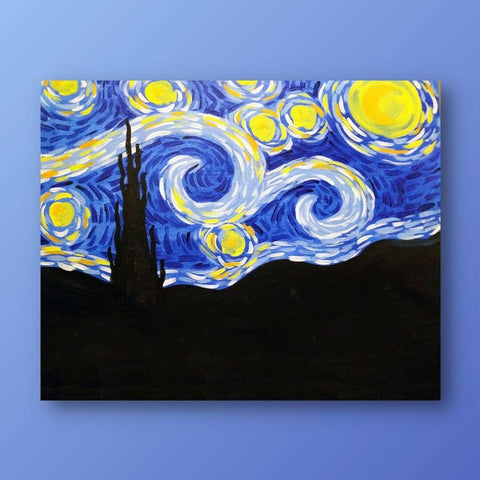
Choose a famous painting and simplify it. Van Gogh’s swirling skies, Monet’s water lilies and Matisse’s cut-outs all translate into beginner-friendly studies when reduced to big shapes and bold color.
7. Idea Boards and Challenges
Online challenge lists and pinboards are useful, but filter them with the criteria above. Many images labeled “easy” are by experienced painters and involve more skill than they appear.
Easy Acrylic Painting Ideas for Beginners by Category
Here are reliable subject categories, with what each teaches. For a quick-results list you can start today, see our roundup of easy acrylic painting ideas for beginners who want quick results.
Skies and Sunsets
A gradient sky teaches blending, the single most useful acrylic skill. Add a silhouette of palm trees, mountains or birds to finish the piece. Work quickly while paint is wet, or mist the canvas with water to extend blending time.
Silhouettes
Paint a colorful background, let it dry, then add a solid black or dark shape on top: a tree, a city skyline, a cat on a fence, a lighthouse. Silhouettes look striking and hide the need for detailed rendering.
Simple Landscapes
Rolling hills, a lake with a single tree or a field of lavender rows. Use three bands: sky, middle ground and foreground. Keep details for the foreground only.
Single Flowers
One sunflower, one tulip or a few daisies. Large blooms are easier than tiny bouquets. Focus on the overall shape and a few strokes for petals.
Easy Animal Painting Ideas for Beginners
Start with animals that have simple outlines: a whale tail, a fox in silhouette, a sleeping cat curled into a circle, a penguin, a koi fish or an owl on a branch. Stylized animals with bold shapes are much easier than realistic portraits. Fur can be suggested with a few directional strokes instead of hundreds of hairs.
Abstracts and Color Blocks
Geometric shapes taped off with painter’s tape, overlapping circles or gestural brushstrokes in a limited palette. Abstracts teach color mixing and composition without the pressure of realism.
Still Life
A lemon, an apple, a mug or a bottle. Single objects teach light and shadow. Place the object near a window so it has one clear light source.
Night Skies and Galaxies
Blend dark blues and purples, then splatter white stars with a toothbrush. Add a moon or a pine-tree silhouette. These are popular because results look impressive with simple techniques.
Easy Canvas Painting Ideas for Beginners vs. Other Surfaces
You do not always need a canvas. Different surfaces suit different kinds of ideas.
| Surface | Good ideas | Notes |
|---|---|---|
| Canvas panel or stretched canvas | Landscapes, sunsets, florals, abstracts | Standard choice; small sizes (8×10 in) are less intimidating |
| Canvas paper or pad | Practice studies, color charts | Inexpensive for experimenting |
| Rocks | Ladybugs, cacti, mandalas, simple faces | Easy rock painting ideas for beginners use the stone’s shape; seal for outdoor use |
| Wood slices | Mountains, moons, florals | Prime first; natural edges frame the design |
| Ceramic tiles | Acrylic pours, simple patterns | Scuff and prime for adhesion |
Acrylic Pouring Ideas for Beginners
Fluid pouring is a different kind of easy. There is little brush control involved; you mix paint with a pouring medium and let it flow. Simple beginner pours include a three-color dirty cup pour, a puddle pour on a small canvas, or coasters. The challenge shifts from drawing skill to getting the paint consistency right.
A Simple System to Turn Ideas Into Paintings
Finding an idea is only half the work. This five-step process turns a loose idea into a finished painting.
- Collect. Keep a folder or notebook of ideas: photos, sketches, color combos. Add to it whenever something catches your eye.
- Filter. Before each session, pick one idea and run it through the easy criteria table. Simplify if needed.
- Thumbnail. Draw two or three tiny sketches (about 2 by 3 inches) to try different compositions. Pick the strongest.
- Limit. Choose your palette before you start. Squeeze out only those colors.
- Paint and review. After finishing, write one thing that worked and one thing to try next time. This turns each painting into a lesson.
Composition is where many beginner paintings succeed or fail. Our guide to acrylic painting composition tips for beginners explains how to place your subject for a stronger result.
How to Simplify an Idea That Feels Too Hard
Sometimes the idea you love most is beyond your current skills. Rather than abandoning it, shrink it down to a version you can paint now. Three simplification moves cover most situations.
- Crop in. Instead of a whole garden, paint one flower head filling the canvas. Instead of a harbor full of boats, paint a single sail against the sky.
- Reduce to silhouette. Turn complex subjects such as city skylines, people or trees into flat dark shapes against a colorful background. You keep the recognizable outline and skip the hard rendering.
- Stylize. Turn realistic forms into simple, graphic shapes, like a cartoon-style fox built from triangles or a tree drawn as a lollipop of dabbed color.
Here is a worked example. Say you want to paint a busy beach photo with people, umbrellas, waves and a pier. A beginner version keeps only the horizon line, a sunset gradient, two bands of ocean color and the dark silhouette of the pier. Four colors, three shapes, under two hours, and it still captures the feeling of the original photo. Next time, you can add the waves.
A Four-Week Beginner Idea Plan
If you prefer structure, here is a progression that builds skills week by week.
| Week | Focus skill | Idea |
|---|---|---|
| 1 | Blending | Sunset gradient with a palm-tree silhouette |
| 2 | Shapes and layering | Mountain landscape in three value bands |
| 3 | Light and shadow | Single lemon or apple on a table |
| 4 | Brushwork | Loose sunflower or simple animal |
Repeat the plan with different subjects in month two. You will notice clear improvement because each skill gets deliberate practice.
Common Mistakes When Choosing Beginner Ideas
- Picking subjects that are too detailed. Portraits, hands and cityscapes frustrate most beginners. Save them for later.
- Using too many colors. More colors increase the chance of muddy mixes. Start with a limited palette.
- Working too large. Big canvases take longer and use more paint. Small sizes let you finish more paintings and learn faster.
- Copying finished art exactly. Use other artists’ work for learning only, and change elements to make it your own if you plan to share it.
- Waiting for the perfect idea. Simple subjects painted often build skills faster than an ambitious piece you never start.
Supplies You Need to Start
You do not need much to begin. A basic beginner kit includes:
- Primary colors (a red, a yellow, a blue), plus white and black or a dark brown
- Three or four synthetic brushes: a large flat, a medium round, a small round and a filbert
- A few small canvas panels or a pad of canvas paper
- A palette or a paper plate
- Two water jars (one for rinsing, one clean)
- Paper towels
Easy watercolor ideas for beginners often overlap with acrylic ones, such as skies, florals and simple landscapes, but acrylic is generally more forgiving because you can paint over mistakes once the layer dries.
FAQs
What should I paint first as a beginner with acrylics?
A sunset with a silhouette is a strong first project. It teaches blending, involves few colors and looks finished even with simple technique.
Where can I find acrylic painting ideas for beginners?
Your own photos, step-by-step books, nature walks, seasonal themes and simplified versions of famous paintings are all reliable sources. Filter each idea for simple shapes and limited colors.
What are some easy animal painting ideas for beginners?
Silhouettes of foxes, cats, birds and whales work well, as do stylized owls, penguins and koi fish. Bold outlines and simple shapes matter more than fur detail.
Are easy rock painting ideas good practice for acrylic painting?
Yes. Rocks are small, cheap and low pressure, which makes them good for practicing color, dots and simple shapes. Use a sealer if the rocks will go outdoors.
How long should a beginner acrylic painting take?
Many beginner projects take one to two hours. Short sessions help you finish more paintings, and finishing is how you learn what works.
Do I need expensive paint to start?
No. Student-grade acrylics are fine for learning. As your skills grow, you may notice artist-grade paint gives stronger color and better coverage.
Next Step
The fastest path from “I don’t know what to paint” to steady progress is a structured sequence of projects. Pick one idea from this guide, paint it this week, and keep a running list of ideas for future sessions.
If you want ready-made lessons that remove the guesswork entirely, a good beginner book is hard to beat. Browse our picks for top acrylic painting books to kickstart your practice to find one that matches your preferred subjects and learning style.




