

PaintingProGuide is reader-supported. When you buy through links on this page we may earn an affiliate commission at no extra cost to you.
Acrylic canvas painting is where most people begin their painting journey, and for good reason. Acrylic dries quickly, cleans up with water and sticks well to primed canvas, so you can start a painting in the evening and have something worth hanging by bedtime. The secret to good results is less about talent and more about process: choosing the right canvas, preparing it, and working from big shapes to small details.
This guide covers the canvas choices, a beginner-friendly painting process, the techniques that matter most, and six canvas packs from current listings.
Quick answer: For most beginners, a multi-size pack like the KEFF 24-Pack Canvas Boards (5×7 to 11×14) is the best way to practice acrylic canvas painting at different scales. When you are ready for gallery-style pieces, the FIXSMITH 11×14 Stretched Canvas 8-Pack offers triple-primed cotton on pine stretcher bars. For low-cost daily studies, Simetufy 8×10 canvas boards (12-pack) use a rigid MDF core that will not warp.
Stretched Canvas vs Canvas Boards
| Feature | Stretched canvas | Canvas board / panel |
|---|---|---|
| Construction | Canvas stapled over a wooden frame | Canvas glued to a rigid board (MDF or card) |
| Feel | Slight bounce | Firm |
| Best for | Finished pieces, gifts, wall art | Practice, studies, travel, classes |
| Framing | Can hang unframed (gallery-wrap) | Usually framed or displayed on an easel |
| Storage | Bulkier | Flat, stackable |
Many painters practice on boards and save stretched canvases for paintings they plan to hang.
Preparing a Canvas for Acrylic
Most store-bought canvases are pre-primed with acrylic gesso and ready to paint. A few optional steps improve results:
- Add a coat of gesso if the surface feels slick or absorbent; sand lightly when dry for a smoother finish.
- Tone the canvas with a thin wash of a mid-value color (burnt sienna, gray or a muted blue). White canvas makes values harder to judge.
- Check tension on stretched canvases. A light mist of water on the back can tighten a slightly loose canvas as it dries.
A Beginner’s Step-by-Step Process
- Plan with a thumbnail. Sketch a tiny version of the composition and decide where the light, dark and focal point will be.
- Sketch on the canvas with thinned paint or a light pencil.
- Block in big shapes with a large flat brush. Ignore detail. Paint the background and largest masses first.
- Establish values. Make sure darks are dark enough and lights are light enough before refining.
- Refine mid-sized shapes with medium brushes, adjusting color and edges.
- Add details and highlights last with small brushes.
- Step back often. View the painting from across the room or in a phone photo to spot problems.
- Seal when dry. Varnish evens sheen and protects the surface.
Essential Acrylic Techniques on Canvas
- Wet blending: blend adjacent colors while wet for skies and soft transitions. Work quickly or mist with water to extend working time.
- Layering: acrylic dries fast, so you can paint light over dark within minutes.
- Dry brushing: a nearly dry brush dragged over texture gives grass, wood grain and highlights.
- Glazing: thin transparent color over a dry layer shifts hue and adds depth.
- Stippling: dabbing creates foliage and texture.
- Palette knife: thick paint applied with a knife creates bold texture and crisp edges.
Practice Project: A Simple Lake at Dusk on an 8×10
This short exercise uses the process above on one small canvas board.
- Tone the board with a thin wash of soft blue-gray and let it dry.
- Paint the sky with a large flat: pale yellow near the horizon, blending up into pink and then blue. Blend while wet with horizontal strokes.
- Mirror the sky in the water. Below the horizon, repeat the same colors in reverse order, slightly darker. Keep strokes horizontal to suggest a calm surface.
- Add the far shoreline as a thin, dark band of blue-purple across the horizon. Keep the edge slightly soft.
- Paint a few pine silhouettes on one side with a small round: a vertical trunk line, then short downward strokes that widen toward the base.
- Reflect the trees in the water with softer, broken vertical strokes in the same dark color.
- Add horizontal light lines across the water with a dry brush and pale color to suggest ripples and the shine of the sky.
- Sign, dry and varnish.
The whole exercise takes about an hour and practices toning, wet blending, silhouettes, reflections and dry brushing. Repeat it with different sky colors and you have a series.
Our Top Picks at a Glance
- KEFF 24-Pack Canvas Boards, 4 Sizes — Best for practicing at different scales
- FIXSMITH Stretched Canvas, 11×14, 8 Pack — Best for finished paintings and wall art
- GOTIDEAL 14-Piece Stretched Canvas Multi Pack — Best for stretched canvases in mixed sizes
- Simetufy 8×10 Canvas Boards, 12 Pack — Best for low-cost daily studies
- ESRICH Canvas Boards, 8×10, 5 Pack — Best for trying canvas painting for the first time
- ESRICH Stretched Canvas Multi Pack (11×14, 8×10, 5×7) — Best for a first set of stretched canvases
| Product | Best For | Key Spec | Key Strength | Price Tier |
|---|---|---|---|---|
| KEFF 24-Pack Canvas Boards, 4 Sizes | Practicing at different scales | 6 each of 5×7, 8×10, 9×12 and 11×14 in. | Triple-primed 100% cotton boards | $$ |
| FIXSMITH Stretched Canvas, 11×14, 8 Pack | Finished paintings and wall art | 11×14 in., 5/8 in. profile, pine bars | Triple-primed with 8 oz acid-free gesso; 100% cotton | $$ |
| GOTIDEAL 14-Piece Stretched Canvas Multi Pack | Stretched canvases in mixed sizes | 4×4, 5×7, 8×10, 11×14 (2 each) plus 4 extra 5×7 | Medium-grain cotton, acid-free gesso, archival claim | $$ |
| Simetufy 8×10 Canvas Boards, 12 Pack | Low-cost daily studies | 12 boards, 8×10 in., MDF core | Rigid core that resists bending and warping | $ |
| ESRICH Canvas Boards, 8×10, 5 Pack | Trying canvas painting for the first time | 5 boards, 8×10 in., cotton, primed | Lowest price tier with a sturdy core | $ |
| ESRICH Stretched Canvas Multi Pack (11×14, 8×10, 5×7) | A first set of stretched canvases | 3 stretched canvases in 3 sizes | Acid-free gesso on pinewood frames | $ |
How We Chose
These canvas packs were selected from Amazon listing details and specifications checked in October 2026. We have not painted on them ourselves. We compared canvas type (stretched or board), fabric, priming, core or frame material, size range and quantity, and favored products widely reviewed by Amazon buyers.
Criteria:
- Priming: pre-primed with acid-free acrylic gesso.
- Material: 100% cotton canvas where stated.
- Rigidity: MDF cores or pine stretcher bars that resist warping.
- Size variety for practice and finished work.
- Value per canvas for frequent painting.
Best Canvases for Acrylic Painting Reviewed
1. KEFF 24-Pack Canvas Boards, 4 Sizes — Best for practicing at different scales

KEFF’s 24-pack includes six boards each in 5×7, 8×10, 9×12 and 11×14 inches. The listing describes 100% cotton, triple-primed surfaces ready for acrylic, oil and other media.
Multiple sizes are genuinely useful for learning. Small boards are ideal for color studies and quick experiments; larger boards let you practice the same composition with bigger brushes and more detail.
Best suited for: Beginners, classes, art journals and painters who like to practice small before going big.
Key features:
- 24 boards in 4 sizes
- 100% cotton
- Triple-primed
- Acrylic and oil ready
Pros:
- Excellent size variety
- Plenty of practice surfaces
- Ready to paint
Cons and limitations:
- Boards are not for gallery-wrap hanging
- Higher up-front tier than small packs
Buying consideration: Paint the same subject on a 5×7 and then an 11×14. Scaling up is one of the fastest ways to improve composition.
2. FIXSMITH Stretched Canvas, 11×14, 8 Pack — Best for finished paintings and wall art

FIXSMITH’s 8-pack of 11×14 stretched canvases uses 100% cotton stretched and stapled onto pinewood bars with a 5/8-inch profile. The listing says each canvas is pre-coated with 8 oz of acid-free acrylic gesso (triple primed), does not crumble or crack, and is ready to paint out of the wrapper.
11×14 is a comfortable size for finished acrylic paintings: large enough to display, small enough to complete in a session or two.
Best suited for: Wall art, gifts, finished pieces and beginners ready to paint on stretched canvas.
Key features:
- 8 stretched canvases, 11×14 in.
- 100% cotton
- Triple-primed acid-free gesso
- Pinewood bars, 5/8 in. profile
Pros:
- Ready to hang or frame
- Good finished size
- Strong priming claim
Cons and limitations:
- Thin profile may look best framed
- Single size
Buying consideration: Paint the canvas edges a solid color or continue the image around them if you plan to hang it unframed.
3. GOTIDEAL 14-Piece Stretched Canvas Multi Pack — Best for stretched canvases in mixed sizes
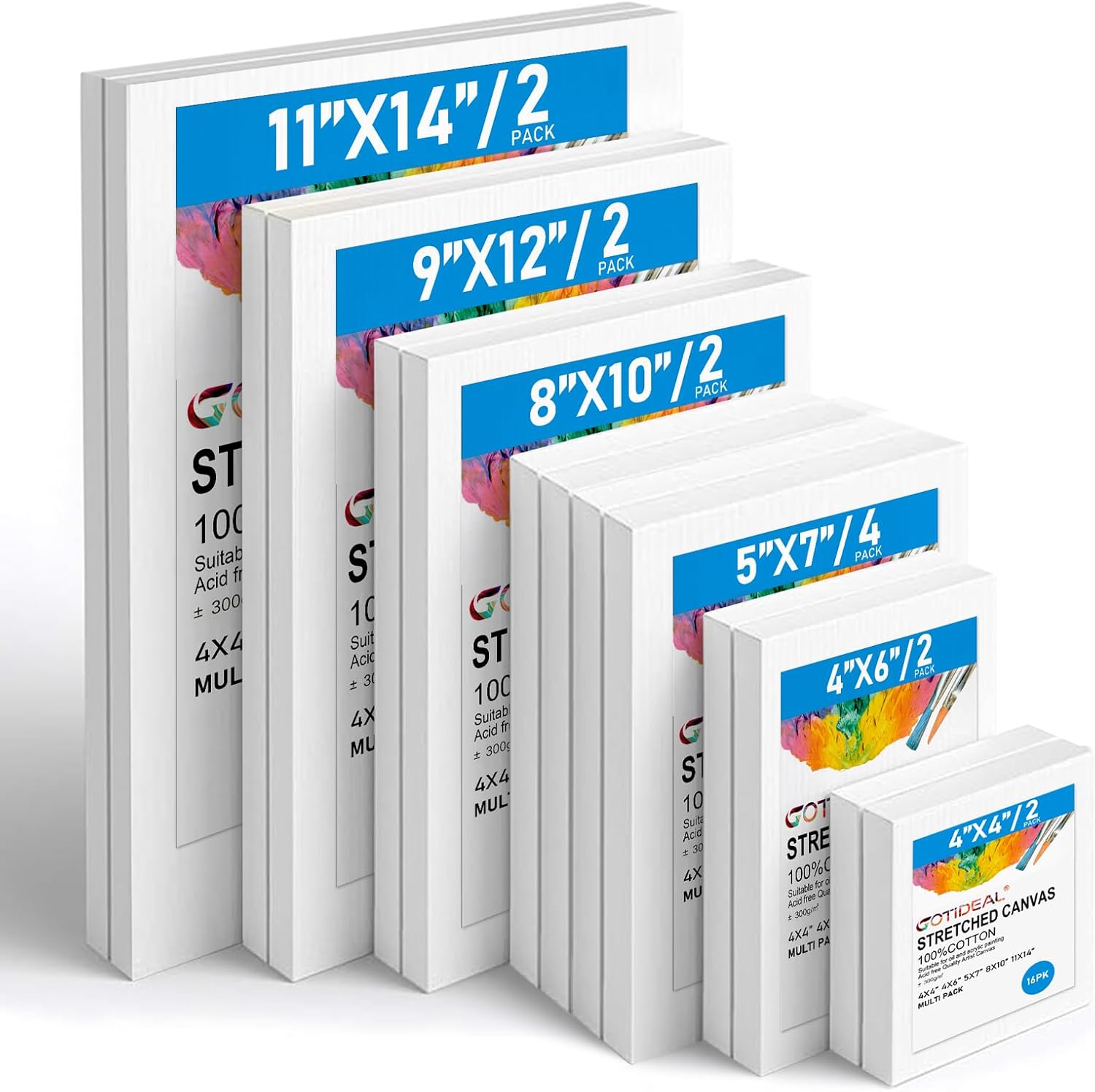
GOTIDEAL’s 14 pre-stretched canvases come in 4×4, 5×7, 8×10 and 11×14 sizes (two each) plus four additional 5x7s. The listing describes 100% cotton with a medium grain that holds paint without absorbing it, firmly nailed wooden frames, and pre-coated acid-free acrylic gesso, labeled acid-free and archival quality.
Tiny 4×4 canvases are perfect for quick daily paintings or a grid of mini artworks.
Best suited for: Mini art series, gifts, multi-canvas wall arrangements and varied practice.
Key features:
- 14 stretched canvases
- 5 sizes including 4×4
- Medium-grain cotton
- Acid-free gesso, archival claim
Pros:
- Stretched canvases in many sizes
- Great for mini paintings
- Archival positioning
Cons and limitations:
- Only two of the larger sizes
- Mid price tier
Buying consideration: Paint a set of 4×4 canvases with a shared color palette and hang them together as a series.
4. Simetufy 8×10 Canvas Boards, 12 Pack — Best for low-cost daily studies

Simetufy’s boards are 100% cotton, acid-free canvas primed with acid-free acrylic on a sturdy MDF core. The listing emphasizes that the MDF prevents bending or warping, unlike recycled paper cores, and that the surface has a nice texture that holds paint without absorbing it.
Rigid boards are excellent for practicing techniques like palette knife work, which can dent cheaper card-core panels.
Best suited for: Daily painting, classes, palette knife practice and plein air.
Key features:
- 12 boards, 8×10 in.
- 100% cotton, acid-free
- MDF core
- Pre-primed
Pros:
- Rigid and warp-resistant
- Good value per board
- Suits knife work
Cons and limitations:
- Heavier than card-core boards
- Single size
Buying consideration: Use these for technique drills: one board for wet blending, one for dry brushing, one for glazing.
5. ESRICH Canvas Boards, 8×10, 5 Pack — Best for trying canvas painting for the first time

ESRICH’s 5-pack of 8×10 boards is a low-cost way to start. The listing describes pure cotton with a smooth surface, a safe, non-toxic, acid-free primer, and a sturdy core that resists warping, suitable for oil, watercolor, acrylic, tempera, pouring and gouache.
Five boards are enough for a first weekend of painting without committing to a big pack.
Best suited for: First-time painters, gifts and trying new techniques.
Key features:
- 5 boards, 8×10 in.
- Pure cotton
- Acid-free primer
- Sturdy core
Pros:
- Lowest price tier
- Small, low-commitment pack
- Multi-media use
Cons and limitations:
- Few boards
- Single size
Buying consideration: Tone all five boards at once with different background colors, then choose which mood suits each painting.
6. ESRICH Stretched Canvas Multi Pack (11×14, 8×10, 5×7) — Best for a first set of stretched canvases

For a first taste of stretched canvas, ESRICH offers three sizes (11×14, 8×10 and 5×7) in one pack. The listing describes canvas nailed firmly to pinewood frames and pre-coated with acid-free acrylic gesso that is easy to paint and resists cracking.
The listing notes that canvases are stacked large and small, so check the back of the largest before counting the pack.
Best suited for: Beginners trying stretched canvas and small gift paintings.
Key features:
- 3 stretched canvases
- 11×14, 8×10 and 5×7
- Pinewood frames
- Acid-free gesso
Pros:
- Low-cost entry to stretched canvas
- Three useful sizes
- Ready to hang
Cons and limitations:
- Only three canvases
- Basic profile
Buying consideration: Start with the 5×7 to test your idea, then paint the final version on the 11×14.
Buying Guide: Choosing Canvas for Acrylic Painting
Practice vs finished work
Boards for practice; stretched canvas for wall-ready art.
Check the priming
Look for acid-free acrylic gesso. Triple-primed surfaces are smoother and less absorbent.
Choose the core or frame
MDF cores resist warping; card cores are lighter but can bend. Pinewood stretcher bars should feel solid and square.
Consider size variety
Multi-size packs help you practice composition and brush scale.
Fabric and texture
100% cotton is standard for most student and hobby canvases. Medium grain suits most acrylic styles; smoother surfaces suit detail.
Buy enough to practice freely
The biggest barrier to improving is hesitating to “waste” a canvas. Keep a stack of inexpensive boards for experiments so the nicer stretched canvases are saved for paintings you have already worked out.
Plan for display
Stretched canvases can hang unframed; boards typically need a frame or stand.
Next Steps for Acrylic Canvas Painters
Try our collection of simple, easy acrylic painting ideas for beginners on canvas, then refine your technique with how to wet blend acrylics on canvas and how to do an acrylic underpainting on canvas. When the painting is done, read how to seal acrylic paint on canvas. For surface prep, see how to prepare canvas for acrylic painting.
Common Mistakes to Avoid
- Starting with details. Block in big shapes first.
- Painting on stark white. Tone the canvas for easier value judgments.
- Using tiny brushes for everything. Use the largest brush that fits each stage.
- Overworking drying paint. Acrylic gets tacky fast; let it dry and layer instead.
- Ignoring values. If a painting looks flat, increase light and dark contrast.
- Skipping varnish. Unvarnished acrylics can look patchy and collect dust.
FAQs
Do I need to prime a canvas for acrylic painting?
Most store-bought canvases are already primed with acrylic gesso. An extra coat of gesso is optional but can improve smoothness and absorbency.
Is canvas board or stretched canvas better for beginners?
Canvas boards are cheaper and ideal for practice. Stretched canvas is better for finished pieces you plan to hang. Many beginners use both.
What size canvas should a beginner start with?
8×10 or 9×12 inches is a comfortable starting size. Small enough to finish quickly, large enough to practice brush control.
How do I keep acrylic paint from drying too fast on canvas?
Work in smaller sections, mist the palette and canvas lightly with water, or use a retarder medium. A stay-wet palette also helps.
Should I varnish an acrylic canvas painting?
Yes, once fully dry. Varnish evens sheen, deepens color and protects against dust and UV.
Can I paint acrylic on canvas paper?
Yes. Canvas paper is a cheap practice surface, though it is less rigid and archival than boards or stretched canvas.
Final Recommendation
For practice at different sizes, choose the KEFF 24-Pack. For finished wall art, the FIXSMITH 11×14 stretched canvases are ready to hang, while the GOTIDEAL 14-piece pack adds variety including minis. Use Simetufy MDF boards for durable daily studies, and start with the ESRICH 5-pack boards or ESRICH 3-size stretched pack if you just want to try acrylic canvas painting.




