

PaintingProGuide is reader-supported. When you buy through links on this page we may earn an affiliate commission at no extra cost to you.
Acrylic is forgiving paint, but it is not indifferent to its surface. On a thin, absorbent canvas, the first layers sink and look chalky; on a slick one, thin washes bead and streak. The best canvas for acrylic painting is cotton primed with acid-free acrylic gesso, with a medium tooth that grips paint, in a format that matches what you paint: rigid canvas panels for studies, practice and travel, and pre-stretched canvas for pieces you want to hang.
The good news is that you do not need expensive linen. Cotton canvas from established value brands, primed with a stated gesso weight, handles acrylic very well. Below are seven options split across both formats, with notes on who each one suits.
Quick answer: If you want one canvas to start with, the FIXSMITH 11×14 stretched canvas 8-pack is the best stretched option, with triple priming and 8 oz acid-free gesso. For practice and studies, the PHOENIX 24-pack canvas panels give you four sizes with 8 oz gesso. If you paint a lot of small pieces, the ESRICH 20-pack 8×10 stretched canvas combines volume with stretched-canvas feel.
Our Top Picks at a Glance
- FIXSMITH Stretched Canvas 11×14, 8 Pack — Best stretched canvas for acrylic painting
- PHOENIX Canvas Panels, 24 Pack (5×7 to 11×14) — Best canvas panels for practice
- ESRICH Stretched Canvas 8×10, 20 Pack — Best high-volume stretched pack
- KEFF Premium Canvas Boards, 24 Pack — Best triple-primed multi-size panels
- ESRICH Stretched Canvas 11×14, 10 Pack — Best 11×14 value pack
- Simetufy Canvas Boards 8×10, 12 Pack — Best rigid MDF-core panels
- ESRICH Canvas Boards 8×10, 5 Pack — Best low-cost trial pack
| Product | Best For | Key Spec | Key Strength | Price Tier |
|---|---|---|---|---|
| FIXSMITH 11×14 | Finished pieces | Stretched, 8 oz triple gesso, 5/8 in | Well-documented priming | $$ |
| PHOENIX 24 Panels | Practice, studies | 4 sizes, 8 oz gesso, cotton | Size range and texture | $$ |
| ESRICH 8×10 x20 | Daily painting | Stretched, 8 oz primed, 5/8 in | Volume of stretched canvas | $$ |
| KEFF 24 Boards | Mixed practice | 5×7 to 11×14, triple primed | Four sizes, six each | $$ |
| ESRICH 11×14 x10 | Series work | Stretched, 8 oz primed | Good per-canvas value | $$ |
| Simetufy 8×10 x12 | Studies, framing | MDF core, 100% cotton | Will not warp | $ |
| ESRICH 8×10 x5 | First try | Board core, cotton | Lowest commitment | $ |
How We Chose
We have not painted on these specific listings. The picks are based on the Amazon listing details and specifications checked in October 2026, how well each canvas’s priming, format and size fit acrylic painting, and how widely each product is reviewed by Amazon buyers. We rely on what each listing states about cotton content, priming and core material.
- Acrylic-friendly priming: acid-free acrylic gesso, with a stated weight or number of coats where possible.
- Surface tooth: medium grain that grips paint without fighting detail.
- Format: stretched canvas for display; MDF-core panels for studies and storage.
- Size mix and pack count: matched to how much and how large you paint.
- Value: price tier relative to quantity and stated construction.
Best Canvas for Acrylic Painting Reviewed
Stretched canvas
1. FIXSMITH Stretched Canvas 11×14, 8 Pack — Best for finished acrylic paintings

FIXSMITH gives the most detail of any stretched pack here. The canvas is 100% cotton, described as free of alkaline rinsing to keep its natural tone and flexibility, stapled tight onto pinewood bars, and triple primed with 8 oz of acid-free acrylic gesso that the listing says will not crumble or crack.
For acrylic, that priming matters. A properly sealed ground keeps colors bright, lets glazes sit on top rather than sinking in, and gives dry-brush strokes something to catch on. The 11×14 size is large enough for a proper composition and easy to frame with a standard 5/8 inch profile.
Eight canvases is a sensible pack for someone working through a few finished pieces at a time.
Best suited for: Acrylic painters producing finished paintings to frame or gift.
Key features:
- 8 canvases, 11×14 in
- 100% cotton
- Triple primed, 8 oz acid-free gesso
- Pinewood bars, 5/8 in profile
Pros:
- Detailed priming spec
- Tight stretch per listing
- Standard frame size
- Ready to paint
Cons and limitations:
- Thin profile unframed
- Single size
- Not heavyweight canvas
Buying consideration: If you want to hang the work without frames, paint the edges a solid color to finish them.
2. ESRICH Stretched Canvas 8×10, 20 Pack — Best for daily acrylic painting

ESRICH’s 20-pack of 8×10 inch stretched canvases lists acid-free acrylic gesso at an 8 oz primed weight, with cotton nailed firmly to a 5/8 inch pinewood frame. That is the same stated priming as many larger packs, applied to a smaller, more practice-friendly size.
Twenty stretched canvases suit a daily painting habit, a course or a classroom where students want the feel of stretched canvas rather than panels. 8×10 is quick to cover and fits standard frames.
If you find you prefer stretched canvas bounce to rigid boards, this pack is an economical way to work on it every day.
Best suited for: Daily painters, students and classes who prefer stretched canvas.
Key features:
- 20 canvases, 8×10 in
- Cotton, 8 oz primed weight
- Acid-free acrylic gesso
- 5/8 in pinewood frame
Pros:
- High count of stretched canvases
- Quick to finish
- Frame-friendly size
- Stated priming weight
Cons and limitations:
- Small format only
- Takes more storage than panels
- Thin profile
Buying consideration: Use these for a 20-day painting challenge; consistent size makes progress easier to compare.
3. ESRICH Stretched Canvas 11×14, 10 Pack — Best for series work at 11×14

The 11×14 ESRICH pack provides ten canvases with the same stated 8 oz primed weight and 5/8 inch pinewood frames. The listing notes they are easy to color and not prone to cracking.
Ten canvases at 11×14 is a good fit for painters working on a themed series, such as a set of landscapes for one wall, where matching sizes matter.
Compared with FIXSMITH, you get two more canvases with a similar specification, though FIXSMITH documents its cotton and triple priming in more detail.
Best suited for: Painters planning a series or regular mid-size work.
Key features:
- 10 canvases, 11×14 in
- Cotton, 8 oz primed
- Acid-free acrylic gesso
- 5/8 in pinewood frame
Pros:
- Good per-canvas value
- Matching sizes for series
- Sturdy per listing
- Ready to paint
Cons and limitations:
- Fewer construction details
- Single size
- Studio profile
Buying consideration: Plan a series of ten on paper first so each canvas gets a deliberate composition.
Canvas panels and boards
4. PHOENIX Canvas Panels, 24 Pack — Best for practice and studies
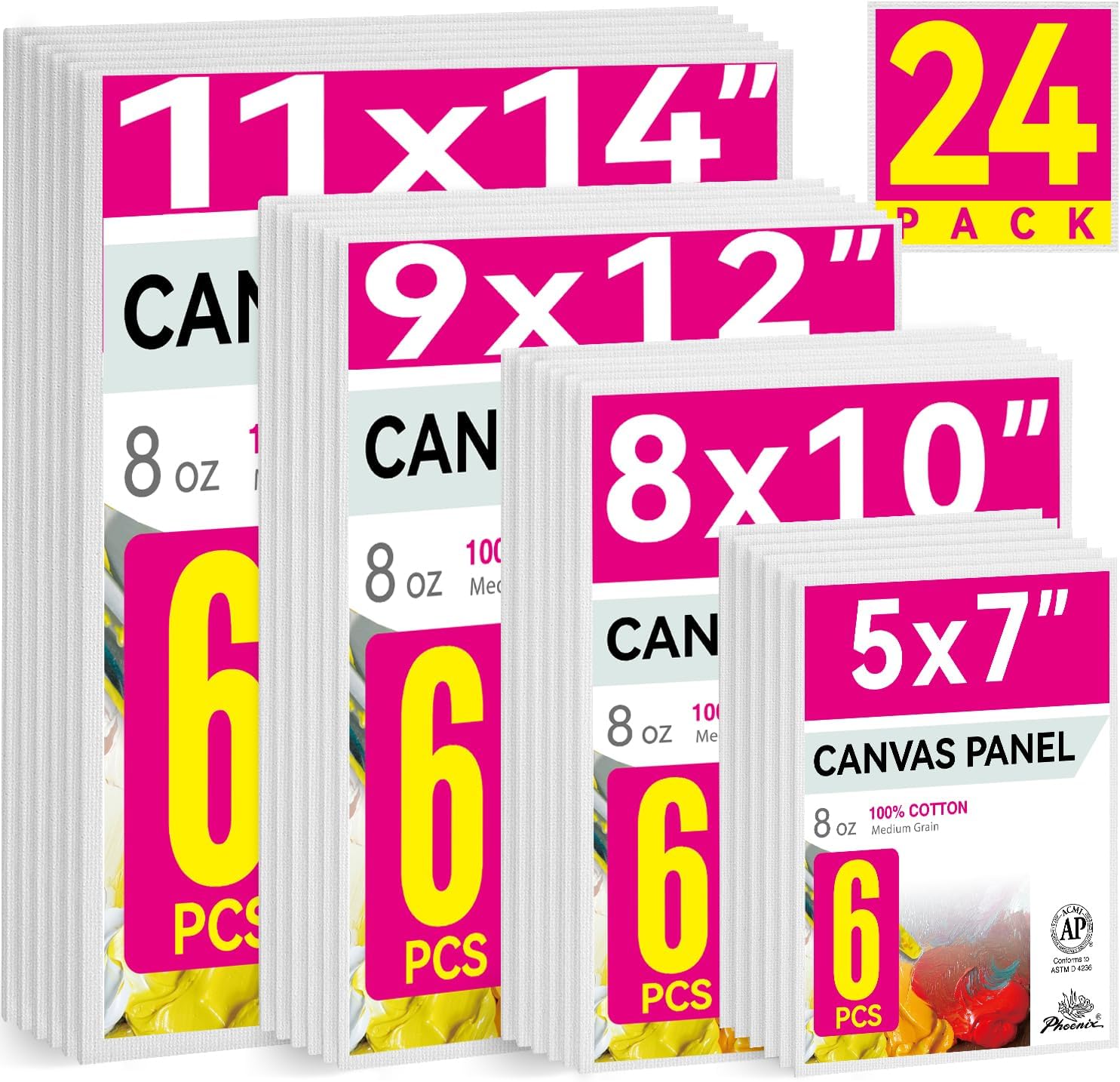
PHOENIX’s 24-pack has six panels each of 5×7, 8×10, 9×12 and 11×14 inches. The listing says they are hand stretched with 100% cotton, have a surface texture that really grabs the paint, and are pre-primed with 8 oz acid-free gesso. It also warns that panels are not designed for heavy wet media, which is honest advice for very watery techniques.
For acrylic practice, panels are hard to beat. They are flat, rigid, cheap per piece and easy to store in a drawer. Having four sizes lets you match the panel to the exercise: 5×7 for color swatches, 8×10 and 9×12 for studies, 11×14 for more finished pieces.
They also travel well for plein air acrylic painting, clipped to a board or pochade box.
Best suited for: Beginners, students and painters who do a lot of studies.
Key features:
- 24 panels: 6 each of 5×7, 8×10, 9×12, 11×14 in
- 100% cotton
- 8 oz acid-free gesso
- Flat, lightweight panels
Pros:
- Four useful sizes
- Paint-grabbing texture per listing
- Stated primer weight
- Easy storage
Cons and limitations:
- Not for very wet techniques
- Need a frame to display
- Board core can warp if soaked
Buying consideration: Keep acrylic washes moderate on panels; save heavy pouring and soaking techniques for stretched canvas or paper.
5. KEFF Premium Canvas Boards, 24 Pack — Best for triple-primed mixed practice

KEFF’s premium pack also includes six panels each of 5×7, 8×10, 9×12 and 11×14 inches, with smooth, triple-primed surfaces and 100% cotton, according to the listing. It is pitched at all ages and multiple media.
With the same size spread as PHOENIX, the choice comes down to surface preference. KEFF describes a smooth, triple-primed finish, which suits fine detail and blending; PHOENIX emphasizes a grabbing texture, which suits textured brushwork.
Both are excellent value for building skills with acrylic.
Best suited for: Painters who prefer a smoother panel surface for detail and blending.
Key features:
- 24 panels, 6 each of 4 sizes
- 100% cotton
- Triple primed
- Smooth surface per listing
Pros:
- Smooth for detail
- Four sizes
- Triple primed
- Gift-ready set
Cons and limitations:
- Primer weight not stated
- Panels need framing
- Heavier pack
Buying consideration: If you are not sure which surface you prefer, buy one PHOENIX and one KEFF pack and compare.
6. Simetufy Canvas Boards 8×10, 12 Pack — Best for rigid MDF-core panels

Simetufy’s 8×10 boards use a sturdy MDF core instead of recycled paper, which the listing says prevents bending or warping. The canvas is 100% cotton, acid-free, primed with acrylic and described as holding paint without absorbing it.
MDF-core panels stay flat even with heavier acrylic applications and palette knife work, and they frame cleanly without bowing. Twelve 8x10s are enough to test the surface over a couple of weeks of practice.
If you like them, Simetufy also sells larger quantities and sizes.
Best suited for: Painters who want rigid, flat studies that frame neatly.
Key features:
- 12 boards, 8×10 in
- 100% cotton, acid-free
- Primed with acid-free acrylic
- MDF core
Pros:
- Will not warp easily
- Low price tier
- Frames flat
- Good with palette knife
Cons and limitations:
- Heavier than paper-core boards
- Single size
- Primer weight not stated
Buying consideration: MDF boards are ideal for impasto acrylic; the rigid core prevents cracking from flexing.
7. ESRICH Canvas Boards 8×10, 5 Pack — Best for a low-cost first try

ESRICH’s five-pack of 8×10 boards uses pure cotton with a smooth surface and a safe, non-toxic, acid-free primer over a board core the listing says resists warping. It is the smallest pack here.
Five boards are perfect for trying acrylic for the first time, testing a new technique, or giving a child a few proper surfaces without buying in bulk.
A smooth surface makes detail easy, though some painters will want to add a coat of gesso for more tooth.
Best suited for: First-time acrylic painters and quick technique tests.
Key features:
- 5 boards, 8×10 in
- Pure cotton, smooth surface
- Acid-free, non-toxic primer
- Board core
Pros:
- Lowest price tier
- Small commitment
- Smooth for detail
- Frame-friendly
Cons and limitations:
- Few panels
- Core type unspecified
- Smooth surface has less tooth
Buying consideration: Add a thin coat of gesso if acrylic slides around; it adds tooth in minutes.
Buying Guide: How to Choose Canvas for Acrylic Painting
Stretched canvas or panels?
Choose stretched canvas when the painting is meant for the wall, when you like a little bounce under the brush, or when you work larger than 16×20. Choose panels for practice, studies, travel and small framed pieces. Many painters keep both.
Check the priming
Look for acid-free acrylic gesso. A stated weight (8 oz) or multiple coats suggests a well-sealed surface. If acrylic sinks or looks dull, add one coat of gesso yourself.
Choose the right texture
Medium grain suits most acrylic techniques. Smooth surfaces suit fine detail, portraits and glazing. Rougher surfaces suit expressive brushwork and dry brushing.
Match size to skill and time
Beginners often do best on 8×10 to 11×14. Small sizes build confidence; large sizes demand more paint, time and planning.
Think about core and profile
MDF-core panels stay flat; paper-core boards can warp. Stretched canvas comes in studio (5/8 to 3/4 inch) and gallery (1.5 inch) profiles.
Buy packs that fit your output
If you paint weekly, a 20- to 24-pack lasts a few months. If you paint occasionally, a 5- to 10-pack keeps canvases from piling up.
Canvas vs Other Acrylic Surfaces
Canvas is not the only option. Acrylic paper and canvas pads are cheaper for exercises and sketchbooks; our comparison of acrylic paper vs canvas pads explains when each makes sense. Canvas boards are a middle ground; see can you use acrylic paint on canvas board.
Preparing and Starting Your Canvas
Even pre-primed canvas benefits from a little preparation. Our guide on how to prepare canvas for acrylic painting covers extra gesso and toning. Next, block in values with an acrylic underpainting on canvas. If you plan to combine media, read can you mix acrylic and oil paint on canvas first, because order matters.
Common Mistakes to Avoid
- Buying the biggest canvas first. Large canvases are harder to fill; start medium.
- Over-thinning acrylic with water. Too much water weakens the binder and can lift on cheap priming.
- Painting on bright white. A toned ground makes judging values easier.
- Ignoring absorbency. Test a drop of water; if it soaks in, add gesso.
- Soaking panels. Heavy water warps board cores.
- Storing wet paintings face to face. Acrylic stays tacky for hours and can stick.
FAQs
What type of canvas is best for acrylic paint?
Cotton canvas primed with acid-free acrylic gesso is the standard choice. Use pre-stretched canvas for display pieces and canvas panels for practice and studies.
Is cotton or linen canvas better for acrylic?
Cotton is the practical choice for most acrylic painters. It is affordable and takes acrylic well. Linen is stronger and finer but costs much more and is chosen mainly for oil.
Do I need to prime canvas for acrylic painting?
Pre-primed canvas is ready to use. Many painters add one thin coat of gesso to improve the surface, especially on budget canvases.
Are canvas panels good for acrylic painting?
Yes. Panels are excellent for practice, studies and small framed works. Avoid very wet techniques that could warp the core.
What size canvas should a beginner use for acrylic?
Start with 8×10 to 11×14. These sizes are big enough to learn composition and small enough to finish in one or two sessions.
How do I protect a finished acrylic painting on canvas?
Let it cure, then apply an isolation coat and a removable acrylic varnish. Our guide on sealing acrylic paint on canvas walks through the steps.
For the full protection process, see how to seal acrylic paint on canvas.
Final Recommendation
If you are painting pieces to hang or gift, start with the FIXSMITH 11×14 stretched pack, which documents its cotton and triple priming more clearly than most. Daily painters who want stretched canvas should look at ESRICH’s 20-pack of 8x10s, and series painters at ESRICH’s 11×14 10-pack.
For practice, PHOENIX and KEFF panel packs give you four sizes each; choose PHOENIX for more texture and KEFF for a smoother finish. Simetufy’s MDF boards are best for flat, rigid studies and impasto, and the ESRICH five-pack is the easy first try.




