PaintingProGuide is reader-supported. When you buy through links on this page we may earn an affiliate commission at no extra cost to you.
Almost every canvas sold for acrylic painting says “primed” or “gessoed” on the label, but the quality of that priming varies a lot. Thin, factory gesso can leave a slick, absorbent or uneven surface, and acrylic paint shows it immediately: streaky first layers, dull patches and brushstrokes that skip across the weave. The best canvas for acrylic paint that is gessoed is one with a stated, decent primer layer (such as 8 oz acid-free gesso or triple priming) on a stable support, and many painters improve even good canvases with one or two extra coats of their own gesso.
So this guide covers both halves of the job: two pre-gessoed canvas panel packs worth starting with, and five acrylic gessoes for adding coats, adjusting tooth or priming raw surfaces yourself.
Quick answer: For ready-to-paint gessoed canvas, the Simetufy 9×12 24-pack lists 8 oz triple gesso priming on cotton over acid-free MDF, which is a solid surface for acrylic straight from the pack. To add your own coats, Liquitex Basics Acrylic Gesso (16 oz) is the dependable standard, and the Handy Art 64 oz gesso is the better buy if you prime a lot of canvas.
Our Top Picks at a Glance
- Simetufy 9×12 Flat Canvas Boards, 24 pack (8 oz gesso) — Best pre-gessoed canvas for acrylic
- Simetufy 8×10 Canvas Boards, 12 pack — Best smaller pre-gessoed pack
- Liquitex Basics Acrylic Gesso, 16 oz — Best all-round gesso for extra coats
- Handy Art Little Masters White Gesso, 64 oz — Best bulk gesso for frequent priming
- BLUEBIRD Studio Acrylic Gesso, 16.9 oz — Best budget liquid gesso
- BLUEBIRD Heavy Gesso Primer, 5.3 oz tub — Best heavy gesso for texture
- Liquitex Professional Clear Gesso, 8 oz — Best clear gesso to keep the canvas color
| Product | Best For | Key Spec | Key Strength | Price Tier |
|---|---|---|---|---|
| Simetufy 9×12 Boards | Ready-to-paint canvas | 24 x 9×12 in, 8 oz triple gesso, MDF | Stated gesso weight | $$ |
| Simetufy 8×10 Boards | Smaller studies | 12 x 8×10 in, cotton, MDF core | Rigid, primed, acid-free | $ |
| Liquitex Basics Gesso | Extra coats | 16 oz, white, satin | One coat usually enough | $ |
| Handy Art Gesso | Bulk priming | 64 oz, white, matte | Pourable, AP certified | $$ |
| BLUEBIRD Studio Gesso | Budget priming | 16.9 oz, white, matte | Liquid, easy to brush | $ |
| BLUEBIRD Heavy Gesso | Texture and tooth | 5.3 oz tub, white, matte | Thick, knife-able | $ |
| Liquitex Clear Gesso | Transparent ground | 8 oz, clear, matte | Keeps surface visible | $$ |
How We Chose
We have not primed or painted on these exact products. The picks are based on the Amazon listing details and specifications checked in October 2026, how well each product’s priming, format and finish suit acrylic painting, and how widely each product is reviewed by Amazon buyers. Technical points about gesso behavior are general, well-established facts about acrylic grounds.
- Stated priming: acid-free acrylic gesso, ideally with a stated weight or number of coats.
- Support: rigid MDF cores that stay flat, versus flimsy paper-core boards.
- Gesso finish: matte or satin, with enough tooth for acrylic to grip.
- Volume against use: small bottles for touch-ups, large containers for regular priming.
- Special grounds: heavy gesso for texture and clear gesso for transparent surfaces.
Best Canvas for Acrylic Paint Gessoed Reviewed
Pre-gessoed canvas
1. Simetufy 9×12 Flat Canvas Boards, 24 pack — Best for pre-gessoed canvas for acrylic

Simetufy lists these 9×12 inch panels as 100% cotton canvas, hand stretched and glued to acid-free MDF board, then triple primed with acid-free acrylic. The title states 8 oz gesso. That is a more substantial primer layer than many budget boards describe, and it is what gives acrylic a consistent, non-absorbent surface.
The listing says the surface holds paint without absorbing it so colors keep their tone, and the MDF core resists bending and warping. At 9×12 inches the panels are large enough for proper studies and small finished pieces, and twenty-four of them is a serious practice supply.
Best suited for: Acrylic painters who want a dependable, ready-to-use gessoed surface for regular studies and finished small works.
Key features:
- 24 panels, 9×12 in
- 100% cotton on acid-free MDF board
- Triple primed, 8 oz acrylic gesso stated
- Listed as not shrinking
Pros:
- Stated gesso weight and coats
- Rigid MDF core
- Large count for practice
- Good study size
Cons and limitations:
- Heavier than paper-core boards (pack listed at 6.81 lb)
- Flat panels need framing to display
- Surface texture is fixed
Buying consideration: If you prefer a smoother surface, sand lightly and add one coat of gesso; if you prefer more tooth, add a coat of heavy gesso with a stiff brush.
2. Simetufy 8×10 Canvas Boards, 12 pack — Best for smaller pre-gessoed studies

The 8×10 Simetufy pack offers twelve panels of 100% cotton canvas, acid-free and primed with acrylic, on a sturdy MDF core instead of recycled paper. The listing says the surface has a nice texture and holds paint without absorbing it.
8×10 fits standard frames and is a comfortable size for color studies and daily paintings. Twelve panels make it a lower-commitment way to see whether you like the surface before buying larger packs.
Best suited for: Beginners and daily painters who want primed, rigid panels in a frame-friendly size.
Key features:
- 12 panels, 8×10 in
- 100% cotton, acid-free
- Primed with acid-free acrylic
- MDF core
Pros:
- Fits standard 8×10 frames
- Rigid, will not warp easily
- Ready to paint
- Low price tier
Cons and limitations:
- Gesso weight not stated
- Small format only
- Flat panels, not stretched
Buying consideration: Use these to test whether one extra coat of gesso improves the surface for your style; it is a cheap experiment.
Gesso for adding coats or priming your own canvas
3. Liquitex Basics Acrylic Gesso, 16 oz — Best for extra coats on any canvas
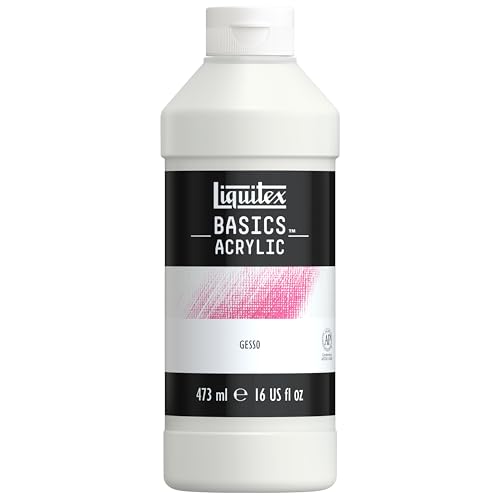
Liquitex Basics Gesso is a value acrylic gesso for preparing surfaces for acrylic and oil, with the listing stating that one coat is usually all that is required. It comes in a 16 oz (473 ml) bottle, dries to a satin finish per the listing details, and is intermixable with Liquitex acrylics and mediums.
This is the gesso many painters use to upgrade factory-primed canvas. A thin coat over a store-bought canvas evens out pinholes and slick patches, giving acrylic a more consistent, slightly toothier surface.
Best suited for: Painters who want a reliable, widely available gesso for topping up pre-primed canvas or priming panels.
Key features:
- 16 oz (473 ml)
- White acrylic gesso
- Satin finish per listing
- For acrylic and oil
Pros:
- Trusted brand
- One coat often enough
- Mixes with Liquitex products
- Good size for regular use
Cons and limitations:
- Satin finish has less tooth than matte grounds
- Not the cheapest per ounce
- Can need thinning for a very smooth surface
Buying consideration: Apply thin coats with a wide flat brush, alternating direction for each coat, and let each dry fully before the next.
4. Handy Art Little Masters White Gesso, 64 oz — Best for bulk priming

Handy Art’s half-gallon gesso is described as thick but low viscosity, bright white, creamy and smooth, for preparing canvas, wood, panels, MDF and cardboard. It comes in an easy-open, pourable container, dries matte per the listing details, and is AP certified non-toxic and free of latex and common allergens.
If you stretch your own canvas or prime many panels, buying gesso in small bottles gets expensive. Sixty-four ounces is enough for a lot of canvas, and the pourable container is convenient for priming large surfaces.
Best suited for: Painters, teachers and studios who prime many surfaces or stretch raw canvas.
Key features:
- 64 fl oz
- White, matte finish
- AP certified non-toxic
- Pourable container
Pros:
- Best value for volume
- Works on many surfaces
- Classroom-safe certification
- Matte finish gives tooth
Cons and limitations:
- Large container to store
- Student-grade line
- Overkill for occasional touch-ups
Buying consideration: Decant a working amount into a smaller jar so the main container stays sealed and does not skin over.
5. BLUEBIRD Studio Acrylic Gesso, 16.9 oz — Best for budget liquid gesso
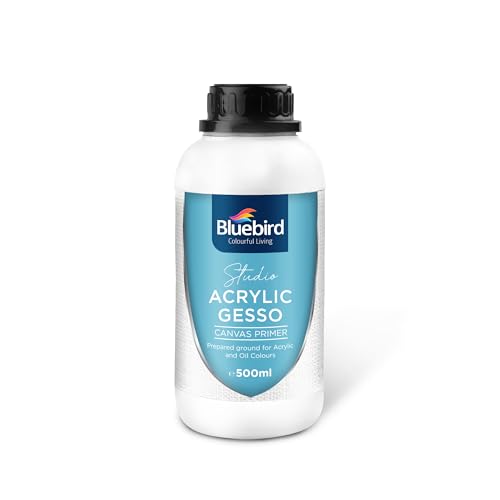
BLUEBIRD Studio Gesso is a liquid primer for canvas, wood and paper in a 16.9 fl oz bottle. The listing says it gives a smooth matte surface for better paint adhesion and is suitable for acrylic, oil and mixed media.
A liquid gesso brushes out thinly and levels well, which is useful for building several smooth coats on a canvas you want to paint fine detail on.
Best suited for: Budget-conscious painters who want a thin, matte gesso for extra coats.
Key features:
- 16.9 fl oz
- Liquid, white, matte
- For canvas, wood, paper
- Acrylic, oil and mixed media
Pros:
- Low price tier
- Brushes thin and smooth
- Matte finish
- Decent volume
Cons and limitations:
- Thinner body may need more coats
- Lesser-known brand
- Opacity not specified
Buying consideration: Plan on two or three thin coats for full coverage on raw surfaces.
6. BLUEBIRD Heavy Gesso Primer, 5.3 oz tub — Best for texture and extra tooth

BLUEBIRD’s heavy gesso comes in a 5.3 oz (150 g) tub and is described as an artist-grade primer with exceptional coverage, adhesion and quick drying. The listing details give a matte finish and non-toxic formula.
Heavy gesso can be applied with a palette knife or stiff brush to create texture before you paint, or to add more tooth to a canvas that feels too slick for acrylic.
Best suited for: Acrylic painters who like textured grounds or want to rough up a smooth canvas.
Key features:
- 5.3 oz (150 g) tub
- Heavy body, white, matte
- Non-toxic
- Quick drying
Pros:
- Builds texture
- Good coverage
- Small tub for testing
- Low price tier
Cons and limitations:
- Small quantity
- Not for smooth, detailed grounds
- Thick body takes longer to level
Buying consideration: Use heavy gesso only where you want texture; thick ridges show through every later layer.
7. Liquitex Professional Clear Gesso, 8 oz — Best for a transparent ground

Liquitex Clear Gesso dries matte and transparent, so the surface underneath stays visible. The listing describes it as fluid, in an 8 oz (237 ml) bottle, and intermixable with Liquitex Professional colors and mediums.
Clear gesso is useful when you want to keep the natural color of linen or raw cotton, or prime over a drawing or collage without hiding it. It still gives acrylic a toothy surface to grip.
Best suited for: Painters who want the raw canvas color to show, or who prime over drawings and mixed media.
Key features:
- 8 oz (237 ml)
- Clear, matte finish
- Fluid consistency
- Professional Liquitex line
Pros:
- Keeps canvas or drawing visible
- Toothy matte surface
- High-quality brand
- Mixes with Liquitex acrylics
Cons and limitations:
- Smaller volume, higher price per ounce
- Not a white ground
- Specialist use
Buying consideration: Test on a scrap first; clear grounds show every brush mark and drip.
Buying Guide: How to Choose Gessoed Canvas for Acrylic Paint
Look for stated priming
Good listings say how the canvas is primed: acid-free acrylic gesso, the weight (8 oz, 10 oz) or the number of coats. Vague “primed” claims are a reason to plan on adding your own coat.
Pick a support
Canvas panels on MDF are rigid and good for studies and framing. Stretched canvas has bounce and looks finished on the wall. Paper-core boards are the cheapest but can warp with heavy, wet acrylic.
Test the surface
Drop a little water on the canvas. If it soaks in quickly, the gesso is thin and acrylic will sink and look dull. If it beads, the surface is well sealed.
Choose matte versus satin gesso
Matte grounds have more tooth and grip paint better, especially for dry brushing. Satin grounds are smoother and suit glazing and fine detail.
Decide on texture
Heavy gesso adds tooth and visible texture. Liquid gesso applied thin and sanded gives a smooth, almost panel-like finish for detailed acrylic work.
Buy gesso by usage
For touch-ups, 8 to 16 oz is plenty. For priming raw canvas or many panels, 32 to 64 oz is far more economical.
How to Add Gesso to a Store-Bought Canvas
- Wipe the canvas with a dry cloth to remove dust.
- Stir the gesso; thin slightly with water if it is very thick.
- Apply a thin coat with a wide flat brush in one direction.
- Let it dry fully, usually 30 to 60 minutes depending on humidity.
- Lightly sand with fine sandpaper if you want a smoother surface.
- Apply a second coat at a right angle to the first.
- Let it cure for a few hours before painting.
Related Acrylic Guides
Once your canvas is primed, set up the painting with our guide on how to do an underpainting on canvas in acrylic. Wondering whether panels behave like stretched canvas? Read can you use acrylic paint on canvas board.
Common Mistakes to Avoid
- Applying gesso too thickly. Thick coats crack and leave ridges; build thin layers instead.
- Painting before gesso is dry. Wet gesso lifts and muddies the first acrylic layer.
- Assuming all primed canvas is the same. Thin factory priming may need an extra coat.
- Using house primer. Wall primers are not formulated for flexible canvas and can yellow or crack.
- Skipping sanding for detail work. A light sand between coats makes fine lines easier.
- Leaving gesso lids open. Gesso skins over quickly; close containers between coats.
FAQs
Do I need to gesso a pre-primed canvas for acrylic?
Not always, but many painters add one or two thin coats to improve the surface. It reduces absorbency, evens out the texture and helps the first layer of acrylic go down smoothly.
What does gessoed canvas mean?
It means the canvas has been coated with gesso, a primer that seals the fibers and gives paint a surface to grip. For acrylic, this is usually acrylic gesso, not traditional chalk-and-glue gesso.
How many coats of gesso does a canvas need?
Raw canvas usually needs two to three thin coats. A pre-primed canvas may only need one extra coat if you want a better surface.
Is clear gesso good for acrylic paint?
Yes. Clear gesso gives acrylic the same tooth as white gesso while letting the canvas color or a drawing show through.
Can you paint acrylic directly on canvas without gesso?
Acrylic can be painted on raw canvas because it does not rot the fibers like oil, but it soaks in, looks duller and uses more paint. Gesso gives better results.
Should I sand gesso before painting?
Sand lightly if you want a smooth surface for detail or glazing. Skip it if you like the tooth for textured or dry-brush work.
Final Recommendation
If you want to start painting immediately, the Simetufy 9×12 24-pack is the best-documented gessoed canvas here, with its stated 8 oz triple priming on MDF. The 8×10 Simetufy pack is the lower-commitment version for smaller studies.
To improve any canvas, keep a bottle of Liquitex Basics Gesso on hand. Choose Handy Art’s 64 oz container if you prime a lot, BLUEBIRD Studio for a budget liquid gesso, BLUEBIRD Heavy for texture, and Liquitex Clear Gesso when you want the canvas or drawing to show through.