
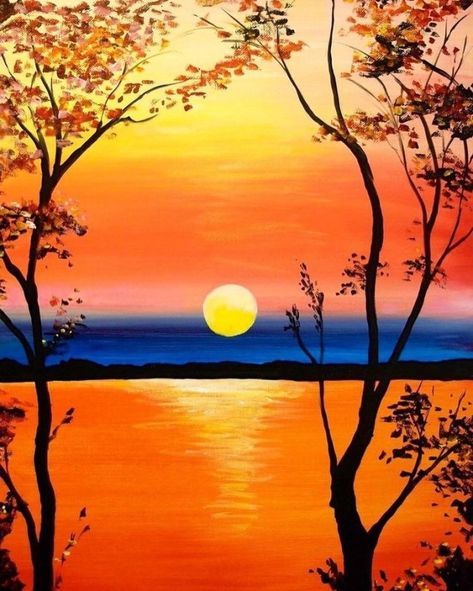
Quick answer: Strong acrylic painting ideas inspired by nature include misty mountain layers, birch trees in snow, a creek over stones, a single fern frond, wildflower meadows, storm clouds, autumn leaves on water and a desert at dusk. The key to making nature look natural in acrylic is mixing your greens and grays instead of using them from the tube, painting distant things cooler and lighter, and keeping texture and detail for the foreground.
Nature is the oldest subject in painting for good reason. It never runs out, it changes every hour, and it forgives loose brushwork in a way that portraits and architecture do not. A crooked branch still looks like a branch.
The difficulty is that nature is also overwhelming. A forest has thousands of leaves, a meadow has endless grass, and a river never holds still. These ideas break natural scenes into paintable pieces, with the color mixes and methods that make acrylic behave like water, bark, sky and foliage.
Mixing Natural Colors in Acrylic
Tube greens like phthalo green or permanent green light are intense and artificial-looking on their own. Real foliage is a range of muted, yellowish, bluish and grayish greens. Mixing your own is the single biggest improvement you can make to nature paintings.
| Natural color | Starting mix | Adjust with |
|---|---|---|
| Spring leaf green | Lemon yellow + a little phthalo or ultramarine blue | White for sunlit leaves |
| Deep forest green | Ultramarine blue + yellow ochre or cadmium yellow | Burnt umber to darken |
| Olive / sage | Yellow + black, or yellow + blue + a touch of red | White for sage |
| Distant hill blue-green | Green mix + white + extra blue | A hint of violet |
| Warm bark brown | Burnt umber + burnt sienna | Ultramarine for cool shadows |
| Cloud gray | Ultramarine + burnt sienna + white | More sienna for warm, more blue for cool |
| Sunlit rock | Yellow ochre + white + a touch of red | Gray mix for shadow side |
Pigment quality changes how far these mixes go. Higher-pigment paint gives you cleaner tints when you add white and richer darks when you mix down. Our comparison of acrylic paint brands for vivid, mixable color shows which lines hold up well in landscape mixing.
Acrylic Painting Ideas Inspired by Nature: Skies and Weather
Storm Clouds Over a Field
Storm clouds are a great subject because drama hides imperfection. Mix a cloud gray from ultramarine, burnt sienna and white in three values. Paint the darkest value along the bottoms of the clouds, which face away from the light, and the lightest value along the tops. Use a round brush in scrubbing, circular motions so edges stay soft.
Keep the field below simple and low on the canvas. A thin strip of sunlit yellow-green on the horizon makes the dark sky feel even heavier.
Golden-Hour Clouds
At sunset, clouds take on pink, orange and violet. Paint the sky gradient first, let it dry, then lay clouds on top with a violet-gray body and warm, almost white-orange rims on the side facing the sun. The contrast between cool cloud bodies and warm edges is what sells the light.
Misty Mountain Layers
This idea teaches atmospheric perspective, the effect that makes distant objects lighter, cooler and less detailed. Paint four or five overlapping mountain ridges, each one darker and slightly warmer than the one behind it. Start with the farthest ridge, almost the color of the sky, and finish with a near-black foreground ridge with a few tree tips along its edge. Let each layer dry before painting the next.
Water Scenes
Creek Over Stones
- Paint the creek bed in browns and ochres, roughly placing a few rounded stones.
- Glaze a thin, transparent green-brown over the deeper sections to suggest depth.
- Add short, broken white and pale blue strokes where water breaks over stones.
- Paint a few stones above the waterline with a clear light side and shadow side, and wet-looking dark rings at the waterline.
Transparent layers are the heart of this subject. Fluid acrylics or a glazing medium help; our review of Daler-Rowney fluid acrylics covers how one popular fluid line handles thin layering.
Autumn Leaves Floating on Dark Water
Paint a near-black water surface using phthalo blue and burnt umber. Once dry, paint scattered maple and oak leaves in orange, red and yellow, each with a slightly darker vein and a subtle shadow on the water just beside it. A few faint concentric ripple lines around one or two leaves add motion. The high contrast between warm leaves and dark water makes this one of the most striking simple nature subjects.
Waterfall in the Woods
Paint the rock face and surrounding trees dark first. Then drag white and pale blue-gray downward with a dry flat brush, lifting at the end of each stroke. Add misty, soft white at the base with a sponge. Waterfalls look best when the water is the lightest thing in the painting.
Trees and Forests
Birch Trees in Snow
A classic for a reason. Paint a soft blue-gray or warm winter sky. Use a palette knife or the edge of a card to scrape white trunks down the canvas. Once dry, add the black markings of birch bark with the corner of the card or a small brush: short horizontal dashes and a few “eye” shapes where branches would have been. A blue-violet shadow on the snow grounds the trees.
Forest Path in Summer
Use the path as a leading line that narrows into the distance. Mass foliage as large shapes in three greens (dark, mid, light) rather than individual leaves. Dab the lightest green with a sponge or stiff brush only where sunlight falls. A few patches of sky showing through the canopy keep the forest from feeling solid.
A Single Ancient Oak
Paint one large tree in an open field. Start with the dark interior masses of the canopy, then build outward with mid and light greens, keeping clusters rather than an even blob. Leave small gaps for “sky holes.” The trunk and main limbs should be visible inside the canopy, which makes the tree feel three-dimensional.
Plants and Flowers
Wildflower Meadow
Paint a soft green-gold field and let it dry. Add flowers in layers: tiny dots of color near the horizon, larger dabs in the middle, and a few detailed blooms (poppies, daisies, cornflowers) in the foreground. Grass blades flicked upward with a liner brush overlapping the flowers tie everything together.
A Single Fern Frond
Botanical studies teach precision. Paint one fern frond against a dark background. Start with the central stem as a gentle curve, then add leaflets in pairs that shrink toward the tip. Use two greens: a darker one for leaflets in shadow and a lighter one for those catching light. An acrylic ink or fine liner works well for crisp stems; inks like those in our Daler-Rowney acrylic ink review suit this kind of line work.
Sunflowers Against Blue Sky
Complementary yellow and blue make this composition glow. Paint the sky first, then the dark brown flower centers, then petals as long, slightly curved strokes radiating outward. Add a few petals in shadow with yellow mixed with a touch of violet.
Texture Tools for Natural Surfaces
Brushes are not the only way to describe nature. Acrylic’s quick drying makes it ideal for building texture with everyday tools, because each layer sets before the next goes on.
- Natural sea sponge: dab foliage, lichen on rocks or sea foam. Rotate the sponge between dabs so the pattern does not repeat.
- Palette knife: scrape rock faces, tree trunks and the hard edges of cliffs. Load paint on the underside of the blade and drag lightly.
- Old credit card or card stock: pull thin, straight lines for grass stems, birch trunks and reeds by touching the card edge to the canvas.
- Fan brush: flick upward for grass, tap for pine needles, or drag lightly for distant tree lines.
- Plastic wrap: press into a wet wash and lift once dry for crackled ice, stone or water patterns.
- Salt or sand mixed into gel: add gritty texture to beaches and desert scenes, sealed under a final layer of paint.
Keep textured marks mostly in the foreground. Heavy texture in the distance flattens the illusion of depth, since the eye reads strong surface detail as near.
Seasonal Nature Painting Ideas
- Spring: cherry blossoms against a pale sky, painted with dabs of pink and white over thin dark branches.
- Summer: a lake at noon with strong reflections and bright, saturated greens.
- Autumn: a hillside of mixed trees in orange, rust and gold with a few evergreens for contrast.
- Winter: a frozen pond with blue shadows and a pale, low sun.
Painting the same location across all four seasons is a rewarding long-term project that teaches how light and color shift through the year.
Metallic and Mixed Ideas from Nature
Metallic acrylic painting ideas fit nature surprisingly well. Try gold leaf veins on a dark green leaf, copper autumn leaves on a navy background, or silver moonlight on water. Use metallics sparingly as accents. A small amount of reflective paint draws the eye; too much flattens the image.
Acrylic paint markers are useful for adding fine natural details over dried paint: veins in leaves, grass blades, bird silhouettes or the texture of bark. They give control that a liner brush can take years to develop.
Painting from Real Nature
Photos are convenient, but painting outdoors (plein air) or from direct observation teaches things a camera flattens. Shadows are rarely gray or black outdoors; they pick up blue from the sky and reflected color from nearby surfaces.
- Bring a small kit: a 6×8 or 8×10 panel, five colors, two brushes and a spray bottle.
- Limit sessions to 45–60 minutes, since light shifts quickly.
- Keep acrylic workable outdoors with a stay-wet palette and frequent misting, especially in sun and wind.
- Take a reference photo when you start so you can finish details at home.
A Desert at Dusk
Not every nature painting needs green. A desert at dusk relies on warm earth tones against a cooling sky. Paint the sky from pale peach at the horizon to dusty violet at the top. Block in sand dunes or mesas with yellow ochre and burnt sienna, keeping the side facing the low sun warm and the shadow side a muted violet. Add a single saguaro or a few low shrubs as dark silhouettes, and the scene is complete with very few elements.
Common Mistakes in Nature Paintings
- Tube-green everything. Mix greens with yellows, blues, reds and earth colors for variety.
- Same detail everywhere. Detail belongs in the foreground. Distant trees are shapes, not leaves.
- Lollipop trees. Real trees have irregular silhouettes, sky holes and visible branches.
- Flat skies. Skies are usually darker and more saturated at the top and lighter near the horizon.
- White water and snow that are pure white everywhere. Shadows in water and snow are blue, violet or gray.
Tips by Skill Level
Beginners: Start with misty mountains, birch trees and silhouettes. They rely on shapes and simple gradients.
Improving painters: Try creek scenes and wildflower meadows to practice glazing and layering.
More experienced painters: Take on forest interiors and waterfalls, where managing values across complex shapes becomes the challenge.
FAQs
What are easy nature acrylic painting ideas for beginners?
Misty mountain layers, birch trees in snow, sunset silhouettes, a single flower and autumn leaves on dark water are all approachable. They use clear shapes, limited colors and forgiving textures.
How do I mix realistic greens with acrylic paint?
Mix yellows with blues rather than relying on tube greens, then adjust with a touch of red, burnt umber or white. Warmer yellows give olive and earthy greens, while lemon yellow gives fresh spring greens.
How do I paint realistic water in acrylics?
Work in thin, transparent layers, paint reflections as slightly darker versions of what sits above, and save bright whites for highlights and foam. Horizontal strokes suggest calm water; broken strokes suggest movement.
Can I paint outdoors with acrylic paint?
Yes, but sun and wind speed up drying. Use a stay-wet palette, mist your paint often, work small and keep sessions short. Find shade for your palette and canvas if possible.
What is the best acrylic painting ideas step by step approach for landscapes?
Work from back to front: sky first, then distant hills, mid-ground, and finally the foreground with the most detail. Let each layer dry before overlapping it with the next.
Should I use photos or paint from real life?
Both are useful. Photos let you work at your own pace, while observation teaches you how color and shadow really look. Many painters sketch outdoors and finish at home using photos as backup.
Final Thoughts
Choose one nature subject that you see often, such as a tree outside your window, a nearby park or the evening sky, and paint it a few times. Repeating a familiar subject reveals more each time and builds your color mixing quickly.
Nature scenes ask a lot of your paint, from transparent water to opaque highlights. To find a range that handles those demands, see our guide to the best acrylic paints for landscape and nature work.





One Comment