
PaintingProGuide is reader-supported. When you buy through links on this page we may earn an affiliate commission at no extra cost to you.
Daler-Rowney fluid acrylic paint, sold as System3 Fluid Acrylic, is the British brand’s pourable, high-flow version of its student-to-artist System3 range. It comes in squeeze bottles rather than tubes, flows without thinning, and is aimed at pouring, murals, large flat areas and work on paper or fabric. This review explains what the current listings promise, how the bottle sizes compare, who will get the most out of it, and where a different fluid paint or an acrylic ink makes more sense.
Fluid acrylics are often bought for one project and then used for years, so it pays to understand viscosity, bottle size and pigment naming before adding a dozen colors to your cart.
Quick answer: For most painters, the Daler-Rowney System3 Fluid Acrylic 250ml bottle is the best way to buy this paint for pouring or large areas, since the bigger bottle suits volume work. Start with the 29.5ml bottles if you want to test colors or paint smaller pieces. If you need a creamier fluid paint with a satin sheen, the Liquitex Basics Acrylic Fluid is the closest alternative; for very thin, ink-like color, look at Daler-Rowney FW Acrylic Ink.
Our Top Picks at a Glance
- Daler-Rowney System3 Fluid Acrylic, 250ml (Cadmium Orange Hue) — Best for pouring and large-area work
- Daler-Rowney System3 Fluid Acrylic, 29.5ml (Cadmium Orange Hue) — Best for testing a color before committing
- Daler-Rowney System3 Fluid Acrylic, 29.5ml (Titanium White) — Best small bottle for tinting and mixing
- Liquitex Basics Acrylic Fluid, Titanium White — Best alternative with a satin sheen and flip-top bottle
- Daler-Rowney FW Acrylic Ink 6-Color Primary Set — Best when you need thinner, ink-like acrylic color
| Product | Best For | Key Spec | Key Strength | Price Tier |
|---|---|---|---|---|
| System3 Fluid 250ml | Pouring, murals | 250ml bottle; lightfast pigments | Volume for big projects | $$ |
| System3 Fluid 29.5ml Orange | Color sampling | 29.5ml bottle; 27-color range | Low-risk way to try a hue | $ |
| System3 Fluid 29.5ml White | Mixing tints | 29.5ml; Titanium White | Essential mixing color | $ |
| Liquitex Basics Fluid | Ready-to-pour coverage | Satin sheen; flip-top cap | No dilution needed | $ |
| FW Acrylic Ink Primary Set | Washes, pens, airbrush | 6 x 29.5ml with dropper | Thinnest flow, permanent | $$ |
What Daler-Rowney Fluid Acrylic Paint Actually Is
System3 is Daler-Rowney’s broad acrylic range. The fluid version keeps the same intermixable acrylic binder but arrives at a pourable consistency, so you can squeeze it straight onto a palette, a canvas or into a pouring cup. According to the listings, it is made with lightfast pigments, is archival, and dries to a permanent, insoluble finish.
The range covers 27 colors in 29.5ml and 250ml bottles, and the listing notes that the seven most-used colors also come in 500ml bottles. It is made in England and marketed to hobbyists, students and professionals alike.
Fluid versus heavy body: why it matters
Heavy-body acrylic holds brush marks and peaks. Fluid acrylic levels out, which is exactly what you want for pours, flat graphic shapes, glazes, staining raw canvas and mural backgrounds. You can still brush it, but it will not hold texture without a gel medium.
Because it is already liquid, fluid acrylic also mixes into pouring medium more evenly than tube paint you have thinned with water. Over-thinning with water alone can weaken the paint film, so a medium is the safer route for heavy dilution.
What “Hue” means on the label
Cadmium Orange Hue is not genuine cadmium pigment. “Hue” is the standard label for a color that imitates a traditional pigment using other pigments. It is usually cheaper and avoids handling concerns around cadmium, though mixing behavior can differ slightly from the real thing.
Specs from the System3 Fluid listings
- Bottle sizes: 29.5ml and 250ml in the listings, with 500ml for seven core colors
- 27 colors in the System3 Fluid range
- Lightfast pigments, archival, intermixable with other acrylics and mediums
- Dries to a permanent, insoluble finish; detail field lists matte
- Indoor and outdoor use; canvas and paper recommended, plus murals and textiles
Who it suits
System3 Fluid fits acrylic pourers, mural painters, art students and anyone covering large areas who wants a recognizable brand at a moderate cost. It is less suited to impasto work or to painters who want a single-pigment professional line with detailed pigment codes on every listing.
Honest limitations
- Amazon listings do not show pigment codes, so check the bottle label if single-pigment colors matter to you.
- Some listing detail fields are clearly wrong (one 250ml bottle is listed as “750 Fl Oz”), so rely on the title for size.
- Fluid paint will not hold brush texture without a gel medium.
How We Chose
We did not pour or paint with these products. The picks are based on Amazon listing details and specifications checked in October 2026, on how well each product’s viscosity, bottle size and finish suit someone shopping for Daler-Rowney fluid acrylic paint, and on how widely each product is reviewed by Amazon buyers.
- Viscosity: genuinely fluid or ink-like, not tube paint.
- Volume per bottle: enough paint for the job the buyer likely has in mind.
- Stated permanence: lightfastness and archival claims in the listing.
- Intermixability: whether it works with other acrylics and mediums.
- Buyer adoption: how widely the product is reviewed on Amazon.
Daler-Rowney Fluid Acrylic Paint Review: The System3 Bottles
1. Daler-Rowney System3 Fluid Acrylic, 250ml — Best for Pouring and Large Areas

Pouring eats paint. A single medium-size pour can use more than a small bottle holds once you factor in mixing with pouring medium, so the 250ml bottle is the practical format for anyone working at scale. It is also the sensible size for mural backgrounds and color fields.
The listing repeats the core System3 claims: lightfast pigments, good coverage, archival, intermixable and a permanent insoluble finish. It names canvas, murals, paper and textiles as suitable surfaces, and covers both indoor and outdoor use.
Best suited for: acrylic pours, murals, large flat areas and classroom projects.
Key features:
- 250ml squeeze bottle
- Cadmium Orange Hue (one of 27 colors)
- Lightfast, archival, intermixable
- Indoor and outdoor use
Pros:
- Better volume for pouring and coverage work
- Works with acrylic mediums for effects
- Made in England by a long-established brand
Cons/limitations:
- Larger commitment if you dislike the color
- Hue color, not genuine cadmium
- Listing size field is inaccurate
Buying consideration: buy 250ml in the colors you use constantly, like white and your main darks, and smaller bottles for accents.
2. Daler-Rowney System3 Fluid Acrylic, 29.5ml Cadmium Orange Hue — Best for Sampling

The 29.5ml bottle is the same paint in a size that makes sense for testing. You can see how the hue mixes with your other colors, how it behaves in a pour and whether you like the finish before buying a large bottle.
It is also the right size for small canvases, paper studies, illustration and detail areas in mixed media. The listing lists canvas and paper as recommended surfaces and confirms indoor and outdoor suitability.
Best suited for: testing colors, small paintings and adding accent colors to a pour.
Key features:
- 29.5ml bottle
- Same System3 Fluid formula as the 250ml
- Indoor/outdoor, canvas and paper
Pros:
- Low-risk way to try a color
- Easy to store and carry
- Good for accents and small work
Cons/limitations:
- Runs out fast in pouring
- Higher cost per ml than the large bottle
- Hue pigment rather than cadmium
Buying consideration: small bottles are cheaper up front but more expensive per ml. Move to 250ml once a color becomes a staple.
3. Daler-Rowney System3 Fluid Acrylic, 29.5ml Titanium White — Best Mixing Color

White is the color you will run out of first, because almost every tint and pastel mix depends on it. Titanium White is the opaque standard white in acrylics, so this bottle is the base of a sensible System3 Fluid palette.
For pouring, a fluid white is useful for cells and lacing effects alongside your colored mixes. For brushwork it gives opaque coverage that heavily diluted tube white often cannot.
Best suited for: tinting, highlights, pours and building a basic fluid palette.
Key features:
- 29.5ml bottle, Titanium White
- Liquid form, matte finish listed
- Indoor and outdoor use
Pros:
- Core color for almost every mix
- Fluid consistency blends evenly into mediums
- Same brand and formula as the colored bottles
Cons/limitations:
- Small volume for a color you use constantly
- Very short title gives little detail
- Large bottle is better value for heavy users
Buying consideration: if you plan to pour regularly, treat this bottle as a trial and expect to buy white in a larger size.
Alternatives Worth Comparing
Only two alternatives in the current product data genuinely fit this query, so this section is short. One is a competing fluid paint, the other a thinner acrylic ink from Daler-Rowney itself.
4. Liquitex Basics Acrylic Fluid, Titanium White — Best Ready-to-Pour Alternative

Liquitex Basics Fluid is the most direct competitor. The listing describes it as ultra smooth, blendable, designed to be used straight from the bottle without diluting, and finished with a satin, mid-sheen surface. It is promoted for pouring, large coverage, fine detail and splatter work.
The bottle design is a practical plus: a squeezable body, a one-handed flip-top cap and a screw-off top with a wide neck. The title lists an 8.5-oz bottle, while a detail field shows 4 fl oz, so check which size is being sold before ordering.
Best suited for: painters who want a satin finish and a bottle built for controlled squeezing.
Key features:
- Fluid viscosity, no dilution needed
- Satin, mid-sheen finish per bullet points
- Flip-top cap with screw-off wide neck
Pros:
- Bottle design suits pouring and dispensing
- Versatile from coverage to detail
- Widely available color range
Cons/limitations:
- Size data in the listing conflict
- Satin sheen differs from System3’s listed matte
- Student-grade line like System3, not a professional range
Buying consideration: choose Liquitex Basics if you prefer a satin finish or already use Liquitex mediums; choose System3 if you want the Daler-Rowney color range.
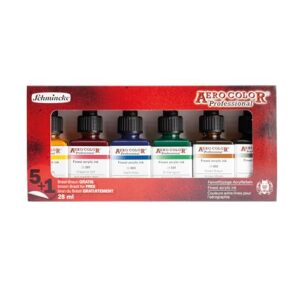
5. Daler-Rowney FW Acrylic Ink 6-Color Primary Set — Best for Thinner Flow

If fluid acrylic still feels too thick for your work, FW Acrylic Ink is the next step down in viscosity. The listing describes water-based, permanent ink with high lightfastness that you can use from the dropper, dilute into washes, run through an airbrush or load into a technical or dip pen. The set includes an empty marker you can fill yourself.
It is not a pouring paint in the usual sense, and the bottles are small. But for illustration, glazing and line work on paper, ink often does what fluid acrylic cannot.
Best suited for: illustrators, mixed-media artists and anyone glazing on paper.
Key features:
- Six 29.5ml primary colors plus an empty marker
- Permanent, water-based, highly lightfast
- Airbrush, dip pen and technical pen compatible
Pros:
- Very thin flow for washes and pen work
- Intermixable with other acrylics
- 45-color range to expand later
Cons/limitations:
- Small bottles for large areas
- Translucent washes, not opaque coverage
- Not a direct substitute for pouring paint
Buying consideration: buy FW for paper and pen work, and System3 Fluid for canvas coverage. Many mixed-media artists keep both.
Getting Good Results with System3 Fluid
Fluid acrylic is forgiving, but a few habits make the difference between muddy pours and clean ones. None of these steps depend on a particular brand; they apply to any fluid acrylic, including System3.
A simple starting ratio for pours
Many pourers begin with roughly one part paint to one or two parts pouring medium, then add water a few drops at a time until the mix runs off a stirring stick like warm honey. Because System3 Fluid is already thin, you usually need less water than with tube paint. Write down your ratios so you can repeat a mix that worked.
Glazing and staining
Thinned with a glazing medium, fluid acrylic makes transparent layers that shift color without hiding the drawing underneath. On unprimed canvas or heavy paper it can also be used as a stain for soft, soaked-in color fields.
Flat graphic shapes and lettering
Fluid paint levels out, so it is well suited to hard-edged shapes, sign-style lettering and mural blocks. Two thin coats generally give a smoother result than one thick coat, especially with lighter colors over dark grounds.
Drying and curing
Thin layers become touch-dry quickly, but thick pours take much longer to cure fully. Keep pours level and dust-free while they dry, and wait until the surface is completely cured before varnishing.
Buying Guide: How to Choose Daler-Rowney Fluid Acrylic Paint
Pick the bottle size by project, not by price
Pouring and murals use far more paint than brushwork. Buy 250ml or 500ml in the colors you rely on, and 29.5ml for accents, tests and small pieces.
Check whether the color is a hue
Colors labeled “Hue” imitate traditional pigments like cadmium or cerulean. They are usually fine for most work, but if you are matching an exact historical pigment, read the label for the pigment code.
Decide on matte or satin
System3 Fluid is listed with a matte finish, while Liquitex Basics Fluid describes a satin sheen. A varnish can change the final surface, but the paint’s own sheen affects how layers look as you work.
Plan your mediums
For pouring, mix fluid acrylic with a pouring medium rather than only water. For glazes, a glazing or fluid medium keeps the paint film strong. System3 is listed as intermixable with acrylic mediums.
Match the paint to the surface
The listing recommends canvas and paper and mentions murals and textiles. For fabric that will be washed, a fabric medium helps flexibility, and for outdoor murals a protective varnish is wise.
Build a minimal palette first
A white, a dark, and a warm and cool version of each primary gives you most mixes. Expand the range only once you know which colors you actually use.
Consider ventilation and clean-up
Acrylic is water-based and cleans up with water while wet, but it dries permanent. Rinse brushes and pouring cups promptly, and avoid sending large amounts of paint water down the drain.
Ideas and Projects for Fluid Acrylic
Fluid acrylic shines on large, flat areas, so our guide to making DIY wall art with acrylic is a natural first project. If you want an easy starting point, browse these simple acrylic painting ideas for beginners.
Common Mistakes to Avoid
- Thinning with too much water. Heavy water dilution can weaken the paint film; use a medium instead.
- Buying every color in small bottles. Your most-used colors will run out first and cost more per ml.
- Expecting fluid paint to hold texture. Add a gel medium if you want impasto.
- Trusting every listing field. Some size fields are wrong; the product title is more reliable.
- Letting paint dry on brushes. Acrylic becomes insoluble once dry.
- Skipping a test pour. Try new color and medium ratios on a small surface first.
FAQs
Is Daler-Rowney System3 Fluid good for acrylic pouring?
Yes, it is marketed as a pouring paint and comes in large bottles suited to the volume pouring needs. Mix it with a pouring medium for the best flow and film strength.
What is the difference between System3 Fluid and FW Acrylic Ink?
System3 Fluid is a pourable paint aimed at coverage, while FW is a thinner, ink-like acrylic for washes, pens and airbrush. Both are permanent when dry and intermixable.
Do I need to thin System3 Fluid Acrylic?
Usually not for brushwork or flat areas, because it is already fluid. For pours or glazes, add a medium rather than lots of water.
Is Daler-Rowney fluid acrylic lightfast?
The listings state it is made with lightfast pigments and is archival. Check individual color labels for specific lightfastness ratings if a piece will hang in strong light.
Can I use System3 Fluid outdoors?
The listings mark it for indoor and outdoor use, including murals. A protective varnish helps outdoor work last longer.
How does it compare with Liquitex Basics Fluid?
Both are student-to-artist fluid acrylics. System3 lists a matte finish, while Liquitex Basics Fluid describes a satin sheen and a flip-top bottle; choose by finish and color range.
Final Recommendation
For pours, murals and large areas, buy Daler-Rowney System3 Fluid Acrylic in 250ml for your core colors. Use the 29.5ml bottles, including Titanium White, to test colors and build a small palette before scaling up.
If you prefer a satin sheen or a flip-top bottle, Liquitex Basics Acrylic Fluid is the most direct alternative. If what you need is thin, permanent color for paper, pens or airbrush, Daler-Rowney FW Acrylic Ink is the better match than any fluid paint.




4 Comments