PaintingProGuide is reader-supported. When you buy through links on this page we may earn an affiliate commission at no extra cost to you.
A good beginner painting inspiration book does something a video cannot: it sits open beside your easel, it does not pause or buffer, and you can flip back to the same page fifty times without losing your place. The best ones combine a little technique with a lot of starting points, so the blank canvas stops being frightening and starts being a list of things to try.
We have gathered seven paperbacks that work as inspiration for new painters, ranging from structured acrylic courses to loose, expressive watercolor. For each we explain, from the listing details, who it suits and what kind of inspiration it offers, and we finish with advice on how to actually use a book like this rather than just reading it once.
Quick answer: Learn to Paint in Acrylics with 50 Small Paintings by Mark Daniel Nelson is the best beginner painting inspiration book for most people: fifty small, finishable projects remove the “what do I paint” problem for months. If your block is confidence rather than ideas, Painting for the Absolute and Utter Beginner by Claire Watson Garcia is the gentlest start, and Everyday Watercolor by Jenna Rainey offers a 30-day structure for watercolor.
Our Top Picks at a Glance
- Learn to Paint in Acrylics with 50 Small Paintings (Mark Daniel Nelson) — Best overall: fifty ready-made starting points
- Painting for the Absolute and Utter Beginner (Claire Watson Garcia) — Best for nervous first-timers
- Acrylics for the Absolute Beginner (Charles Evans) — Best structured acrylic introduction
- Acrylic Landscapes for Beginners (Sarah Johnston) — Best for scenery and landscape inspiration
- Everyday Watercolor: Learn to Paint Watercolor in 30 Days (Jenna Rainey) — Best watercolor program
- Creative Abstract Watercolor (Kate Rebecca Leach) — Best for expressive, non-representational work
- Compendium of Acrylic Painting Techniques (Gill Barron) — Best technique reference to pair with any of the above
| Product | Best For | Key Spec | Key Strength | Price Tier |
|---|---|---|---|---|
| 50 Small Paintings | Project-based inspiration | Paperback; 50 small acrylic projects | Many quick wins | $$ |
| Absolute and Utter Beginner | Confidence building | Paperback; foundational approach | Gentle entry point | $ |
| Acrylics for the Absolute Beginner | Structured learning | Paperback; acrylic basics | Step-by-step format | $$ |
| Acrylic Landscapes for Beginners | Landscape subjects | Paperback; drives, forests, mountains | Scenic project themes | $ |
| Everyday Watercolor | Daily watercolor practice | Paperback; 30-day structure | Built-in schedule | $ |
| Creative Abstract Watercolor | Expressive, abstract work | Paperback; imaginative techniques | Freedom from realism | $ |
| Compendium of Acrylic Techniques | Technique reference | Paperback; technique compendium | Broad reference | $ |
How We Chose
These books were selected from the Amazon listing details checked in October 2026, from how directly each title’s format and subject serve a beginner looking for inspiration rather than theory, and from how widely each is reviewed by Amazon buyers. We have not read every page of each, and we have kept claims to what the titles, authors and listings state. The criteria:
- Beginner focus. Titles explicitly aimed at beginners or absolute beginners.
- Inspiration value. Project collections, structured programs and subject-themed books ranked above pure theory.
- Medium coverage. A spread across acrylic and watercolor, the two media most beginners start with.
- Format. Paperbacks that lie open and can live at the easel.
- Price tier. All sit in the low or lower-mid tier.
Best Beginner Painting Inspiration Books Reviewed
1. Learn to Paint in Acrylics with 50 Small Paintings by Mark Daniel Nelson — Best for Fifty Ready-Made Starting Points

The title tells you the method: fifty small acrylic paintings, each a self-contained project. For a beginner whose real problem is deciding what to paint, that is fifty answers in one paperback. The subtitle, “pick up the skills, put on the paint, hang up your art,” signals the emphasis on finishing pieces rather than studying theory.
Small paintings suit beginners because they are cheap in paint and canvas, quick to complete, and forgiving of mistakes. Working through even a dozen of these builds the habit of starting and finishing, which is the habit that matters most.
Best suited for: Beginners who learn by doing and want a long queue of achievable projects.
Key features:
- Paperback with 50 small acrylic painting projects
- Skills introduced through the paintings themselves
- Focused on producing finished, hangable work
Pros:
- Removes the blank-canvas problem for months
- Small format keeps costs low
- Lower-mid price tier
Cons and limitations:
- Acrylic only
- Small projects may feel limiting once skills grow
Buying consideration: Buy a pack of 5×7 or 8×10 canvas panels at the same time so you can start the first project immediately.
2. Painting for the Absolute and Utter Beginner by Claire Watson Garcia — Best for Nervous First-Timers

Claire Watson Garcia’s title is aimed at people who do not yet believe they can paint at all. It is the most foundational book here, and its value as inspiration lies in permission: it is written for the reader who has never held a brush and assumes nothing.
If you have bought supplies and still have not opened them, this is the book that gets them open. It is also the lowest price tier in the roundup, which makes it an easy first purchase.
Best suited for: Adults who feel they “can’t draw” and need an encouraging, zero-assumption start.
Key features:
- Paperback for absolute beginners
- Foundational approach to painting
- Written for readers with no prior experience
Pros:
- Encouraging and accessible
- Lowest price tier
- Builds confidence before technique
Cons and limitations:
- Less project-driven than the Nelson book
- Readers with some experience may outgrow it quickly
Buying consideration: Read it in one sitting, then keep it as a reference while you work through a project book.
3. Acrylics for the Absolute Beginner by Charles Evans — Best for A Structured Acrylic Introduction

Charles Evans is a well-known instructional painter, and this paperback introduces acrylics to complete beginners in a structured way. Where the Nelson book throws you into fifty projects, this one builds up more methodically, which some beginners prefer.
As inspiration, it works by showing what acrylic can do in a beginner’s hands, and by giving a clear path to follow when motivation dips. Pair it with a project book and you have both the “how” and the “what.”
Best suited for: Beginners who like a course-style progression and want acrylic specifically.
Key features:
- Paperback acrylic introduction for absolute beginners
- Methodical, structured approach
- From an established instructional author
Pros:
- Clear progression
- Acrylic focus matches most beginner kits
- Lower-mid price tier
Cons and limitations:
- Fewer standalone project ideas
- Acrylic only
Buying consideration: Work through it with the same limited palette throughout so you learn mixing rather than hunting for colors.
4. Acrylic Landscapes for Beginners by Sarah Johnston — Best for Scenery and Landscape Inspiration

Sarah Johnston’s book narrows the field to landscapes, with the subtitle promising step-by-step guides to scenic drives, misty forests, snowy mountains and more. For beginners drawn to scenery, this specificity is the inspiration: every chapter is a place you might want to paint.
Landscapes are forgiving subjects for new painters because nobody can say the tree is in the wrong place, and the atmospheric effects (mist, snow, distance) are satisfying to pull off with simple techniques.
Best suited for: Beginners who want to paint places and skies rather than objects or people.
Key features:
- Paperback of step-by-step acrylic landscape projects
- Subjects include scenic drives, misty forests and snowy mountains
- Written for beginners
Pros:
- Focused subject matter
- Landscapes suit beginners
- Lower-mid price tier
Cons and limitations:
- Not for those who want portraits or still life
- Acrylic only
Buying consideration: Photograph your own local scenery and adapt the book’s approaches to it; that is where the projects become your own.
5. Everyday Watercolor: Learn to Paint Watercolor in 30 Days by Jenna Rainey — Best for A 30-Day Watercolor Program
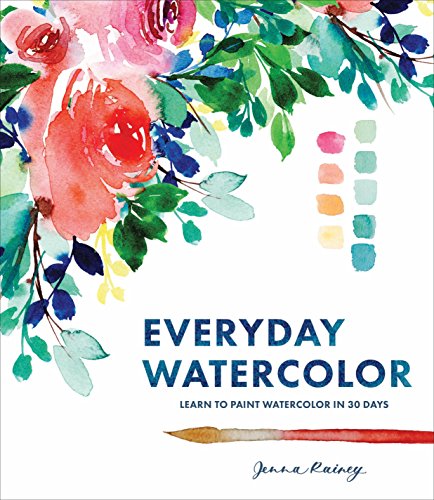
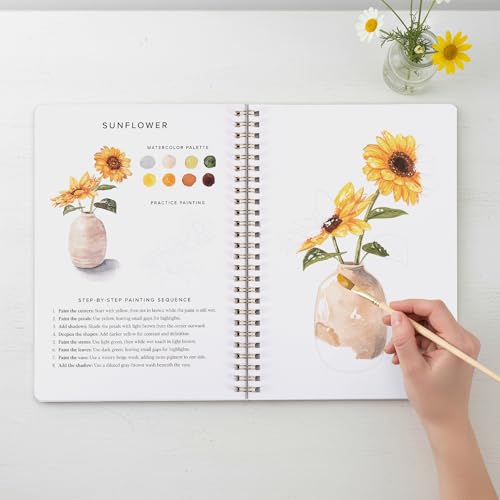
Jenna Rainey’s book organizes watercolor learning into a 30-day sequence. The inspiration here is structural: you do not decide what to do today, the book does, and the daily cadence builds the habit that most beginners lack.
Watercolor is an inexpensive medium to start, and a month of short daily sessions is a realistic commitment for a busy adult. The perfect-paperback format lies reasonably flat beside a paper pad.
Best suited for: Beginners who respond to schedules and want to try watercolor.
Key features:
- Perfect paperback with a 30-day watercolor structure
- Daily lessons for beginners
- Watercolor focus
Pros:
- Built-in daily plan
- Low price tier
- Inexpensive medium
Cons and limitations:
- Watercolor only
- Daily structure can feel rigid once you want to wander
Buying consideration: Buy a pad of 140 lb cold-press paper and a basic 12-color pan set before day one so nothing interrupts the schedule.
6. Creative Abstract Watercolor by Kate Rebecca Leach — Best for Expressive, Non-Representational Work

Not every beginner wants to paint a recognizable tree. Kate Rebecca Leach’s beginner’s guide to expressive and imaginative watercolor removes the pressure of likeness entirely, and for many people that is exactly the inspiration they need: permission to play with color and water.
Abstract work also teaches composition and color relationships faster than representational painting, because there is nothing else to think about. It is a good second book for anyone who found the structured programs too tight.
Best suited for: Beginners who want freedom and color play over accuracy.
Key features:
- Paperback beginner’s guide to abstract watercolor
- Focus on expressive and imaginative techniques
- No drawing skill required
Pros:
- Removes the fear of getting it wrong
- Teaches color and composition directly
- Lower-mid price tier
Cons and limitations:
- Not for those who want to paint realistic subjects
- Watercolor only
Buying consideration: Use heavy paper; abstract watercolor techniques often involve more water than beginner paper can take.
7. Compendium of Acrylic Painting Techniques by Gill Barron — Best for A Technique Reference for Any Project Book

Gill Barron’s compendium is the reference book in this group: a broad collection of acrylic techniques rather than a set of projects. Its inspirational value is indirect but real. Flipping through a compendium of what acrylic can do, from glazing to texture, suggests directions you did not know existed.
It pairs naturally with the Nelson or Johnston project books. When a project calls for a technique you have not met, the compendium explains it.
Best suited for: Beginners who like to understand the “why” and want a reference beside their project books.
Key features:
- Paperback compendium of acrylic techniques
- Reference format
- Covers a broad range of methods
Pros:
- Answers technique questions as they arise
- Suggests new directions
- Lower-mid price tier
Cons and limitations:
- Not a project book
- Acrylic only
Buying consideration: Keep it on the shelf and reach for it when a project stalls on a technique you do not understand.
Buying Guide: How to Choose a Beginner Painting Inspiration Book
Projects vs. programs vs. references
Project books (Nelson, Johnston) give you things to paint. Programs (Rainey) give you a schedule. References (Barron) answer questions. Most beginners get the most from one project book plus one reference.
Medium
Match the book to the paint you own. Four of the seven here are acrylic, two are watercolor, and one is medium-neutral. Buying a watercolor book for an acrylic kit is a common and frustrating mistake.
Subject preference
If you already know you love landscapes or abstraction, a focused book will inspire more than a general one. If you do not know yet, the fifty-painting collection gives you a sample of everything.
Confidence level
Readers who feel they cannot paint at all should start with the Garcia book before anything else; its job is to get the first brush wet.
Format
Paperbacks that lie open are more useful at the easel than hardcovers that snap shut. All seven here are paperbacks.
Price
Every title sits in the low or lower-mid tier, so buying two is realistic. The expense in painting is the supplies, not the books.
How to Use an Inspiration Book
Reading is not painting. The books that work are the ones with paint on them. Pick one project, gather only the colors it needs, and finish it in one or two sessions before reading further. If a book’s projects use reference photos, our guide on how to use reference photos for artistic inspiration will help you adapt them to your own images. For more starting points between books, see our beginner easy paintings and how to find inspiration for your next painting project; abstract painters will also like our DIY abstract art techniques and inspiration.
Common Mistakes to Avoid
- Buying five books and painting nothing. One project book, used, beats a shelf of unread ones.
- Choosing a watercolor book for an acrylic kit or vice versa.
- Skipping ahead to the hardest project because it looks best; finish three easy ones first.
- Copying a project exactly and stopping there. Change one thing, the color scheme or the season, and it becomes yours.
- Treating a reference compendium as a project book and getting lost in technique.
- Judging your result against the book’s photo on the first attempt. Compare to your own last painting instead.
FAQs
What is the best painting book for a complete beginner?
For most people, Learn to Paint in Acrylics with 50 Small Paintings, because it provides dozens of small finishable projects. If confidence is the barrier, start with Painting for the Absolute and Utter Beginner.
Should a beginner start with acrylic or watercolor books?
Match the book to your paint. Acrylic is more forgiving and most beginner kits are acrylic, so the Nelson, Evans, Johnston and Barron books suit most people. Watercolor beginners should look at Rainey or Leach.
Are painting books better than YouTube for beginners?
They complement each other. Books sit open at the easel, do not need a screen, and are easier to revisit. Videos show motion and timing. Many beginners use a book for structure and videos for specific techniques.
How many projects should I finish before buying another book?
At least five. If you have finished five projects from one book, you know what you like and the next purchase will be far better targeted.
Do I need drawing skills to use these books?
No. Landscape and abstract books in particular need very little drawing, and the absolute-beginner titles assume none.
Which book is best for learning techniques rather than projects?
The Compendium of Acrylic Painting Techniques by Gill Barron is the reference title here; use it alongside a project book rather than instead of one.
Final Recommendation
Start with Learn to Paint in Acrylics with 50 Small Paintings if you want projects, or Painting for the Absolute and Utter Beginner if you need confidence first. Add Acrylics for the Absolute Beginner for structure or Acrylic Landscapes for Beginners if scenery is your interest.
Watercolor beginners should choose between Everyday Watercolor for a 30-day plan and Creative Abstract Watercolor for freedom, and anyone working in acrylic will get long-term value from the Compendium of Acrylic Painting Techniques on the shelf. Whichever you pick, open it beside a canvas, not on the sofa.