

PaintingProGuide is reader-supported. When you buy through links on this page we may earn an affiliate commission at no extra cost to you.
Blending tools for painters depend on the medium. Oil and acrylic painters blend with brushes, but also with palette knives and scrapers that mix color cleanly and drag one color into another. Pastel and charcoal artists use paper stumps and sponge blenders. Alcohol ink artists push and lift color with foam swabs.
This guide gathers the most useful non-brush blending tools in our product data: two palette knife sets, paper stumps and tortillions, two kinds of pastel blending pens and alcohol ink swabs. For each, we explain the medium it suits and how to get smooth transitions without muddy color.
Quick answer: Oil and acrylic painters should start with the CONDA 5-Piece Palette Knife Set for clean mixing and knife blending. Add N NOROCME blending stumps for charcoal underdrawings and pastel, and Kosiz oil pastel blenders if you work in oil pastel.
Our Top Picks at a Glance
- CONDA 5-Piece Stainless Steel Palette Knife Set — Best for mixing and knife-blending oil and acrylic
- CllyCnny Palette Knife Set with 6 Plastic Scrapers — Best for knife blending plus texture scraping
- N NOROCME Blending Stumps and Tortillions (12 + sandpaper) — Best for drawing, underdrawings and pastel blending
- Kosiz Oil Pastel Blending Pens (6 pack) — Best for oil pastel gradients and color separation
- salbsever Dual-Tip Sponge and Felt Blending Pens (4 pc) — Best for soft shading in sketches and pastel
- U.S. Art Supply Alcohol Ink Blending Swabs (30 pack) — Best for blending alcohol ink and dyes
| Product | Best For | Key Spec | Key Strength | Price Tier |
|---|---|---|---|---|
| CONDA 5-Piece Stainless Steel Palette Knife Set | Mixing and knife-blending oil and acrylic | 5 standard knife styles; stainless steel; wood handles | Five shapes for mixing, spreading and scumbling | $ |
| CllyCnny Palette Knife Set with 6 Plastic Scrapers | Knife blending plus texture scraping | 5 stainless knives + 6 plastic scrapers | Scrapers for broad blends and texture | $ |
| N NOROCME Blending Stumps and Tortillions (12 + sandpaper) | Drawing, underdrawings and pastel blending | 6 stumps (#1–6) + 6 tortillions; sandpaper pointer | Precise smudging and soft gradients | $ |
| Kosiz Oil Pastel Blending Pens (6 pack) | Oil pastel gradients and color separation | 6 dual-tip sponge pens; two sizes | Separate tools for light, dark, warm, cool | $ |
| salbsever Dual-Tip Sponge and Felt Blending Pens (4 pc) | Soft shading in sketches and pastel | Sponge tip + felt tip; two sizes; washable | Two textures in one tool | $ |
| U.S. Art Supply Alcohol Ink Blending Swabs (30 pack) | Blending alcohol ink and dyes | 30 foam-tip swabs; assorted shapes and sizes | Many tip shapes for ink work | $ |
How We Chose
Our picks come from Amazon listing details and specifications checked in October 2026, how well each tool’s design matches a painting or drawing medium, and how widely each product is reviewed by Amazon buyers.
We compared:
- Medium compatibility (oil, acrylic, pastel, charcoal, ink)
- Range of sizes and shapes
- Material durability
- Ease of cleaning
- Control over the blend
- Value for the price tier
Which Blending Tool for Which Medium?
- Oil: soft brushes, fan blenders and palette knives; slow drying gives time to blend.
- Acrylic: palette knives, scrapers and damp brushes; add retarder or work quickly.
- Soft pastel and charcoal: paper stumps, tortillions, chamois and fingers (sparingly).
- Oil pastel: sponge blenders, stumps, or a little odorless solvent on a brush.
- Alcohol ink: foam swabs, alcohol and air.
Choose tools for the medium you use most, then add others as you branch out.
Best Blending Tools for Painters Reviewed
1. CONDA 5-Piece Stainless Steel Palette Knife Set — Best for mixing and knife-blending oil and acrylic

Blending in painting starts on the palette. A palette knife mixes color more thoroughly than a brush, without wearing out bristles or trapping paint in a ferrule, so you get clean, consistent mixes. On the canvas, knives blend by dragging one color into another, leaving smooth or textured transitions depending on pressure.
CONDA’s set includes one each of five standard knife styles in stainless steel with ergonomic wooden handles. The listing names mixing, spreading, scumbling, scratching and large paintings and murals among uses. Individual packaging protects each blade.
Five shapes give you a long blade for mixing, a small pointed blade for detail and a range in between for spreading and scraping.
Best suited for: Oil and acrylic painters who want clean mixes and knife blending on canvas.
Key features:
- Five stainless steel palette knives
- Five standard knife styles
- Ergonomic wooden handles
- Individually packaged
Pros:
- Clean, thorough color mixing
- Knife blending and texture
- Very low price tier
Cons and limitations:
- Budget steel may flex unevenly
- No plastic scrapers
- Requires practice to blend on canvas
Buying consideration: Wipe the blade clean between colors; a dirty knife spreads contamination faster than a brush.
2. CllyCnny Palette Knife Set with 6 Plastic Scrapers — Best for knife blending plus texture scraping

CllyCnny adds six plastic scrapers in different shapes to five stainless steel palette knives with plastic handles. The listing describes the knives as rust-resistant and the scrapers as useful for texture, smoothing and detailed decorating.
Plastic scrapers blend and spread paint across wider areas than a knife, which is useful for smooth backgrounds in abstract and acrylic work, or for creating combed and scraped textures.
Best suited for: Acrylic and abstract painters who want both knife blending and broad scraped effects.
Key features:
- Five stainless steel palette knives
- Six shaped plastic scrapers
- Lightweight plastic handles
- Easy to clean
Pros:
- Eleven tools for many effects
- Scrapers cover broad areas
- Low price tier
Cons and limitations:
- Plastic handles feel lighter than wood
- Scrapers are multipurpose, not art-specific
- Knife flex not described
Buying consideration: Use scrapers with heavy-body acrylic or a gel medium; fluid paint just slides off them.
3. N NOROCME Blending Stumps and Tortillions (12 + sandpaper) — Best for drawing, underdrawings and pastel blending

Blending stumps and tortillions are rolled paper tools for smudging graphite, charcoal and pastel. Stumps are dense and pointed at both ends; tortillions are hollow and spirally wound with one point. NOROCME’s set has six stumps in sizes 1 to 6, six tortillions in three sizes and a sandpaper block for cleaning and re-pointing.
For painters, they are useful in the drawing stage: blending charcoal underdrawings, working out values before painting, and blending soft pastel in pastel paintings.
Best suited for: Painters who draw charcoal underdrawings or work in pastel and want precise blending.
Key features:
- Six blending stumps, sizes 1 to 6
- Six tortillions in three sizes
- Sandpaper pencil pointer
- Compressed and rolled paper
Pros:
- Precise control for small areas
- Wide size range
- Very low price tier
Cons and limitations:
- For dry media only
- Tips wear and need re-sanding
- Not for wet paint
Buying consideration: Keep separate stumps for light and dark values; a stump loaded with charcoal will gray any light area it touches.
4. Kosiz Oil Pastel Blending Pens (6 pack) — Best for oil pastel gradients and color separation
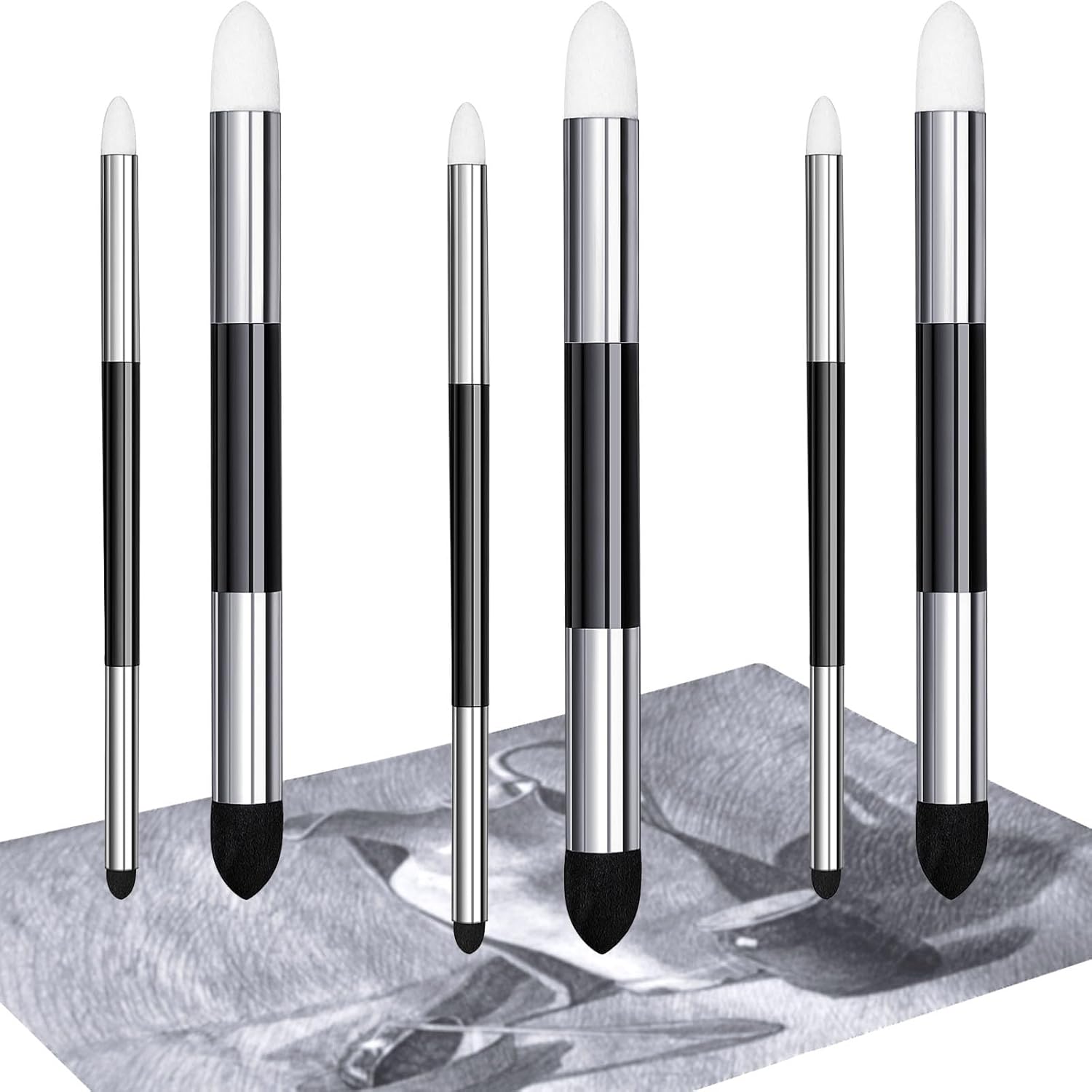
Oil pastels blend by pressure and warmth, and fingers quickly mix every color into mud. Kosiz’s six dual-tip sponge pens give you dedicated blenders: the listing suggests keeping separate tools for light, dark, warm and cool colors to reduce unwanted mixing.
Each pen has a larger tip for backgrounds and shadows and a smaller tip for details, in two overall sizes. They suit soft gradients, softening hard edges and blending layered color.
Best suited for: Oil pastel artists and mixed-media painters who want clean, controlled blends.
Key features:
- Six dual-tip blending pens
- Large and small tips on each
- Two overall sizes
- Sponge tips
Pros:
- Clean color separation
- Two tip sizes per pen
- Low price tier
Cons and limitations:
- Sponge tips wear over time
- For pastel, not wet paint
- Limited firmness
Buying consideration: Label each pen by color family with a marker on the handle so you always pick the right one.
5. salbsever Dual-Tip Sponge and Felt Blending Pens (4 pc) — Best for soft shading in sketches and pastel

salbsever’s blending pens pair a soft black sponge tip for shading and initial blending with a firmer white felt tip for detail. They come in two sizes, about 5.5 and 7.8 inches long, and are washable and reusable.
Having two textures on one tool lets you rough in soft shading and then tighten edges without switching tools, useful for charcoal studies and oil pastel work.
Best suited for: Sketchers and pastel painters who want soft and firm blending in one tool.
Key features:
- Four dual-tip pens
- Sponge and felt tips
- Two sizes
- Washable and reusable
Pros:
- Two blending textures per pen
- Reusable
- Low price tier
Cons and limitations:
- Dry media only
- Felt tip can pick up too much pigment
- Fewer pens than the Kosiz set
Buying consideration: Wipe the felt tip on scrap paper between strokes; it loads up quickly and can drag dark pigment into light areas.
6. U.S. Art Supply Alcohol Ink Blending Swabs (30 pack) — Best for blending alcohol ink and dyes

Alcohol ink moves differently from paint: it flows, re-wets with alcohol and blends on non-porous surfaces such as Yupo paper. U.S. Art Supply’s 30 foam-tipped swabs in assorted shapes and sizes are made for blending, mixing, re-wetting, lifting and drawing with alcohol ink and dyes.
Swabs give more control than tilting or blowing, letting you push ink into specific areas and lift highlights.
Best suited for: Alcohol ink artists and mixed-media painters working on non-porous surfaces.
Key features:
- 30 foam-tip swabs
- Assorted tip shapes and sizes
- For blending, mixing, re-wetting and lifting
Pros:
- Many shapes in one pack
- Good control for ink
- Low price tier
Cons and limitations:
- Specialist use
- Foam degrades with heavy use
- Not for oil or acrylic blending
Buying consideration: Dip swabs in a little isopropyl alcohol to re-wet and lift dried ink for soft highlights.
How to Blend Smoothly in Oil and Acrylic
Mix intermediate values. The smoothest blends come from mixing two or three in-between colors on the palette with a knife and laying them side by side before softening.
Blend wet into wet. In oil, colors stay workable for hours. In acrylic, work small areas, mist the surface or use a retarder or slow-drying medium.
Soften, do not scrub. Use light, crisscross strokes with a clean, soft brush along the seam, wiping the brush often.
Use the knife for texture blends. Drag one color into the next with the flat of a knife for a bold, slightly broken transition.
Keep it clean. Muddy blends usually come from dirty tools. Wipe knives and brushes between strokes.
Blending Pastel and Charcoal Underdrawings
Start with light pressure and build gradually. Use the side of a stump for broad areas and the tip for edges. Clean stumps on sandpaper often. For oil pastel, layer light to dark, then blend with a sponge pen or a little solvent on a brush.
If you paint over a charcoal underdrawing, blow or tap off excess dust and consider a light fixative so charcoal does not mix into your first paint layer.
Palette Knife Basics for Blending
Choose the right blade. A long, straight blade mixes large amounts on the palette. A trowel-shaped knife with a cranked handle keeps your knuckles out of the paint while you work on canvas. Small pointed blades handle edges and fine highlights.
Mix thoroughly. Fold the colors together, spread them flat, scrape them up and repeat until there are no streaks. Brush-mixed color often hides streaks that appear later on the canvas.
Blend on canvas with light pressure. Lay two colors next to each other, then drag the flat of the blade across the seam with a gentle, even stroke. Lift at the end of the stroke to avoid ridges.
Vary pressure for texture. Heavy pressure scrapes paint thin and shows the layer underneath; light pressure leaves thick, broken color on top. Both are useful blends.
Clean constantly. Wipe the blade on a rag after every stroke or two. A clean knife is the difference between a fresh transition and a muddy smear.
Buying Guide: How to Choose Blending Tools
Start with your medium
Each blending tool suits specific media. Palette knives cover oil and acrylic; stumps and sponges cover dry media; swabs cover ink.
Buying tools for media you do not use is the most common waste.
Steel quality for knives
Stainless steel resists rust. Flexible blades blend and spread smoothly; stiffer blades scrape and mix heavy paint.
Range of sizes
Small tools control edges and details; larger ones handle backgrounds. Sets with several sizes are more versatile.
Dedicated tools per color family
Separate blenders for light, dark, warm and cool colors keep blends clean, especially in pastel.
Ease of cleaning
Steel wipes clean; paper stumps need sanding; sponges need washing. Clean tools make clean blends.
Combine with brushes
Blending tools complement brushes rather than replace them. Most smooth blends combine knife mixing with soft brush softening.
Blending Technique Guides
For a complete walk-through of oil blending, read our guide on achieving smooth blending in oil paintings. Looking for subjects to practice gradients on? Browse our collection of artistic inspiration and creative ideas for painters.
Common Mistakes to Avoid
- Overblending until colors turn muddy
- Using dirty knives or blenders
- Using one stump for both light and dark values
- Trying to blend acrylic after it starts drying
- Blending oil pastel with bare fingers across many colors
- Skipping intermediate values on the palette
FAQs
What tools do painters use to blend?
Soft brushes, fan blenders and palette knives for oil and acrylic; stumps, tortillions and sponges for pastel and charcoal; foam swabs for alcohol ink.
Can you blend with a palette knife?
Yes. Dragging one color into another with a knife creates bold, textured blends, and knives also mix palette colors cleanly.
What is the difference between a blending stump and a tortillion?
A stump is solid compressed paper pointed at both ends; a tortillion is hollow, spirally rolled paper with one point, better for small areas.
How do I blend acrylic paint smoothly?
Work wet, in small sections, with intermediate mixed values. Use a retarder or slow-drying medium and soft brushes.
How do I blend oil pastels?
Layer colors, then blend with a sponge blender, stump or a brush with a little odorless solvent.
How do I clean blending stumps?
Rub them on fine sandpaper to remove pigment and re-sharpen the point.
Final Recommendation
For oil and acrylic painters, the CONDA palette knife set is the essential blending tool, mixing color cleanly and blending on canvas. The CllyCnny set adds scrapers for broad and textured blends, especially in abstract acrylic work.
Painters who draw charcoal underdrawings or work in pastel should add NOROCME stumps and tortillions, oil pastel artists the Kosiz or salbsever blending pens, and alcohol ink artists the U.S. Art Supply swabs. Clean tools and intermediate values are the real secret to smooth blends.




