PaintingProGuide is reader-supported. When you buy through links on this page we may earn an affiliate commission at no extra cost to you.
Choosing paintbrushes for painters is less about brand and more about shape, size and hair. A good round, a flat or two and a utility brush for rough work will carry a beginner a long way, and the right choice depends on whether you paint in acrylic, watercolor or oil.
The sets in our product data are budget and starter options rather than premium individual brushes, so this guide is built for painters starting out or adding inexpensive workhorses. We compare six options, from round pointed sets and varied starter kits to bulk flats, chip brushes and a kids’ set, and explain how to build a sensible brush collection over time.
Quick answer: For most beginners, the Phinus 20-Piece Round Pointed Set is the best foundation, with two of each size. Add the KEVIN&SASA 24-Piece Set for variety and storage, and keep Newkita chip brushes for gesso and texture.
Our Top Picks at a Glance
- Phinus 20-Piece Round Pointed Brush Set — Best for detail and general painting in acrylic and watercolor
- KEVIN&SASA CRAFTS 24-Piece Set with Canvas Case — Best for variety of shapes plus storage
- AROIC 10-Piece Paint Brush Set — Best for the lowest-cost starter set
- UPINS 30-Piece Small Flat Brushes — Best for classrooms and small flat work
- Newkita Chip Brushes (3 pack) — Best for gesso, priming and texture
- Anezus Chubby Kids Paint Brushes (10 pc) — Best for young children painting with the family
| Product | Best For | Key Spec | Key Strength | Price Tier |
|---|---|---|---|---|
| Phinus 20-Piece Round Pointed Brush Set | Detail and general painting in acrylic and watercolor | 10 sizes from 2/0 to 5/8; nylon; double crimped | Two of each size | $ |
| KEVIN&SASA CRAFTS 24-Piece Set with Canvas Case | Variety of shapes plus storage | 24 brushes; watercolor and acrylic; canvas case | Case included | $ |
| AROIC 10-Piece Paint Brush Set | The lowest-cost starter set | 10 sizes; nylon; anti-rust nickel ferrules | Lowest price tier | $ |
| UPINS 30-Piece Small Flat Brushes | Classrooms and small flat work | 30 flat brushes; 0.28 in width; short plastic handles | Bulk quantity of one useful shape | $ |
| Newkita Chip Brushes (3 pack) | Gesso, priming and texture | 3 sizes; synthetic bristles; wooden handles | Cheap utility brushes | $ |
| Anezus Chubby Kids Paint Brushes (10 pc) | Young children painting with the family | 5 round + 5 flat; chunky handles; hog bristle | Easy grip for small hands | $ |
How We Chose
These picks come from Amazon listing details and specifications checked in October 2026, how well each set’s shapes, sizes and bristles fit common painting needs, and how widely each product is reviewed by Amazon buyers. We excluded wall-painting sets designed for house trim and stain.
Our criteria:
- Shapes included and their usefulness
- Size range
- Bristle type and medium compatibility
- Ferrule construction and shedding risk
- Handle length and comfort
- Value for the price tier
Brush Shapes Explained
- Round: pointed tip; lines, details, shapes and washes depending on pressure. The most versatile brush.
- Flat: square end; bold strokes, edges, blocks of color and backgrounds.
- Bright: a short flat; controlled, thicker strokes, popular in oil and acrylic.
- Filbert: flat with a rounded end; soft edges, blending, petals and portraits.
- Fan: spread hairs; foliage, grass, texture and blending.
- Angle: slanted flat; edges, corners and curved strokes.
- Liner or rigger: long, thin hair; fine lines, branches and lettering.
- Mop: large, soft and round; watercolor washes and softening.
A practical starter collection is a small and a medium round, a medium flat, a filbert and a liner. Add others as specific needs arise.
Best Paintbrushes for Painters Reviewed
1. Phinus 20-Piece Round Pointed Brush Set — Best for detail and general painting in acrylic and watercolor

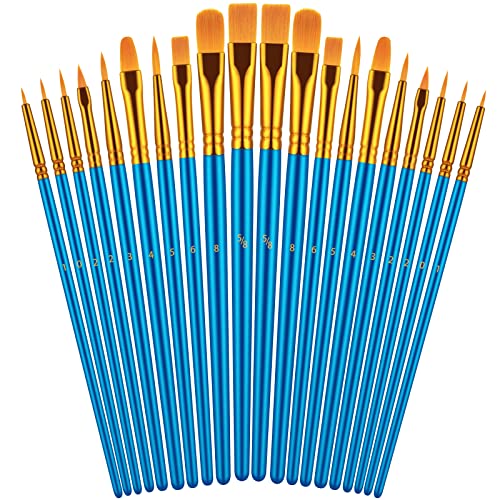
If you could own only one brush shape, the pointed round would be the one. It fills shapes, draws lines and dots details, all depending on how hard you press. Phinus’s set gives you 20 rounds in ten sizes, two of each, from 2/0 up, 6.5 to 7.5 inches long, with synthetic nylon bristles, rust-resistant nickel ferrules and double-crimped construction.
Two of each size is more useful than it sounds. Keep one set for acrylic and one for watercolor, or one for warm colors and one for cool, and your mixes stay cleaner. The listing names acrylic, watercolor, oil, miniature detailing and rock painting.
Synthetic nylon rounds are the right default for most painters today: they handle acrylic well, keep a point reasonably long and clean easily with soap and water.
Best suited for: Beginners and hobby painters in acrylic and watercolor who want a solid set of rounds for detail and general work.
Key features:
- 20 round pointed brushes
- Ten sizes, two of each
- Synthetic nylon bristles
- Rust-resistant nickel ferrules, double crimped
- 6.5 to 7.5 inch length
Pros:
- Duplicate sizes for separate media
- Pointed rounds cover most tasks
- Very low price tier
Cons and limitations:
- Rounds only, no flats
- Budget nylon wears faster than premium synthetics
- Short handles for easel work
Buying consideration: Pair these with one or two flats for backgrounds and edges; rounds alone make large flat areas slow.
2. KEVIN&SASA CRAFTS 24-Piece Set with Canvas Case — Best for variety of shapes plus storage

KEVIN&SASA CRAFTS packs 24 functional brushes for watercolor and acrylic with a canvas brush case. The listing positions it as a gift and back-to-school set, and the case keeps brushes organized and protected for travel.
Variety is the point here. A beginner can try rounds, flats, filberts and other shapes to discover which they actually use, and the case keeps the set together.
Best suited for: Beginners and gift buyers who want many shapes and a case.
Key features:
- 24 brushes in assorted shapes
- Canvas brush case
- For watercolor and acrylic
Pros:
- Many shapes to experiment with
- Storage case included
- Low price tier
Cons and limitations:
- Shape list not detailed in listing
- Gift-set quality
- Not for heavy oil work
Buying consideration: After a few weeks, note which brushes you reach for and replace those with better quality first.
3. AROIC 10-Piece Paint Brush Set — Best for the lowest-cost starter set

AROIC’s ten-piece set gives you ten multipurpose nylon brushes in various sizes and shapes with anti-rust nickel ferrules and solid wood handles. The listing names watercolor, oil, gouache and acrylic.
At this price, it is a disposable-friendly set for messy techniques, kids’ projects, rock painting or a first try at painting.
Best suited for: First-time painters and anyone needing inexpensive brushes for rough jobs.
Key features:
- Ten brushes
- Nylon bristles
- Anti-rust nickel ferrules
- Solid wood handles
Pros:
- Very low price tier
- Covers basic sizes
- Fine for rough use
Cons and limitations:
- Basic quality
- Few shape details in listing
- Not for fine detail work
Buying consideration: Use these for texture, gesso and mixed media so your better brushes stay in shape.
4. UPINS 30-Piece Small Flat Brushes — Best for classrooms and small flat work

UPINS provides 30 small flat brushes, 0.28 inch wide, with synthetic nylon hair in aluminum ferrules and short plastic handles. The listing says the bristles are securely anchored, and names watercolor, acrylic, oil, gouache and ceramics.
Small flats are excellent for clean edges, small blocks of color and lettering. Thirty of them is a classroom or party quantity, but individual painters can use them as disposable detail flats.
Best suited for: Teachers, party hosts and painters who want many small flats.
Key features:
- 30 flat brushes
- 0.28 inch width
- Synthetic nylon
- Aluminum ferrules
- Short plastic handles
Pros:
- Very low cost per brush
- Useful small flat shape
- Good for groups
Cons and limitations:
- One size only
- Plastic handles
- Short for easel painting
Buying consideration: Give each child or participant a few and keep the rest sealed; they stay fresh longer in the package.
5. Newkita Chip Brushes (3 pack) — Best for gesso, priming and texture

Every studio needs a few utility brushes that are not precious. Newkita’s three chip brushes come in three sizes with synthetic bristles and wooden handles, and the listing names stains, varnishes, acrylics and gesso.
Use them to prime canvases and panels, apply texture paste, seal the backs of boards and paint large rough underlayers in acrylic. The smallest also works for loose acrylic painting.
Best suited for: Painters who prepare their own surfaces or want rough, expressive brushes.
Key features:
- Three chip brushes
- Synthetic bristles
- Wooden handles
- Wash with soap and water
Pros:
- Extremely low price tier
- Good for gesso and texture
- Disposable
Cons and limitations:
- Coarse finish
- May shed
- Not for detailed work
Buying consideration: Keep chip brushes away from finished paintings and varnish; they are for preparation and texture.
6. Anezus Chubby Kids Paint Brushes (10 pc) — Best for young children painting with the family
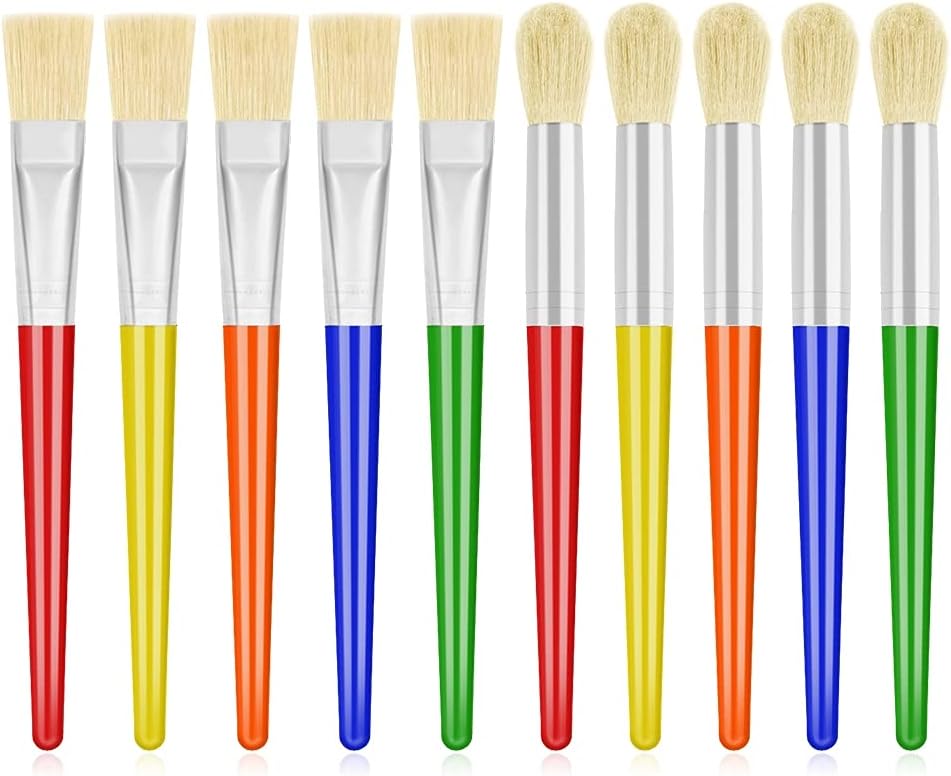
If you paint with children, giving them proper kids’ brushes keeps them from borrowing yours. Anezus’s set has five rounds and five flats with chunky, colorful handles, soft hog bristle and rust-proof ferrules, for washable paint, tempera and acrylic.
Thick handles suit small hands that grip with a fist, and the bristle stands up to pressing and scrubbing.
Best suited for: Parents and teachers painting alongside young children.
Key features:
- Ten brushes: five round, five flat
- Chunky handles
- Hog bristle
- Rust-proof ferrules
Pros:
- Sized for small hands
- Durable with thick paint
- Low price tier
Cons and limitations:
- Not for adult detail work
- Hog bristle is streaky in thin paint
- Material listing inconsistent
Buying consideration: Set these aside as the kids’ set and keep them separate from your own brushes.
Synthetic, Natural or Hog Bristle?
Synthetic (nylon, taklon): the default for acrylic and a good choice for watercolor and gouache. Durable, easy to clean and affordable.
Natural soft hair (sable, squirrel, goat): holds the most water and suits watercolor. More delicate and expensive.
Hog bristle: stiff and springy, the traditional choice for oil painting, where it moves thick paint and leaves visible brushwork.
For a mixed-media beginner, synthetic brushes are the safest all-round choice. Add hog bristle if you take up oils and natural hair if you specialize in watercolor.
Building a Brush Collection Over Time
Start with an inexpensive set to discover which shapes and sizes you use. After a month or two, replace your most-used brushes with better-quality versions. Keep old brushes for rough jobs: gesso, texture, mixed media and kids’ projects.
Clean brushes after every session, dry them flat or bristles-down and store them upright with heads up. Good care extends even budget brushes’ lives considerably.
Brush Sizes: What the Numbers Mean
Brush sizes are numbered, but there is no universal standard; a size 6 round from one maker can be noticeably larger than a size 6 from another. Sizes below zero are written as 2/0, 3/0 and so on, getting smaller as the first number rises. Flats are often sized by width in inches or millimeters.
As a rough guide for a beginner working on 9 by 12 to 16 by 20 inch surfaces:
- Detail: round size 0 to 2, liner 0 or 1
- General painting: round size 4 to 8, flat or filbert size 6 to 10
- Backgrounds and large areas: flat size 12 or larger, or a 1-inch flat
Use the largest brush that will do the job. Big brushes force you to simplify shapes, which usually improves a painting, and save detail brushes for the final touches.
When in doubt, look at the width of the hair rather than the number on the handle. Compare it with the smallest and largest marks you expect to make, and choose sizes that bridge that range.
Buying Guide: How to Choose Paintbrushes
Match brushes to your medium
Acrylic: synthetic. Watercolor: soft synthetic or natural hair. Oil: hog bristle plus a few soft synthetics. Gouache: soft synthetics.
Using the right hair type matters more than buying an expensive brand.
Cover the essential shapes
A round, a flat and a liner handle most beginner paintings. Filberts and fans are useful additions.
Resist buying every specialty shape at once; each new brush is easier to learn when you add it with a specific purpose in mind.
Choose sizes for your canvas
Larger canvases need larger brushes. A common mistake is painting a 16 by 20 inch canvas with tiny detail brushes, which leads to fussy, slow work.
Check construction
Double-crimped ferrules and securely set bristles reduce shedding. Smooth, sealed handles resist cracking.
Gently tug a few hairs on a new brush; a couple of loose hairs is normal, but a steady stream means the brush will keep shedding into your paint.
Handle length
Short handles suit tabletop and watercolor work. Long handles suit easel painting at arm’s length.
Holding a long-handled brush further back loosens your strokes, which many painters find helps them avoid overworking.
Budget wisely
Inexpensive sets are excellent for learning. Spend more on the one or two brushes you use most.
Brush Technique and Care
Learn to get the most from a round and a liner with our guides on using a liner brush for detail work and which brush size suits detailed acrylic work. Keep budget brushes performing longer by learning how to keep paint brushes from shedding.
Common Mistakes to Avoid
- Buying a huge set and using only two brushes
- Using tiny brushes on large canvases
- Letting acrylic dry in the brush
- Standing brushes on their heads in water
- Using good brushes for gesso and texture
- Mixing oil and water-based media in the same brushes
FAQs
What paintbrushes do beginners need?
A small and medium round, a medium flat, a filbert and a liner cover most beginner paintings.
Are cheap paint brush sets worth it?
Yes, for learning and for rough jobs. Replace the brushes you use most with better versions over time.
Which brushes are best for acrylic paint?
Synthetic nylon or taklon brushes. They handle acrylic well and clean easily.
What is the most versatile paint brush?
The round. Depending on pressure, it draws lines, fills shapes and adds details.
How do I make paint brushes last longer?
Clean promptly, use brush soap, reshape the tip, dry flat or bristles-down and store heads up.
Do I need different brushes for oil and acrylic?
It is best to keep them separate. Oil residue affects acrylic, and hog bristle suits oil better than acrylic.
Final Recommendation
Start with the Phinus round set as your foundation, add the KEVIN&SASA set if you want a variety of shapes and a case, and keep a couple of Newkita chip brushes for gesso and texture. AROIC’s ten-piece set is the cheapest way to begin or to stock rough-use brushes.
Teachers and party hosts should look at the UPINS bulk flats, and families painting together will appreciate the Anezus chubby brushes for small hands. As your painting develops, upgrade the brushes you reach for most.
Good painting comes from practice, not from owning every brush. A handful of well-chosen, well-cared-for brushes used every week will teach you more than a drawer full of sets you never open.