PaintingProGuide is reader-supported. When you buy through links on this page we may earn an affiliate commission at no extra cost to you.
The best first acrylic paintings are small, quick and built around one skill. A sunset teaches blending, a lemon teaches light and shadow, a row of pine trees teaches brush control. Stack enough of those small wins and you have the foundation for any subject you want to paint later. This list of easy acrylic painting ideas for beginners to try at home is organized exactly that way: each idea comes with the skill it trains and a realistic time estimate.
After the ideas, we cover a simple home setup and review seven beginner acrylic books on Amazon, including two built around dozens of small paintings, for when you want a guided path instead of picking projects yourself.
Quick answer: Start with a gradient sunset silhouette, then a single piece of fruit, then a simple mountain landscape. Those three paintings teach blending, form and depth. For a guided program, Learn to Paint in Acrylics with 50 Small Paintings is the best book for building skills through short projects, while Acrylics for the Absolute Beginner suits people who want techniques explained from the very start.
20 Easy Acrylic Painting Ideas, From First Session to Confident Beginner
| # | Idea | Skill it teaches | Time |
|---|---|---|---|
| 1 | Sunset gradient with palm silhouette | Wet blending | 45 min |
| 2 | Color mixing chart | Mixing secondaries and tints | 40 min |
| 3 | Abstract color blocks | Flat, even coverage | 30 min |
| 4 | Starry night sky | Dark backgrounds, splatter | 45 min |
| 5 | Layered mountains | Atmospheric depth | 1 hr |
| 6 | A single lemon or apple | Light, shadow, form | 1 hr |
| 7 | Simple tulips or daisies | Brush-shape strokes | 1 hr |
| 8 | Pine tree forest | Fan or flat brush control | 1 hr |
| 9 | Moon over water | Reflections | 1 hr |
| 10 | Ocean wave | Dry brushing for foam | 1.5 hr |
| 11 | Coffee mug still life | Ellipses, highlights | 1.5 hr |
| 12 | Hot air balloons | Simple shapes, pattern | 1 hr |
| 13 | Cactus in a pot | Texture with stippling | 1 hr |
| 14 | Winter birch trees | Tape resist, scraping | 1 hr |
| 15 | Cherry blossom branch | Dabbing with cotton swab or sponge | 45 min |
| 16 | Lighthouse at dusk | Straight edges, contrast | 1.5 hr |
| 17 | Seashells on sand | Neutral color mixing | 1.5 hr |
| 18 | Cat or dog silhouette at a window | Composition, negative space | 1 hr |
| 19 | Galaxy | Sponge blending, glow | 45 min |
| 20 | Small landscape with a path | Perspective, leading lines | 2 hr |
Step-by-Step: Four Starter Paintings
Sunset gradient with palm silhouette
- Paint the top third of the canvas a warm orange, the middle a yellow and the bottom a pink or red, leaving small gaps between bands.
- With a damp wide flat brush, blend each boundary in horizontal strokes while the paint is wet. Acrylic dries quickly, so work in sections.
- Let it dry fully. Paint a black ground line and a curved palm trunk with a small round brush.
- Add palm fronds with flicking strokes outward from the top of the trunk.
A single lemon
- Paint a light gray-blue background and a slightly darker table surface.
- Block in an oval of mid-yellow.
- Mix a little purple or brown into yellow for the shadow side and paint it opposite your light source.
- Add pale yellow mixed with white on the light side and a tiny white highlight.
- Paint a soft cast shadow on the table under the lemon.
Layered mountains
- Paint a sky that is lighter near the horizon.
- Mix blue, a touch of purple and lots of white for the farthest range.
- Add less white for each closer range, overlapping the one behind.
- Finish with the darkest range or a line of trees at the bottom.
Pine tree forest
- Paint a soft gradient background, such as pale blue to white.
- Mix a dark green and paint a thin vertical line for each trunk.
- Starting at the top of each line, tap the corner of a flat or fan brush outward, widening as you move down.
- Paint distant trees lighter and smaller, nearer trees darker and larger.
Want more themes? Browse our seasonal acrylic painting ideas for beginners for holiday and weather subjects, or our easy abstract acrylic ideas if you prefer shapes and color over realism.
A Four-Week Practice Plan Using These Ideas
Ideas are more useful in a sequence. If you paint three times a week, this plan moves you from your first brushstroke to a small finished landscape in a month.
- Week 1, control: color mixing chart, abstract color blocks, sunset gradient. Focus on even coverage and smooth blends.
- Week 2, form: a single lemon, a coffee mug, seashells. Focus on light direction, shadow shapes and one clean highlight.
- Week 3, brush marks: tulips, pine forest, cherry blossoms. Focus on letting the shape of the brush do the work.
- Week 4, depth: layered mountains, moon over water, landscape with a path. Focus on making distant things lighter, cooler and less detailed.
At the end of the month, lay all twelve paintings out together. You will see clear progress in the later pieces, and you will also see which subjects you enjoyed most. Follow that enjoyment for month two.
Finding Subjects Around the House
You do not need reference photos for every painting. A home is full of beginner-friendly subjects: fruit in the kitchen, a plant on the windowsill, a stack of books, a favorite mug, the view from a window at sunset. Painting from real objects trains your eye faster than copying photos because you have to judge color and light yourself. Put the object on a plain cloth, light it from one side with a lamp, and squint to simplify what you see into a few big shapes before you start.
Setting Up to Paint Acrylics at Home
- Surface: canvas panels in 8×10 or 9×12 are cheap and stable. Stretched canvas is nice for pieces you want to hang.
- Paint: a small set plus a large tube of titanium white, which you will use most.
- Brushes: a 1-inch flat, a medium flat, a small round and a liner or detail brush.
- Palette: a stay-wet palette or a damp paper towel under parchment slows drying on the palette.
- Water: two jars, one to rinse and one clean for thinning.
- Space: a covered table near a window or under a daylight-balanced lamp.
If you are short on supplies, our guide to easy acrylic painting ideas with limited supplies shows how far a few colors can go.
Our Top Picks at a Glance
- Learn to Paint in Acrylics with 50 Small Paintings — Best for learning through many short projects
- Acrylics for the Absolute Beginner — Best for complete beginners
- Easy Acrylic Painting: Beginner Tutorials for Small Still Lifes — Best for still life subjects
- Acrylic Landscapes for Beginners — Best for landscape lovers
- Lee Hammond’s Big Book of Acrylic Painting — Best for a wide range of subjects
- Acrylic Painting Step by Step — Best budget technique overview
- Compendium of Acrylic Painting Techniques — Best technique reference
| Product | Best For | Key Spec | Key Strength | Price Tier |
|---|---|---|---|---|
| Learn to Paint in Acrylics with 50 Small Paintings | Short projects | 50 small paintings | Build skills fast | $$ |
| Acrylics for the Absolute Beginner | First-timers | Absolute beginner course | Starts from zero | $$ |
| Easy Acrylic Painting: Small Still Lifes | Still life | Beginner tutorials | Small, doable subjects | $$ |
| Acrylic Landscapes for Beginners | Landscapes | Step-by-step scenes | Forests, mountains, drives | $ |
| Lee Hammond’s Big Book | Many subjects | Fast, easy techniques | Breadth | $ |
| Acrylic Painting Step by Step | Budget basics | Artist’s Library series | Lowest price tier | $ |
| Compendium of Acrylic Techniques | Reference | Technique compendium | Look-up resource | $ |
How We Chose
We reviewed Amazon listings checked in October 2026 and selected books based on what their titles and descriptions promise, how well they suit absolute and early beginners painting at home, the range of subjects they cover, and how widely each is reviewed by Amazon buyers. Book listings carry limited detail, so we describe each title only from its listing information.
- Beginner focus.
- Project-based vs reference format.
- Subject range.
- Price tier.
Best Acrylic Painting Books for Beginners Reviewed
1. Learn to Paint in Acrylics with 50 Small Paintings — Best for learning through many short projects
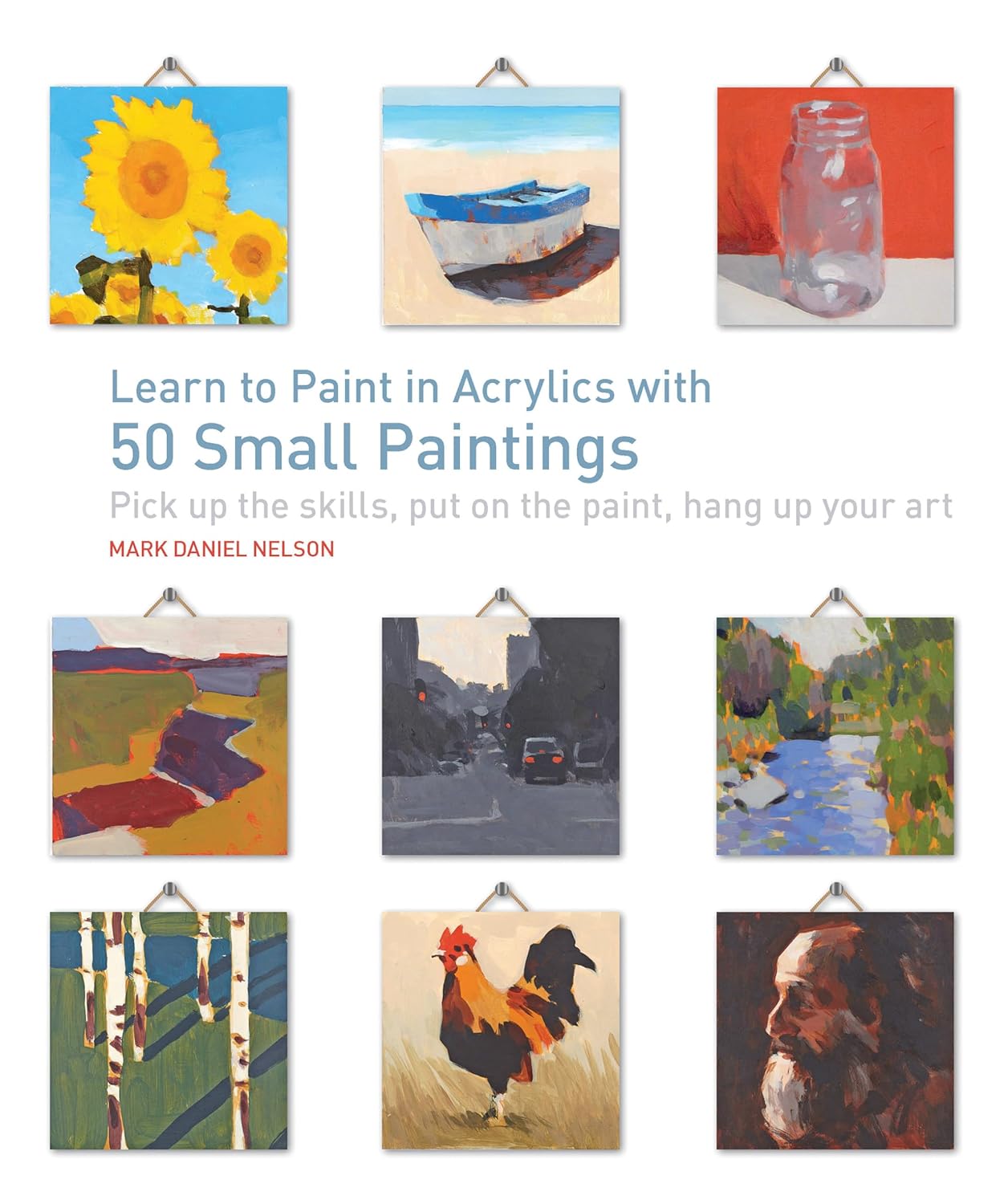
Mark Daniel Nelson’s book is built around a promise in its subtitle: pick up the skills, put on the paint, hang up your art. Fifty small paintings is the ideal structure for beginners because each project is finishable in one sitting.
Small formats mean less paint, less time and less pressure, and the volume of practice builds confidence quickly.
Best suited for: Beginners who learn by doing and want a clear sequence of projects.
Key features:
- 50 small paintings
- Skills-first progression
- Paperback
Pros:
- Finishable projects
- Lots of practice
- Mid price tier
Cons and limitations:
- Small scale may not satisfy those wanting large pieces
- Supplies sourced separately
Buying consideration: Work through the projects in order; skills build on each other.
2. Acrylics for the Absolute Beginner — Best for complete beginners

Charles Evans writes for people who have never painted. The “absolute beginner” framing suits anyone nervous about starting, with techniques explained before projects.
If you want to understand why a technique works rather than only following steps, this is a good first book.
Best suited for: People picking up a brush for the first time.
Key features:
- Absolute beginner level
- Acrylic-focused
- Paperback
Pros:
- Gentle introduction
- Mid price tier
- Clear focus
Cons and limitations:
- May feel basic for returning painters
- Fewer total projects than a 50-painting book
Buying consideration: Pair it with the color mixing chart idea above before tackling the projects.
3. Easy Acrylic Painting: Beginner Tutorials for Small Still Lifes — Best for still life subjects

Jennifer Funnell focuses on small still lifes. Still life is ideal for home painting because your subject sits on the table, under consistent light, for as long as you need.
Fruit, cups and small objects teach form and light more directly than landscapes do.
Best suited for: Beginners who want to paint from real objects at home.
Key features:
- Beginner tutorials
- Small still life subjects
- Paperback
Pros:
- Paint from life easily at home
- Teaches light and form
- Small, quick projects
Cons and limitations:
- Narrower subject range
- Upper-mid price tier for a focused book
Buying consideration: Set up a lamp from one side so light and shadow stay consistent between sessions.
4. Acrylic Landscapes for Beginners — Best for landscape lovers

Sarah Johnston’s step-by-step guide covers scenic drives, misty forests, snowy mountains and more. Landscapes are forgiving for beginners: a tree that is slightly off still looks like a tree.
The subjects listed in the title line up with several ideas on our list, including mountains and forests.
Best suited for: Beginners who want to paint nature scenes.
Key features:
- Step-by-step landscapes
- Forests, mountains, scenic drives
- Paperback
Pros:
- Forgiving subjects
- Clear steps
- Mid price tier
Cons and limitations:
- Landscape only
- Less on still life or figures
Buying consideration: Use a limited palette for the first few to keep greens and blues harmonious.
5. Lee Hammond’s Big Book of Acrylic Painting — Best for a wide range of subjects

Lee Hammond’s book promises fast, easy techniques for painting favorite subjects. A big-book format gives variety, so you can jump between flowers, animals and scenery as your interest moves.
It suits beginners who get bored with one subject.
Best suited for: Beginners who want variety in one volume.
Key features:
- Fast, easy techniques
- Wide subject range
- Paperback
Pros:
- Breadth of subjects
- Mid price tier
- Good long-term reference
Cons and limitations:
- Less structured progression
- Can feel busy for absolute beginners
Buying consideration: Pick one chapter per week to avoid jumping around too much.
6. Acrylic Painting Step by Step — Best for budget technique overview

Tom Swimm’s title in the Artist’s Library series covers the basics plus a range of special techniques for creating your own paintings. It sat in the lowest price tier in our listing check.
Concise technique books are useful when you want to understand a method like glazing or dry brushing quickly.
Best suited for: Budget-minded beginners.
Key features:
- Basics and special techniques
- Artist’s Library series
- Paperback
Pros:
- Low price tier
- Covers fundamentals
- Compact
Cons and limitations:
- Less project depth
- Smaller format series
Buying consideration: Use it alongside a project book rather than as your only resource.
7. Compendium of Acrylic Painting Techniques — Best for a technique reference

Gill Barron’s compendium is a reference rather than a course. When a project calls for scumbling, impasto or sgraffito and you are not sure what that means, a compendium answers it quickly.
It keeps its value long after you have finished beginner projects.
Best suited for: Beginners who want a reference to keep beside their palette.
Key features:
- Technique compendium
- Acrylic-specific
- Paperback
Pros:
- Long-term reference
- Low price tier
- Broad technique coverage
Cons and limitations:
- Not a step-by-step course
- Less hand-holding
Buying consideration: Pair with a project book: projects for practice, compendium for look-ups.
Buying Guide: Choosing an Acrylic Painting Book for Home Practice
Projects or reference
Project books guide you through finished paintings. Reference books explain techniques. Beginners usually need one of each.
Subject interest
Choose a landscape, still life or mixed-subject book based on what you actually want to paint.
Project size
Small paintings mean faster finishes and lower supply costs.
Explanation depth
Absolute beginners benefit from books that explain why, not only how.
Supply lists
Check the preview for required colors and brushes so you can buy once.
Preview the layout
Large step photos are easier to follow than dense text.
Common Mistakes to Avoid
- Starting too big. An 8×10 finishes in an evening; a 24×36 can stall for weeks.
- Not enough white paint. You will use far more white than any other color.
- Overworking wet areas. Acrylic gets tacky fast. Let it dry and paint another layer.
- Thinning with too much water. It weakens the paint film and causes streaks.
- Leaving brushes in water. It ruins the shape and loosens the ferrule.
- Judging the first ten paintings. Count them, do not grade them.
FAQs
What should I paint first with acrylics?
A gradient sunset with a silhouette is the classic first painting. It teaches blending and gives a satisfying result in under an hour.
What size canvas is best for beginners?
8×10 or 9×12 inches is ideal. It is big enough to practice brushwork and small enough to finish in one session.
How many colors do I need to start acrylic painting?
Red, yellow, blue, white and black can mix almost everything. Many beginners add burnt sienna or a green for convenience.
How do I stop acrylic paint drying too fast?
Use a stay-wet palette, mist the palette lightly, work in smaller sections, or add a slow-drying medium.
Can I paint acrylics at home without a studio?
Yes. A covered table, good light and two water jars are enough. Acrylics clean up with water and have little odor.
How long does acrylic paint take to dry?
Thin layers usually dry to the touch in minutes to an hour. Thick layers take longer, so check before adding the next layer.
Final Recommendation
Begin with the four starter paintings above, then work down the list of twenty ideas at your own pace. If you want a book to guide you, Learn to Paint in Acrylics with 50 Small Paintings gives the most practice per page, and Acrylics for the Absolute Beginner is the gentlest start. Choose Easy Acrylic Painting for still lifes or Acrylic Landscapes for Beginners if nature scenes are what you want to paint, and keep the Compendium of Acrylic Painting Techniques nearby for look-ups as your skills grow.