
PaintingProGuide is reader-supported. When you buy through links on this page we may earn an affiliate commission at no extra cost to you.
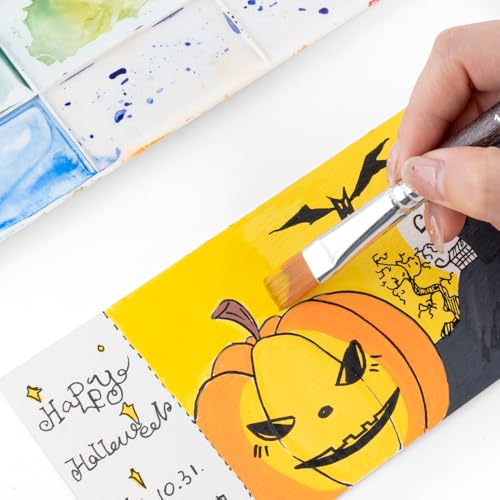
Streaks in a background usually come from the brush, not the painter. A flat brush with stiff, uneven bristles leaves ridges; a soft, dense, well-shaped flat lays paint down in a smooth sheet. The best flat brush for smooth painting has synthetic bristles fine enough to level the paint, a crisp chisel edge for clean lines, and enough width to cover an area in a few strokes so the paint stays wet while you work.
This guide compares six flat and wide flat brushes for canvases, panels and craft surfaces, from a five-size artist set to wide paddle brushes for backgrounds, varnish and gesso. House-painting brushes were left out; they are designed for walls and trim rather than artwork.
Quick answer: For smooth artwork on canvas and panels, the GACDR 5-piece Flat Paint Brush Set is the best all-round pick, with sizes from 1/4 inch to 1-1/2 inches in synthetic nylon. For smooth basecoats on crafts and decor, FolkArt’s 1-1/2 inch gold taklon flats are a focused choice, and the Fuumuui 4-piece paddle set (1 to 4 inches) is best for large, even backgrounds and varnish.
Our Top Picks at a Glance
- GACDR Flat Paint Brushes Set (5 Pcs) — Best for smooth artwork across canvas sizes
- FolkArt Gold Taklon Flat Brush (1-1/2″, 2 Pack) — Best for smooth basecoats on crafts and decor
- Fuumuui 4pcs Flat Paddle Paint Brush Set — Best for large backgrounds and varnish
- Bates Flat Paddle Paint Brush Set (3 Pack) — Best for budget wide flats
- PHOENIX Flat Paint Brush Set (3 Sizes) — Best for gesso, texture and durable everyday use
- Alrhso 3Pcs Wide Flat Acrylic Paint Brushes — Best for large-format acrylic and varnish
| Product | Best For | Key Spec | Key Strength | Price Tier |
|---|---|---|---|---|
| GACDR Flat Paint Brushes Set (5 Pcs) | smooth artwork across canvas sizes | 1/4″, 3/8″, 1/2″, 1″, 1-1/2″ synthetic nylon | Artist sizes from edges to backgrounds | $ |
| FolkArt Gold Taklon Flat Brush (1-1/2″, 2 Pack) | smooth basecoats on crafts and decor | 2 x 1-1/2″ gold taklon flats | Soft taklon for even basecoats | $ |
| Fuumuui 4pcs Flat Paddle Paint Brush Set | large backgrounds and varnish | 1″, 2″, 3″, 4″ soft synthetic paddles | Wide coverage with soft bristles | $$ |
| Bates Flat Paddle Paint Brush Set (3 Pack) | budget wide flats | 1″, 2″, 3″ nylon paddle brushes | Low-cost wide coverage | $ |
| PHOENIX Flat Paint Brush Set (3 Sizes) | gesso, texture and durable everyday use | 1″, 2″, 3″ high-density nylon | Firm, chemical-resistant bristles | $ |
| Alrhso 3Pcs Wide Flat Acrylic Paint Brushes | large-format acrylic and varnish | 3 large nylon flats, wooden handles | Big brushes at a modest tier | $ |
How We Chose
We did not paint with these brushes. Picks are based on the Amazon listing details and specifications checked in October 2026, how well each brush’s bristle type, width range and handle fit smooth, streak-free painting on art surfaces, and how widely each product is reviewed by Amazon buyers. Criteria:
- Bristle type: soft synthetic nylon or taklon for smooth, even application.
- Width range: narrow flats for edges and wide flats for backgrounds.
- Edge quality: chisel or tapered edges that cut clean lines.
- Construction: crimped ferrules and secure bristles.
- Intended use: artist and craft brushes rather than house-painting tools.
Best Flat Brushes for Smooth Painting Reviewed
1. GACDR Flat Paint Brushes Set (5 Pcs) — Best for smooth artwork across canvas sizes

GACDR’s set spans five practical widths: 1/4, 3/8, 1/2, 1 and 1-1/2 inches. That range takes you from crisp edges and small shapes up to quick background coverage on a medium canvas, without switching to hardware-store brushes.
The listing describes synthetic nylon bristles with good paint pickup, smooth release and precise edge control, on birch wood handles. It lists acrylic, oil, watercolor, gouache, tempera and craft paints on canvas, wood and other surfaces.
Best suited for: Acrylic and oil painters who want a set of artist flats for smooth backgrounds, blocks of color and clean edges.
Key features:
- 5 flat brushes from 1/4 to 1-1/2 inches
- Synthetic nylon bristles
- Birch wood handles
- Multi-medium use
Pros:
- Most useful size spread for artwork
- Edge control for clean lines
- Works with several media
Cons/limitations:
- Largest size is 1-1/2 inches, small for big canvases
- Listing gives limited detail on bristle softness
Buying consideration: For very large canvases, add one wide paddle brush for the initial background coat.
2. FolkArt Gold Taklon Flat Brush (1-1/2″, 2 Pack) — Best for smooth basecoats on crafts and decor

FolkArt is a familiar craft brand, and this two-pack of 1-1/2 inch flats is made for one job: smooth, solid basecoats. The listing highlights gold taklon bristles for smooth, even brushstrokes.
Taklon is a fine, soft synthetic fiber that releases acrylic paint smoothly and leaves fewer brush marks than stiffer bristles. Two identical brushes mean you can keep one for light colors and one for dark, or one for paint and one for sealer.
Best suited for: Crafters basecoating wood signs, furniture accents, plaques, ornaments and canvases with acrylic.
Key features:
- Two 1-1/2 inch flat brushes
- Gold taklon bristles
- Designed for basecoating
- Soap-and-water cleanup
Pros:
- Soft fibers for smooth coats
- Trusted craft brand
- Duplicate brushes for different colors
Cons/limitations:
- Single size only
- Not suited to fine edges or details
Buying consideration: Reshape the bristles with your fingers after washing so they dry with a straight edge.
3. Fuumuui 4pcs Flat Paddle Paint Brush Set — Best for large backgrounds and varnish

Large canvases need wide brushes to avoid patchy backgrounds. Fuumuui’s set offers paddle brushes from 1 to 4 inches with soft synthetic bristles, double-crimped stainless steel ferrules and short birch handles, according to the listing.
The listing describes good load capacity and smooth paint flow, and suggests turning the brush on its edge for sharp, straight lines. Wide paddles are also ideal for applying gesso and varnish evenly.
Best suited for: Painters working on large canvases or murals, and anyone applying gesso or varnish.
Key features:
- 4 paddle brushes: 1, 2, 3 and 4 inches
- Soft synthetic bristles
- Double-crimped stainless steel ferrules
- Short ergonomic birch handles
Pros:
- Covers large areas quickly and evenly
- Soft bristles reduce streaks
- Useful for gesso and varnish
Cons/limitations:
- Too wide for small paintings
- Higher price tier than other sets here
Buying consideration: Keep one paddle dedicated to varnish so pigment residue never tints your final coat.
4. Bates Flat Paddle Paint Brush Set (3 Pack) — Best for budget wide flats

Bates offers three paddle brushes at 1, 2 and 3 inches with nylon bristles and ergonomic short handles. The product highlight mentions oil and acrylic paints and varnishes, which places it closer to artist use than the house-painting brushes we excluded.
The listing describes smooth, even paint application. At the lowest price tier in this guide, it is a sensible way to add wide brushes for backgrounds, gesso and glazes without much outlay.
Best suited for: Budget-minded painters who need wide brushes for backgrounds, gesso and varnish.
Key features:
- 3 paddle brushes: 1, 2 and 3 inches
- Nylon bristles
- Short ergonomic handles
- For paints, stains and varnishes
Pros:
- Lowest price tier
- Wide sizes for fast coverage
- Comfortable grip
Cons/limitations:
- Listing does not specify bristle softness
- General-purpose positioning
Buying consideration: Test on a scrap canvas; if bristles feel stiff, use them for gesso and save softer brushes for final coats.
5. PHOENIX Flat Paint Brush Set (3 Sizes) — Best for gesso, texture and durable everyday use

PHOENIX’s three flats (1, 2 and 3 inches) use high-density nylon fibers that the listing describes as stiff enough for control with good flexibility. Tapered edges help cut crisp lines, and the firm bristles are said to suit textured effects.
The listing highlights resistance to thick mediums and harsh materials, and lists acrylics, oils, gesso and varnish. Firmer brushes are not the smoothest for final coats, but they are excellent for gesso and robust everyday work.
Best suited for: Painters who want sturdy wide flats for gesso, texture and thick mediums.
Key features:
- 3 flat brushes: 1, 2 and 3 inches
- High-density nylon bristles
- Tapered edges
- For acrylic, oil, gesso and varnish
Pros:
- Durable with thick mediums
- Crisp edges
- Easy to clean
Cons/limitations:
- Firmer bristles may leave more texture in final coats
- Not as soft as taklon
Buying consideration: Use these for gesso and underpainting, then switch to a softer flat for the smoothest final layer.
6. Alrhso 3Pcs Wide Flat Acrylic Paint Brushes — Best for large-format acrylic and varnish

Alrhso’s set offers three large flat brushes with nylon bristles and sturdy wooden handles. The listing positions them for acrylic painting, watercolor, oil, gesso, varnish and craft projects.
Exact widths are not specified in the listing, which makes it harder to compare against the others, but the brushes are described as large and wide. They are a reasonable option for painters who want long-handled wide flats rather than short paddles.
Best suited for: Painters who want large, long-handled flats for big acrylic areas and varnish.
Key features:
- 3 large flat brushes
- Nylon bristles
- Wooden handles
- For acrylic, oil, watercolor, gesso and varnish
Pros:
- Wide brushes for big areas
- Multi-medium use
- Lightweight handles
Cons/limitations:
- Widths not listed
- Limited construction details
Buying consideration: Check the product photos and questions on the listing to confirm widths before buying.
How to Paint Smooth, Streak-Free Coats With a Flat Brush
- Use the right consistency. Acrylic should flow like cream. Add a few drops of water or a flow medium; for oils, a little medium.
- Load evenly. Dip about half the bristle length and wipe one side on the palette so paint sits evenly across the brush.
- Use the biggest practical brush. Fewer strokes mean fewer ridges and less drying between passes.
- Work in one direction, then cross-hatch lightly. Lay paint in one direction, then lightly brush at 90 degrees, and finish with very light strokes in the original direction.
- Keep a wet edge. Work in sections and overlap while paint is still wet.
- Apply two thin coats. Thin coats level better than one thick one.
- Do not overwork. Once acrylic starts to set, stop and let it dry before the next coat.
Which Flat for Which Job?
| Job | Suggested width | Bristle |
|---|---|---|
| Canvas backgrounds up to 16×20 | 1 to 1-1/2 inch | Soft synthetic |
| Large canvases and murals | 2 to 4 inch paddle | Soft synthetic |
| Craft basecoats on wood | 1 to 1-1/2 inch | Taklon |
| Gesso and primer | 1 to 3 inch | Firm nylon |
| Varnish | 2 to 3 inch | Soft synthetic, dedicated brush |
| Edges and small shapes | 1/4 to 1/2 inch | Soft or medium synthetic |
Buying Guide: How to Choose a Flat Brush for Smooth Painting
Bristle type
Soft synthetics like taklon leave the fewest brush marks. Firmer nylon handles thick paint and gesso. Natural hog bristle is best for textured oil work, not smooth finishes.
Width
Match width to area: 1/4 to 1/2 inch for edges and small shapes, 1 to 1-1/2 inches for medium areas, and 2 to 4 inches for backgrounds and varnish.
Flat vs bright vs paddle
Flats have longer bristles that hold more paint; brights are shorter and stiffer for control; paddles are very wide flats for coverage.
Edge
A sharp chisel edge lets you cut in clean lines without tape. Check that bristles line up evenly.
Ferrule and shedding
Double-crimped ferrules and good adhesive keep bristles from shedding into a smooth coat.
Handle length
Long handles suit easel work at a distance; short handles give control on a tabletop.
For a size-by-size breakdown of smaller brushes, see what size brush to use for detail acrylic work.
Flat Brush Techniques Beyond Backgrounds
- Chisel-edge lines: turn the brush on its thin edge and pull for crisp horizon lines, window frames and architecture.
- Color blocking: lay flat shapes of color side by side for modern, graphic paintings.
- Gradients: paint two colors next to each other, then blend the boundary with long horizontal strokes of a clean, slightly damp flat.
- Dry brushing: wipe most paint off and skim the surface for wood grain, grass and weathered textures.
- Double loading: dip each corner in a different color and stroke for petals and ribbons that shade themselves.
Cleaning and Caring for Flat Brushes
A flat brush is only as smooth as its edge. Rinse acrylic out before it dries, especially near the ferrule, then wash with mild soap and lukewarm water until the water runs clear. Press the bristles between paper towels to restore the flat shape and dry the brush lying flat or bristles up. For oils, wipe excess paint, rinse in solvent or a solvent-free brush cleaner, then wash with soap. Never leave flats standing on their bristles in a water jar; a bent edge rarely recovers.
Keep Learning
Flats handle the big shapes; finer brushes handle the rest. When you are ready to add branches, grass or lettering on top of a smooth background, our tutorial on using a liner brush for detail work picks up where this guide leaves off.
Common Mistakes to Avoid
- Using house-painting brushes on artwork. They are made for walls and often leave coarse marks.
- Painting with paint that is too thick. Thick paint drags and shows ridges.
- Going back over half-dry acrylic. It lifts and creates texture.
- Using a small brush for a big area. More strokes mean more streaks.
- Letting paint dry near the ferrule. It splays the bristles and ruins the edge.
- Varnishing with a dirty brush. Pigment residue can tint the varnish.
FAQs
What brush gives the smoothest finish with acrylic?
A soft synthetic flat, such as a taklon brush, used with fluid paint in thin coats gives the smoothest finish.
Why does my flat brush leave streaks?
Common causes are paint that is too thick, a brush that is too small or stiff, overworking drying paint, and uneven loading.
What size flat brush should I buy?
A set from about 1/4 inch to 1-1/2 inches covers most canvases. Add a 2 to 3 inch paddle for large backgrounds.
Can I use a flat brush for varnish?
Yes. A wide, soft flat or paddle brush is ideal for varnish. Keep it dedicated to varnish so it stays clean.
What is the difference between a flat and a bright brush?
Flats have longer bristles that hold more paint and make long strokes; brights have shorter bristles for more control and texture.
Is taklon good for acrylic paint?
Yes. Taklon is a soft synthetic fiber that works very well with acrylics and leaves smooth strokes.
Final Recommendation
Choose the GACDR five-piece set for the best all-round range of artist flats. Pick FolkArt’s taklon flats for the smoothest craft basecoats, Fuumuui’s paddles for large backgrounds and varnish, and Bates for budget wide brushes. PHOENIX’s firmer flats are best kept for gesso and texture, and Alrhso’s large flats suit painters who prefer long handles for big areas.
If you can only buy one thing today, make it a soft synthetic flat around 1 inch wide. It handles most backgrounds on small and medium canvases, cuts clean edges with its chisel, and teaches the loading and stroke habits that make every other flat brush easier to use.



One Comment