PaintingProGuide is reader-supported. When you buy through links on this page we may earn an affiliate commission at no extra cost to you.
Fine lines, eye highlights, lettering, whiskers and the last crisp edge on a petal all come down to one thing: a brush tip that holds a point and releases paint slowly. The best paint brushes for detail work are short-to-medium synthetic rounds and liners in the 3/0 to 1 range, with a firm enough belly to carry paint and a tip that snaps back after every stroke. Size matters less than shape retention, which is why a small set covering several tip profiles usually beats one expensive brush.
Quick answer: For most painters, the JusArt 12 PCS Miniature Paint Brushes are the most complete starting point, running from an ultra-fine 10/0 up to size 8 so you can block in and then refine with the same set. If you want liners and rounds in matching sizes, the PANDAFLY 15-piece Detail Set adds flats, an angular and a filbert. If you burn through tiny brushes quickly on models or rock painting, the Anezus 30-piece pack gives you ten each of #0, #00 and #000.
This guide explains what makes a detail brush work, which tip shapes to own, and how six affordable sets compare for acrylic, watercolor, gouache, oil and miniature painting.
Our Top Picks at a Glance
- JusArt Miniature Paint Brushes, 12 PCS — Best overall size range for detail painting
- PANDAFLY Detail Paint Brushes Set, 15 pcs — Best for mixed tip shapes (liners, rounds, flats, angles)
- Golden Maple Detail Paint Brushes Set, 10 pcs — Best for stepping from fine detail to small fills
- Anezus Tiny Detail Paint Brushes, 30 pcs — Best multi-pack of the three tiniest sizes
- Phinus 60PCS Detail Paint Brushes — Best bulk supply for classes and heavy hobby use
- YFLLN 6Pcs Miniature Paint Brushes Set — Best minimal kit for occasional detail work
| Product | Best For | Key Spec | Key Strength | Price Tier |
|---|---|---|---|---|
| JusArt 12 PCS | All-round detail work | 10/0 to 8, triangular handles | Widest size span | $ |
| PANDAFLY 15 pcs | Line and edge variety | Liners and rounds 4/0 to 1, plus flats, angular, filbert | Matched liner and round sizes | $ |
| Golden Maple 10 pcs | Fine to small fills | 5/0 to 8, birch handles, tubes | Even size progression | $$ |
| Anezus 30 pcs | Tiny sizes in volume | #0, #00, #000, ten of each | Spares when tips wear | $ |
| Phinus 60 pcs | Groups and workshops | #0, #00, #000, plastic handles | Highest brush count | $ |
| YFLLN 6 pcs | Light occasional use | Rounds 5/0 to 4, Angle 2 | Small, focused set | $ |
How We Chose
We have not painted with these specific sets. The picks are based on the Amazon listing details and specifications checked in October 2026, how well each set’s sizes and tip shapes fit genuine detail painting, and how widely each product is reviewed by Amazon buyers. Where a listing makes a broad claim, we only repeat the concrete parts: sizes, hair type, ferrule and handle material, and included accessories.
What we looked for:
- Size coverage in the fine range: at least two sizes below 0 (2/0, 3/0, 5/0 or smaller) so you can scale lines to the subject.
- Tip profiles: liners for long lines, short rounds for dots and controlled marks, and an angle or flat for crisp edges.
- Synthetic nylon hair: springy, easy to clean, and workable in acrylic, watercolor, gouache and oil.
- Grip: triangular or ergonomic handles reduce rolling and help steady the hand on tiny marks.
- Tip protection: protective tubes or caps, because a bent point ruins a detail brush faster than anything else.
- Count against use: fine tips wear out; multi-packs make sense for model painters and classes.
Best Paint Brushes for Detail Work Reviewed
1. JusArt Miniature Paint Brushes, 12 PCS — Best for all-round detail painting

JusArt spans an unusually wide range for a detail set: 10/0, 5/0, 3/0, 2/0, 0, 1, 2, 3, 4, 5, 6 and 8. That matters because detail work is rarely one size. You might lay a base color on an eye with a 2, model the iris with a 0, and place the catchlight with a 5/0 or 10/0. Having every step in one matched set keeps the handling consistent as you move down in size.
The listing describes synthetic nylon bristles that are soft and springy, with handcrafted wooden triangular handles. A triangular handle does not roll in the fingers, which is a real advantage when you are pulling a hairline across a canvas and any twist shifts the tip. The listing names acrylic, oil, watercolor, gouache, enamel and tempera as compatible media.
Best suited for: Painters who want one set for portraits, botanicals, small figures and finishing touches on larger paintings.
Key features:
- 12 brushes: 10/0, 5/0, 3/0, 2/0, 0, 1, 2, 3, 4, 5, 6, 8
- Synthetic nylon bristles
- Triangular wooden handles
- Listed for acrylic, oil, watercolor, gouache, enamel, tempera
Pros:
- Widest size span among these picks
- Includes a true micro tip (10/0)
- Anti-roll grip
- Enough mid sizes to block in small areas
Cons and limitations:
- 10/0 holds very little paint, so it suits dots and highlights more than lines
- Mostly round tips; no dedicated long liner called out
- Synthetic hair will not mimic sable spring exactly
Buying consideration: Treat the 10/0 and 5/0 as finishing tools and use the 0 to 2 range for most of the work. Microscopic brushes are hard to reload often, so thin your paint slightly and keep the stroke short.
2. PANDAFLY Detail Paint Brushes Set, 15 pcs — Best for mixed tip shapes

Most cheap detail sets are all rounds. PANDAFLY splits its 15 brushes into liners in 4/0, 3/0, 2/0, 0 and 1, rounds in the same five sizes, flats in 0 and 1, plus an angular 1, a filbert 1 and an angled spot 0. Pairing a liner and a round at each size is genuinely useful: the round makes controlled marks and dots, while the longer liner hair holds more paint for continuous lines such as branches, rigging or signatures.
The listing calls out soft synthetic nylon bristles, chrome-plated copper ferrules, triangular wooden handles and protective tubes for storing the tips. The small flats and angular brush are handy for crisp edges on lettering, architecture and sharp shadow shapes, which a round cannot do as cleanly.
Best suited for: Painters who switch between lines, dots and hard edges, including sign-style lettering, miniatures and botanical illustration.
Key features:
- 15 brushes: 5 liners, 5 rounds (4/0 to 1), 2 flats, angular, filbert, angled spot
- Synthetic nylon hair
- Chrome-plated copper ferrules
- Protective tip tubes
Pros:
- Liner and round in matching sizes
- Includes edge tools (flat, angle)
- Tubes protect the points between sessions
- Good teaching set for learning which shape does what
Cons and limitations:
- Smallest size stops at 4/0
- Largest brushes are small, so you still need separate brushes for backgrounds
- Listing lists face and nail use too, so it is a general-purpose rather than fine-art-specific set
Buying consideration: If you want to learn liner technique specifically, this is the set to practice with because it gives you liners in five sizes rather than one.
3. Golden Maple Detail Paint Brushes Set, 10 pcs — Best for fine detail through small fills

Golden Maple runs 5/0, 3/0, 2/0, 0, 1, 2, 3, 4, 6 and 8, a smooth ladder from fine lines up to small fills. The listing describes birch wood handles in an easy-grip triangular shape, nylon hair, and protective tubes to keep the tips in shape after cleaning.
This is a good middle path between the extremes. It does not chase micro sizes like 10/0, but it covers the range where most detail painting actually happens on canvas and paper. The 6 and 8 are useful for laying in small shapes before you go back with the 0 and 2/0 to refine edges.
Best suited for: Acrylic and watercolor painters who want a tidy, evenly spaced set that covers detail and small passages.
Key features:
- 10 brushes: 5/0, 3/0, 2/0, 0, 1, 2, 3, 4, 6, 8
- Nylon hair
- Triangular birch handles
- Protective tubes included
Pros:
- Even size progression
- Tubes for storage
- Comfortable grip shape
- Covers small fills as well as lines
Cons and limitations:
- No flats, angles or long liners
- Finest tip is 5/0, not smaller
- Sits at the upper end of this group for a 10-piece set
Buying consideration: Buy this if you want one round in each useful size without duplicates. Pair it with a single liner if you paint long lines often.
4. Anezus Tiny Detail Paint Brushes, 30 pcs — Best for tiny sizes in volume
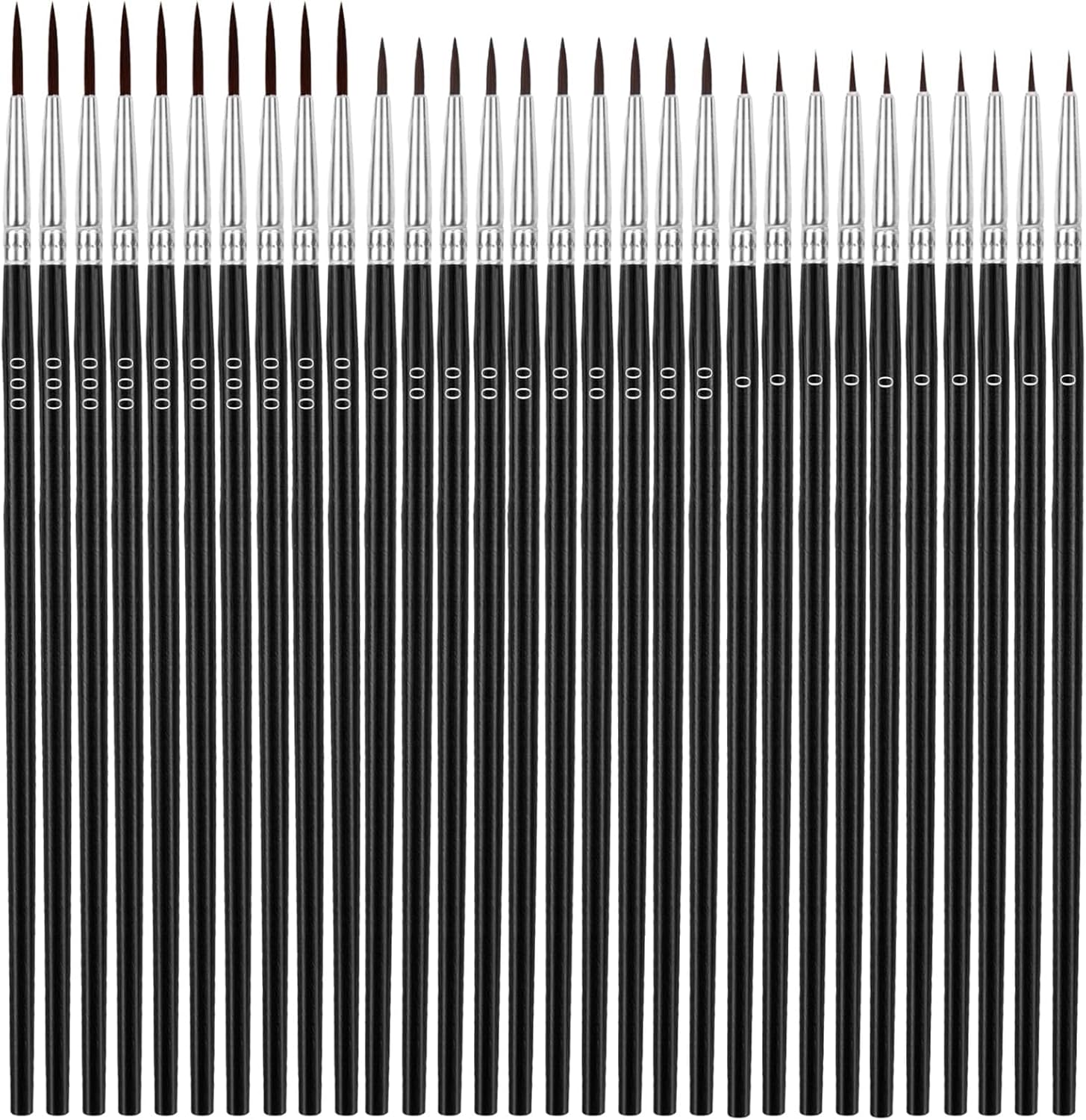
Anezus takes a different approach: thirty brushes in only three sizes, #0, #00 and #000. The listing gives hair lengths of roughly 0.23 inch for the #0, 0.5 inch for the #00 and 0.6 inch for the #000, which means the smaller numbers here are actually longer, liner-like tips. That makes the #000 useful for fine continuous lines rather than just dots.
The listing describes anti-shedding synthetic hair, anti-rust nickel ferrules and wooden handles, and says the brushes clean with soap and water and reshape with your fingers. With ten of each size you can retire a brush as soon as the tip splays, which is the main reason detail work starts to look fuzzy.
Best suited for: Miniature and model painters, rock painters and anyone who wears out fine tips quickly.
Key features:
- 30 brushes: 10 each of #0, #00, #000
- Approx. hair lengths 0.23 in, 0.5 in, 0.6 in
- Synthetic anti-shedding hair
- Nickel ferrules, wooden handles
Pros:
- Lots of spares in the most-used fine sizes
- Longer hair on #00 and #000 suits lines
- Easy soap-and-water cleanup
- Good for shared or class use
Cons and limitations:
- Only three sizes, so no small fill brushes
- Round handles, not triangular
- Hair length naming can confuse buyers expecting shorter tips
Buying consideration: Keep one brush of each size as your “good” brush and use the rest for metallics, masking fluid or rough jobs that would ruin a fine tip.
5. Phinus 60PCS Detail Paint Brushes — Best for bulk supply for groups

Phinus offers sixty fine-tip brushes in #0, #00 and #000, with bristle lengths the listing gives as 0.23 to 0.6 inch, synthetic bristles described as non-shedding, and sturdy plastic handles. The handle colors (black, blue and red per the listing details) make it quick to sort sizes on a shared table.
For an individual painter, sixty brushes is more than you need. For a classroom, a paint-and-sip night, a model club or a family that paints rocks together, it removes the worry about someone ruining a brush. Plastic handles also tolerate being left in a water jar better than unsealed wood, though no handle likes soaking.
Best suited for: Art teachers, workshop hosts and hobby groups who need many matching detail brushes.
Key features:
- 60 brushes in #0, #00, #000
- Bristle length approx. 0.23 to 0.6 in
- Synthetic bristles listed as non-shedding
- Plastic handles in multiple colors
Pros:
- Highest count per pack
- Color-coded handles help sort sizes
- Good for messy or shared use
- Soap-and-water cleanup
Cons and limitations:
- Only three sizes
- Plastic handles feel lighter and less balanced than wood
- Price listed at more than one level on the check date, so compare before buying
Buying consideration: If you are buying for a group, plan on roughly three to five brushes per person and keep the rest in reserve for the next session.
6. YFLLN 6Pcs Miniature Paint Brushes Set — Best for occasional detail work

YFLLN keeps things small: rounds in 5/0, 3/0, 0, 2 and 4, plus an angle 2. The listing describes an extra-fine tip, triangular wooden handles and protective tubes, and says to clean with warm soapy water and reshape the tip after painting.
Six brushes are enough for someone who mostly paints with larger brushes and only needs a few fine tools for signatures, highlights and tidy edges. The angle 2 is a nice inclusion because it cuts crisp corners and edges that a round tends to soften.
Best suited for: Painters who need a compact finishing kit to sit beside their main brushes.
Key features:
- 6 brushes: rounds 5/0, 3/0, 0, 2, 4 and angle 2
- Fine point synthetic bristles
- Triangular wooden handles
- Protective tubes
Pros:
- Low commitment
- Includes an angled brush for edges
- Compact and easy to store
- Tubes protect tips
Cons and limitations:
- No liners
- Gaps between sizes
- Too few brushes for model painters who wear tips quickly
Buying consideration: Choose this as a top-up rather than your only detail set. It fills the fine end of a standard brush collection without duplicating sizes you already have.
Buying Guide: How to Choose Paint Brushes for Detail Work
Learn what the numbers mean
Brush sizes below 0 are written as 2/0, 3/0, 5/0 and so on, or as 00, 000. Higher numbers before the slash mean a smaller brush. Sizing is not standardized between brands, so a 0 from one maker can be noticeably larger than another’s. Look for listed hair lengths where they exist, as Anezus and Phinus provide, rather than assuming.
Choose shapes for the marks you make
Rounds are the workhorse: they dot, dab and pull short lines. Liners and riggers have longer hair that holds a reservoir of thinned paint for long, even lines such as grass, hair, rigging and lettering. Small flats and angles are for crisp edges and corners. A short spotter-style round gives the most control for dots and eye highlights.
Look for a tip that returns to a point
The single most important quality is snap. A good detail brush, loaded and then lifted, should come back to a single point rather than splitting. Synthetic nylon is the common choice at this price because it springs back well and tolerates acrylic, which is hard on natural hair.
Match the hair to your medium
For acrylic and gouache, a firm synthetic works well. Watercolor benefits from a brush that holds more water, so a longer liner or a round with more belly helps. For oil, synthetic detail brushes are fine as long as you clean them thoroughly with an appropriate solvent or oil, then soap and water.
Think about handle and grip
Detail painting is slow and precise. Triangular handles stop the brush rolling, and a slightly thicker handle can reduce cramping during long sessions. Shorter handles suit close work at a desk; long handles are made for standing at an easel.
Buy for wear, not just for range
Fine tips wear out. Paint dries in the ferrule, tips curl, and hairs splay. If you paint miniatures or detailed acrylic work daily, multi-packs like Anezus or Phinus are not wasteful; they mean you always have a fresh point ready.
Check for tip protection
Tubes or caps keep tips aligned during storage and travel. Never jam a damp brush tip-first into a cup, and never store detail brushes standing on their hair.
Learn the Technique Behind the Tools
A good brush only gets you halfway. If long, even lines are your goal, our guide on how to use a liner brush for detail work covers paint consistency, loading and arm movement. Unsure where to start on size? See what size brush to use for detail acrylic work. And if your fine brushes keep losing hairs, read how to keep paint brushes from shedding before you replace them.
Common Mistakes to Avoid
- Using paint that is too thick. Detail lines need paint thinned to an ink-like or cream consistency, or the tip drags and breaks.
- Choosing the smallest brush for everything. A 10/0 holds almost no paint. Use a 0 or 1 with a good point for most lines and save micro sizes for the final marks.
- Letting acrylic dry in the ferrule. Rinse often during a session; dried paint near the ferrule spreads the hair permanently.
- Leaving brushes standing in water. It bends tips and loosens the glue inside the ferrule.
- Skipping reshaping. After washing, roll the tip to a point with your fingers and let it dry flat or tip-up.
- Using your best detail brush for masking fluid or metallics. Keep a sacrificial brush for those jobs.
- Painting without support. Rest your painting hand on a mahl stick, a bridge or your other hand to steady fine strokes.
FAQs
What size brush is best for fine detail?
For most detail on canvas or paper, a round or liner in size 0 to 2/0 does the bulk of the work. Sizes like 5/0 and 10/0 are for the final dots and highlights. Because sizing varies between brands, compare listed hair lengths where possible.
Are liner brushes the same as detail brushes?
A liner is a type of detail brush with longer hair that holds more paint, which makes it better for long, continuous lines. Short rounds and spotters are better for dots, small marks and tight control.
Can I use the same detail brushes for acrylic and watercolor?
Yes, synthetic detail brushes work in both. Clean them thoroughly between media, and remember that watercolor generally benefits from a brush that holds more water, such as a liner with a longer belly.
Why does my detail brush lose its point?
The usual causes are dried paint in the ferrule, storing the brush on its tip, harsh scrubbing, or simply wear. Rinse often, reshape after cleaning and replace fine brushes once the tip splits.
Are cheap detail brush sets good enough?
For many painters, yes. Synthetic sets are inexpensive enough to replace when the tips wear, which is why multi-packs are popular with miniature painters. Look for protective tubes and a sensible size spread rather than a high brush count alone.
How do I paint thin, steady lines?
Thin the paint, load the brush fully, and move from the elbow or shoulder rather than the fingers. Rest your hand on a support, keep the brush close to perpendicular for very fine lines, and practice the stroke on scrap first.
Final Recommendation
If you want one set for most detail work, the JusArt 12-piece set gives you the broadest size span, from micro tips for highlights to small fill sizes. If lines and edges matter as much as dots, PANDAFLY’s mix of liners, rounds, flats and an angle is the better teaching set. Golden Maple suits painters who prefer one clean round in each step.
Model and miniature painters, or anyone who wears out tiny tips, will get more from the Anezus 30-pack, while groups and classrooms should look at the Phinus 60-pack. The YFLLN six-piece set is a sensible add-on if you only need a handful of fine brushes alongside your main collection.