

PaintingProGuide is reader-supported. When you buy through links on this page we may earn an affiliate commission at no extra cost to you.
Detail work in oil painting means the last ten percent of a picture: catchlights in an eye, whiskers, rigging on a ship, the veins of a leaf, your signature. The best oil painting brushes for detail work hold a sharp point, carry enough paint to finish a line in one stroke, and survive solvent cleaning without the tip splaying.
Most dedicated detail sets are synthetic nylon, which is actually a sensible choice for oils at these sizes. Fine synthetics snap back to a point and are inexpensive enough to replace once the tip wears. Here are six sets from current listings, and how to choose between them.
Quick answer: The JusArt 12-piece miniature brush set is the most complete choice for oil detail work, covering 10/0 through size 8 with ultra-fine 10/0 and 5/0 tips, double-crimped ferrules and protective tubes. For a cheaper, liner-heavy option, the PANDAFLY 15-piece set adds flats, a filbert and an angled brush. If you mainly need tiny lines, the Anezus 30-piece value pack gives ten each of sizes 0, 00 and 000.
Detail Brush Shapes and What They Do in Oil
- Round (small sizes): the general detail tool. Use the belly to carry paint and the tip for small marks, highlights and edges.
- Liner / rigger: long, thin hair that holds more paint for long continuous lines, such as branches, hair strands and rigging.
- Spotter: very short hair for tiny, controlled dots and precise touches.
- Small flat or angle: crisp edges, architectural lines and sharp corners.
- Small filbert: soft-edged small strokes, petals and blending tiny transitions.
A good detail set should give you at least two tiny rounds, one liner and one small flat or angle.
Our Top Picks at a Glance
- JusArt Miniature Paint Brushes, 12 pcs — Best for the most complete detail range
- PANDAFLY Detail Paint Brushes, 15 pcs — Best for shape variety on a budget
- Anezus Tiny Detail Paint Brushes, 30 pcs — Best for replaceable fine liners in bulk
- Golden Maple Detail Paint Brushes, 10 pcs — Best for a balanced round set for daily detail
- KIASON Miniature Detail Paint Brushes, 10 pcs — Best for sturdy ferrules and longer handles
- YFLLN Miniature Paint Brushes, 6 pcs — Best for a small starter detail kit
| Product | Best For | Key Spec | Key Strength | Price Tier |
|---|---|---|---|---|
| JusArt Miniature Paint Brushes, 12 pcs | The most complete detail range | 10/0 to 8 (12 sizes), aluminum ferrules | Double-crimped ferrules and protective tubes | $ |
| PANDAFLY Detail Paint Brushes, 15 pcs | Shape variety on a budget | Liners and rounds 4/0–1, flats, angle, filbert, spotter | Five liners plus specialty small shapes | $ |
| Anezus Tiny Detail Paint Brushes, 30 pcs | Replaceable fine liners in bulk | 10 each of #0, #00, #000; hair 0.23–0.6 in. | Anti-shedding synthetic hair, nickel ferrules | $ |
| Golden Maple Detail Paint Brushes, 10 pcs | A balanced round set for daily detail | Sizes 5/0, 3/0, 2/0, 0, 1, 2, 3, 4, 6, 8 | Steady progression from fine to small | $$ |
| KIASON Miniature Detail Paint Brushes, 10 pcs | Sturdy ferrules and longer handles | 10 sizes; 7 to 7.6 in. handles | Double-crimped ferrule with reinforced adhesive | $ |
| YFLLN Miniature Paint Brushes, 6 pcs | A small starter detail kit | Rounds 5/0, 3/0, 0, 2, 4 plus angle #2 | Compact set with one angled brush | $ |
How We Chose
Our selection draws on Amazon listing details and specifications checked in October 2026. We did not paint with these brushes. We compared each set’s size range, brush shapes, ferrule and handle construction, and storage features against what oil detail work demands, and favored sets that are widely reviewed by Amazon buyers.
Selection criteria:
- Smallest size available (10/0 to 0) and overall range.
- Shape variety, especially liners and tiny rounds.
- Ferrule build, such as double crimping and rust resistance.
- Handle design for grip and stability during fine strokes.
- Point protection, like included tubes, to keep tips sharp.
- Stated oil compatibility on the listing.
Best Oil Painting Brushes for Detail Work Reviewed
1. JusArt Miniature Paint Brushes, 12 pcs — Best for the most complete detail range

JusArt covers more sizes than any other set here: 10/0, 5/0, 3/0, 2/0, 0, 1, 2, 3, 4, 5, 6 and 8. That spread matters in oil, because detail work often starts with a size 4 or 6 to block in small shapes and ends with a 10/0 for the final highlight.
The listing describes soft, springy synthetic nylon bristles that resist shedding, rust-resistant aluminum ferrules with a double crimp, triangular wooden handles to stop rolling, and protective tubes for each brush. Oils are named among compatible paints.
Best suited for: Portrait details, botanical work, small-format realism and painters who want one set that covers every fine size.
Key features:
- 12 sizes from 10/0 to 8
- Synthetic nylon bristles
- Double-crimped aluminum ferrules
- Triangular handles and protective tubes
Pros:
- Ultra-fine 10/0 and 5/0 for the tiniest marks
- Larger sizes for small blocking-in
- Tubes help preserve points between sessions
Cons and limitations:
- All rounds, so no flat or angle for crisp edges
- Fine nylon tips wear faster when scrubbed
Buying consideration: Reserve the 10/0 and 5/0 for final touches only. Using the tiniest brushes for general painting wears the tip quickly.
2. PANDAFLY Detail Paint Brushes, 15 pcs — Best for shape variety on a budget

PANDAFLY is the set to choose if you want more than rounds. It includes liners in 4/0, 3/0, 2/0, 0 and 1; rounds in the same five sizes; flats 0 and 1; an angular 1; a filbert 1; and an angled spot 0. That combination covers lines, dots, edges and soft small strokes.
Bristles are soft synthetic nylon with chrome-plated copper ferrules, triangular wooden handles and protective tubes. The listing names oil among compatible paints.
Best suited for: Painters who need liners and edge brushes, landscape details like branches, and anyone building a first detail kit.
Key features:
- 15 brushes
- 5 liners and 5 rounds (4/0 to 1)
- Flats, angular, filbert and angled spot
- Triangular handles and protective tubes
Pros:
- Best shape variety in this list
- Low price tier
- Liners for long continuous lines
Cons and limitations:
- Smallest size is 4/0, not 10/0
- Small sizes only, no mid-size rounds
Buying consideration: Load liners with slightly thinned paint. Oil straight from the tube is often too stiff to flow through a long liner stroke.
3. Anezus Tiny Detail Paint Brushes, 30 pcs — Best for replaceable fine liners in bulk
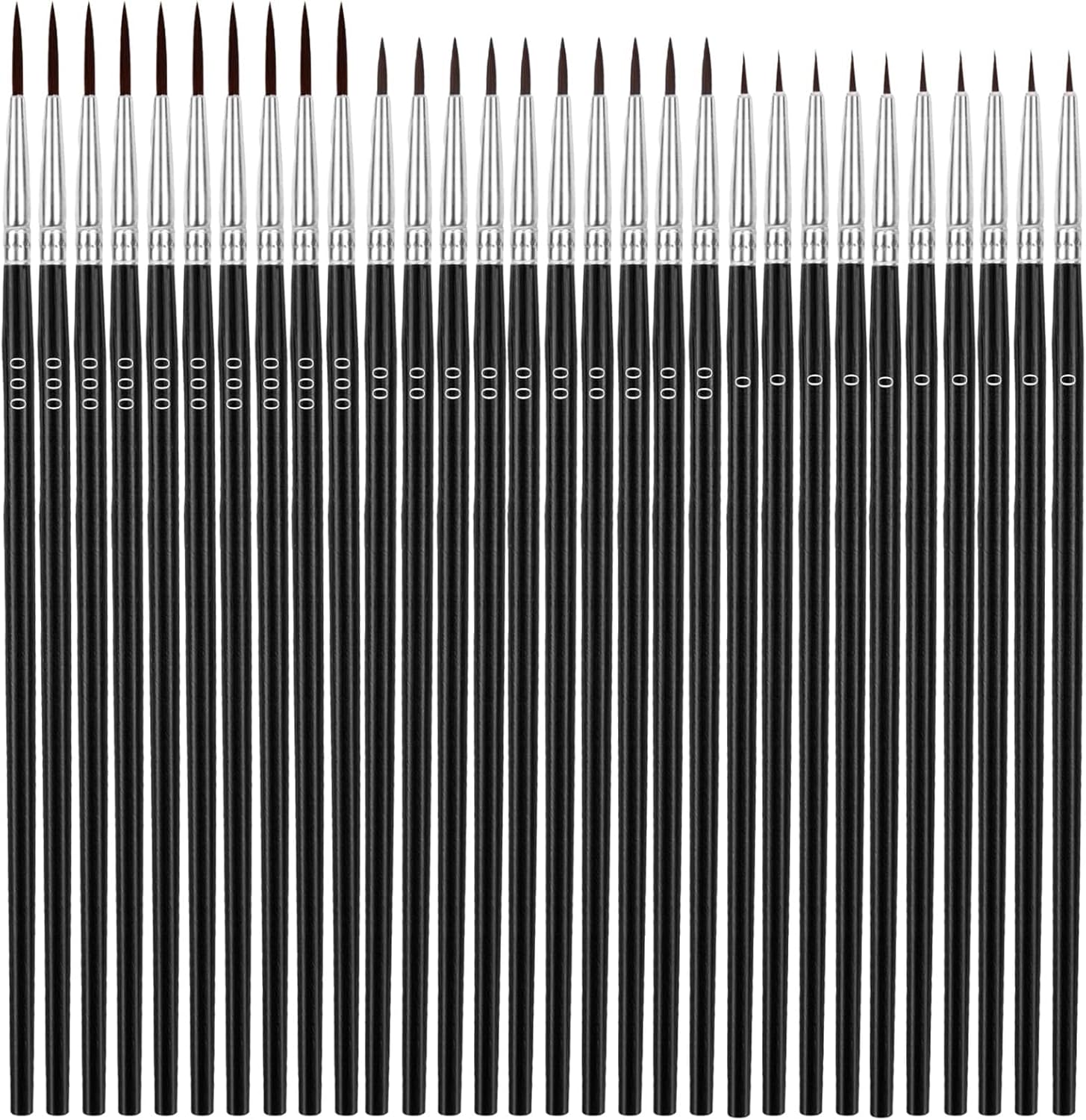
Thirty brushes in just three sizes: ten each of #0, #00 and #000. The listing gives hair lengths of about 0.23 inches for #0, 0.5 inches for #00 and 0.6 inches for #000, which means the smallest sizes are actually longer, liner-style hairs suited to fine continuous lines.
Fine tips eventually lose their point no matter how carefully you clean them. With ten of each size, you can keep a fresh brush for final details and retire worn ones to rougher jobs.
Best suited for: Hair strands, fur, grasses, signatures and anyone who goes through fine brushes quickly.
Key features:
- 30 brushes in 3 sizes
- Liner-style hair lengths
- Anti-shedding synthetic hair
- Anti-rust nickel ferrules
Pros:
- Excellent value for replaceable tips
- Long hairs hold paint for fine lines
- Always a sharp spare on hand
Cons and limitations:
- Only three sizes
- No protective tubes mentioned
Buying consideration: Label or separate brushes by use. Keep a few untouched for final details and use older ones for underpainting outlines.
4. Golden Maple Detail Paint Brushes, 10 pcs — Best for a balanced round set for daily detail

Golden Maple’s set is a clean progression of round brushes from 5/0 up to 8, which covers nearly every detail stage: block-in at 6 or 8, refinement at 1 to 4, and fine finishing at 0 down to 5/0. Triangular wooden handles and protective tubes are included.
It lists oil among compatible media, along with acrylic and watercolor.
Best suited for: Painters who prefer rounds for most detail, small still lifes and miniature-scale paintings.
Key features:
- 10 round sizes, 5/0 to 8
- Triangular wooden handles
- Protective tubes
- Listed for oil, acrylic and watercolor
Pros:
- Logical size steps
- Comfortable grip for control
- Tubes protect points
Cons and limitations:
- No liner or flat
- Higher price tier than similar sets
Buying consideration: Pair this set with one small flat if you paint architecture or hard-edged objects.
5. KIASON Miniature Detail Paint Brushes, 10 pcs — Best for sturdy ferrules and longer handles

KIASON focuses on construction. The listing says ferrules are double crimped to the handle with an adhesive blend for long-term strength, and handles are UV-cured, varnished black birch to resist splitting. Brush lengths run about 7 to 7.6 inches.
That slightly longer handle gives more distance between your hand and the wet painting, which some oil painters prefer to avoid smudging nearby passages.
Best suited for: Painters who have had ferrules wobble on cheap brushes, and detail work on medium-sized canvases.
Key features:
- 10 assorted sizes
- Double-crimped chrome-plated copper ferrules
- UV-cured varnished birch handles
- Triangular, balanced grip
Pros:
- Emphasis on durable construction
- Handle length helps avoid smudging
- Synthetic bristles hold shape after cleaning
Cons and limitations:
- Fewer ultra-fine sizes than JusArt
- Size labeling on listing is less clear
Buying consideration: Check the smallest size against your needs. If you need 5/0 or 10/0, pair this set with an ultra-fine brush.
6. YFLLN Miniature Paint Brushes, 6 pcs — Best for a small starter detail kit

YFLLN keeps it simple: rounds in 5/0, 3/0, 0, 2 and 4, plus a #2 angle brush. Six brushes is enough to cover fine detail without paying for sizes you will not use. Triangular handles and protective tubes are included, and oil is listed as compatible.
It appears at more than one price tier on Amazon; the contents are the same, so compare listings.
Best suited for: Beginners adding detail brushes to a starter oil kit, and travel kits.
Key features:
- 5 rounds and 1 angle
- Triangular handles
- Protective tubes
- Listed for oils, acrylics and watercolor
Pros:
- Low cost
- Angle brush adds edge control
- Compact
Cons and limitations:
- Limited range
- No liner
Buying consideration: This is an add-on set. Most oil painters will also want a liner for long, thin lines.
A Simple Detail Workflow in Oil
- Let the base layer set. Details painted into very wet paint blur. Wait until the underlying passage is tacky or touch-dry.
- Mix detail paint separately. Pull a small amount of color aside and add a drop of medium so it flows. Keep it slightly more oil-rich than the layer beneath, in line with fat over lean.
- Block small shapes with a size 2 to 4 round. Get the shape and value right before refining.
- Refine with 0 to 3/0. Sharpen edges, add smaller forms and correct drawing.
- Finish with 5/0 or 10/0. Highlights, catchlights and the thinnest lines go in last, ideally in one confident stroke.
- Steady your hand. A mahl stick or resting the side of your hand on a clean paper towel over dry areas helps control long strokes.
Working in this order means your finest brushes only touch paint for a few strokes each session, so they keep their points far longer.
Buying Guide: How to Choose Oil Painting Brushes for Detail Work
Understand detail sizing
Brush sizes below 0 are written as 2/0 (00), 3/0 (000) and so on, getting smaller as the first number rises. A 10/0 is extremely fine. Sizes are not standardized between brands, so use them as relative guides within a set.
Choose rounds for control, liners for lines
Rounds give you dots, small shapes and highlights. Liners carry more paint for long strokes. Most detail-heavy oil painters use both.
Synthetic or natural hair
At tiny sizes, synthetic nylon is common and practical: it holds a point, springs back, and handles solvent cleaning. Natural sable is prized for paint capacity but costs far more. For detail work that wears tips out, synthetics are a sensible starting point.
Ferrule quality matters
A loose ferrule makes fine strokes impossible. Look for double crimping and rust-resistant metals, especially since oil brushes are cleaned with solvents and soap repeatedly.
Handle shape and length
Triangular handles resist rolling and give a stable grip. Short handles suit close work at a desk; slightly longer handles keep your hand away from wet paint on an easel.
Paint consistency for detail
Oil from the tube is often too stiff for fine lines. A drop of medium or a little solvent helps paint flow from a liner. Thin paint too much, though, and lines lose opacity.
Protect the points
Protective tubes help, but only if the brush is completely clean and reshaped before capping. Storing a brush with paint in the ferrule ruins it regardless of the tube.
Care and Technique for Fine Brushes
Fine tips are easy to ruin with heavy solvent use. Our guide on cleaning oil paint brushes without odor walks through a gentler routine, and you can learn stroke control in how to use a liner brush for detail work.
Common Mistakes to Avoid
- Using detail brushes for blocking in. Large areas wear fine tips quickly.
- Painting details too early. Wait until the underlying layer is tacky or dry so details sit crisply on top.
- Loading paint to the ferrule. Load only the front half to two-thirds of the hair.
- Stiff, unthinned paint in liners. Lines break up; add a touch of medium.
- Leaving brushes in solvent. Tips bend permanently.
- Capping a dirty brush. Paint dries inside the tube and the brush is lost.
FAQs
What size brush is best for fine detail in oil painting?
Sizes 0 to 3/0 handle most fine detail, while 5/0 and 10/0 are for the smallest highlights and lines. Keep a size 2 to 4 round for small shapes before you refine with the tiny brushes.
Can synthetic brushes be used with oil paint?
Yes. Synthetic nylon brushes work with oils and are common for detail sizes. Clean them promptly and avoid leaving them in solvent, since prolonged soaking can affect the bristles and glue.
What is the difference between a liner and a round brush?
A round has a fuller belly and a pointed tip for dots and small shapes. A liner has long, thin hair that holds more paint, making it better for long, continuous fine lines.
How do I keep detail brushes sharp?
Clean thoroughly after each session, reshape the tip with your fingers, dry flat or tip-down, and store with protective tubes. Reserve the finest brushes for final details only.
Why does my detail brush leave broken lines with oil?
The paint is likely too stiff. Thin it slightly with medium so it flows, load more paint into the brush, and use the full length of a liner rather than just the tip.
Are cheap detail brushes worth it for oil painting?
For many painters, yes. Fine tips wear out with use, so affordable synthetic sets let you replace them often. Invest more only if you find yourself needing greater paint capacity.
Final Recommendation
Choose the JusArt 12-piece set if you want one purchase that covers ultra-fine to small sizes. The PANDAFLY 15-piece set is best when you need liners, flats and a filbert alongside rounds, and Anezus is the value pick for painters who wear through fine liners. Golden Maple suits round-brush loyalists, KIASON prioritizes durable construction, and YFLLN is a compact starter set.




