PaintingProGuide is reader-supported. When you buy through links on this page we may earn an affiliate commission at no extra cost to you.
Most rock painting is done with brushes, dotting tools and paint pens, so it is fair to ask why anyone needs a palette knife at all. The answer is texture and control at small scale. A small trowel-shaped knife lays thick acrylic onto a stone for petals, leaves, tree bark and waves in a way a brush cannot, and a straight knife mixes custom colors and spreads base coats cleanly across a curved surface.
The best palette knife for rock painting is small, flexible and pointed or teardrop-shaped, because rocks are small and curved. Below are seven sets compared on blade variety, handle comfort and how well they suit work on stones.
Quick answer: The Honoson 7-piece palette knife set is the best palette knife for rock painting overall: it has seven blade shapes on beech handles, and its listing names rock painting and miniatures among its uses. For more small trowels in one pack, the Cualork 10-piece set doubles up on shapes, and the CllyCnny set with plastic scrapers adds texture tools for patterned backgrounds.
Our Top Picks at a Glance
- Honoson 7-Piece Painting Knife Set, Wood Handles — Best overall for rock painting
- Cualork 10-Piece Palette Knife Set — Best for groups and spare blades
- conda 5-Piece Palette Knife Set, Wood Handles — Best classic five-shape set
- CllyCnny 5 Knives + 6 Plastic Scrapers — Best for textured backgrounds
- Herain 5-Piece All-Steel Palette Knife Set — Best durable budget set
- Egypamid 5-Piece Palette Knife Set — Best lowest-cost starter
- Honoson 2-Piece Mixing Knife Set — Best for mixing custom colors
| Product | Best For | Key Spec | Key Strength | Price Tier |
|---|---|---|---|---|
| Honoson 7-Piece | Overall rock painting | 7 shapes, beech handles | Names rock painting and miniatures | $ |
| Cualork 10-Piece | Groups, spare blades | 10 knives, 5 shapes x 2 | Two of each shape | $ |
| conda 5-Piece | Classic shapes | 5 standard shapes, wood handles | Individually packaged | $ |
| CllyCnny 11-Piece | Texture and patterns | 5 steel knives + 6 plastic scrapers | Scrapers for texture | $ |
| Herain 5-Piece | Durable budget | 5 styles, stainless handles | All stainless steel | $ |
| Egypamid 5-Piece | First set | 5 shapes, plastic handles | Lowest price | $ |
| Honoson 2-Piece | Mixing paint | 1 in and 1.4 in wide blades | Straight mixing blades | $ |
How We Chose
We have not painted rocks with these knives. Picks are based on the Amazon listing details and specifications checked in October 2026, how well each set’s blade shapes, sizes and handles suit small, curved rock surfaces, and how widely each product is reviewed by Amazon buyers.
We looked for:
- Small, pointed blades: teardrop and trowel shapes for petals, leaves and details.
- Shape variety: sets with several blade styles let you try different strokes.
- Flexibility: stainless steel blades with some spring for spreading and lifting paint.
- Handle comfort: wood or ergonomic plastic handles for controlled, small movements.
- Extras: scrapers or straight mixers that help with base coats and color mixing.
How Palette Knives Are Used on Rocks
Rock painters use knives in four main ways. First, mixing: a straight or slightly cranked knife blends acrylic on a palette without wasting paint in brush bristles. Second, base coats: a wide blade can spread thick paint across a flat face of a stone before detail work. Third, texture: a small trowel pressed and lifted leaves ridges that look like petals, feathers, waves or tree bark. Fourth, scraping: the edge of a blade can scratch through a top layer to reveal color underneath.
Because rocks are small and curved, the smallest blades in a set get the most use. A teardrop blade about the size of a thumbnail is ideal for single-stroke flowers. Heavy-body acrylic or acrylic thickened with a little modeling paste holds knife marks better than fluid craft paint.
Three Knife Strokes to Try on Your First Rock
The press-and-pull petal: load the tip of a small teardrop blade with thick paint, touch it to the rock, press lightly and pull toward the center. Repeat in a circle for a daisy or sunflower, then add a dot center with the end of a brush handle.
The side-swipe leaf: load the flat side of a trowel blade, lay it on the rock at an angle and slide sideways while lifting. The paint breaks into a leaf shape with a natural ridge down one side.
The edge scratch: paint a solid area, wait until it is tacky rather than wet, then drag the edge of a clean blade through it to reveal the base color beneath. This works well for grass, fur and wood-grain lines.
Best Palette Knives for Rock Painting Reviewed
1. Honoson 7-Piece Painting Knife Set — Best Overall for Rock Painting

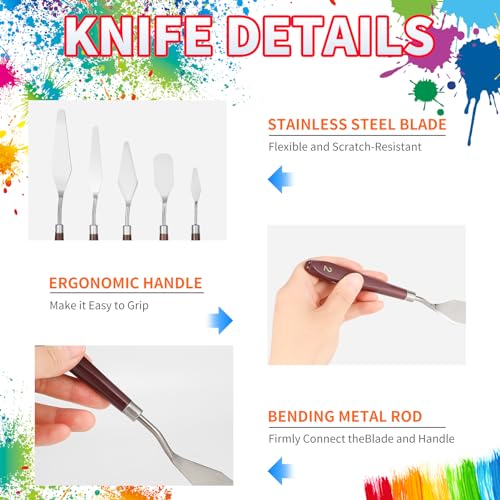
Honoson’s set includes seven different blade shapes with stainless steel blades and beech handles. The listing describes the blades as flexible enough to bend to different degrees, resistant to rust and corrosion, and firmly attached to curved wooden handles that fit the hand comfortably.
Unusually, the listing names rock painting, miniatures, models and crafts among its uses. Seven shapes give you more small trowels and pointed blades than a standard five-piece set, which is useful for petals, leaves and fine texture on stones.
Best suited for: Rock painters who want a good spread of blade shapes for texture and detail.
Key features:
- 7 blade shapes
- Stainless steel blades
- Beech wood handles
- Flexible, rust-resistant blades
- Clean with soap and warm water
Pros:
- More shapes than standard sets
- Listing names rock painting
- Comfortable wooden handles
Cons and limitations:
- Mid price tier
- Do not soak wooden handles
- No case for storage
Buying consideration: If you will only buy one set for rocks, this offers the most useful variety.
2. Cualork 10-Piece Palette Knife Set — Best for Groups and Spare Blades

Cualork’s set includes ten knives: 4 long-bladed spreaders, 2 angled spades, 2 rounded spreaders and 2 angled trowels. Having two of each small shape is handy for rock painting parties, family sessions or keeping one knife for light colors and one for dark.
The listing describes flexible stainless steel blades, ergonomic plastic handles and a curved steel shank that keeps fingers off the paint surface, which matters when you hold a small rock in your other hand.
Best suited for: Families, classrooms, rock painting groups and painters who like spare blades.
Key features:
- 10 knives in 5 shapes
- Stainless steel blades
- Ergonomic plastic handles
- Curved shank keeps fingers clear
Pros:
- Two of each shape
- Low price tier for ten knives
- Cranked shank improves control
Cons and limitations:
- Plastic handles feel lighter than wood
- Several long spreaders are less useful on small rocks
- No case
Buying consideration: Good value for sharing. Use the angled trowels and spades most for rock work.
3. conda 5-Piece Palette Knife Set, Wood Handles — Best Classic Five-Shape Set

conda’s set includes one each of five standard knife styles with stainless steel blades and wood handles. The listing says blades range from a couple of inches to only slightly longer than a thumbnail, which covers both mixing and small detail work.
Each knife is individually packaged. The brand lists modeling paste and texture gels among compatible media, which is useful if you want raised texture on rocks.
Best suited for: Hobby rock painters who want a reliable, traditional set.
Key features:
- 5 standard knife styles
- Stainless steel blades
- Wood handles
- Blades from about thumbnail length to a couple of inches
Pros:
- Includes a very small blade for details
- Wooden handles
- Works with texture gels and pastes
Cons and limitations:
- Only one of each shape
- Fewer shapes than the Honoson 7-piece
- Handles not dishwasher safe
Buying consideration: A good choice if you prefer classic shapes and wooden handles.
4. CllyCnny 5 Palette Knives with 6 Plastic Scrapers — Best for Textured Backgrounds

CllyCnny pairs five stainless steel palette knives with six differently shaped plastic scrapers. The steel knives handle mixing and detail; the scrapers create combed, ridged or patterned textures. On rocks, scrapers can drag lines through wet paint for wood grain, waves or abstract backgrounds.
Handles are plastic, and the listing says both the steel and plastic parts are easy to clean.
Best suited for: Rock painters who like abstract or textured backgrounds and mixed-media effects.
Key features:
- 5 stainless steel knives
- 6 plastic texture scrapers
- Plastic handles
- Easy to clean
Pros:
- Adds texture tools other sets lack
- Good for experimentation
- Mid price tier
Cons and limitations:
- Scrapers may be large for small rocks
- Plastic handles
- Fewer small trowel shapes
Buying consideration: Choose this if texture and pattern interest you as much as flowers and details.
5. Herain 5-Piece All-Steel Palette Knife Set — Best Durable Budget Set

Herain’s set is all stainless steel, including the diamond-shaped handles. The listing describes flexible, scratch-resistant blades with smooth edges and joints that are tightly articulated so blades do not fall off.
All-metal knives can be washed thoroughly without worrying about wooden handles swelling. They are listed for oil, acrylic and cake decorating.
Best suited for: Budget-conscious painters who want durable, easy-to-clean knives.
Key features:
- 5 styles
- Stainless steel blades and handles
- Diamond-shaped handles
- Smooth, burr-free edges
Pros:
- Easy to wash thoroughly
- Low price tier
- Durable construction
Cons and limitations:
- Metal handles can feel cold and slippery
- Only five shapes
- Lighter weight may feel less controlled
Buying consideration: Good as a hard-wearing starter set, especially if knives will be shared or washed often.
6. Egypamid 5-Piece Palette Knife Set — Best Lowest-Cost Starter

Egypamid offers five knife shapes with flexible stainless steel heads and lightweight plastic handles at the lowest price in this roundup. The listing notes that if pigment dries, soak the knife in warm water for a few minutes before cleaning.
It is a good way to discover whether knife work suits your rock painting before investing in a larger set.
Best suited for: Beginners trying knife texture on rocks for the first time.
Key features:
- 5 shapes
- Flexible stainless steel heads
- Lightweight plastic handles
- Easy cleaning
Pros:
- Lowest price
- Flexible blades
- Light and easy to handle
Cons and limitations:
- Plastic handles
- Fewer shapes
- Less detail about blade sizes
Buying consideration: Start here if you are unsure; upgrade later if knife texture becomes part of your style.
7. Honoson 2-Piece Palette Knife Set — Best for Mixing Custom Colors

Honoson’s two-piece set focuses on mixing. The small knife is about 1 inch wide and 8.3 inches long; the large one is 1.4 inches wide and 8.7 inches long. Both have stainless steel blades and beech handles with a hanging hole.
Rock painters often mix custom colors for backgrounds and need enough paint to cover several stones. A straight mixing knife blends acrylic evenly without wasting it in brush bristles. The listing also names rock painting among its uses.
Best suited for: Rock painters who mix their own colors and want a dedicated mixing tool.
Key features:
- 2 knives: 1 in and 1.4 in wide
- Stainless steel blades
- Beech handles with hanging hole
- Listed for rock painting and crafts
Pros:
- Good blade width for mixing
- Comfortable wooden handles
- Hangs for storage
Cons and limitations:
- Not designed for fine texture work
- Only two knives
- Tip can be sharp; handle carefully
Buying consideration: Pair with a small trowel set: use these for mixing and the small knives for texture.
Buying Guide: How to Choose a Palette Knife for Rock Painting
Rocks are small, curved and hard. These factors help you choose a knife that works with them.
Blade Size
Small blades get the most use on rocks. Look for at least one teardrop or trowel blade about the size of a thumbnail for petals and leaves. Long spreaders are better for mixing on a palette than for painting on a stone.
Blade Shape
Teardrop and diamond shapes make petals and leaves. Angled trowels reach into curves. Straight blades mix and spread. A set with several shapes lets you experiment.
Cranked Handle
A cranked (offset) shank lifts your knuckles above the surface, which helps when one hand holds the rock and the other works the knife. Most painting knives have this; straight mixing knives usually do not.
Flexibility
Flexible stainless steel blades spring back and give softer strokes. Stiffer blades are better for scraping. Most sets here describe flexible blades suited to acrylic.
Handle Material
Wood handles feel warm and secure but should not be soaked. Plastic handles are light and washable. All-steel handles are the easiest to clean but can feel slippery.
Paint Consistency
Knife work needs thicker paint. Heavy-body acrylic or craft acrylic thickened with modeling paste holds knife marks. Fluid craft paint will flatten out.
Sealing Textured Rocks
Thick knife texture takes longer to dry. Let it cure fully before sealing with a brush-on or spray varnish, especially for rocks that will sit outdoors.
Learn the Knife Techniques
The strokes are the same on a rock as on a canvas, only smaller. Our guide on how to use a palette knife explains loading, pressing and lifting paint. For the fine lines and outlines that finish a painted rock, see how to use a liner brush for detail work.
Common Mistakes to Avoid
- Using fluid craft paint for knife texture; it will flatten.
- Choosing only large blades that are too big for small rocks.
- Soaking wooden-handled knives in water.
- Letting acrylic dry on blades; wipe them as you work.
- Sealing textured rocks before thick paint has fully cured.
- Pressing too hard and scraping paint off curved edges.
FAQs
Can you use a palette knife on rocks?
Yes. Small palette knives are useful for mixing, spreading base coats and adding texture such as petals, leaves and bark on painted rocks.
What size palette knife is best for rock painting?
Small teardrop or trowel blades about the size of a thumbnail suit most rock designs. Larger blades are better kept for mixing paint on a palette.
What paint works with a palette knife on rocks?
Heavy-body acrylic or craft acrylic thickened with modeling paste holds knife texture. Thin, fluid paint will level out and lose the marks.
How do I clean acrylic off palette knives?
Wipe the blade while paint is wet, then wash with soap and warm water. If acrylic dries, soak the blade (not wooden handles) in warm water and peel it off.
Are plastic or metal palette knives better for rocks?
Metal knives are more precise and flexible. Plastic knives are cheaper and safer for kids but can be too soft for fine texture.
Do I need to seal knife-painted rocks?
Yes, especially for outdoor rocks. Let thick paint cure fully, then apply a brush-on or spray sealer suitable for acrylic.
Final Recommendation
For most rock painters, the Honoson 7-piece set provides the best range of small shapes. Groups and families should consider the Cualork 10-piece set, while traditionalists will like the conda 5-piece with its thumbnail-sized blade.
If texture is your focus, add the CllyCnny set with scrapers. For tight budgets, the Herain all-steel set and the Egypamid starter are inexpensive ways to begin. And if you mix lots of custom colors, the Honoson 2-piece mixing knives are a practical companion.