
PaintingProGuide is reader-supported. When you buy through links on this page we may earn an affiliate commission at no extra cost to you.
Rock painting uses small amounts of many colors. A mandala stone might need eight or ten colors in dabs no bigger than a fingernail, and you mix almost nothing in bulk. That makes the best palette for rock painting different from a canvas painter’s palette.
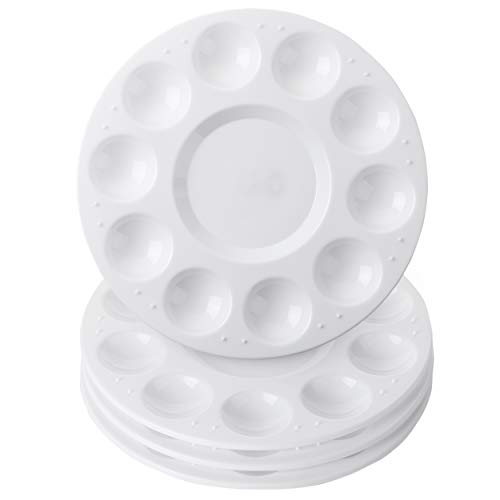
What works is a tray with lots of small, separate wells so bright acrylics do not run together, a central space for the occasional mix or for thinning paint for dots, and a surface that rinses clean before the acrylic cures. Round 10-well trays tick all of those boxes and cost very little.
The real decision is quantity. One painter needs a couple of trays; a rock painting party or classroom needs a stack. Below we compare four multi-packs of round trays and two acrylic sets that include a palette, so you can buy once and start painting.
We also cover how to keep acrylic workable on the palette, because craft acrylic in tiny dabs dries fast, especially outdoors where a lot of rock painting happens.
Quick answer: For a solo rock painter, the Mr. Pen Round Paint Tray Palettes 4-Pack covers everything: 10 wells, a central reservoir and 0.4-inch deep wells, at a tiny cost. For groups, the FANDAMEI 20-Piece Round Paint Trays give everyone a tray. If you are starting from scratch, the Shuttle Art 36-Color Acrylic Set includes paint, brushes and a palette in one box.
What Rock Painters Need From a Palette
Most rock art is done in acrylic: craft bottles, artist tubes or paint pens. Acrylic dries quickly in thin dabs, and once it cures on a palette it peels off in sheets rather than rinsing away. Small wells that each hold a single color are easier to manage than one big flat surface, because you only expose the paint you are using.
Dot work adds a twist. Dotting tools pick up paint best from a shallow puddle of slightly thinned acrylic, so a central reservoir or a large well to thin a color with a drop of water is useful. Fine line details with a liner brush also need paint thinned to an ink-like flow.
Finally, rock painters often work outdoors, at kitchen tables with kids, or at community events. Light trays that stack, travel and can be rinsed under a tap matter more than a premium surface.
Our Top Picks at a Glance
- Mr. Pen Round Paint Tray Palettes (4-Pack) — Best overall palette for rock painting
- FANDAMEI 20-Piece Round Paint Trays — Best for rock painting parties
- LNAUJS 15-Pack Round Paint Trays — Best mid-size multi-pack
- Hulameda 12-Piece Paint Tray Palettes — Best for families and small clubs
- Shuttle Art 36-Color Acrylic Paint Set with Brushes and Palette — Best complete starter kit
- Nicpro 24-Color Acrylic Paint Set with 12 Brushes and Palette — Best paint set for detail work
| Product | Best For | Key Spec | Key Strength | Price Tier |
|---|---|---|---|---|
| Mr. Pen Round Paint Tray Palettes (4-Pack) | overall palette for rock painting | 6.7 in diameter, 10 wells + center, 0.4 in deep | Deep wells keep colors separate | $ |
| FANDAMEI 20-Piece Round Paint Trays | rock painting parties | 20 trays, 6.7 in, 10 wells + center reservoir | Enough for a full group | $ |
| LNAUJS 15-Pack Round Paint Trays | mid-size multi-pack | 15 trays, 6.69 in, 3.07 in center well | Large central mixing area | $ |
| Hulameda 12-Piece Paint Tray Palettes | families and small clubs | 12 trays, 6.7 x 6.7 in | Break-resistant stackable trays | $ |
| Shuttle Art 36-Color Acrylic Paint Set with Brushes and Palette | complete starter kit | 36 x 2 oz bottles, brushes and palette included | Metallics and a full color range | $$ |
| Nicpro 24-Color Acrylic Paint Set with 12 Brushes and Palette | paint set for detail work | 24 x 2 oz bottles, 12 brushes, palette | More brushes for fine detail | $$ |
How We Chose
We did not paint rocks with these products. Picks are based on the Amazon listing details and specifications checked in October 2026, how well each palette’s wells, size and quantity suit rock painting with acrylic, and how widely each product is reviewed by Amazon buyers.
- Number of separate wells for many small colors
- Central space for thinning paint for dots
- Well depth to stop colors running together
- Pack size for solo versus group painting
- Ease of rinsing acrylic before it cures
- Value of kits that include paint and brushes
Best Palettes for Rock Painting Reviewed
1. Mr. Pen Round Paint Tray Palettes (4-Pack) — Best overall palette for rock painting

This is the classic rock painting palette. Ten wells circle a central reservoir, which is exactly the layout dot and mandala painters need: each color in its own well, plus a space in the middle to thin paint for dotting.
The listing gives a 6.7-inch diameter and a well depth of 0.4 inches, slightly deeper than many budget trays, which helps keep bright acrylics from creeping together. Four trays per pack means you can rotate: one in use, one soaking, two spare.
Smooth plastic makes cleanup simple as long as you rinse before acrylic dries.
Best suited for: Solo rock painters, families painting together and anyone who needs a handful of spare trays.
Key features:
- Four round plastic palettes
- 10 wells plus a central reservoir
- 6.7-inch diameter, 0.4-inch deep wells
- Light enough for children to hold
Pros:
- Ideal layout for dot painting
- Lowest cost per tray among small packs
- Easy to rinse
Cons / limitations:
- Not enough for a whole class
- Small wells for big batch mixing
- Thin plastic flexes
Buying consideration: Keep a spray bottle handy; misting the wells every 10 to 15 minutes keeps craft acrylic usable.
2. FANDAMEI 20-Piece Round Paint Trays — Best for rock painting parties

Twenty trays covers a classroom table, a scout troop or a birthday party. Each tray has 10 holes and a central reservoir, and the listing notes deep wells to keep colors separate, plus uses like Easter egg and Halloween mask painting.
Cleaning instructions suggest rinsing gently with a brush under running water, and the trays stack for storage.
Best suited for: Teachers, party hosts and community rock painting events.
Key features:
- 20 round palettes
- 6.7-inch diameter
- 10 wells and 1 central reservoir
- Stackable for storage
Pros:
- One tray per painter
- Deep wells separate colors
- Cheap enough to replace
Cons / limitations:
- More than a solo painter needs
- Light plastic
- Storage space for the stack
Buying consideration: Pre-fill wells with the same set of colors on every tray before guests arrive to avoid queues at the paint table.
3. LNAUJS 15-Pack Round Paint Trays — Best mid-size multi-pack

LNAUJS lists precise dimensions: each 6.69-inch tray has a central mixing area 3.07 inches across and 0.34 inches deep, surrounded by smaller wells. That larger central zone is handy for mixing a custom background color for several rocks at once.
Fifteen trays sits between family packs and party packs, which makes it a good fit for small classes or homeschool groups.
Best suited for: Homeschool groups, small classes and families who paint often.
Key features:
- 15 round plastic palettes
- 6.69-inch outer diameter
- Central well 3.07 inches across, 0.34 inches deep
- Stackable and portable
Pros:
- Roomy central mixing well
- Good group quantity
- Precise listing dimensions
Cons / limitations:
- Shallower center than some trays
- Basic white plastic
- Not airtight
Buying consideration: Use the large center well for background colors and outer wells for detail colors.
4. Hulameda 12-Piece Paint Tray Palettes — Best for families and small clubs

A dozen trays is plenty for a family that paints often or a small rock painting club. Hulameda describes the trays as sturdy, break-proof molded plastic with a smooth surface that washes off quickly.
They stack to save space and are light enough for children to hold.
Best suited for: Families, small clubs and repeat craft afternoons.
Key features:
- 12 plastic paint trays
- About 6.7 x 6.7 inches
- Break-resistant molded plastic
- Stack for storage
Pros:
- Durable for a budget tray
- Easy cleanup
- Good family quantity
Cons / limitations:
- Fewer trays than party packs
- Small mixing area
- Plastic stains over time
Buying consideration: If you only paint alone, a 4-pack is enough; buy this when others join in.
5. Shuttle Art 36-Color Acrylic Paint Set with Brushes and Palette — Best complete starter kit

If you have no supplies yet, a set that includes paint, brushes and a palette is the simplest start. Shuttle Art’s set has 36 colors in 2 oz bottles, including metallics, plus brushes and a palette.
The listing names wood and rock among suitable surfaces and describes the paint as fast-drying, waterproof and fade-resistant, conforming to ASTM D-4236. A gloss finish gives rocks a bright look even before varnish.
Best suited for: New rock painters who need paint and a palette in one purchase.
Key features:
- 36 acrylic colors in 2 oz bottles
- Includes metallic colors
- Brushes and palette included
- Gloss finish, ASTM D-4236
Pros:
- Huge color range
- Metallics suit mandala stones
- Everything in one box
Cons / limitations:
- Included palette is basic
- Bundled brushes will not replace good detail brushes
- Highest price tier among palettes here
Buying consideration: Seal painted rocks with an outdoor-rated varnish if they will be placed in gardens or hidden for others to find.
6. Nicpro 24-Color Acrylic Paint Set with 12 Brushes and Palette — Best paint set for detail work

Nicpro’s set has fewer colors than the Shuttle Art kit but twelve brushes, which matters for rock painters who need small rounds and liners. The paint is listed as creamy, fast-drying, waterproof and fade-resistant, with a semi-gloss finish and ASTM D-4236 conformance.
Rock is named among suitable surfaces alongside wood, canvas, ceramic and fabric.
Best suited for: Rock painters who want a solid paint range and more brush shapes.
Key features:
- 24 colors in 2 oz bottles
- 12 brushes and a palette
- Semi-gloss finish
- ASTM D-4236, non-toxic
Pros:
- Good brush selection
- Semi-gloss looks finished
- Bottles last for many rocks
Cons / limitations:
- Fewer colors than larger sets
- Palette is basic
- No metallics listed
Buying consideration: Add a few round trays; one included palette fills up fast with 24 colors.
Setting Up a Palette for a Rock Painting Session
Plan your colors before you open a bottle. Most rock designs need a base color, a contrasting outline color, white and black for highlights and shadows, and three to six accent colors. Put each in its own well in the same order every time, so your hand learns where to reach.
Squeeze out less than you think. A pea-sized dab fills a 10-well tray’s well and covers a lot of dots. Put the base color in the central reservoir if you are painting several rocks the same background color.
Thin dot paint in a separate well, not in the bottle. Add water a drop at a time with a brush handle or dropper until the paint flows off a dotting tool and forms a rounded dome. Keep that well for dots only.
Keep a damp paper towel next to the tray for wiping tools between colors, and a spray bottle of water to mist the wells every so often. In hot sun, set up in shade; direct sunlight can skin over craft acrylic in minutes.
When you finish, scrape leftover paint onto a paper towel, then rinse the tray. If you plan to keep painting tomorrow, cover the tray with plastic wrap pressed down onto the wells instead.
Buying Guide: How to Choose a Rock Painting Palette
Wells over open space
Rock painting uses dabs of many colors rather than large mixes, so separate wells matter more than a wide flat area.
Ten wells around a center is the sweet spot for most designs. If you regularly use more than ten colors, keep a second tray beside the first rather than crowding colors together.
A central reservoir for dots
Dots look smoother when paint is slightly thinned. A central reservoir or large well gives space to add a drop of water and stir.
Thin a little at a time. Paint that is too runny forms flat, spreading dots; paint that is too thick leaves peaks. A test dot on scrap paper tells you which way to adjust.
Depth
Deeper wells, around 0.4 inches, keep bright acrylics from creeping together when the tray tilts.
Shallow trays are fine for adults at a table, but children tend to tip trays, so depth matters more with young painters.
Quantity
Solo painters need two to four trays. Families need about a dozen. Parties and classes need one per person plus spares.
Cheap trays reduce stress at group events. If one is ruined by dried paint, it can simply be recycled.
Cleanup
Plastic trays rinse clean while acrylic is wet. Once dry, soak in warm soapy water and peel. Some painters line trays with plastic wrap for easy cleanup.
Never pour large amounts of acrylic down a drain; wipe excess onto a paper towel first.
Kits versus palettes alone
If you already own paint, buy trays only. If you are new, a set with paint, brushes and a palette is the most economical start.
Keep in mind that kit palettes are usually basic, so a pack of round trays is a worthwhile add-on.
Keep Your Palette Working
Acrylic dries quickly in small wells; our guide to keeping a paint palette from drying out covers misting, covers and wet palettes.
A wet palette is worth trying for long sessions. When you finish, see how to clean a painting palette without scratching it.
Common Mistakes to Avoid
- Squeezing out large blobs of acrylic that dry before you use them
- Thinning paint for dots with too much water
- Letting acrylic cure in trays before rinsing
- Sharing one palette among several kids and muddying every color
- Using a flat palette and letting bright colors run together
- Skipping varnish on rocks that will live outdoors
FAQs
What kind of palette is best for rock painting?
A round plastic tray with about 10 wells and a central reservoir. It keeps many small colors separate and gives you space to thin paint for dots.
Can I use a paper plate as a rock painting palette?
Yes, in a pinch. Paper plates absorb some water and acrylic dries faster on them, but they are fine for quick sessions and parties.
How do I keep acrylic paint from drying on my palette?
Squeeze small amounts, mist with water regularly, cover the palette between sessions or use a wet palette.
What paint is best for rock painting?
Acrylic paint, in bottles, tubes or paint pens. It sticks to stone and dries water-resistant. Seal finished rocks with varnish.
How many palettes do I need for a rock painting party?
One per person plus a couple of spares. Packs of 15 or 20 round trays are designed for this.
How do I clean dried acrylic off a plastic palette?
Soak it in warm soapy water for a while and the dried paint will soften and peel. Avoid sharp tools that scratch the plastic.
Final Recommendation
For individual rock painters, the Mr. Pen 4-Pack is the best value palette here, with deep wells and the ideal dot-painting layout. Hosts and teachers should choose by group size: FANDAMEI 20-piece for large groups, LNAUJS 15-pack for smaller classes and Hulameda 12-piece for families.
If you need paint as well, the Shuttle Art 36-color set gives the widest range including metallics, while the Nicpro 24-color set includes more brushes for detail work.





One Comment