PaintingProGuide is reader-supported. When you buy through links on this page we may earn an affiliate commission at no extra cost to you.
A palette knife does two jobs in oil painting: it mixes paint cleanly on the palette, and it lays paint onto the canvas in ways a brush cannot, from crisp ridges of impasto to scraped-back passages. The best palette knives for oil painting have a flexible stainless blade, a cranked (offset) neck that keeps your knuckles out of wet paint, and a range of blade shapes so you can switch between broad spreading and small sharp marks.
Most affordable knife sets on Amazon share the same basic design, so the real differences come down to handle material, how many shapes you get, whether there are duplicates, and extras like plastic scrapers. This guide sorts six sets by those differences and then explains which shapes to reach for and how to use them without ruining your colors.
Quick answer: Choose the CONDA 5-Piece Palette Knife Set for a straightforward set of the five standard shapes with wood handles and individually packed blades. If you want spares so one knife stays clean for mixing while another paints, the Cualork 10-Piece Set gives you two of each shape. For texture work, the CllyCnny 11-Piece Set adds six plastic scrapers to five steel knives.
Our Top Picks at a Glance
- CONDA 5-Piece Palette Knife Set — Best overall starter set
- Cualork 10-Piece Palette Knife Set — Best for separate mixing and painting knives
- CllyCnny 5 Knives + 6 Plastic Scrapers — Best for texture and impasto experiments
- LIGHTWISH 5-Piece Painting Knives — Best classic wood-handle alternative
- Herain 5-Piece All-Steel Palette Knives — Best for easy cleanup
- EGYPAMID 5-Piece Palette Knife Set — Best low-cost backup set
| Product | Best For | Key Spec | Key Strength | Price Tier |
|---|---|---|---|---|
| CONDA 5-Piece | First knife set | 5 standard shapes, wood handles | Each knife individually packed | $ |
| Cualork 10-Piece | Mixing plus painting | 2 of each of 5 shapes, plastic handles | Duplicates keep colors clean | $ |
| CllyCnny 11-Piece | Texture and sgraffito | 5 steel knives + 6 plastic scrapers | Extra mark-making tools | $ |
| LIGHTWISH 5-Piece | Traditional feel | Wood handles, cranked steel necks | Flexible, corrosion-resistant blades | $ |
| Herain 5-Piece | Quick cleaning | Stainless blade and handle | Diamond-shaped grip, no wood to soak | $ |
| EGYPAMID 5-Piece | Spare or classroom set | 5 shapes, plastic handles | Wipe-clean, lightweight | $ |
How We Chose
Our picks are based on the Amazon listing details and specifications checked in October 2026, how well each set’s blade shapes and construction fit oil painting, and how widely each set is reviewed by Amazon buyers. We did not paint with these knives. Because many budget sets come from similar factories and look almost identical, we paid particular attention to genuine differences that would change how you use them.
- Blade material: stainless steel that resists corrosion from oil, solvents and acrylic.
- Cranked neck: a bent shaft that lifts the handle above the canvas or palette.
- Shape variety: a mix of long spreaders, trowels and small pointed blades.
- Handle: wood for a traditional feel, plastic or steel for easier cleaning.
- Set extras: duplicate knives or scrapers that add real function, not just piece count.
Palette Knife vs Painting Knife: What Is the Difference?
Strictly speaking, a palette knife is a straight or slightly cranked spatula used for mixing and scraping the palette, while a painting knife has a pronounced cranked neck and a thinner, more flexible blade for applying paint to canvas. In practice, almost every set sold today is made of cranked painting knives, and people use the terms interchangeably.
For oil painters, the cranked style is the more useful. It lets you lay the blade flat on the canvas to spread a smooth plane of color without dragging your fingers through wet paint, and it is still perfectly good for mixing.
Best Palette Knives for Oil Painting Reviewed
1. CONDA 5-Piece Palette Knife Set — Best Overall Starter Set

CONDA’s set includes one each of five standard knife styles, from blades a couple of inches long down to ones only slightly longer than a thumbnail. The blades are stainless steel described as resisting wear and corrosion from any medium, with a flexible spring, and the wood handles are shaped for grip. Each knife arrives in its own package, which helps protect the thin blade edges in transit.
The listing also covers gesso, modeling paste, texture gels and aggregates, which is a good sign the blades have enough backbone for heavy material, not just soft paint. Five distinct shapes is the right number for most oil painters: one large for mixing and big planes, two medium for general application, and small tips for accents.
Best suited for: Oil painters buying their first knife set who want the standard range of shapes without duplicates.
Key features:
- 5 standard knife styles, one of each
- Stainless steel blades with flexible spring
- Ergonomic wood handles
- Individually packaged knives
- Suitable for gesso, modeling paste and texture gels
Pros:
- Covers large to small marks
- Sturdy enough for heavy pastes
- Classic wood handle feel
Cons:
- Only one knife per shape
- Wood handles should not soak in solvent or water
- No case for storage
Buying consideration: Keep the largest blade reserved for mixing and you effectively have a mixing knife and four painting knives in one set.
2. Cualork 10-Piece Set — Best for Separate Mixing and Painting Knives

Cualork doubles up on five shapes: four long-bladed spreaders, two angled spades, two rounded spreaders and two angled trowels. That duplication is more useful than it looks. In oil painting, a knife used to mix a warm light can contaminate the next cool shadow mixture if you do not wipe it perfectly. Having two of each shape lets you keep one for lights and one for darks, or one for mixing and one for applying.
The stainless blades connect to ergonomic plastic handles with a bent metal rod, which the listing notes keeps fingers off the painting and prevents the blade from loosening.
Best suited for: Painters who mix a lot of color with the knife and want spares to keep mixtures clean, and teachers sharing tools between students.
Key features:
- 10 knives: 4 long spreaders, 2 angled spades, 2 rounded spreaders, 2 angled trowels
- Stainless steel blades
- Ergonomic plastic handles
- Cranked steel neck
Pros:
- Duplicates for clean light and dark mixtures
- Plastic handles tolerate cleaning well
- Good value per knife
Cons:
- Four of the ten are the same long spreader style
- Fewer very small tips for fine accents
- Plastic feels lighter than wood
Buying consideration: If you mostly paint thick impasto with one or two knives, the duplicates are less useful; a five-piece set may be enough.
3. CllyCnny 11-Piece Set — Best for Texture and Impasto Experiments
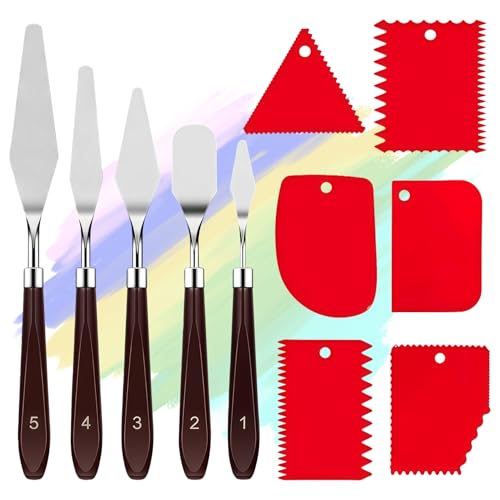
This set pairs five stainless palette knives with plastic handles and six differently shaped plastic scrapers. The scrapers are the point of difference. Dragged through wet oil they create combed lines, grooves and broken textures, and their soft edges are useful for removing paint without scratching the ground.
For oil painters exploring abstract or heavily textured work, the scrapers are a cheap way to try sgraffito and combing before investing in specialty tools. The five steel knives cover everyday mixing and application.
Best suited for: Painters experimenting with texture, abstraction and scraping back, as well as mixed media artists.
Key features:
- 5 stainless steel palette knives
- 6 plastic scrapers in assorted shapes
- Lightweight plastic handles
- Easy to clean
Pros:
- Adds texture tools steel knives cannot match
- Scrapers are gentle on the painting surface
- Versatile for gesso and paste work
Cons:
- Plastic scrapers wear faster than steel
- Knife shapes are not individually described in the listing
- More pieces to keep clean
Buying consideration: Wipe scrapers immediately after use; dried oil paint is much harder to remove from plastic grooves than from steel.
4. LIGHTWISH 5-Piece Painting Knives — Best Classic Wood-Handle Alternative

LIGHTWISH offers the familiar five-knife layout with stainless blades described as having good elasticity and resistance to wear and corrosion, red-brown wood handles and curved steel bars connecting blade and handle. The listing highlights mixing, spreading, scumbling and scratching, as well as larger paintings and murals.
It is very similar in concept to the CONDA set, and the choice between them will often come down to availability and which shapes appear in the product photos. If one is out of stock, the other is a reasonable substitute.
Best suited for: Painters who prefer wood handles and want a backup or alternative to the CONDA set.
Key features:
- 5 stainless steel blades
- Red-brown wood handles
- Curved steel neck keeps fingers off the canvas
- For oil, acrylic and canvas work
Pros:
- Traditional handle feel
- Flexible blades for spreading and scumbling
- Simple to clean
Cons:
- Shapes not individually named
- Wood handles need care
- No storage case
Buying consideration: Compare the product photos with CONDA’s; pick the set whose small blades best match the size of marks you make.
5. Herain 5-Piece All-Steel Palette Knives — Best for Easy Cleanup
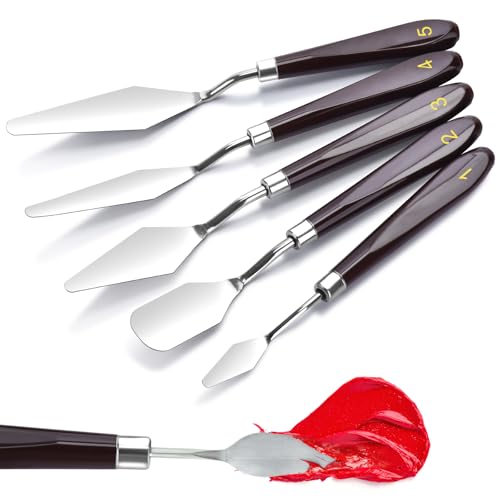
Herain’s knives use stainless steel for the handle as well as the blade, with a diamond-shaped grip. That is a practical advantage for oil painters who clean tools with solvent: there is no wood to swell or crack and no paint-soaked handle finish to peel. The listing notes smooth edges without burrs and blades that pick up heavy paint.
Steel handles are a little colder and heavier in the hand than wood, and the set is also marketed for cake decorating, so keep your painting knives separate from kitchen use.
Best suited for: Painters who clean knives with solvent or soap and water and want handles that will not deteriorate.
Key features:
- 5 styles of stainless steel knives
- Stainless steel diamond-shaped handles
- Smooth, burr-free edges
- Picks up heavy paint
Pros:
- Handles survive solvent and washing
- Tight blade joint per the listing
- Compact and durable
Cons:
- Steel grip may feel less comfortable for long sessions
- Fewer details on blade sizes
- Do not share with food use
Buying consideration: Never use knives that have touched oil paint, pigment or solvent for food, whatever the listing says about cake decorating.
6. EGYPAMID 5-Piece Palette Knife Set — Best Low-Cost Backup Set

EGYPAMID’s set covers five shapes with stainless steel blades and lightweight plastic handles. The listing explicitly mentions experimenting with thick acrylic and oil to build layers, and gives a useful cleaning tip: if paint sets hard, soak the blade briefly in warm water before cleaning, which applies to acrylic rather than oil.
It is a sensible spare set to keep in a plein air bag or for a student who is just trying knife painting for the first time.
Best suited for: Beginners trying knife painting and painters who want a spare set for travel or classes.
Key features:
- 5 knife shapes
- Stainless steel blades with flexible tips
- Lightweight plastic handles
Pros:
- Very inexpensive way to try knife painting
- Light for travel kits
- Easy wipe-clean
Cons:
- Plastic handles feel less substantial
- Few construction details
- Overlaps closely with other budget sets
Buying consideration: For oil, clean with a rag and solvent or oil and soap; warm-water soaking is for dried acrylic.
Buying Guide: How to Choose Palette Knives for Oil Painting
Look for a cranked neck
The bend between handle and blade lifts your hand clear of the surface. Without it, you will drag knuckles through wet oil every time you lay the blade flat.
Match blade shapes to the marks you make
Long, narrow blades lay down lines and edges. Wide trowel shapes spread flat planes of color, like skies or walls. Small pointed and diamond tips place accents and highlights. Rounded tips make softer, petal-like marks.
Flexibility versus stiffness
A flexible blade bends under pressure and lets you feather paint thinly or scrape back. A stiffer blade moves heavy, cold paint and impasto mediums. Budget sets tend to sit in the middle; if you mainly mix large amounts, you may want a separate stiff mixing knife later.
Handle material and cleaning
Wood handles are comfortable but dislike soaking. Plastic and steel handles tolerate solvent and soap better. Whatever you choose, wipe the blade clean immediately after use.
Edges and finish
Edges should be smooth with no burrs that can scratch the canvas or palette. Check the blade-to-neck joint; a loose blade is the most common failure in cheap knives.
One set or two
Many painters keep one knife only for mixing and others for painting. Sets with duplicates, like Cualork’s, make that easy.
Set Up the Rest of Your Oil Palette
Knives work best alongside a well-organized palette. Our guide on how to set up an oil painting palette covers color order and mixing space, and pairs naturally with learning how to use a palette cup for oil painting to keep your medium and solvent at hand.
Common Mistakes to Avoid
- Mixing with a brush instead of a knife, which wastes paint and wears brushes; the knife mixes faster and cleaner.
- Not wiping the blade between colors, which carries one mixture into the next.
- Pressing so hard that the blade bends permanently; let the flex do the work.
- Overworking knife marks; the appeal of knife painting is a confident, single pass.
- Leaving oil paint to dry on the blade, then scraping it off with something that scratches the steel.
- Painting thick impasto on a flexible stretched canvas without a firm support, which can crack later.
FAQs
Can I use the same palette knife for oil and acrylic?
Yes, stainless steel knives work with both. Clean them thoroughly between mediums, because dried acrylic flakes can end up in oil mixtures and vice versa.
How do I clean a palette knife after oil painting?
Wipe it with a rag while the paint is wet, then clean with a little solvent or vegetable oil, and finish with soap and water. Dry it fully to protect the joint.
Which palette knife shape should a beginner use first?
A medium trowel or pear-shaped blade is the most versatile. It mixes well and lays down both broad strokes and edges.
Do I need a stiff knife for mixing?
Not at first. A flexible set handles most mixing. Painters who mix large quantities of stiff paint often add a sturdier straight palette knife later.
Is knife painting good for beginners?
Yes. It encourages bold decisions and simple shapes, and it is a useful break from fiddly brushwork. Start with small panels to keep it manageable.
How long does thick knife-applied oil paint take to dry?
Much longer than thin layers; heavy impasto can take weeks to be touch dry and longer to cure. Some painters add an alkyd or impasto medium to speed it up.
Final Recommendation
For most oil painters, the CONDA set is the simplest good choice: five standard shapes, wood handles and protected blades. Choose the Cualork 10-piece set if you want spare knives to keep lights and darks clean, and the CllyCnny set if texture and scraping are part of your style.
The LIGHTWISH set is a close alternative to CONDA, the Herain all-steel knives make sense if you clean with solvent often, and EGYPAMID is a low-cost backup for travel or classes. None of these is a lifetime heirloom tool, but at these price tiers it is easy to try a few shapes and learn which ones you actually use.