
PaintingProGuide is reader-supported. When you buy through links on this page we may earn an affiliate commission at no extra cost to you.
Sand art kits look simple: peel a section of sticky board, sprinkle colored sand, tap off the extra, repeat. In practice, the experience depends on details that are easy to miss on a product page. How many colors are there, are the boards pre-numbered or free-form, does the kit include a tray to catch spills, and is the recommended age actually right for your child?
We compared six sand art painting kits, from peel-and-stick color-by-number boards for preschoolers to a mixed-media sand paint set for older kids and a 30-pack for parties. The best sand art painting kit for your family will depend mostly on age and how much guidance the child wants.
Quick answer: For most kids 5 and up, the Klever Kits Glow Sand Art Kit is the best sand art painting kit here: 14 sand colors including 2 glow-in-the-dark, 6 themed boards, 4 blank sheets and a mess-free tray. Preschoolers do better with the numbered READY 2 LEARN Sea Life kit, and older kids who want to actually paint with sand should look at the Faber-Castell 3D Sand Painting Kit.
Our Top Picks at a Glance
- Klever Kits Glow Sand Art Kit — Best overall sand art kit
- Faber-Castell 3D Sand Painting Kit — Best for real sand painting, ages 6+
- READY 2 LEARN Sand Art, Sea Life — Best color-by-number for young kids
- MoimTech Princess and Castle Sand Art Kit — Best themed kit with tray
- Zddaoole 32-Piece Sand Art Kit — Best value for free-form designs
- MLOLM 30-Set Mandala Sand Art Kit — Best for parties and groups
| Product | Best For | Key Spec | Key Strength | Price Tier |
|---|---|---|---|---|
| Klever Kits Glow Sand Art | Ages 5+, independent play | 14 colors (2 glow), 6 boards, 4 blank sheets | Tray and video guide | $$ |
| Faber-Castell 3D Sand Painting | Ages 6+, mixed media | 5 sand paints, 12 watercolors, 5 boards | Paint with sand texture | $$ |
| READY 2 LEARN Sea Life | Ages 4-6, guided | 4 scenes, 10 colors, styluses | Numbered stickers | $$ |
| MoimTech Princess | Princess fans, 3+ | 16 designs, 12 colors, tray, brush | Most designs with tray | $$ |
| Zddaoole 32-Piece | Budget, free-form | 12 colors, 20 cards, 1.25 oz bottles | Most cards per price | $ |
| MLOLM 30-Set Mandala | Parties, Diwali, groups | 30 kits, 10 colors, 5 in designs | Most kits per box | $$ |
How We Chose
We did not complete these kits ourselves. Picks are based on the Amazon listing details and specifications checked in October 2026, how well each kit’s contents, age range and design style fit typical use, and how widely each product is reviewed by Amazon buyers.
Our criteria:
- Real sand: we dropped a kit that, despite its title, describes sticker mosaics rather than sand.
- Age fit: clear minimum ages and design complexity that matches.
- Mess control: trays, sealed bottles and resealable lids.
- Guidance: numbered boards for younger kids, blank sheets for older ones.
- Value: number of boards and sand quantity for the price tier.
How Sand Art Kits Work
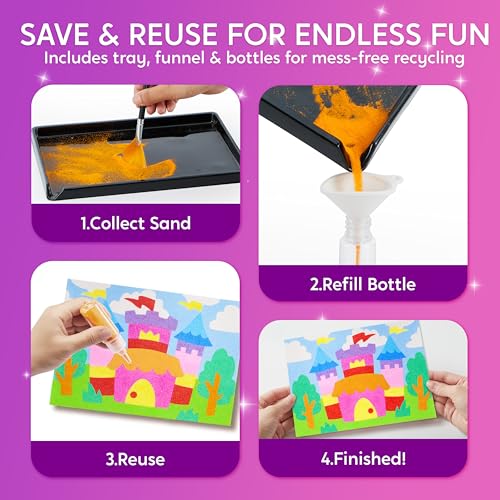
Most sand art kits use pre-cut adhesive boards. Each section is covered by a peel-off layer, sometimes numbered to match a sand color. A child peels one section, pours or sprinkles sand onto the exposed glue, presses gently, then tips off the excess back into the bottle or a tray. Working from dark colors to light keeps colors from contaminating each other.
A second type, like the Faber-Castell kit, uses sand mixed into squeeze-tube paint. Children paint textured pictures rather than filling glue sections. It is closer to real painting and better for older kids who want more freedom.
Setting Up a Low-Stress Sand Art Session
A little preparation turns sand art from a cleanup chore into a calm half hour. Cover the table with a vinyl tablecloth or newspaper, and give each child a tray or rimmed baking sheet so loose sand has somewhere to go. Line up the bottles in the order the board needs them, darkest first, and open only the colors in use so a tipped bottle does not empty itself.
Show younger children how to peel one small section, pour, press gently with a finger, and then tip the board on its edge over the tray. Once they have done it twice, most kids settle into the rhythm. Keep a small funnel or folded paper handy for pouring leftover sand back into bottles at the end.
Finally, plan where finished pieces will go. Sand boards are best stored flat or framed, since loose grains can shed if the pictures are stacked face to face. A shallow box or a clear frame keeps the work intact long enough to show off.
Best Sand Art Painting Kits Reviewed
1. Klever Kits Glow Sand Art Kit — Best Overall Sand Art Kit
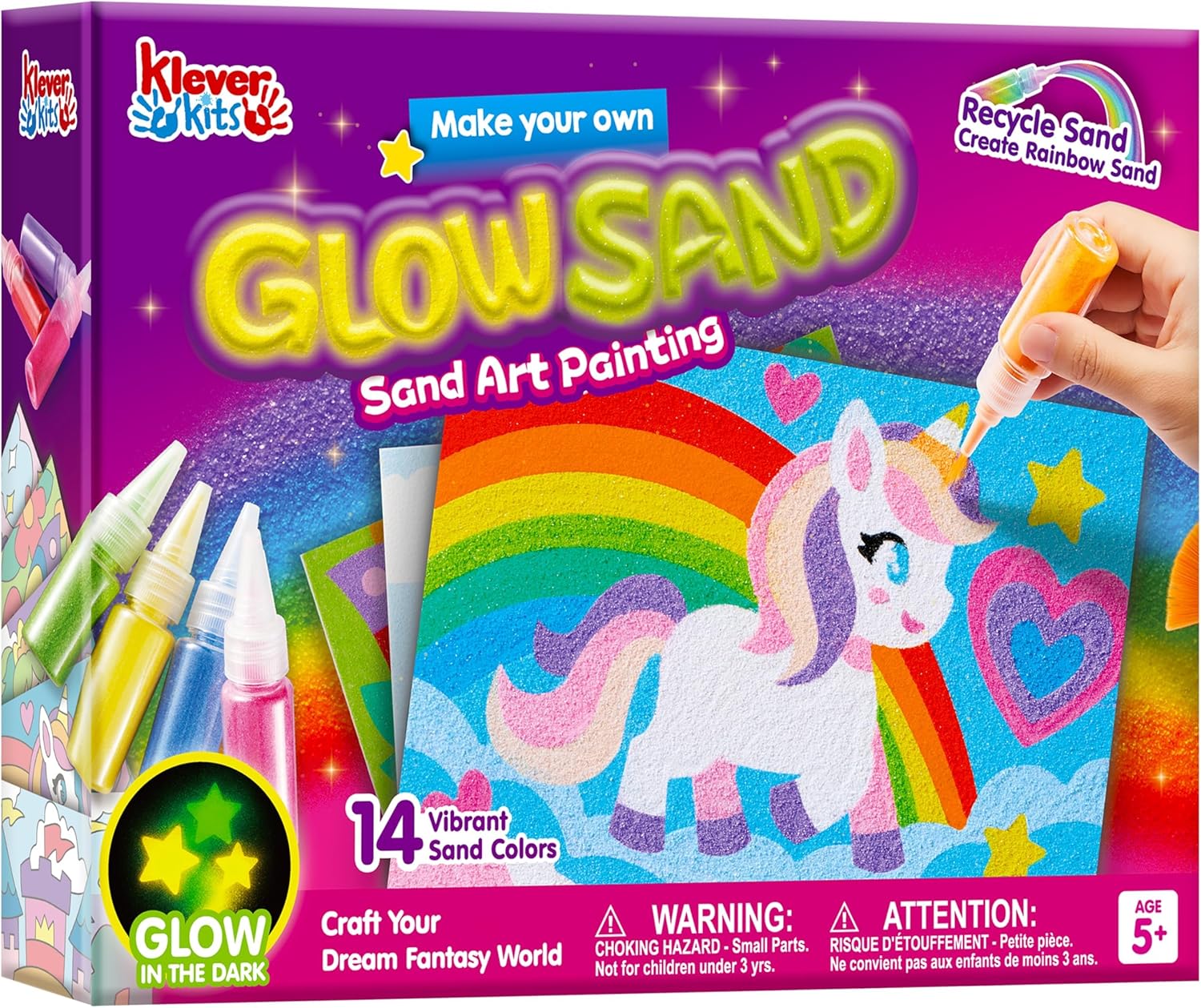
Klever Kits includes 12 bright sand colors plus 2 glow-in-the-dark colors, 6 pre-cut themed boards (unicorn, mermaid, castle, fairy, princess and butterfly) and 4 blank DIY sheets. All sand comes in individual bottles, and a mess-free tray catches spills.
The blank sheets and a video tutorial let kids move beyond the templates. There is also an empty bottle for collecting leftover sand into a custom rainbow blend, which reduces waste. The kit is recommended for ages 5 and up.
Best suited for: Kids 5 and up, gifts, rainy days and children who enjoy both guided and free designs.
Key features:
- 12 bright + 2 glow-in-the-dark sand colors
- 6 themed pre-cut boards
- 4 blank DIY sheets
- Mess-free tray
- Video tutorial
Pros:
- Glow sand adds a fun twist
- Blank sheets encourage creativity
- Tray contains mess
Cons and limitations:
- Fantasy themes may not appeal to every child
- Mid price tier
- Glow effect depends on light exposure
Buying consideration: The best all-round kit for kids who are old enough to work independently.
2. Faber-Castell 3D Sand Painting Kit — Best for Real Sand Painting, Ages 6+

Faber-Castell’s kit is the one that actually involves painting. It includes 5 sand paint colors in squeeze tubes, 12 watercolors, 5 art boards, a texture tool, a palette knife, a paintbrush, loose sand and twist-top containers for mixing DIY sand paint colors.
Kids paint watercolor backgrounds, then add raised, textured sand paint on top. The result is a 3D mixed-media picture. It is recommended for ages 6 and up, with a stated age range up to 12.
Best suited for: Kids 6 to 12 who like painting and want more freedom than sticker-style kits.
Key features:
- 5 sand paint squeeze tubes
- 12 watercolors
- 5 art boards
- Texture tool, palette knife, brush
- Loose sand and mixing containers
Pros:
- True painting experience
- Introduces mixed media and color mixing
- Trusted art brand
Cons and limitations:
- Only 5 projects
- Messier than peel-and-stick kits
- Too advanced for preschoolers
Buying consideration: Choose this for creative older kids rather than for guided coloring.
3. READY 2 LEARN Sand Art Painting, Sea Life — Best Color-by-Number for Young Kids

READY 2 LEARN’s kit has four underwater scenes with sharks, starfish and seahorses, and 10 sand colors. Boards are numbered, and styluses help peel stickers one at a time. Kids work from dark to light, which keeps colors clean.
No glue or paint is required. The listing suggests ages 4 to 6 and encourages framing finished pieces.
Best suited for: Preschoolers and early elementary kids who need clear guidance.
Key features:
- 4 sea life designs
- 10 sand colors
- Color-by-number boards
- Styluses for peeling
Pros:
- Numbers make it easy to follow
- Styluses help small fingers
- Finished scenes can be framed
Cons and limitations:
- Only four designs
- Limited free creativity
- Sea theme only
Buying consideration: The best pick for younger kids who need step-by-step structure.
4. MoimTech Princess and Castle Sand Art Kit — Best Themed Kit with Tray

MoimTech includes 16 designs (12 princess characters and 4 castles), 12 mini sand bottles, a brush and a spill-proof reusable tray. Sixteen designs is the most in this roundup apart from the free-form card sets.
The listing includes a clear choking hazard warning and says it is not suitable for children under 3.
Best suited for: Princess fans, gifts and kids who want lots of small projects.
Key features:
- 16 designs: 12 princesses, 4 castles
- 12 mini sand bottles
- Brush and reusable tray
- Not for under 3
Pros:
- Many designs
- Tray included
- Gift-ready box
Cons and limitations:
- Mini bottles may run low on popular colors
- Theme-specific
- Small parts
Buying consideration: Ideal for kids who love princess themes and want several quick projects.
5. Zddaoole 32-Piece Sand Art Kit — Best Value for Free-Form Designs

Zddaoole includes 12 colored sand bottles (about 1.25 oz each), 20 blank pattern cards in two sizes and a stick. Medium cards measure 4.7 x 6.4 inches and small ones 3.4 x 4.5 inches.
The bottles seal well, according to the listing; you cut the cap tip with scissors to open them. The brand also suggests using the sand with canvas and glue, or layering it in vases.
Best suited for: Budget-conscious families, kids who like many small projects, and crafters who want extra sand for other uses.
Key features:
- 12 sand colors in sealed bottles
- 20 pattern cards (two sizes)
- Stick tool
- 1.25 oz bottles
Pros:
- Most cards for the price
- Sand works for other crafts
- Low price tier
Cons and limitations:
- No tray
- Cards are small
- Fewer instructions than guided kits
Buying consideration: Add a baking tray to catch spills and this becomes an excellent value kit.
6. MLOLM 30-Set Mandala Sand Art Kit — Best for Parties and Groups

MLOLM’s box contains 30 self-adhesive mandala flower templates in 6 designs, 10 colored sands and 2 spoons. Each design is about 5 inches. The listing frames it around Diwali and Rangoli, and the geometric mandala designs suit older kids and adults too.
Thirty kits in one box make it practical for classrooms, festivals, birthday parties and community events.
Best suited for: Classrooms, Diwali celebrations, birthday parties and mixed-age groups.
Key features:
- 30 mandala templates, 6 designs
- 10 sand colors
- 2 spoons
- About 5 inch designs
Pros:
- Most kits per box
- Mandala designs suit older kids and adults
- Cultural celebration theme
Cons and limitations:
- Sand must be shared across many kits
- No tray
- Small designs
Buying consideration: Ideal for group activities. Set out sand in shallow bowls with spoons for sharing.
Buying Guide: How to Choose a Sand Art Painting Kit
Choosing the right sand art kit comes down to the child’s age, patience and the mess you can handle.
Age and Skill
Ages 3 to 4 need large sections, few colors and adult help. Ages 4 to 6 do well with numbered boards. Ages 6 and up can handle detailed designs, blank sheets or sand paint. Always check the listing’s minimum age and choking warnings.
Guided or Free-Form
Color-by-number boards build confidence and produce tidy results. Blank sheets and sand paint encourage creativity but require more planning. Kits like Klever Kits offer both.
Number of Colors
More colors give more possibilities, but young kids do fine with 10 or so. Glow-in-the-dark sand adds novelty.
Mess Control
A tray catches loose sand and lets kids pour excess back into bottles. If a kit has no tray, use a baking sheet or shallow box lid.
Sand Quantity
Small bottles may run out on large areas. Kits that encourage collecting leftover sand reduce waste.
Group Size
For parties and classes, multi-kit boxes like MLOLM’s 30 sets are more practical than buying several individual kits.
Sand Art Versus Other Kids’ Art Kits
Compared with paint-by-number kits, sand art is drier and faster: there is no waiting for layers to dry, no brushes to wash, and a small picture can be finished in one sitting. Compared with diamond or sticker mosaics, it is more tactile and more forgiving, because a misplaced pinch of sand can usually be tipped off before you press it down.
The trade-off is precision. Sand art produces bold, flat areas of color rather than fine detail, so it suits cartoon characters, sea creatures, mandalas and simple scenes. Children who want realistic pictures will get more satisfaction from a painting kit, while those who like quick, colorful results tend to love sand.
Make Your Own Sand Art
Once kids have finished the boards, they can keep going with homemade designs. Our guide to DIY sand art painting shows how to make sand pictures with glue, cardstock and colored sand. Hosting a group? Browse our sip and paint ideas for adult-friendly projects to run alongside a kids’ sand art table.
Common Mistakes to Avoid
- Peeling all sections at once, which mixes colors.
- Starting with light colors; work dark to light for cleaner results.
- Buying detailed designs for preschoolers.
- Skipping a tray and spending an hour cleaning sand from the floor.
- Leaving bottles open, which spills sand and lets it collect dust.
- Ignoring small-parts warnings for children under 3.
FAQs
What age is sand art suitable for?
Most sand art kits are labeled for ages 3 or older because of small parts. Peel-and-stick numbered boards suit ages 4 to 6, and sand painting kits like Faber-Castell’s suit ages 6 and up.
How do you make sand art less messy?
Use a tray or baking sheet, peel one section at a time, and pour excess sand back into bottles. Kits with included trays make this easier.
Can you reuse leftover sand?
Yes. Pour excess sand back into its bottle, or collect mixed leftovers into a separate container for rainbow designs or other crafts.
What is the difference between sand art and sand painting?
Sand art usually means sprinkling sand onto adhesive boards. Sand painting can mean using paint mixed with sand to create textured pictures, as in the Faber-Castell kit.
How do I preserve finished sand art?
Press sand firmly onto the adhesive, tap off excess, and display finished pieces in a frame. A light spray of clear sealer can help hold loose grains.
How long does a sand art board take to finish?
Small boards and cards often take 15 to 30 minutes. Larger themed boards with many sections can take an hour or more, which makes them good for rainy afternoons or quiet time.
Can adults enjoy sand art kits?
Yes. Detailed designs such as the MLOLM mandala templates suit teens and adults, and sand art makes a relaxed group activity at parties and festivals.
Is sand art good for motor skills?
Many kits highlight hand-eye coordination and fine motor practice from peeling, pouring and pressing sand. It is also a calm, screen-free activity.
Final Recommendation
For most kids 5 and up, the Klever Kits Glow Sand Art Kit offers the best mix of guided boards, blank sheets and a tray. Younger children are better served by the numbered READY 2 LEARN Sea Life kit, while creative kids 6 and older will enjoy the Faber-Castell 3D Sand Painting Kit.
Princess fans should look at the MoimTech kit, budget shoppers can stretch further with the Zddaoole 32-piece set, and for parties or festivals, the MLOLM 30-set mandala box covers a crowd.



One Comment