

PaintingProGuide is reader-supported. When you buy through links on this page we may earn an affiliate commission at no extra cost to you.
Good watercolor brushes do two jobs at once. They soak up a generous charge of water and pigment, then release it in a controlled flow, and they come back to a sharp point or a clean edge every time you lift them. That is why watercolorists care so much about fiber: soft, absorbent hair such as squirrel or a synthetic that imitates it behaves very differently from the springy nylon used for acrylics.
The best watercolor brushes for most painters today are synthetic squirrel sets, which approach natural-hair water capacity at a fraction of the cost and survive beginners’ mistakes. This guide ranks them alongside budget nylon rounds, a mixed-shape set for multi-media painters, and an ox-ear liner set for long, flowing line work.
Quick answer: The ARTEGRIA 10-piece Synthetic Squirrel set is the best watercolor brush set for most painters: soft, absorbent fibers in rounds from #0 to #12 plus a dagger, oval wash and flat, packed with a storage tube and travel bag. The Fuumuui 10-piece synthetic squirrel set is a close alternative with a cat’s tongue and dagger. On a tight budget, the FENORKEY 12-piece nylon rounds cover every size from #1 to #12.
Our Top Picks at a Glance
- ARTEGRIA Intuition Series 10 Synthetic Squirrel Brushes — Best overall watercolor brush set
- Fuumuui 10 Pcs Synthetic Squirrel Watercolor Brushes — Best shape variety for watercolor
- FENORKEY 12 Pcs Round Watercolor Brushes — Best budget round set
- ARTIFY Long Liner Brushes (Ox Ear Hair) — Best for long lines and botanical detail
- Sdanart 10 PCS Watercolor Brushes — Best for experimenting with specialty shapes
- Benicci 12-Piece Brush Set — Best for painters who switch between watercolor and acrylic
- AROIC 10 Pcs Paint Brushes — Best for kids and casual painters
| Product | Best For | Key Spec | Key Strength | Price Tier |
|---|---|---|---|---|
| ARTEGRIA 10 Synthetic Squirrel | Most watercolorists | Rounds #0–#12, dagger, oval wash, flat | High water capacity, storage tube | $$ |
| Fuumuui 10 Synthetic Squirrel | Shape variety | Rounds, flats, cat’s tongue, dagger, oval wash | Soft fibers, short handles | $$ |
| FENORKEY 12 Round | Budget beginners | Nylon rounds #1–#12 | Full size run | $ |
| ARTIFY Long Liners | Lines and botanicals | Ox ear hair #1, #3, #5 | Long continuous strokes | $$ |
| Sdanart 10 PCS | Specialty shapes | Rigger, rounds to #16, dagger | Shape variety | $ |
| Benicci 12-Piece | Mixed media | Flat, round, fan, filbert | Works across media | $ |
| AROIC 10 Pcs | Kids and casual use | 10 nylon brushes | Low cost | $ |
How We Chose
Our picks come from the Amazon listing details and specifications as checked in October 2026, how well each set’s fiber, shapes and sizes fit watercolor painting, and how widely each set is reviewed by Amazon buyers. We have not painted with these brushes; descriptions of water capacity and spring come from the listings and from established differences between brush fibers.
- Fiber: synthetic squirrel and natural hair for water capacity; nylon for budget and durability.
- Shapes: rounds first, then flats, ovals, daggers and liners.
- Size range: small enough for details, large enough for washes.
- Construction: crimped ferrules, balanced handles and tip protection.
- Extras: storage tubes and cases that protect points.
Watercolor Brush Fibers Explained
Natural squirrel holds an enormous amount of water and releases it gently, which is ideal for washes, but it has little spring. Kolinsky and other sables combine good capacity with snap and a fine point, at a premium price. Synthetic squirrel is engineered to mimic squirrel’s softness and capacity; modern versions are excellent value. Nylon is springy and durable, holds less water, and is often sold as all-media brushes. Ox ear hair, used in the ARTIFY liners, is a natural hair valued for its long length and smooth release.
For most watercolorists, a synthetic squirrel set is the sweet spot: better water handling than nylon and far less fragile and costly than natural hair.
Best Watercolor Brushes Reviewed
1. ARTEGRIA Intuition Series Watercolor Brush Set (10 Synthetic Squirrel) — Best Overall Watercolor Brush Set

ARTEGRIA’s set is designed specifically for water-based paints. It includes fine-tipped rounds #0, #3, #6, #8, #10 and #12, a 3/8-inch dagger striper, a 3/4-inch oval wash (cat’s tongue) and a #6 3/4-inch flat. That spread covers details, everyday painting, broad washes and leaf-like dagger strokes.
The soft synthetic squirrel fibers are described as having great liquid holding capacity with good spring and shape holding. Double-crimped ferrules and lightweight handles are listed, and the set comes with a storage tube, a black velvet travel bag, a mini guide and an ebook.
For a single purchase that covers almost every watercolor need, this is the most complete set here.
Best suited for: Beginners through intermediate watercolorists who want one well-designed set for washes and details.
Key features (from the listing):
- 10 synthetic squirrel brushes
- Rounds #0, #3, #6, #8, #10, #12
- Dagger striper 3/8″, oval wash 3/4″, flat 3/4″
- Double-crimped ferrules
- Storage tube and velvet travel bag
Pros:
- Designed for watercolor specifically
- Excellent shape and size coverage
- Good storage and travel protection
Cons and limitations:
- Synthetic squirrel has less snap than nylon
- No rigger
- Mid tier compared with nylon sets
Buying consideration: Soft fibers need a gentle touch. Do not scrub with them; use a stiffer nylon brush for lifting and scrubbing.
2. Fuumuui 10 Pcs Synthetic Squirrel Watercolor Brushes — Best Shape Variety
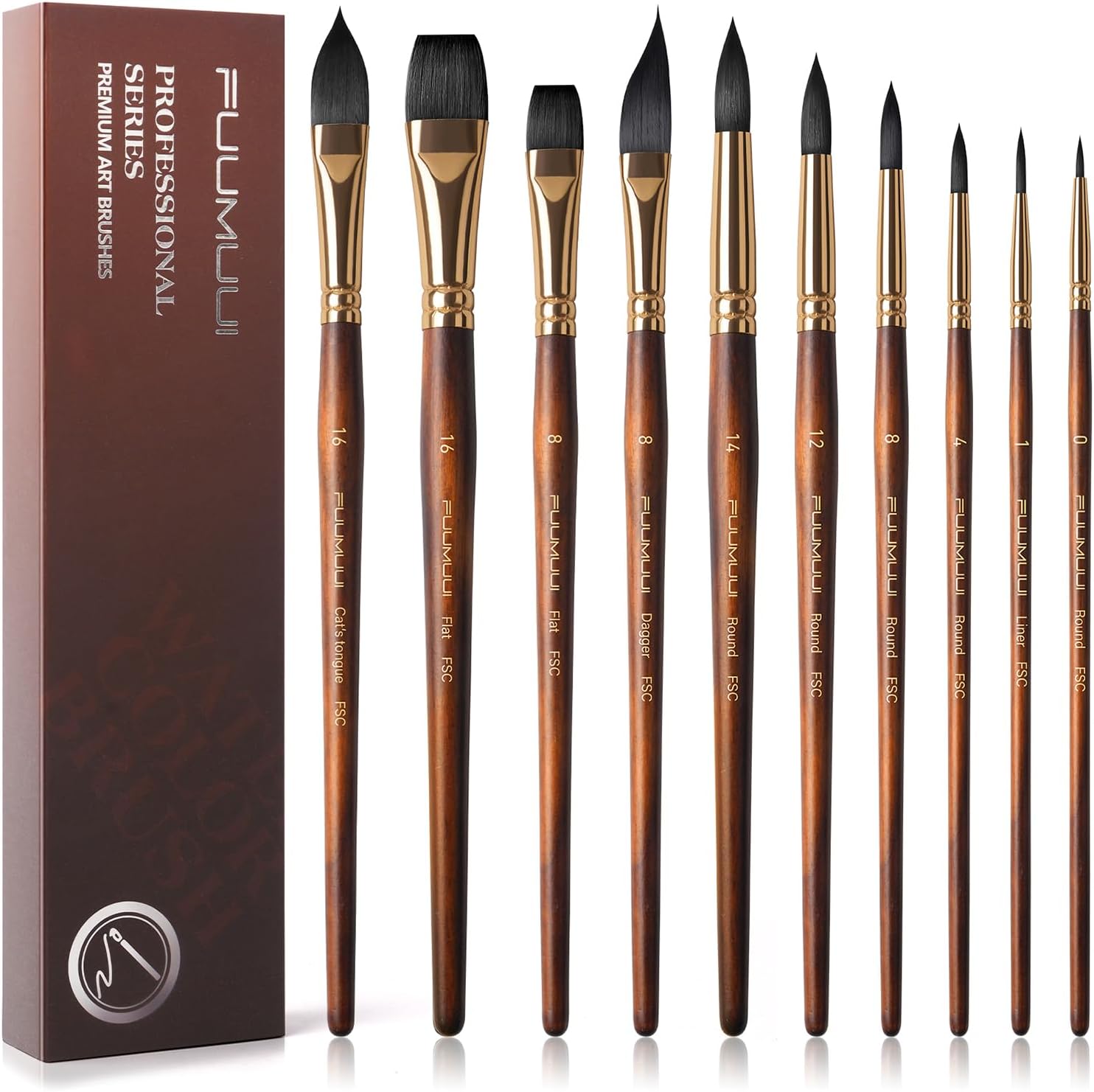
Fuumuui offers pointed rounds, flats, a cat’s tongue, a dagger and an oval wash, all in soft synthetic squirrel. The listing emphasizes color flowing evenly from the point with enough carrying capacity for gestural strokes, which is what you want in watercolor.
Aluminum ferrules resist corrosion, and polished birch handles are short and ergonomic for desk work. The set is also suitable for gouache, fluid acrylic, ink and tempera.
Best suited for: Watercolorists who want to explore cat’s tongue and dagger shapes alongside rounds.
Key features (from the listing):
- 10 synthetic squirrel brushes
- Pointed rounds, flats, cat’s tongue, dagger, oval wash
- Aluminum ferrules
- Short birch handles
Pros:
- Good variety of watercolor shapes
- Soft, absorbent fibers
- Short handles suit desk painting
Cons and limitations:
- Fewer small rounds than ARTEGRIA
- No storage case listed
- Short handles less suited to easel painting
Buying consideration: The cat’s tongue is a great all-rounder: it lays washes with its body and draws lines with its point.
3. FENORKEY 12 Pcs Round Watercolor Brushes — Best Budget Round Set

FENORKEY’s 12 nylon rounds, sizes #1 through #12, are the cheapest way to have every round size on the table. Nylon holds less water than squirrel but springs back well and survives scrubbing, lifting and the occasional dip in acrylic.
Aluminum crimped ferrules and lacquered waterproof handles are listed. For beginners, the full size run makes it easy to discover which sizes you use most.
Best suited for: Budget beginners, students and painters who want durable rounds for practice.
Key features (from the listing):
- 12 nylon rounds, #1–#12
- Aluminum crimped ferrules
- Lacquered waterproof handles
- For watercolor, acrylic and gouache
Pros:
- Full size run
- Durable
- Low tier
Cons and limitations:
- Less water capacity than squirrel
- Rounds only
- Points may wear faster
Buying consideration: Pair these with one large synthetic squirrel mop or oval wash for skies, and you have a capable budget kit.
4. ARTIFY Long Liner Brushes, Ox Ear Hair (#1, #3, #5) — Best for Long Lines and Botanical Detail

ARTIFY’s three liners use imported ox ear hair with long, flexible bristles that hold plenty of paint and water and release it evenly. The listing focuses on pulling long, continuous lines with fewer reloads, and on responsive control from hair-fine to wider strokes.
That makes them ideal for branches, vines, grass, whiskers and lettering. Gold-plated copper ferrules, birch handles and a protective storage box are included.
Best suited for: Botanical painters, landscape painters and letterers who need long, flowing lines.
Key features (from the listing):
- 3 liner brushes: #1, #3, #5
- Imported ox ear hair
- Gold-plated copper ferrules
- Birch handles, protective box
Pros:
- Long strokes without reloading
- Natural hair release
- Three useful line widths
Cons and limitations:
- Specialist brushes only
- Natural hair needs care
- Mid tier for three brushes
Buying consideration: Load liners fully and pull with a relaxed grip from the end of the handle for the most natural lines.
5. Sdanart 10 PCS Watercolor Brushes — Best for Experimenting with Shapes

Sdanart mixes a rigger #1, fine-tip rounds #2, #10, #12 and #16, a dagger #10 and other shapes in nylon. It is a lower-tier way to try specialty brushes such as daggers and riggers before upgrading.
Handles are lacquered in a mahogany color. The large #16 round is unusual at this tier and useful for loose washes.
Best suited for: Painters who want to experiment with shapes on a budget.
Key features (from the listing):
- 10 nylon brushes, mixed shapes
- Rigger #1, rounds up to #16, dagger #10
- Lacquered wooden handles
Pros:
- Large #16 round
- Includes rigger and dagger
- Low tier
Cons and limitations:
- Nylon holds less water
- Listing is partly keyword lists
- Fewer mid-size rounds
Buying consideration: Use the rigger for branches and the #16 for skies; the combination covers a surprising amount of landscape painting.
6. Benicci Professional Artist Paint Brush Set of 12 — Best for Multi-Media Painters

Benicci’s 12-piece set includes flat, round, fan and filbert shapes in nylon and is designed for acrylic, watercolor and mixed media. It is not a watercolor-specialist set, but it suits painters who switch between media.
Best suited for: Mixed-media painters and classes covering several media.
Key features (from the listing):
- 12 nylon brushes
- Flat, round, fan, filbert
- Ergonomic wooden handles
Pros:
- Versatile across media
- Durable nylon
- Includes flats for washes
Cons and limitations:
- Not optimized for watercolor water capacity
- Fan and filbert less useful in watercolor
- Fewer rounds
Buying consideration: Keep a dedicated set for watercolor if you can; acrylic residue changes how brushes handle water.
7. AROIC 10 Pcs Paint Brushes — Best for Kids and Casual Painters

AROIC’s ten nylon brushes in assorted shapes are general-purpose brushes for watercolor, acrylic, gouache and crafts. Anti-shedding bristles, nickel ferrules and solid wood handles are listed.
They are a sensible pick for children, classrooms and casual painting where brushes may be mistreated.
Best suited for: Kids, classrooms and casual painters.
Key features (from the listing):
- 10 nylon brushes, assorted shapes
- Nickel ferrules
- Solid wood handles
Pros:
- Low cost
- Durable
- Multi-purpose
Cons and limitations:
- Not watercolor-specific
- Limited water capacity
- Shapes and sizes not detailed
Buying consideration: For children, short handles and sturdy nylon brushes are more forgiving than soft watercolor fibers.
Building a Watercolor Brush Kit in Stages
You do not need ten brushes on day one, but buying a good set and then adding one or two specialists is usually cheaper than collecting single brushes. Here is a sensible progression.
Stage one: the core
A medium round around #8, a large round or oval wash for skies and backgrounds, and a small round for details. Synthetic squirrel rounds work best here because their water capacity keeps washes even. Most of a painting can be completed with just these three.
Stage two: edges and lines
Add a flat for crisp edges, architecture and even graded washes, and a liner or rigger for branches, grasses and lettering. These two shapes solve problems that rounds handle awkwardly.
Stage three: expressive shapes
Daggers make leaves and petals in one stroke, cat’s tongue or oval brushes combine wash and line work, and mops hold huge amounts of water for wet-in-wet skies. Add these when you know which subjects you paint most.
Stage four: a premium round
Once your habits are settled, one natural-hair or high-end synthetic round in your most-used size is the upgrade you will feel most. Keep your synthetic set for rough work, masking fluid and scrubbing.
Buying Guide: How to Choose Watercolor Brushes
Prioritize water capacity
Watercolor depends on how much water a brush carries. Synthetic squirrel and natural hair carry more than nylon, which helps washes stay even and wet edges stay alive.
Check the point
A round should form a sharp point when wet. Rounds with good points can paint both broad strokes and fine details.
Cover three size zones
Have something small for details, something medium for general painting, and something large or an oval wash for big areas.
Add one or two specialty shapes
A liner or rigger for lines and a dagger or cat’s tongue for leaves and petals add a lot of range.
Protect the tips
Storage tubes, cases or rolls protect brushes in transport. Soft fibers bend easily if stored loosely.
Match handle length to posture
Short handles suit painting at a desk, which is how most watercolor is done. Longer handles suit easel work.
Brand Reviews and Care
Looking at premium brands? Read our Raphael watercolor brush review, our Princeton watercolor brush review, our Blick watercolor brush review and our Arteza watercolor brush review for detailed brand comparisons. Whatever you buy, our guide on how to care for watercolor brushes will help them last for years.
Common Mistakes to Avoid
- Buying only small brushes and painting big areas with them.
- Scrubbing paper with soft squirrel brushes, which splays the fibers.
- Leaving brushes standing in water.
- Using watercolor brushes with acrylic, then back in watercolor.
- Storing brushes wet in sealed containers.
- Ignoring the point when choosing rounds.
FAQs
What are the best watercolor brushes for beginners?
A synthetic squirrel set such as ARTEGRIA or Fuumuui offers good water capacity and useful shapes at a reasonable tier. Budget nylon rounds from FENORKEY are also fine for learning.
Are synthetic watercolor brushes good?
Yes. Modern synthetic squirrel brushes hold a lot of water and are durable and affordable. Nylon synthetics hold less water but spring back well.
What watercolor brush shapes do I need?
Start with rounds in small, medium and large sizes, then add a flat or oval wash for big areas and a liner for long lines.
Do I need natural hair watercolor brushes?
Not to start. Natural hair, such as squirrel and sable, has advantages in capacity and point, but synthetics now perform well at much lower cost.
How do I clean watercolor brushes?
Rinse in clean water, wash occasionally with mild soap, reshape the tip and let brushes dry flat or tip-down. Never let them rest on their tips in water.
Can I use acrylic brushes for watercolor?
You can, but stiffer acrylic brushes hold less water and can feel scratchy. Watercolor-specific brushes make washes and soft edges much easier.
Final Recommendation
Most painters will be happiest with the ARTEGRIA synthetic squirrel set, which covers washes and details and protects brushes in storage. Choose Fuumuui if you want a cat’s tongue and more shape variety, and FENORKEY if budget comes first. Add the ARTIFY liners for long, flowing lines, and keep Benicci or AROIC for mixed media or children.





One Comment