
PaintingProGuide is reader-supported. When you buy through links on this page we may earn an affiliate commission at no extra cost to you.
If you are shopping for a Grumbacher acrylic brush, the listing most buyers land on today is the Grumbacher Academy Hog Bristle 3-Brush Set #1, a trio of stiff natural-bristle brushes made for oil and acrylic paint. It is a narrow, focused set rather than a starter kit, and that matters: it excels at pushing thick paint around and does very little for fine detail or thin washes.
This review breaks down what the Academy set includes, the jobs hog bristle does well with acrylics, where it falls short, and which three alternatives fill the gaps. Grumbacher is a long-running American art brand, but the name on the handle matters less than whether the fiber and shape match the paint you actually use.
Quick answer: The Grumbacher Academy Hog Bristle 3-Brush Set #1 is the pick if you paint with heavy body acrylics and want textured, visible brushwork from a filbert, flat and bright. If you work with softer or more fluid acrylics and want cleaner edges, the Princeton Aspen 6500 synthetic set is the better match. If you want one purchase that covers every shape for practice and experimenting, the Fuumuui 26-piece set is the broad-coverage option.
Our Top Picks at a Glance
- Grumbacher Academy Hog Bristle 3-Brush Set #1 — Best for textured heavy body acrylic and oil work
- Princeton Aspen 6500 Series 5-Piece Set — Best synthetic alternative for smooth acrylic application and detail
- Fuumuui 26-Piece Professional Brush Set — Best for beginners who want every shape in one roll
- Transon Red Sable Filbert Set (6 pcs) — Best for soft blending in thinned acrylic, gouache and watercolor
| Product | Best For | Key Spec | Key Strength | Price Tier |
|---|---|---|---|---|
| Grumbacher Academy Hog Bristle Set #1 | Heavy body acrylic texture | Filbert 10, Flat 12, Bright 12; hog bristle | Stiff, springy bristle moves thick paint | $$ |
| Princeton Aspen 6500 (5 pc) | Smooth acrylic layers | Stiff synthetic; round, bright, flat, filbert, liner | Holds shape, resists solvents | $$$ |
| Fuumuui 26 pcs | Learning all shapes | Synthetic nylon; 15+ shapes; canvas roll | Breadth of shapes for the price | $$ |
| Transon Red Sable Filbert (6 pc) | Soft blending | Natural sable; sizes 2 to 12 | High liquid capacity, soft edges | $$ |
How We Chose
We did not paint with these brushes. The picks come from the Amazon listing details and specifications checked in October 2026, how well each set’s fiber, shapes and sizes fit acrylic painting, and how widely each product is reviewed by Amazon buyers. When a listing leaves something out, such as handle length, we say so instead of guessing.
Only four listings fit this query well, so this page covers four brushes rather than padding the list with off-topic sets. The criteria we weighed:
- Fiber type: hog bristle, synthetic or natural soft hair, because it decides how the brush handles acrylic’s fast drying and its thickness range.
- Shapes included: flats, brights and filberts for blocking in; rounds and liners for detail.
- Size spread: whether the set covers both broad passages and smaller marks.
- Durability signals: ferrule construction, shape retention claims and cleaning guidance in the listing.
- Fit for acrylic specifically: some brushes cross over well from oil; some do not.
Grumbacher Acrylic Brush Review: The Academy Hog Bristle Set
1. Grumbacher Academy Hog Bristle 3-Brush Set #1 — Best for Textured Heavy Body Acrylic

The Academy Set #1 (model 760.SET1) contains three brushes: a Filbert 10, a Flat 12 and a Bright 12. All three use hog bristle, which the listing describes as springy, tough and stiff, and the bristle type is noted as flagged. Flagged tips are the natural split ends of hog hair; they hold a little more paint at the tip and soften the edge of a stroke slightly compared with a cut synthetic.
The listing is clear about the job: spreading medium to thick paint smoothly and evenly, and creating textural effects. That is exactly where hog bristle shines with acrylics. Heavy body acrylic is stiff enough that a soft brush just slides over it; a firm bristle grips the paint and leaves ridges, broken color and directional marks that read as confident brushwork. If you like impasto-leaning acrylic painting, alla prima landscapes or loose still lifes, this trio covers the core of the work.
The three shapes complement each other. The flat 12 lays in large shapes and crisp, wide strokes. The bright 12, with its shorter hair, gives more control and pushes thick paint harder. The filbert 10 blends edges and handles organic forms such as clouds, foliage and skin. Many painters do most of a painting with just these three.
Best suited for: acrylic painters using heavy body or thick student paint on canvas or panel who want visible texture, and oil painters who also dabble in acrylic.
Key features (from the listing):
- Three brushes: Filbert 10, Flat 12 and Bright 12
- Natural hog bristle with flagged tips
- Listed for oil and acrylic paints
- Nickel-colored ferrules; sizes listed as 10 mm, 12 mm and 12 mm
- Designed for medium to thick paint and textural effects
Pros:
- Stiff, springy bristle moves heavy body acrylic without bending flat
- Three most useful blocking-in shapes in one set
- Natural texture-making ability that synthetics struggle to copy
- Crosses over to oil painting if you switch mediums later
Cons / limitations:
- No round, liner or small sizes, so detail work needs another brush
- Hog bristle can soften and splay over time with water-based paint if left soaking
- Not suited to fluid acrylics, glazing or smooth, brushmark-free finishes
- Listing does not state handle length
Buying consideration: Treat this set as the workhorse core of a brush kit, not the whole kit. Pair it with a small synthetic round or liner for signatures, highlights and fine lines, and you have a complete acrylic setup.
Hog bristle and acrylic: what to expect
Hog bristle was the traditional oil painter’s brush long before acrylics existed. It works with acrylic too, with two caveats. First, acrylic dries quickly and is permanent once dry, so paint creeping up toward the ferrule must be washed out before it sets. Second, natural bristle absorbs some water, which can make it a little floppier during a long session if you keep the brush wet. Rinse often, squeeze out excess water before reloading, and never leave it standing on its tip in a jar.
The payoff is texture. Hog bristle leaves broken, scumbled strokes when dragged over dry layers, and the flagged tips hold paint in a way that produces lively edges. If your acrylic paintings look flat and over-blended, a stiff bristle is often the fix.
Who should skip the Academy set
Painters who mostly use fluid or soft body acrylics, who glaze in thin transparent layers, or who want smooth gradients without brush marks will be happier with a synthetic. Crafters painting small objects, rocks or miniatures need much smaller brushes than a 10 or 12. And beginners who have never painted at all may find a three-brush set too limiting to explore with.
Alternatives Worth Comparing
Each of these covers ground the Grumbacher trio does not, from smaller detail sizes to a softer touch.
2. Princeton Aspen 6500 Series 5-Piece Set — Best Synthetic for Smooth Acrylic

Princeton’s Aspen 6500 line uses stiff synthetic bristle designed to behave a little like natural hog but with the durability of a synthetic. The listing says the fibers resist damage from solvents and paints, retain their shape, and clean up easily. That shape retention is what acrylic painters value most, because acrylic is hard on brushes.
The set is more varied than the Grumbacher trio. The listing names a size 2/0 round, a 2 bright, a 6 flat, a 4 short filbert and a 2 liner. That gives you a fine round and a liner for detail plus mid-size shapes for general work. It does not include anything as large as the Grumbacher’s 12s, so it is best for small to medium canvases.
Best suited for: acrylic painters who want cleaner, smoother strokes and a mix of detail and blocking shapes in one compact set.
Key features:
- Stiff synthetic bristle with wooden handles
- Round 2/0, bright 2, flat 6, short filbert 4 and liner 2
- Non-glare ferrules; brush width listed at 0.48 inches
- Built to resist damage from solvents and paints
- Also suited to oil and gouache
Pros:
- Includes true detail shapes the Grumbacher set lacks
- Synthetic fiber copes with water and acrylic better over time
- Firm enough for heavier paint, smooth enough for clean layers
Cons / limitations:
- Smaller sizes overall; slow for large backgrounds
- Higher price tier than a basic synthetic set
- Less natural texture than hog bristle
Buying consideration: If you already own large flats, this set is a sensible upgrade for detail and mid-tone work. If you own nothing, consider it alongside the Grumbacher trio rather than instead of it.
3. Fuumuui 26-Piece Professional Brush Set — Best All-Shapes Starter Kit

Where the Grumbacher set is narrow, the Fuumuui set is wide. The listing names a long run of shapes: large wide flat, pointed, liner, flat, brights, slant, dagger, filbert, fan, feather, comb, deerfoot, mop and a scraper. That breadth is useful when you are still working out which shapes suit your style; you can try a fan for foliage or a dagger for long tapered strokes without buying each one separately.
The bristles are soft synthetic nylon with double-crimped copper ferrules and birch handles, and everything stores in a canvas roll. Soft synthetic is comfortable with fluid and soft body acrylic, though it will not grip very heavy paint the way hog bristle does.
Best suited for: beginners and hobby painters who want one purchase that covers detail, blending and special-effect shapes.
Key features:
- 26 pieces in many shapes, including fan, dagger, comb, mop and deerfoot
- Soft synthetic nylon bristles
- Double-crimped copper ferrules; birch wood handles
- Portable nylon canvas storage roll
- Listed for acrylic, oil, watercolor and gouache
Pros:
- Huge shape variety for experimenting
- Storage roll protects tips in transit
- Soft fiber suits fluid and soft body acrylic well
Cons / limitations:
- Soft bristles bend under very thick heavy body paint
- You will likely use only a handful of the shapes regularly
- Listing gives shapes but not individual sizes
Buying consideration: A broad set like this pairs well with a few stiff bristle brushes. Use the Fuumuui for detail and effects, and something firmer for moving thick paint.
4. Transon Red Sable Filbert Set — Best for Soft Blending
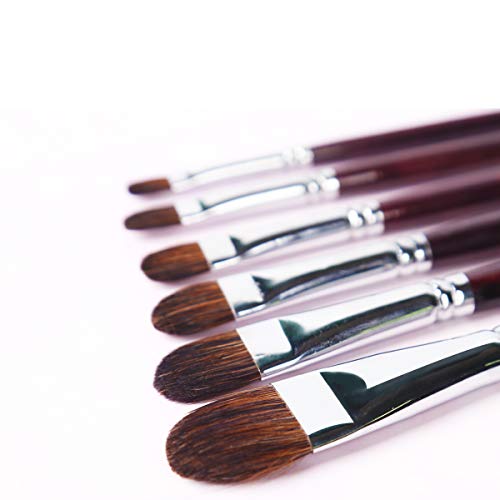
This is a very different brush from the Grumbacher. The Transon set uses natural sable hair in six filbert sizes: 2, 4, 6, 8, 10 and 12. The listing highlights high liquid capacity and good resilience, with FSC-certified birch handles and double-crimped nickel-plated copper ferrules.
Soft natural hair is at its best with thin paint. For acrylic users, that means glazes, thinned layers, soft gradients in skies and skin, and gouache-like work. It is the wrong brush for heavy body impasto: thick paint will overwhelm soft hair, and acrylic left in natural hair is hard on it. Many painters keep a soft filbert or two specifically for blending passages after the stiff brushes have blocked everything in.
Best suited for: painters who work in thinned acrylic, gouache or watercolor and want smooth, soft-edged blending.
Key features:
- Six filberts in sizes 2, 4, 6, 8, 10 and 12
- Natural sable hair with flagged bristle type
- FSC-certified birch handles with UV-coated finish
- Double-crimped nickel-plated copper ferrules
- Listed as not suitable for face or body painting
Pros:
- Full size run in one useful shape
- Holds a lot of liquid for smooth, even strokes
- Gentle edges for blending and glazing
Cons / limitations:
- Not suited to heavy body acrylic or texture work
- Natural hair needs careful, prompt cleaning with acrylic
- Only one shape included
Buying consideration: Buy this as a companion to a stiff set, not as a replacement. Reserve it for thin layers and clean it immediately after each session.
Buying Guide: How to Choose a Grumbacher Acrylic Brush or an Alternative
Acrylic is unusually demanding on brushes. It ranges from almost-liquid to butter-thick, dries in minutes and becomes plastic once cured. The right brush depends mostly on which end of that range you work at.
Match the fiber to your paint’s thickness
Heavy body acrylic needs stiff fiber: hog bristle like the Grumbacher Academy set or a firm synthetic like the Princeton Aspen. Soft body and fluid acrylics behave closer to gouache and pair better with soft synthetics or soft natural hair. If you use both, own both kinds of brush rather than forcing one to do everything.
Decide how much texture you want
Do you want brushmarks to show? Hog bristle leaves strong, broken texture. Stiff synthetics leave visible but cleaner marks. Soft hair erases texture and blends smoothly. Look at paintings you admire and notice which finish they have.
Cover the four core shapes
Most acrylic paintings can be made with a flat, a bright, a filbert and a round. The Grumbacher set gives you three of those in large sizes. Add a small round or liner, as in the Princeton set, and you have the essentials.
Choose sizes by canvas size
On a 16×20 canvas, a 12 flat is a sensible blocking brush. On an 8×10, it can feel oversized, and a 6 or 8 is easier to control. A good rule is to start with the biggest brush you can manage for the area you are painting, then step down for detail.
Check ferrule construction
Acrylic that dries in the heel of the brush pushes the hairs apart and ruins the shape. Double-crimped ferrules, mentioned in the Fuumuui and Transon listings, hold the hair firmly. Regardless of ferrule, keep paint out of the heel by loading only the front half of the brush.
Think about cleaning habits
Synthetics forgive sloppy habits better than natural hair. If you tend to leave brushes in water or forget to wash them until later, synthetic fiber will survive longer. Natural bristle and sable reward painters who rinse promptly, reshape the tips and dry them flat or tip-up.
Keep Learning: Brush Technique Guides
Large bristle brushes handle the big shapes, but finishing touches need a smaller tool. Our guide to choosing the right brush size for detailed acrylic work explains how to step down through sizes without losing control. For branches, whiskers and fine lines, see how to use a liner brush for detail work.
Common Mistakes to Avoid
- Using hog bristle for everything. It is excellent for texture and blocking in but poor for fine lines and smooth glazes.
- Letting acrylic dry near the ferrule. Once cured, it is very hard to remove and splays the brush permanently.
- Leaving brushes soaking tip-down. This bends the tips and can loosen handles over time.
- Buying sizes too small. Tiny brushes on large canvases lead to fussy, overworked paintings.
- Using natural soft hair with thick paint. Sable and similar hair cannot push heavy body acrylic.
- Skipping soap. Water alone leaves a film of acrylic in the bristles; mild soap after each session keeps them springy.
FAQs
Are Grumbacher hog bristle brushes good for acrylic paint?
Yes, for heavy body acrylic and textured work. The Academy set is listed for oil and acrylic and designed for medium to thick paint. For thin, fluid acrylic or smooth finishes, a synthetic brush is a better choice.
What brushes come in the Grumbacher Academy Set #1?
The set includes a Filbert 10, a Flat 12 and a Bright 12, all with hog bristle and flagged tips.
Is hog bristle or synthetic better for acrylics?
It depends on your paint and style. Hog bristle grips thick paint and leaves texture. Synthetic holds its shape longer with water-based paint and gives cleaner strokes. Many acrylic painters keep both.
Can I use the same brushes for oil and acrylic?
You can, but most painters keep separate sets. Residue from one medium can interfere with the other, and solvents used for oil cleanup are not needed with acrylic. If you share brushes, clean them thoroughly before switching.
How do I keep acrylic brushes from getting stiff?
Rinse often during painting, never let paint dry in the bristles, wash with mild soap at the end of each session, reshape the tip and let the brush dry flat or tip-up.
Do I need a detail brush as well as the Grumbacher set?
Almost certainly. The Academy set’s smallest brush is a Filbert 10. Add a small round or liner, such as those in the Princeton Aspen set, for highlights, edges and signatures.
Final Recommendation
The Grumbacher Academy Hog Bristle Set #1 is a focused, practical buy for acrylic painters who use thick paint and want texture in their brushwork. It gives you three reliable blocking shapes and little else, which is exactly what some painters want.
If you prefer smoother acrylic surfaces or need detail sizes, start with the Princeton Aspen 6500 set. If you are just beginning and want to try every shape, the Fuumuui 26-piece set is the broad option. And if your work leans toward thin glazes, gouache or watercolor, add the Transon sable filberts for blending. Most acrylic painters end up with one stiff set and one soft set; pick the pair that matches the paint on your palette.


One Comment