PaintingProGuide is reader-supported. When you buy through links on this page we may earn an affiliate commission at no extra cost to you.
Princeton does not make one “acrylic brush.” It makes several distinct lines, and the right Princeton acrylic brush depends on how thick your paint is and how small your marks are. Aspen is the stiff, bristle-like synthetic for heavy body paint. Velvetouch is the soft, springy line for blending and detail. Select Artiste is the all-rounder with the widest shape catalog, and Real Value is the classroom-priced white taklon option.
This review breaks down each line using the details printed on the current Amazon listings, explains where each one fits on a real acrylic palette, and points out the gaps in each set so you know what you would still need to buy.
Quick answer: For most acrylic painters working with heavy body or tube paint, the Princeton Aspen 4-piece set is the strongest starting point because its synthetic fibers are built to be as stiff as natural bristle. If you paint smooth blends, glazes or fine detail, the Velvetouch 5-piece set is the better match. On a tight budget, the Select Artiste 7-brush set covers the most shapes for the least money.
Our Top Picks at a Glance
- Princeton Aspen Acrylic & Oil Brush Set, 4 Piece — Best for heavy body acrylics and textured strokes
- Princeton Velvetouch Series 3950, 5-Piece Set — Best for smooth blending and small detail
- Princeton Select Artiste Series 3750, Set of 7 — Best value all-rounder for students
- Princeton Real Value Series 9100 Set — Best for classrooms, crafts and throwaway jobs
- Princeton Velvetouch Series 3950, Set of 4 — Best lower-cost entry into Velvetouch
- Princeton Aspen Series 6500 Flat Mottler, 2 Inch — Best for backgrounds and underpainting
- Fuumuui 25-Piece Paint Brush Set — Best non-Princeton alternative for shape variety
| Product | Best For | Key Spec | Key Strength | Price Tier |
|---|---|---|---|---|
| Princeton Aspen 4-Piece Set | Heavy body acrylic | Stiff synthetic, flagged tips | Holds shape under pressure | $$ |
| Princeton Velvetouch 5-Piece | Blending and detail | Spotter 5/0, angle 1/4″, rounds 2 and 8, filbert 8 | Fine points with spring | $$$ |
| Princeton Select Artiste Set of 7 | Students, mixed media | 7 brushes, mixed synthetic filaments | Widest shape range per dollar | $ |
| Princeton Real Value 9100 | Classrooms and crafts | White taklon rounds 3/0, 2, 4; flats 2, 6 | Very low cost per brush | $ |
| Princeton Velvetouch Set of 4 | Trying Velvetouch | 4 brushes, multi-filament blend | Same fiber blend, smaller set | $$ |
| Princeton Aspen 6500 Mottler | Backgrounds | 2-inch flat mottler | Covers large areas fast | $ |
| Fuumuui 25-Piece Set | Exploring shapes | 24 brushes, 9 shapes, knife, roll | Case and variety included | $$ |
How We Chose
We did not paint with these brushes for this article. The picks are based on the Amazon listing details and specifications checked in October 2026, on how well each set’s fiber type, shapes and sizes fit acrylic painting, and on how widely each product is reviewed by Amazon buyers. When a listing leaves out something important, such as exact sizes, we say so instead of guessing.
These were the criteria that decided the order:
- Fiber stiffness versus paint body: heavy body acrylic needs a stiffer fiber than fluid acrylic or glazes.
- Shapes included: a useful acrylic kit needs at least one flat or bright, one round and something for edges or blending.
- Size spread: a set that is all small brushes forces you to overwork large areas.
- Durability signals: ferrule and handle details, and what the maker claims about shape retention.
- Cost per useful brush: not the cheapest set, but the one that wastes the fewest brushes.
Princeton Acrylic Brush Lines Reviewed
Princeton Art & Brush Company is a US brush maker best known for synthetic fibers designed to imitate natural hair and bristle. For acrylic painters that matters, because acrylic is hard on natural hair. The paint is water-based, dries fast and can build up in the ferrule, and synthetics tend to survive that abuse better. Below are the four Princeton lines that show up most for acrylic work, followed by alternatives worth comparing.
1. Princeton Aspen 4-Piece Set — Best for Heavy Body Acrylics

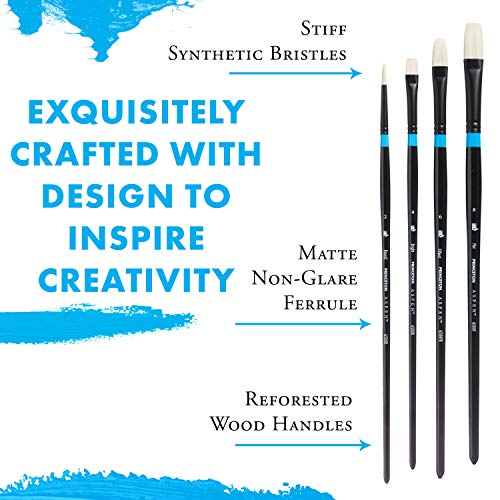
Aspen is the Princeton line to reach for when your paint comes out of the tube thick. The listing describes its synthetic bristles as “as stiff as natural bristles,” and the details list the bristle type as flagged, meaning the fiber tips are split to hold more paint. That combination is what lets a brush push heavy body acrylic around without the fibers splaying out flat.
Princeton positions Aspen as a mixed-media brush for acrylics, oils and water-soluble oils. The handles are black, and the listing emphasizes that the brushes keep their shape regardless of surface or pressure. The weak spot is the listing itself: it does not name the four shapes or sizes in this set, so check the product photos before you buy if you need a specific round or filbert.
Best suited for: painters using heavy body or impasto acrylic who want a firm brush that leaves visible strokes and still returns to shape.
Key features:
- Synthetic fibers designed to match natural bristle stiffness
- Flagged bristle tips for better paint pickup
- Rated for acrylics, oils and water-soluble oils
- Four-piece set with black wooden handles
Pros:
- Stiffness suits thick paint and textured surfaces
- Crosses over to oils if you switch mediums later
- Synthetic fiber handles water cleanup well
Cons/limitations:
- Shape and size breakdown is not spelled out in the listing
- Too firm for soft glazes or wet blending
- Only four brushes, so you will likely add a detail round
Buying consideration: Aspen works best when paint has body. If you mostly thin your acrylics with water or flow medium, a softer line will give you smoother results.
2. Princeton Velvetouch Series 3950, 5-Piece — Best for Blending and Detail

Velvetouch is the soft counterpart to Aspen. Princeton says this set mirrors the characteristics of sable brushes, and each brush uses a blend of synthetic filaments for color-holding capacity, a precise taper and what the listing calls a resilient snap. In plain terms, the brushes should hold a point, carry a decent load of fluid paint and spring back after each stroke.
This listing is unusually clear about the contents: Spotter 5/0, Angle Shader 1/4 inch, Round 8, Filbert 8 and Round 2. That is a sensible detail kit. The spotter handles tiny highlights, the angle shader cuts clean edges, the filbert blends transitions and the two rounds cover lines from fine to medium. The handle has a satin “slip-free” finish and is made from FSC wood.
Best suited for: acrylic painters who work with soft-body or fluid paint, glazes, portrait and wildlife detail, or miniatures.
Key features:
- Spotter 5/0, Angle Shader 1/4″, Round 8, Filbert 8, Round 2
- Multi-filament synthetic blend with precision taper
- Satin-finish FSC wood handles
- Marketed for acrylic, oil, watercolor and gouache
Pros:
- Clear, well-planned mix of detail shapes
- Soft enough for blending without streaks
- Works across water-based mediums
Cons/limitations:
- Highest price tier in this roundup
- No large flat for blocking in big areas
- Soft fibers can bend under heavy body paint
Buying consideration: If you already own a couple of large flats, this set fills the detail end of the kit well. If it would be your only set, add a broad flat or the Aspen mottler below.
3. Princeton Select Artiste Series 3750, Set of 7 — Best Value All-Rounder

Select Artiste is the line Princeton labels its best-selling brush, and it is easy to see why. The collection spans 29 shapes and 108 individual styles, including flats, shaders, rounds, fans, daggers, filberts, washes and liners. Filament types vary by shape, so a liner gets a different fiber than a wash brush.
This particular listing is set 23, a seven-brush set with blue satin handles and silver ferrules. The listing gives a brush width of 0.25 inch as a detail, but it does not list each shape and size, so look at the photos to confirm the mix. For a student or a painter testing acrylics for the first time, seven brushes at the lowest regular tier is hard to argue with.
Best suited for: beginners, art students and mixed-media painters who want one affordable set that handles acrylic, watercolor and oil.
Key features:
- Seven-brush set from the Select Artiste range
- Multiple synthetic filament types matched to shape
- Satin-finish blue handles, silver ferrules
- Range includes 29 shapes if you want to add open-stock brushes later
Pros:
- Lowest cost per brush among the Princeton sets with a real shape mix
- Easy to expand with single brushes from the same line
- Medium stiffness is forgiving for beginners
Cons/limitations:
- Exact shapes in this set are not listed in text
- Not as firm as Aspen for impasto
- Not as fine-pointed as Velvetouch for tiny detail
Buying consideration: Select Artiste is a middle-of-the-road brush in the good sense. It is rarely the perfect tool, but it is rarely the wrong one.
4. Princeton Real Value Series 9100 — Best for Classrooms and Crafts

Real Value is Princeton’s budget line, and this five-brush set is white taklon: Round 3/0, Round 2, Round 4, Flat 2 and Flat 6. White taklon is a smooth synthetic that holds a point and releases fluid paint evenly, which is why it shows up in so many craft and school kits.
The collection runs to 46 different sets in short and long handles. For acrylic painters, the value here is in having cheap brushes you do not mind ruining: applying gel medium, varnish tests, pouring touch-ups, or kids’ projects. The small sizes mean this is not a set for covering a canvas.
Best suited for: teachers, crafters, rock painters and anyone who needs inexpensive small brushes for jobs that wear brushes out.
Key features:
- White taklon synthetic fibers
- Round 3/0, 2, 4 and Flat 2, 6
- Rated for acrylic, oil, watercolor and tempera
Pros:
- Lowest price tier in the roundup
- Exact sizes listed, so no surprises
- Good fine rounds for lettering and dots
Cons/limitations:
- All small sizes, nothing for backgrounds
- Soft taklon struggles with heavy body paint
Buying consideration: Treat Real Value as a utility set. It earns its place next to a better brush set rather than replacing one.
Alternatives Worth Comparing
The four sets above cover the main Princeton lines. These three options are worth a look if you want a cheaper way into Velvetouch, a single large brush, or a non-Princeton set with more shapes.
5. Princeton Velvetouch Series 3950, Set of 4 — Best Lower-Cost Velvetouch
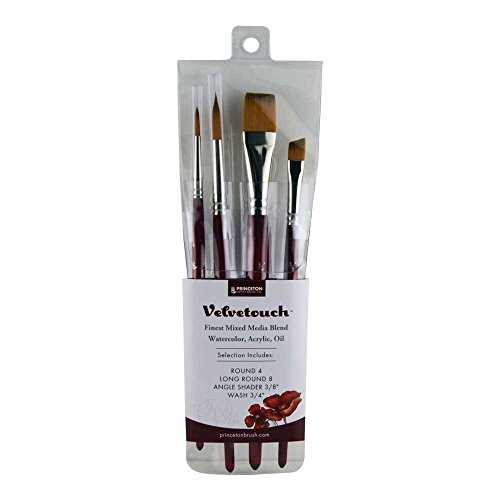
This four-brush Velvetouch set uses the same multi-filament synthetic blend and FSC wood handle as the five-piece kit, at a lower tier. The full Velvetouch collection covers 72 brushes in 20 shapes, including shaders, rounds, fans, liners, grainers, mops, spotters and blenders, available in long handle, short handle and mini-detail versions.
The trade-off is information. The listing does not state which four shapes or sizes are included, so compare the photos with the five-piece set before choosing. If you mainly want to find out whether the Velvetouch feel suits you, this is the cheaper experiment.
Best suited for: painters curious about Velvetouch who do not need a dedicated spotter and angle shader yet.
Key features:
- Four Velvetouch brushes with luxury synthetic blend
- Comfort handle in FSC-certified wood
- Collection available in long, short and mini-detail handles
Pros:
- Velvetouch fiber at a mid-range tier
- Same handle comfort as the larger set
Cons/limitations:
- Shapes and sizes not listed in text
- Fewer brushes for the money than Select Artiste
Buying consideration: If detail is the main goal, the five-piece set’s spotter and angle shader are worth the step up.
6. Princeton Aspen Series 6500 Flat Mottler, 2 Inch — Best for Backgrounds

Every set above is missing the same thing: a wide brush. The Aspen mottler is a 2-inch flat built from the same stiff synthetic as the Aspen set, with a polished black handle from reforested wood and a matte black ferrule that the listing says cuts reflection when painting outdoors.
A 2-inch mottler lays in skies, toned grounds and underpaintings in a few passes. It also spreads gesso evenly if you prime your own boards. For acrylic painters who fight streaky backgrounds with small brushes, this one tool often solves the problem.
Best suited for: blocking in large areas, toning canvases, applying gesso and painting big abstract fields.
Key features:
- 2-inch flat mottler shape
- Aspen stiff synthetic fiber
- Matte black ferrule, polished black handle
Pros:
- Fills the large-brush gap in most sets
- Firm enough to move heavy paint across a canvas
- Low tier for a single specialty brush
Cons/limitations:
- Single brush only
- Too large for anything under about 8×10 inches
Buying consideration: Pair it with the Velvetouch five-piece and you have a complete range from 5/0 to 2 inches.
7. Fuumuui 25-Piece Paint Brush Set — Best Non-Princeton Alternative

If shape variety matters more than brand, the Fuumuui set is the obvious comparison. It includes 24 brushes in nine shapes (large wide flat, flat, filbert, fan, dagger, cat tongue, round, angle and rigger), a palette knife and a waterproof canvas roll. The ferrules are double-crimped copper and the handles are birch.
That is far more shapes than any single Princeton set here, which makes it useful for learning what a fan or dagger actually does before buying better versions. What you give up is the specific fiber engineering Princeton describes for Aspen and Velvetouch.
Best suited for: beginners exploring shapes, and painters who want a travel roll included.
Key features:
- 24 brushes in 9 shapes plus palette knife
- Waterproof canvas roll with separate slots
- Double-crimped copper ferrules, birch handles
Pros:
- Most shapes per dollar in this roundup
- Storage roll protects tips in transport
Cons/limitations:
- Fiber performance claims are the maker’s own
- Many sizes you may rarely use
Buying consideration: A good discovery set. Once you know your favorite shapes, replace them with single brushes from a line that suits your paint.
Buying Guide: How to Choose a Princeton Acrylic Brush
Choosing between Princeton acrylic brush lines comes down to a few practical questions. Answer them honestly and the right set usually becomes obvious.
Match Fiber Stiffness to Paint Body
Heavy body acrylic has the consistency of soft butter. A soft brush sinks into it and folds. Fluid and soft-body acrylics behave closer to cream and need a softer, springier fiber to lay down smoothly. Aspen sits at the stiff end, Select Artiste in the middle, and Velvetouch and Real Value at the soft end.
Cover Three Sizes, Not Ten
Most acrylic paintings need one large brush for blocking in, one medium brush for shapes, and one small brush for detail. Sets with seven tiny rounds look generous but leave you overworking the canvas. Check that whatever you buy reaches at least a size 8 to 12 flat or filbert, or add a wide brush like the 2-inch mottler.
Know Your Core Shapes
Flats and brights make crisp, blocky strokes. Filberts blend edges and suggest soft forms. Rounds draw lines and fill small areas. Angle shaders cut clean corners. Liners and spotters handle the last five percent of a painting. A first acrylic kit only needs a flat, a filbert and a round in two sizes.
Short or Long Handle
Long handles let you stand back from an easel and paint with your arm. Short handles give more control at a table. Princeton offers several lines in both, so decide where you will paint before you buy open stock to expand a set.
Ferrule and Handle Quality
Acrylic that dries inside the ferrule splays the brush permanently. A well-crimped ferrule and a smooth handle finish make cleaning easier and stop loosening. The Velvetouch satin handle and Fuumuui’s double-crimped ferrules both address this, at different price levels.
Budget for Replacement
Acrylic brushes wear out faster than oil brushes because dried paint is permanent. Many painters keep a cheaper set for rough work and mediums, and a better set for finishing. Real Value plus Velvetouch is a sensible two-tier combination.
Learn the Brush Skills That Make These Sets Pay Off
If you are unsure which round size to use for small features, our guide on choosing the right brush size for detailed acrylic work breaks it down by subject. For branches, rigging and lettering, practice the long, steady stroke covered in how to use a liner brush for detail work. And if you have a spare round from the Real Value set, try the simple exercise in painting clean dots with a round brush.
Common Mistakes to Avoid
- Using soft brushes for heavy body paint. The fibers fold and the stroke turns mushy. Use Aspen or another stiff synthetic.
- Letting acrylic dry in the ferrule. Rinse often during a session and never leave brushes standing on their tips in water.
- Buying only small brushes. Painting a background with a size 4 round invites streaks and fatigue.
- Using your best detail brush for mediums. Gel, gesso and varnish wear fibers quickly; keep a cheap brush for them.
- Ignoring handle length. Long handles at a tabletop can feel awkward; short handles at an upright easel force you too close.
- Cleaning with hot water. Heat can loosen glue and affect synthetic fibers. Lukewarm water and mild soap are enough.
FAQs
Which Princeton brush is best for acrylic paint?
It depends on paint thickness. Aspen suits heavy body acrylic because its fibers are designed to be as stiff as natural bristle. Velvetouch suits fluid acrylic, glazing and detail. Select Artiste is the best general-purpose compromise.
Are Princeton brushes good for beginners?
Yes. Select Artiste and Real Value sit in the lowest price tiers and are rated for acrylic, oil and watercolor, which makes them easy first sets. Beginners who want one better set for acrylic detail can step up to Velvetouch.
Can I use Princeton Velvetouch brushes with heavy body acrylic?
You can, but they are soft and springy rather than stiff. Thin heavy body paint slightly with water or medium, or use a firmer brush such as Aspen for impasto passages.
What is the difference between Princeton Aspen and Catalyst?
Both are stiff synthetics for heavier paint. Aspen is listed as a flagged synthetic that matches natural bristle stiffness for acrylic and oil. Catalyst brushes use Polytip fibers with split tips and are designed for medium to heavy body acrylic and oil.
How do I keep Princeton acrylic brushes from wearing out?
Rinse frequently while painting, wash with mild soap at the end of each session, reshape the tip and dry brushes flat or tip-up. Avoid letting acrylic dry near the ferrule, which is the most common cause of splayed brushes.
Do I need a large brush if I buy a Princeton set?
Most Princeton detail sets top out at a medium size. If you paint on anything larger than about 9×12 inches, add a wide flat or mottler for backgrounds.
Final Recommendation
There is no single best Princeton acrylic brush, because the lines are built for different paint. Pick by how you paint:
- Thick, textured acrylic: the Princeton Aspen 4-piece set, plus the 2-inch Aspen mottler for backgrounds.
- Smooth blends and fine detail: the Velvetouch 5-piece set with its spotter, angle shader and filbert.
- First set on a budget: Select Artiste set of seven.
- Classrooms, crafts and mediums: Real Value 9100.
- Exploring many shapes at once: the Fuumuui 25-piece set.
For most acrylic painters, the most useful combination is one stiff set, one soft detail set and one wide brush. Princeton makes all three, and buying them as separate lines usually works out better than hunting for one set that tries to do everything.