Quick answer: A standard studio easel is usually about 5 to 7 feet tall at its lowest setting and extends to roughly 7 to 10 feet with the mast raised. Tabletop easels run about 12 to 30 inches, portable tripod and field easels about 4 to 6 feet when extended, and children’s easels around 3 to 4 feet. What matters more than the overall height is the maximum canvas height it can hold and whether it fits under your ceiling.
Ask ten painters how tall is an easel and you will hear ten different numbers, because “easel” covers stands that fit in a backpack and machines that need a 10-foot ceiling. The useful answer depends on which height you mean: the folded height, the extended height, the canvas height it accepts or the working height of the tray.
Below you will find real-world height ranges for every common easel type, the measurements to check before buying, and how to set an easel so the painting sits at the right level for your body.
The Four Heights That Matter
Product listings often quote just one number, which causes confusion. Here is what each measurement actually means.
- Minimum height: The easel’s overall height with the mast fully lowered. This decides whether it fits in a room with low ceilings or a sloped attic.
- Maximum height: The overall height with the mast fully extended. This must clear your ceiling, light fixtures and ceiling fans.
- Maximum canvas height: The tallest canvas the easel can clamp between its lower tray and top holder. This is the number that limits the size of work you can make.
- Tray height range: How low and how high the canvas ledge can go. This controls where the painting sits relative to your eyes.
How Tall Is an Easel? Heights by Type
| Easel type | Min. overall height | Max. overall height | Typical max canvas height |
|---|---|---|---|
| Tabletop (folding/box) | About 10 to 14 in | About 18 to 30 in | About 12 to 24 in |
| Kids’ easel (double-sided) | About 36 in | About 48 in | About 18 to 24 in |
| Portable tripod / field easel | About 20 to 25 in folded | About 60 to 72 in | About 30 to 48 in |
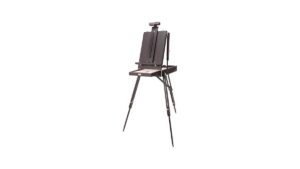
| French box easel | About 18 to 22 in folded | About 60 to 70 in | About 30 to 34 in |
| Display / presentation easel | About 40 to 50 in | About 60 to 72 in | About 36 to 60 in |
| A-frame (lyre) studio easel | About 60 to 72 in | About 85 to 100 in | About 48 to 75 in |
| H-frame studio easel | About 70 to 80 in | About 95 to 115 in | About 70 to 120 in |
| Crank / multi-function studio easel | About 75 to 85 in | About 105 to 125 in | Up to about 120 in |
These are typical ranges across many designs; individual models vary. Professional wooden studio easels sit at the tall end of the scale, which is why ceiling height becomes a real buying factor. Our guide to the best professional wooden easels lists the working dimensions of each pick so you can check them against your room.
Check Your Ceiling Before You Buy
A standard US ceiling is 8 feet (96 inches). Many A-frame and H-frame easels exceed that when fully extended, but you rarely need full extension. The mast only rises that high to hold very tall canvases.
- Measure floor to ceiling where the easel will stand, and note beams, sloped sections and ceiling fans.
- Compare with the easel’s minimum height. If the minimum height is close to your ceiling, you will struggle to move it or adjust it.
- Estimate your largest canvas. Add the canvas height to the lowest tray height plus a few inches for the top clamp. That total is how tall the easel needs to be in use.
- Leave clearance. Aim for at least 6 inches between the top of the mast and the ceiling so you can loosen and slide the top clamp.
For example, a 48-inch canvas on a tray set 24 inches above the floor needs about 76 inches of usable height. A standard 8-foot ceiling handles that easily. A 72-inch canvas on the same tray needs around 100 inches, which will not fit under a 96-inch ceiling unless you lower the tray.
How Tall an Easel You Need for Common Canvas Sizes
Working backward from the canvas is often the quickest way to choose. The table assumes the canvas tray sits about 24 inches off the floor for a standing painter, plus a few inches above the canvas for the top clamp.
| Canvas size (height) | Approx. easel height in use | Easel types that usually fit |
|---|---|---|
| 8 x 10 to 11 x 14 in | Tabletop height or 40 to 45 in on a floor easel | Tabletop, tripod, French box |
| 16 x 20 in | About 48 in | Tripod, French box, A-frame |
| 24 x 36 in (portrait) | About 63 in | Sturdy tripod, A-frame, H-frame |
| 30 x 40 in (portrait) | About 67 in | A-frame, H-frame |
| 36 x 48 in (portrait) | About 75 in | Tall A-frame, H-frame |
| 48 x 60 in (portrait) | About 87 in | H-frame or crank studio easel |
| 72 in and taller | About 100 in or more | Large H-frame or crank easel; may need a lower tray |
Landscape-oriented canvases need far less height. A 48 x 36 inch canvas turned sideways only needs around 63 inches of usable height. If your ceiling is low, painting large work horizontally and rotating it for checks is a practical workaround.
Sitting vs. Standing: How It Changes the Height You Need
Painters who sit need the canvas tray to drop much lower than standing painters. Some A-frame easels have a fixed lower crossbar that stops the tray at 25 to 30 inches, which can put a seated painter’s eye level near the top of a small canvas. H-frame and crank easels usually let the tray go lower, sometimes almost to the floor, which suits seated work and very large canvases.
Standing painters, on the other hand, benefit from a tray that goes high enough to bring small canvases up to eye level. If you are tall and work small, check the tray’s maximum height, not just the mast height. A sketch box or tabletop easel placed on a high table is another way to raise small work without straining your neck.
Finding the Right Working Height for Your Body
Overall height tells you if an easel fits the room. Working height tells you if it fits you. The general guideline used by many art teachers is to place the center of the area you are painting at or slightly below eye level.
| Painter position | Typical eye level | Suggested tray height (for a 24 in canvas) |
|---|---|---|
| Standing adult (5 ft 4 in) | About 60 in | About 46 to 50 in |
| Standing adult (5 ft 10 in) | About 66 in | About 52 to 56 in |
| Standing adult (6 ft 2 in) | About 70 in | About 56 to 60 in |
| Seated adult (standard chair) | About 45 to 48 in | About 30 to 36 in |
| Child aged 5 to 8 | About 36 to 44 in | About 20 to 28 in |
These are approximations. A simple method is to stand or sit in your normal painting position, look straight ahead and adjust the tray so the middle of the canvas lands just under your gaze. Move the canvas up or down as you work on different areas rather than hunching or reaching.
Why Working Height Matters
When a painting sits too low, you look down at it, and the top of the canvas appears smaller than the bottom. This foreshortening can lead to distorted proportions that only show up when the painting is hung. Painting too high strains the shoulders. A correctly placed canvas, roughly perpendicular to your line of sight, gives the most accurate view.
How to Use an Easel: Adjusting the Height Step by Step
Most wooden studio easels share the same adjustment layout, even if knobs look different.
- Set the mast height. Loosen the mast lock and raise or lower the extension. Retighten firmly.
- Set the lower tray. Loosen the tray knob, slide the tray to your chosen height and lock it. On crank easels, turn the handle instead.
- Place the canvas. Rest it squarely on the tray.
- Lower the top clamp. Slide it down until it grips the top edge of the canvas, then tighten.
- Set the tilt. On A-frames, adjust the back leg. On H-frames and crank models, use the tilt mechanism. A slight backward lean reduces glare on wet oil paint; a forward tilt helps keep dust off and suits pastel work.
- Re-check. Step back, confirm the canvas sits at eye level and the easel does not rock.
How to Put Together a Wooden Easel
Many wooden studio easels arrive flat-packed. Assembly is usually simple, but a few habits prevent wobbles later.
- Lay out every part first and match it to the parts list.
- Assemble on a soft surface such as a rug or blanket to protect the wood.
- Insert bolts by hand first and leave them slightly loose until the frame is fully assembled. Then tighten everything evenly.
- Stand the easel up and check it is square before the final tightening. A twisted frame will wobble forever.
- Do not over-tighten into softwood. Crushed wood around a bolt eventually lets it loosen.
- Re-tighten after a week, because wood settles slightly once it adjusts to your room’s humidity.
How to Build a Wooden Easel at the Right Height
If you plan to build an easel for painting, decide on the dimensions before cutting any wood. A practical home-built H-frame for an average adult often uses uprights about 72 to 84 inches tall, a base around 24 to 30 inches wide and deep, and a sliding tray adjustable from about 18 to 48 inches off the floor. That covers canvases up to around 48 inches tall under an 8-foot ceiling.
Use straight, knot-free lumber, brace the joints between the uprights and the base with triangular gussets, and lock the sliding tray with carriage bolts and wing nuts. For an A-frame, three legs of about 72 inches joined at the top with a hinge, plus a crosspiece and tray, is a common simple design. Either way, test the finished easel with a heavier load than you plan to use.
Easel How to Use for Beginners: Height Tips
- Start with the canvas a little lower than you think. It is easier to raise it than to fix proportions later.
- Stand an arm’s length or slightly more from the canvas so you can see the whole image.
- Step back every 10 to 15 minutes to check the painting from a distance.
- If you sit to paint, choose an easel whose tray goes low enough, ideally down to about 20 to 24 inches.
- Kids’ easels should let the top of the paper sit no higher than the child’s eye level.
Common Mistakes When Choosing Easel Height
- Buying a tall H-frame without checking the minimum height against a low ceiling.
- Choosing an easel whose tray cannot go low enough for seated painting.
- Ignoring the maximum canvas height and discovering your big canvas will not clamp.
- Painting with the canvas well below eye level, causing distortion.
- Extending a tripod to full height and making it top-heavy.
FAQs
How tall is a standard art easel?
A typical floor-standing studio easel is about 5 to 7 feet tall at its lowest setting and extends to roughly 7 to 10 feet. Portable easels are shorter, usually up to around 5 to 6 feet.
How tall should an easel be for a beginner?
Most beginners do well with an easel that adjusts from roughly 4 to 6 feet tall and holds canvases up to about 36 to 48 inches. That covers common canvas sizes without needing a large studio.
Will a studio easel fit under an 8-foot ceiling?
Usually yes in use, because you rarely extend the mast fully. Check that the easel’s minimum height is comfortably below 96 inches and that you leave clearance above the top clamp.
What height should a canvas be on an easel?
Place the center of the area you are working on at or slightly below your eye level. Adjust the tray as you move to different parts of the painting.
How tall is a tabletop easel?
Tabletop easels are usually about 12 to 30 inches tall and hold canvases up to roughly 12 to 24 inches high, depending on the model.
How tall is a kids’ easel?
Most children’s easels stand around 3 to 4 feet tall, with paper or board areas positioned for kids roughly 3 to 8 years old. Some offer adjustable legs.
Final Thoughts
The height of an easel only matters in relation to two things: the room it lives in and the person standing in front of it. Measure your ceiling, decide on your largest likely canvas and check that the tray can reach your eye level. Those three numbers narrow the choice quickly.
If you are ready to invest in a solid, adjustable studio stand, our roundup of professional wooden studio easels compares heights, canvas capacity and build quality side by side.