PaintingProGuide is reader-supported. When you buy through links on this page we may earn an affiliate commission at no extra cost to you.
If you searched for a Jackson’s synthetic brush on Amazon in the US, you probably noticed how thin the selection is. Jackson’s is a London art retailer with its own brush lines, but only a handful of those brushes reach Amazon.com, and the one we could verify in October 2026 is not a pure synthetic at all. It is the Jackson’s Icon Sable Synthetic Mix watercolour quill in size 0, a blended-hair round sold for detail and wash work.
This review covers what that listing actually tells you, who the brush makes sense for, where the blend sits between pure synthetic and pure sable, and how to judge whether a small quill is the right tool before you pay import-level prices for a single brush.
Quick answer: The only Jackson’s synthetic-family brush we could confirm on Amazon.com is the Jackson’s Icon Sable/Synthetic Mix Quill No.0. It suits watercolor and gouache painters who want a small, responsive round for detail lines and controlled touches, with some of the water-holding feel of sable at a lower cost than pure sable. If you want a fully synthetic brush for acrylics, or a cheap brush you can abuse, a blended sable quill is the wrong buy; look at a nylon or taklon round instead.
Jackson’s Synthetic Brush Options at a Glance
- Jackson’s Icon Sable Synthetic Mix Watercolour Quill No.0 — Best for fine watercolor detail with a softer, sable-like spring
- All-synthetic taklon or nylon rounds (any brand) — Better for acrylic and for students who scrub and rinse hard
- Synthetic squirrel mops and quills (any brand) — Better for broad washes that need a large water reservoir
- Pure sable rounds (any brand) — The traditional upgrade if you paint watercolor daily and want maximum point and spring
Only the first item is a specific product we can link. The rest are brush categories, listed so you can judge where the Icon blend fits rather than buying it by default.
| Product | Best For | Key Spec | Key Strength | Price Tier |
|---|---|---|---|---|
| Jackson’s Icon Quill No.0 | Watercolor detail, small washes | Red sable/synthetic mix, round, size 0 | Natural-hair softness with synthetic resilience | $$ |
| All-synthetic taklon round | Acrylic, gouache, classroom use | 100% man-made filament | Tough, easy to clean, cheap to replace | Varies |
| Synthetic squirrel quill or mop | Large watercolor washes | Fine, crimped synthetic fibers | High water capacity, soft release | Varies |
| Pure sable round | Serious daily watercolor | Natural sable hair | Sharpest point and best snap | Varies |
How We Chose
We did not handle or paint with this brush. The assessment is based on the Amazon listing details and specifications checked in October 2026, on how well the brush’s fiber, shape and size fit the typical reasons people search for a Jackson’s synthetic brush, and on how widely the listing has been reviewed by Amazon buyers. Where we describe how blended or synthetic fibers usually behave, we rely on well-established properties of those materials, not on claims about this specific brush.
- Fiber honesty: whether the listing describes pure synthetic, pure natural hair or a blend, because that changes care, medium compatibility and price.
- Shape and size: a size 0 round quill is a detail tool, so we judged it on detail work, not on large washes.
- Medium fit: the listing calls it a watercolour brush, so watercolor and gouache are the main use cases.
- Availability in the US: many Jackson’s lines ship from the UK; we only covered what was actually listed on Amazon.com.
- Buyer feedback volume: used as a reliability signal only; we do not print ratings or counts.
Jackson’s Synthetic Brush Review: The Icon Quill No.0 in Detail
1. Jackson’s Icon Sable Synthetic Mix Watercolour Quill No.0 — Best for Fine Watercolor Detail

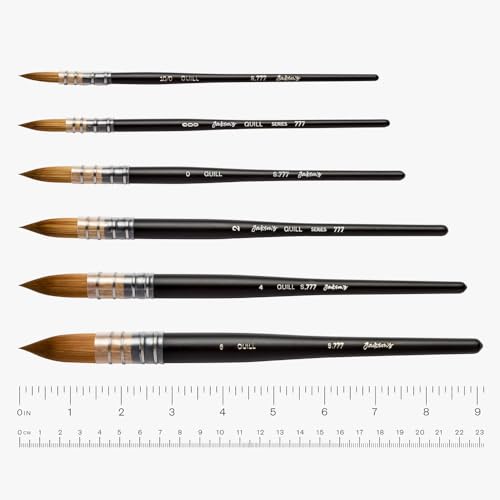
The listing title spells out the essentials: Jackson’s own Icon range, a red sable and synthetic hair mix, a watercolour brush, quill style, size 0. The bullet points add three more facts: it is described for detail and wash, the hair is a red sable/synthetic mix, and the shape is round. That is a short spec sheet, but it is enough to place the brush.
A size 0 round is small. In most brush ranges it sits just above the 00 and 000 sizes used for the very finest lines, so expect it to handle eyelashes, twigs, rigging lines on boats, botanical veins, lettering and the last highlights on a small study. “Wash” on such a small brush means local washes: tinting a petal, glazing a window pane, softening one edge. It will not lay in a sky.
The blend is the interesting part. Natural sable hair is prized because each hair tapers to a fine tip and the brush holds more water than its size suggests, then releases it gradually. Synthetic filament is tougher, cheaper and more consistent, and it returns to shape after harsh use. Blending the two is a well-known way to get part of the sable feel at a lower price and with more resilience than pure sable. That is the job the Icon mix is built for.
Best suited for: watercolor and gouache painters who already own a few larger brushes and want one dependable small round for fine detail, especially painters curious about sable who are not ready to pay for a pure sable brush.
Key features
- Jackson’s Icon range, a house brand from a specialist art retailer
- Red sable and synthetic hair mix
- Round, quill-style head in size 0
- Sold as a watercolour brush for detail and wash
Pros
- Blended hair aims to combine water-holding softness with synthetic durability
- Size 0 is versatile for detail in watercolor, gouache and ink
- A single brush lets you add one quality detail tool without buying a whole set
- Comes from a retailer whose core business is fine art supplies
Cons and limitations
- Not a pure synthetic brush, despite how it often surfaces in searches
- The listing gives very few specifications: no handle length, hair length or ferrule material
- Price per brush is high compared with all-synthetic rounds of the same size
- Natural hair content makes it a poor choice for heavy acrylic or solvent work
- Only one size appears on Amazon.com, so you cannot build a matching range there
Buying consideration: confirm you actually want a blend. If your main medium is acrylic, or you rinse brushes roughly in a classroom setting, the natural sable content is a cost you will not benefit from.
What “quill” means on this brush
Brush makers use “quill” in two ways. Historically, quill brushes had the hair bound into a bird-feather quill rather than a metal ferrule, a style still common for French squirrel mops. In modern ranges the word is also used for a round with a generous belly and a long, fine point. The Icon listing pairs “quill” with “round”, so expect a pointed round profile. Because the listing does not specify the ferrule, do not assume a traditional feather quill binding.
How a size 0 blended round fits a watercolor kit
Most watercolorists work with three tiers of brushes. A large wash brush or mop carries skies and backgrounds. A medium round, often a 6 to 10, does most of the painting. A small round, roughly 0 to 2, handles detail. The Icon quill belongs firmly in the third tier. It does not replace your main round, and it cannot do the work of a mop.
That matters for value. A pricey small brush gets used for short bursts, so it tends to last a long time if you care for it. Spending a little more on the detail brush is often more sensible than spending more on a large wash brush, because the point is what wears first and what you notice most.
Using the Icon quill with gouache and ink
Gouache is thicker than watercolor and dries matte. A soft blended round is comfortable for gouache detail as long as you thin the paint to a creamy, flowing consistency. Very stiff, undiluted gouache will splay a soft point. For ink, a small natural-blend round can pull very fine lines, but rinse promptly, because shellac-based or acrylic-based inks dry hard inside the ferrule.
Why it is a poor match for acrylic
Acrylic dries into a plastic film. If it dries near the ferrule, it locks the hairs together, and natural hair suffers more from the scrubbing needed to remove it. Acrylic painters are usually better served by all-synthetic brushes that tolerate harsher cleaning. You can use the Icon for very diluted acrylic glazes, but it was not designed for that.
Alternatives Worth Comparing
We could not verify other Jackson’s synthetic brushes on Amazon.com at the time of checking, and we will not link products we have not confirmed. Instead, here is how the main alternative categories compare, so you can search for the right type with confidence.
All-synthetic taklon or nylon rounds
These are the default for acrylic painters and students. Taklon and similar filaments hold a decent point, clean easily and survive heavy use. They hold less water than sable or blended hair, so long watercolor strokes may need more reloading. If your searches for a Jackson’s synthetic brush started because you wanted a tough, low-maintenance brush, this category is what you are really looking for.
Synthetic squirrel quills and mops
Synthetic squirrel fibers are very fine and soft, designed to mimic natural squirrel hair’s huge water capacity. In larger sizes they are wash tools that let you flood an area evenly. They are the opposite end of the kit from a size 0 round: buy one if your problem is streaky washes, not shaky detail.
Pure sable rounds
Pure sable is the traditional benchmark for watercolor rounds: excellent point, snap and controlled water release. It is also the most expensive category and needs the gentlest care. If you paint watercolor most days and the Icon blend feels right, a pure sable round in a mid size is the logical next step.
Other blended rounds
Many brands sell sable/synthetic blends. When comparing them, look for the hair blend stated plainly, a seamless ferrule, and clear size information. A blend from any maker is a compromise by design, so judge it by the job, not by the label.
Buying Guide: How to Choose a Jackson’s Synthetic Brush or Blended Round
Read the fiber description first
“Synthetic”, “synthetic mix”, “sable blend” and “sable” are different products. A pure synthetic is tough and cheap to replace. A blend gains softness and water capacity but needs gentler care. Pure sable gives the best performance and the highest cost. The Icon quill is a blend, and the listing says so; read it before you add to cart.
Match size to the detail you actually paint
Size numbers are not standardized between brands, but within a range, smaller numbers mean smaller heads. A 0 is a general detail size. If you paint large loose landscapes, you may rarely need it. If you paint botanicals, birds, architecture or small-format work, a 0 or 1 round gets daily use.
Decide what “wash” means for your work
Many listings call a brush suitable for washes. On a size 0 that means small local washes. If your real frustration is uneven backgrounds, buy a larger brush first. The right order is usually large wash brush, then medium round, then a quality detail round.
Check the medium on the listing
The Icon is sold as a watercolour brush. Watercolor, gouache and inks are the natural fit. Oil painters need stiffer brushes for thick paint and solvents; acrylic painters are better off with tougher synthetics. Using a brush outside its intended medium shortens its life.
Consider handle length
Watercolor brushes are typically short-handled because you work close to paper laid flat or at a slight angle. The Icon listing does not state the handle length, so if you prefer to work standing at an easel, check the product images carefully.
Think about cost per year, not cost per brush
A detail round used for minutes per painting can last years with good care. A cheap brush that loses its point in weeks is not cheaper. Price tier matters, but so does how gently you will treat it.
Buy singly if you already own the basics
One advantage of the Icon quill is that it is sold as a single brush. If you already own a reasonable set, adding one better detail round is a focused upgrade instead of buying ten more brushes you will not use.
Learn the Techniques Before You Upgrade
If you are still deciding whether you need a synthetic or blended brush, start with our explainer on what a synthetic paint brush is and how it differs from natural hair. For small rounds specifically, our guide on which brush size works best for detail work helps you decide whether a 0 is the right number for your style, and the walkthrough on using a liner brush for fine detail covers the long, thin lines a small round cannot always reach.
Caring for a Sable/Synthetic Blend
Blended brushes reward basic care more than pure synthetics do. Rinse in clean, cool water as soon as you finish. Use a mild soap now and then, working it gently into the hair rather than grinding the brush against the jar. Reshape the point with your fingers and dry the brush flat or head down, never standing on its hairs in a jar.
Avoid leaving it in water. Standing a brush on its tip bends the point permanently and can loosen the glue inside the ferrule. Keep a separate, cheaper brush for masking fluid, which ruins fine hair quickly. Store the brush where moths cannot reach it if you leave it unused for long periods, since natural hair content can attract them.
Common Mistakes to Avoid
- Assuming every Jackson’s brush on Amazon is fully synthetic. The Icon quill is a sable blend.
- Buying a size 0 to fix poor washes. Wash problems need a larger brush and more water.
- Using the brush for undiluted acrylic or masking fluid, both of which damage fine hair.
- Leaving the brush standing in the water jar between sessions.
- Pressing the point down hard to fill an area. Detail rounds are for lines and small shapes; let a larger brush do the filling.
- Comparing price without comparing fiber. A blended round and a nylon round of the same size are different tools.
FAQs
Is the Jackson’s Icon brush synthetic or sable?
The Amazon listing describes it as a red sable and synthetic mix, so it is a blend. It is not a pure synthetic and not a pure sable brush.
Can I use a Jackson’s synthetic mix brush for acrylic paint?
You can for thin, diluted acrylic glazes if you clean it immediately, but it is sold as a watercolour brush. For regular acrylic painting, a fully synthetic taklon or nylon brush is a safer choice.
What is a size 0 brush used for?
A size 0 round is a general detail brush: fine lines, small shapes, highlights, lettering and small local washes. It is too small for backgrounds or skies.
Why are Jackson’s brushes hard to find on Amazon in the US?
Jackson’s is a UK-based art supplier, and only a small part of its own-brand brush range is listed on Amazon.com. Availability can change, so check the current listing before planning a full set around it.
Is a blended brush worth it over a cheap synthetic?
For watercolor detail, a blend usually holds and releases water more smoothly than a basic synthetic, which helps with longer fine strokes. For acrylic or heavy classroom use, the extra cost brings little benefit.
How should I store a sable/synthetic quill?
Store it dry, with the point reshaped, either flat or upright with the hairs facing up. Keep it away from moths and never store it resting on its tip.
Final Recommendation
The Jackson’s Icon Sable Synthetic Mix Quill No.0 is a sensible buy for one specific painter: someone working in watercolor, gouache or ink who wants a single better detail round with some sable character without paying pure sable prices. Read it as a precise tool, not a starter brush.
If you came looking for an all-synthetic Jackson’s brush for acrylic, this is not that product, and a tough taklon or nylon round from any reputable maker will serve you better. If your frustration is washes rather than detail, put your money into a larger mop or wash brush first. Buy the Icon quill when detail is the job and you are prepared to look after natural hair.